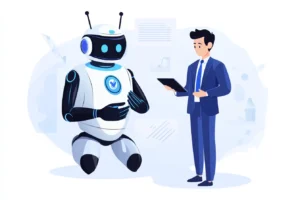




Far from being a mere gadget, digital marketing chatbots are now becoming a strategy in relationship marketing. With automation, a chatbot can streamline customer interactions, personalize exchanges and centralize data in the CRM. A well-integrated chatbot doesn’t just automate responses: it anticipates, engages and builds customer loyalty.
But how does a chatbot really work? What are its concrete applications in digital marketing? And how can its effectiveness be measured? In this article, we take a comprehensive look at the links between chatbots, marketing and automation.
What is a chatbot?
A chatbot is a program that simulates a human conversation. It operates in natural language via instant messaging: on a website, an application or a social network.
In a business context, it automates exchanges with customers. It responds instantly, provides guidance and advice, and can even accompany a prospect through to purchase!
With an automated chatbot, customer service becomes much faster and smoother, with user satisfaction greatly enhanced.
AI chatbots in digital marketing have become a must!
The truth is, chatbots have been around for years, based on a system of fixed rules and pre-established scripts. But today, chatbots use conversational AI and have completely changed the rules of digital technology.
Whereas chatbots used to perform simple tasks (FAQs, appointment scheduling, guidance), those now powered by AI can understand human natural language accurately and adapt to the context in real time.
In the field of digital marketing, chatbots have become a benchmark for companies that want to offer personalized customer relations in a totally seamless way!
An automated chatbot will be able to hold a conversation with the user on different channels: directly from the website or via social media such as Messenger, Instagram, and WhatsApp.
These intelligent chatbots can now detect the user’s real intention, reformulate, restart a conversation, and even propose actions in real time.
They can ask questions, qualify a need, generate a personalized response… and all in a natural way, like a human advisor.
Example of an automated message from an AI chatbot
Let’s take a simple example of an automated conversation on WhatsApp, in an e-commerce context:
- Customer: Hi, I’m looking for a waterproof jacket for hiking.
- Chatbot AI : Hello 👋 Great choice! What type of hiking are you looking for your jacket for:
🌧️ Light rain and occasional walks
🏔️ Mountainous conditions and unstable weather
- (Customer selects an option)
- AI Chatbot : Perfect! Here are 3 models to suit your needs, with free 48-hour delivery:
– TrailFit Pro jacket – lightweight and breathable (€129)
– StormShield jacket – ideal at altitude (€149)
– UrbanDry jacket – urban look + rain protection (€119)
Need a review? I can also send you customer reviews or suggest a size according to your measurements.
Would you like me to keep you up to date on upcoming special offers on hiking equipment?
Chatbots and relationship marketing
Instantaneity has become the spearhead of modern society. Responsiveness is now a basic consumer expectation. A chatbot or virtual assistant is fully in line with the fundamentals of digital marketing, particularly relationship marketing: personalisation, loyalty, dialogue and continuity.
- Un chatbot offre des réponses instantanées (réactivité) ;
- It can be customised via CRM (personalisation).
- He is able to maintain a fluid conversation (dialogue);
- It is available at all times, 24 hours a day, 7 days a week (continuity).
A chatbot doesn’t just automate exchanges: it maintains a direct link with the customer, transforming every customer interaction into a genuine loyalty-building opportunity. It accompanies the customer before, during and after the purchase. Even though it’s an automated tool, it manages to humanize the relationship and embody the brand’s voice, while remaining perfectly scalable.
A chatbot can thus become a true digital ambassador. Major groups such as Air France and Sephora are now using marketing automation chatbots so well designed that they give the impression of interacting with a real human advisor – one who is available, relevant and personalized.
Chatbot marketing automation: the role of CRM and data
In any marketing strategy involving chatbot automation, customer data plays a central role! In order for the chatbot to personalise each of its interactions (or conversations) with its user, it will need to capture information via a CRM (Customer Relationship Management) tool.
Each interaction (a question asked, a click on a button, an expressed preference or purchasing behavior) will generate valuable data, which is automatically transmitted to the CRM to enrich the customer file in real time. This will give both the chatbot and the company a comprehensive, up-to-date view of each customer and enable them to personalise future interactions.
This enables highly targeted automated marketing scenarios to be triggered in a fully personalised manner.
Anticipating customer needs with a chatbot
The chatbot then becomes proactive: no longer waiting for a request, it anticipates needs and acts according to the user’s profile.
In concrete terms, when a user consults the same product category twice, the system automatically detects this recurrence as an indicator of purchase intent. The chatbot then kicks in to offer a personalised recommendation based on the items viewed, or presents a limited-time special offer to encourage conversion!
Measure chatbot performance using specific KPIs
Measuring a chatbot’s performance with specific KPIs helps identify areas for improvement, measure its concrete business value (cost reduction, customer satisfaction) and justify the investment in a chatbot.
Chatbot metrics are very important for ongoing optimization, but also for early detection of whether the chatbot is performing well. Without these measures, it is impossible to know whether the chatbot is achieving its objectives or progressing effectively!
To see the effects of a chatbot on your business in terms of marketing, we recommend measuring:
- The engagement rate, i.e. how many users actually interact with the bot?
- Average response time, i.e. how much does the chatbot reduce perceived waiting time?
- Customer satisfaction via post-conversation surveys or NPS (Net Promoter Score);
- Conversion rate: how many actions (appointments, purchases, downloads) are generated by the chatbot?
- The quality of the data collected: level of form completion, fields filled in, enriched behavior.
Examples of chatbot use in marketing

As we’ve seen, automated marketing chatbots integrate almost naturally into digital touchpoints.
Here we present concrete examples of how chatbots can be used in marketing: to generate and qualify leads, automate customer support, re-launch abandoned shopping carts, personalize recommendations and improve user experience and conversion rates.
Example of chatbot marketing on Facebook: automated Messenger campaigns
Businesses are using chatbots on Facebook Messenger to automate conversations, engage users 24/7 and qualify leads without human intervention.
Facebook Messenger, or even Instagram messaging can be automated by companies via a chatbot. Messenger chatbots can also be used to send personalized offers, event reminders or guide users through the purchasing process. And it works well!
For example, cosmetics group Sephora used a Click-to-Message campaign on Messenger to enable customers to book a makeover via a chatbot. This dramatically reduced the 5-step booking process and increased the booking rate by 11%.
Chatbot and instant after-sales service in the e-commerce sector
An e-commerce chatbot manages after-sales service by providing instant answers to frequently asked questions (order tracking, returns, refunds). It will guide customers through the process, 24/7.
Danish hair cosmetics brand Hairlust has automated the majority of its customer requests on its website and social networks thanks to a chatbot. This saved her 20% in communication time and greatly improved customer satisfaction by reducing response times.
Product retargeting, basket recovery: no more notifications, make way for instant messages via chatbot
Reviving an abandoned basket traditionally relied on sending a mobile notification or email, channels that often suffer from low open and engagement rates.
Today, chatbots make it possible to automate shopping cart relaunches andreach customers via more interactive, high-performancechannels such as WhatsApp Business, Facebook Messenger, Instagram Direct, SMS, email or even online chat on the site, with personalized messages.
For example, a user leaves an e-commerce site without completing their purchase; the chatbot sends them a personalised message with a discount to encourage them to return and complete their order!
Conversational lead generation (form via bot discussion)
A chatbot replaces traditional forms with an interactive conversation: it asks relevant, natural questions to qualify the prospect. It also collects contact details in a fluid and engaging way.
For example, on a B2B site, the chatbot engages the visitor, identifies their needs, collects their email and automatically forwards the lead to the CRM for personalized sales follow-up.
Personalized recommendations and cross-sell
Thanks to the connection with the CRM, the chatbot analyzes purchase history and preferences to propose complementary products or solicit feedback, without repeating offers already received.
For example, if a customer has bought a smartphone, the chatbot can suggest a suitable case or ask for feedback on the purchase, strengthening the relationship and stimulating additional sales.
Which platforms should you choose to launch your chatbot?

If you’re looking for a simple, high-performance and specialized platform, Botnation is designed to deploy a marketing chatbot in just a few clicks.
- Rapid integration of your chatbot across all platforms: website, instant messaging such as Messenger and/or WhatsApp;
- An intuitive no-code interface, compatible with AI models on the market (ChatGPT, Claude, etc.);
- Reactive technical support and assistance in setting up your chatbot;
- Performance monitoring and ongoing optimization of your chatbot!