


In short. “Making a chatbot undetectable” covers three different requests: getting an AI-generated text past detectors (technically possible, but fragile), making visitors forget they are talking to a machine (the real playground), and hiding that status (prohibited: the European AI regulation has required informing the visitor since 2 August 2026, with fines of up to 15 million euros). Text detectors get things badly wrong in both directions, and OpenAI withdrew its own in July 2023 due to its low rate of accuracy. The right strategy fits in one sentence: a chatbot that announces itself, yet is so well tuned (welcome message, knowledge base, tone, rhythm, human handoff) that nobody thinks about it. Six concrete levers and an interactive diagnostic in this guide.
You have just put a chatbot online and a prospect writes: “this is a robot, right?”. Or you write with ChatGPT, a detection tool displays “87% AI” and you are looking for how to bring that score down. Two different situations, one query, and a search results page full of tools promising to “humanize” your texts in one click. This guide takes the problem from the other end: what “detectable” actually means, what European law has required since 2 August 2026, why detectors are a moving target, and above all the six levers that make a chatbot feel natural to your visitors. Checked and verified on September 9, 2026.
“Undetectable”: three very different intents
Type “how to make a chatbot undetectable” into a search engine and most results talk about something else: how to make a text produced by ChatGPT undetectable to detection software. The distinction matters, because the three readings of the query have neither the same answer nor the same legality.
AI text detector: software that estimates the probability that a text was written by a generative AI, based on statistical signals (vocabulary regularity, predictability of transitions). Humanizer: a paid tool that automatically rewrites AI-generated text to lower the scores of those detectors.
| What you are looking for | What actually works | The blocking point |
|---|---|---|
| Getting an AI text past detectors | Rewrite it yourself, vary your sources, interview, document | Detectors err in both directions: “beating a score” proves nothing |
| A chatbot that does not “sound” robotic | The six levers of this guide (welcome, base, tone, rhythm, handoff, training) | It takes continuous work: no single setting does it all |
| Hiding from the visitor that they are talking to a robot | Nothing: this is the prohibited option | Article 50 of Regulation (EU) 2024/1689, applicable since 2 August 2026 |
The rest of this article covers all three, in order: first the legal constraint that frames everything else, then the question of text detectors, and finally the heart of the matter for a chatbot operator: making the experience so smooth that the nature of the speaker stops being the topic.
What the law says: transparency is not optional
Since 2 August 2026, the European regulation on artificial intelligence (Regulation (EU) 2024/1689, the “AI Act”) applies, and its Article 50 lands exactly on our subject. Here it is, re-read on September 9, 2026 on EUR-Lex, the Official Journal portal of the Union:
“Providers shall ensure that AI systems intended to interact directly with natural persons are designed and developed in such a way that the natural persons concerned are informed that they are interacting with an AI system, unless this is obvious from the point of view of a natural person who is reasonably well-informed, observant and circumspect, taking into account the circumstances and the context of use.” (Article 50, paragraph 1)
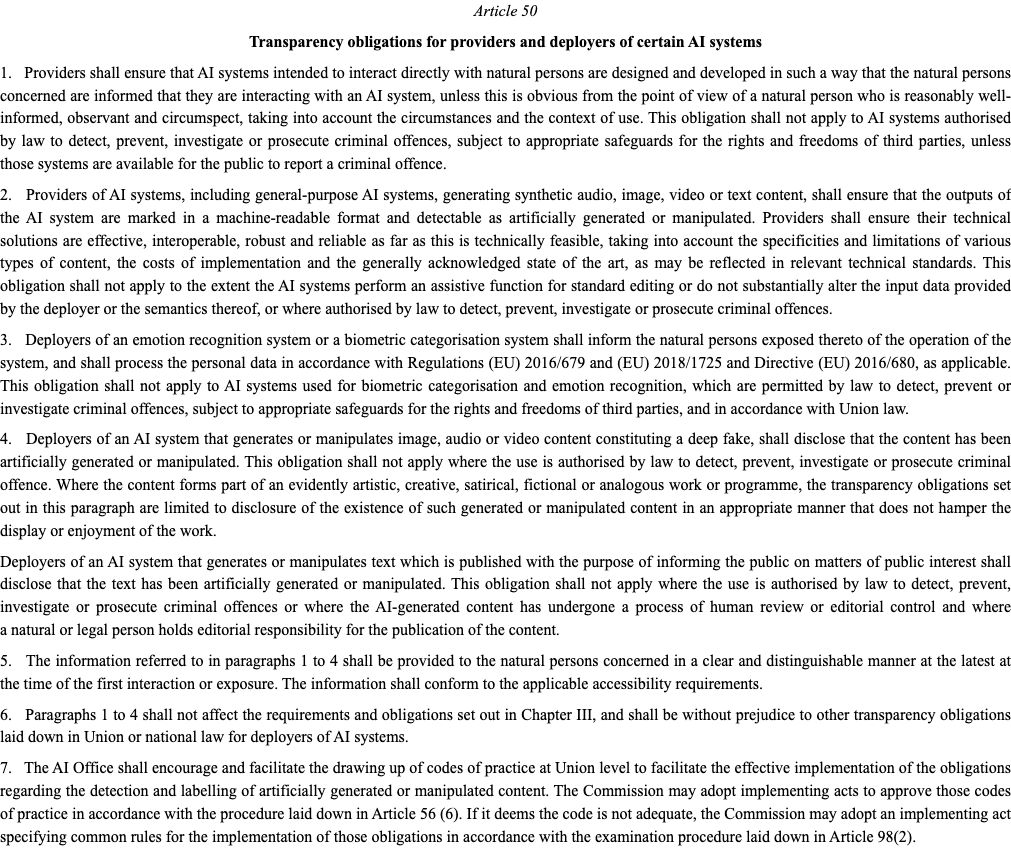
In practice: passing your chatbot off as a human to your visitors is not just an image risk, it contradicts the text. Article 50 also contains an honest exception, the “unless this is obvious”: a robot avatar, an explicit assistant name, a banner in the first message can be enough to make the status evident. That is exactly the spirit to aim for. The same Article states that the information must be provided “in a clear and distinguishable manner at the latest at the time of the first interaction” (paragraph 5): not at the 15th message, not in terms and conditions nobody reads.
The text goes further for content publishers: texts generated or manipulated by AI “published to inform the public on matters of public interest” must be disclosed as such, unless they have undergone human review and a natural or legal person assumes editorial responsibility for the publication (Article 50, paragraph 4). And the sanction matches: non-compliance with these obligations is punishable by an administrative fine of up to EUR 15 000 000 or, for a company, up to 3% of its total worldwide annual turnover for the previous financial year (Article 99, paragraph 4).
The goal is therefore not to “hide” the bot: it is to announce it plainly, then to make it so good that the announcement becomes a detail. A chatbot that says what it is and solves the problem inspires more trust than a fake human discovered at the third reply. For the other obligations that frame a customer-facing chatbot (after-sales service, withdrawal, refunds), see our guide on which requests a support chatbot should handle.
AI text detectors: why “beating the detector” is the wrong target
If your concern is the text, not the chatbot, you need to know what you are playing against. Detectors do not “recognize” AI the way a human recognizes a style: they measure statistical regularities. A very fluid text with predictable vocabulary resembles what language models produce; a choppy, idiosyncratic text escapes them. In other words, they confuse “written by an AI” with “written very smoothly”, in both directions.
The evidence is solid and dated. A study published in 2023 in the journal Patterns by a team of Stanford researchers (Liang et al.) submitted 91 TOEFL English test essays written by non-native authors to seven widely used detectors: on average, 61.22% of these human texts were classified as “AI-generated”. The same study shows the flip side: genuinely AI-generated texts, but with a prompt asking for more sophisticated vocabulary, passed as human. A tool that condemns a majority of non-native speakers while letting well-dressed machine texts through is not a judge, it is a statistical artefact.
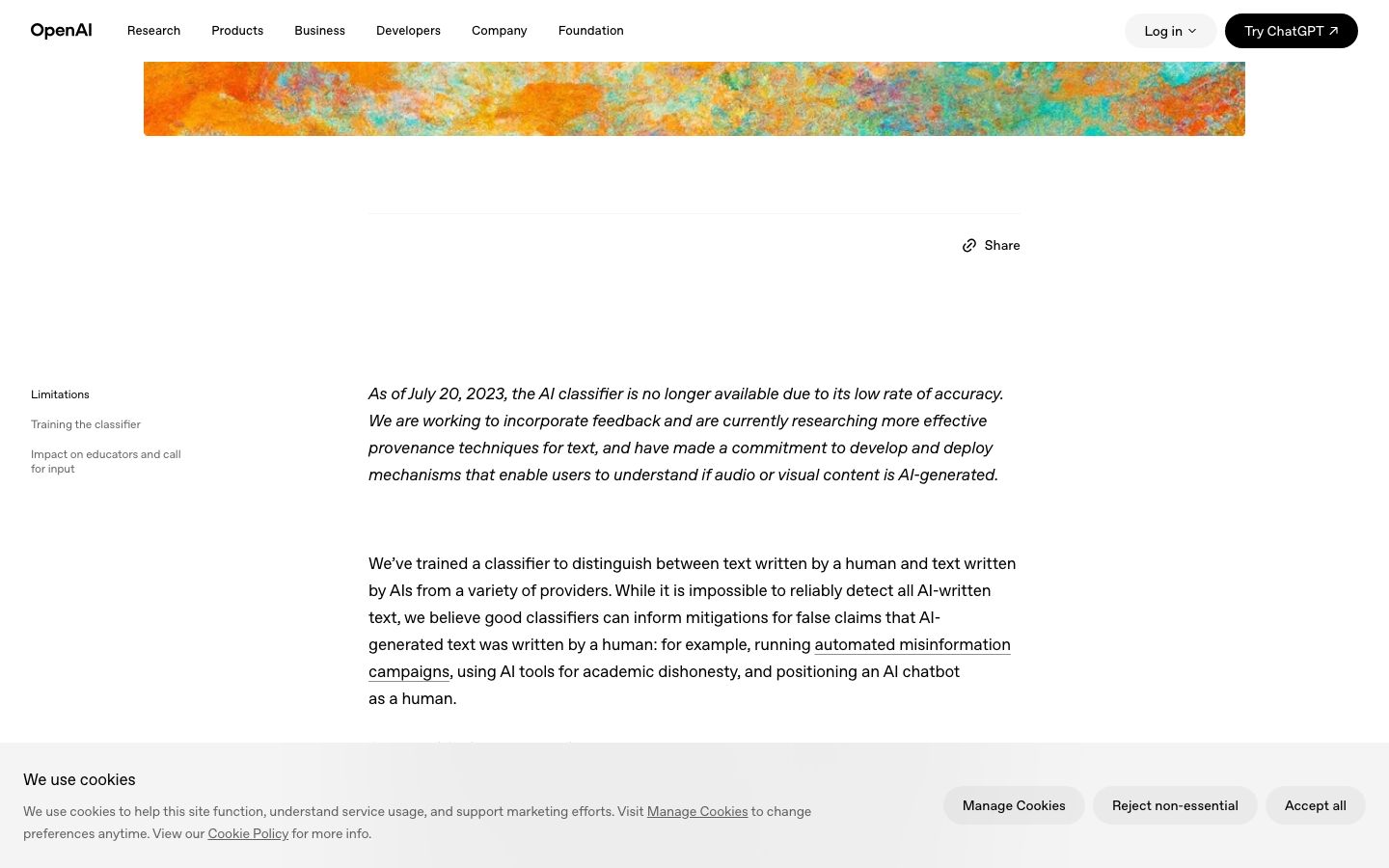
The model vendors know this better than anyone: OpenAI launched its own AI text classifier in early 2023, then withdrew it. Its official page still carries the exact note, checked on September 9, 2026: “As of July 20, 2023, the AI classifier is no longer available due to its low rate of accuracy.” When the company that builds the models gives up on detecting them, that is a clear signal.
Then there are the “humanizers”, the tools that dominate the search results for this query (Uncheck AI, BypassGPT, Monica, HIX, to name the most visible ones, unlinked here so as not to advertise them). Their principle: automatically paraphrase your text to blur its statistical signature. Their limit: automatic paraphrasing degrades meaning, breaks numbers and introduces errors; some universities and publishers already use paraphrase detection; and the result remains a text you no longer control. For professional use, the method that holds up is simpler: draft with AI, then rewrite in your own words, with your examples and your verified data. It is faster than a battle of scores, and the text sounds like you. If you want to understand what a generative model actually does inside a chatbot, our article on the generative AI chatbot details the mechanism.
What a humanizer does
- Rephrases every sentence to blur the statistics
- Often lowers the score of a given detector, at a given moment
- Costs a subscription, text after text
What it does not do
- It fact-checks nothing: the AI’s errors stay in
- It brings neither your experience, nor your data, nor your tone
- It does not protect you from another detector, or from the same one tomorrow
What gives a chatbot away to your visitors
Now let us put the chatbot itself on the examination table. A visitor does not run detection software: they decide within a few messages, on very human signals. Here they are, by frequency, in the conversations we read:
- The impossible rhythm: a five-line block displayed in three tenths of a second. No human types that fast; a typing indicator that flashes too quickly is worse than nothing.
- Recurring phrasing: “I am sorry for the inconvenience” repeated with every message. Two replies with identical structure to two different questions, and the machine is unmasked.
- The inability to handle off-script questions: ask something slightly unusual and the bot loops back to its previous question instead of admitting its limits.
- The re-clarification loop: the bot asks the same question three times in different words, never offering a way out.
- Amnesia: asking again for the e-mail address or order number already given two messages earlier.
- No visible human exit: when the bot fails, the visitor looks for a human and finds none; that is the most maddening detection of all.
- Context contradictions: promising “an advisor will reply within 24 h” on a Sunday at 3 a.m., or ignoring that the customer already has an open ticket.
The dialogue that burns the bot: “I want to change my delivery date.” “I can help you track your order. Would you like to: 1. track an order, 2. track an order, 3. track an order?”
The dialogue that makes you forget the bot: “I want to change my delivery date.” “I can change a date if the parcel has not shipped yet. Shall I check your order number? Or I can hand you over to a colleague, as you prefer.” Same machine, a two-sentence adjustment: the exchange stays useful, and the speaker’s nature fades into the background.
None of these signals is fixed by a magic tool. All of them are fixed by tuning, which is the subject of the next section.
The six levers of a chatbot you stop “seeing”
Here are the six adjustments that, in our experience building chatbots, make the difference between a robot people endure and an assistant they use without thinking about it. They are deliberately operational: each translates into questions to ask yourself or concrete tasks.
1. A welcome message that owns up and frames
First message = status + promise + routes. “Hi, I am Lea, [brand]’s virtual assistant. I answer questions about tracking, billing and warranties; for anything else, I will hand you over to a colleague.” The visitor knows what to ask, to whom, and where to turn if it goes wrong. It is also, in practice, the easiest way to satisfy Article 50: the status “is obvious” from the very first contact.
2. A knowledge base that lives
A bot indexed on your real content (FAQ, documentation, product sheets, internal procedures) answers with your words and your business exceptions; a bot fed generic texts sounds generic. If the topic interests you, our article on where a chatbot gets its knowledge details how to connect a real base rather than general knowledge. And a base lives: closed offer, changed price, extended warranty, every month of delay creates wrong answers that “give the bot away” far more than its nature does.
3. A calibrated tone, not a neutral one
The default tone of models is smooth, polite, featureless: that is precisely the signature visitors (and detectors) spot. Decide on formality, business vocabulary, target length (40 words per message, one idea per message), then ban recycled phrasing. Two rules work well: vary the wording of apologies and follow-ups, and allow a few short, deliberate, slightly imperfect sentences.
4. A human rhythm
Progressive typing on long replies, slightly variable delays, one question at a time. The goal is not to simulate a human (that would be doubling down on the wrong idea), but to avoid the “instant telegram” effect that makes the exchange mechanical. Transparency stays intact: the machine presents itself as a machine, it just takes the time to type.
5. A clean, visible exit to a human
Even the best chatbot in the world sometimes fails; at that moment, the quality of the exit door decides the visitor’s opinion. One-click handoff from the first menu, context passed to the advisor (no re-explaining the problem), support hours stated up front. Our customer support chatbot page shows how this connection is architected between bot and team.
6. Training on your real conversations
The last lever is not a setting, it is a habit: read the conversations that went wrong every week, identify the misrecognized intent, fix the reply or the rule, and retrain. A “natural” chatbot is one whose failures have been erased one by one. That is also what separates a demo from a production tool.
Two indicators are enough: the human takeover rate (share of conversations transferred to an advisor) and the question asked after the exchange (“is your problem solved?”). A takeover rate that falls over the weeks without satisfaction dropping is the signature of a bot that learns.
Diagnostic: is your chatbot “detectable”?
This diagnostic turns the six levers above into six questions. Tick the option closest to your situation for each question: the score (out of 12 points), the verdict and the priorities recalculate on every click. No data is sent: everything is computed in your browser.
Is your chatbot detectable?
Six questions, one minute, an immediate verdict.
1. Your welcome message
2. Unexpected or out-of-scope question
3. The bot’s knowledge base
4. Tone and phrasing
5. Reply rhythm
6. Exit to a human
6 naturalness points out of 12
Your visitor knows they are talking to a machine within the first exchanges, and the experience does not make up for it. Work through the priorities below one by one, starting with the status disclosure and the human exit: those are the two cheapest fixes.
The foundations are there, but blind spots remain: follow the priorities below, ordered by lever. An average profile turns natural in a few iterations of reviewed and corrected conversations.
Announced, competent, well-paced and connected to a human: your chatbot makes people forget its nature without ever hiding it. Keep the level up by reviewing the conversations that went wrong every week.
Top priorities Add the status disclosure to your welcome message: without it, a visitor may believe they are chatting with a human, and the information required by the AI Act is missing. | Plan real out-of-scope handling: a varied apology, two clarification questions, then a handoff instead of a loop. | Schedule a monthly review: a bot quoting an offer closed six months ago gives itself away. | Vary length and phrasing: two replies with identical structure to two different questions instantly sound machine-made. | Simulate typing on long replies: a block displayed in a tenth of a second reads like a telegram. | Move the human exit up into the first menu: an escape hatch buried in a submenu is as good as none.
The five-step method (with no detection tool)
Do you recognize your chatbot in the diagnostic? Here is the order in which we build this type of project when we run it for clients, and which you can follow on your own if you prefer:
- Set the scope on real material. Export three months of tickets, e-mails and calls: the 20 recurring questions are your v1 scope. Everything else must lead to a human exit, not to improvisation.
- Write the dialogues by hand first. For each question: the ideal reply, two wording variants, and the follow-up question. Read them out loud: what sounds wrong to the ear is fixed in five minutes on paper, five weeks in production.
- Wire the base and the tone. Connect your real content, set formality, vocabulary, target length and forbidden phrasing. This is the step where a no-code platform like Botnation takes over from paper.
- Test with ten people who do not know the project. Only one question matters: at which message did you know it was a bot, and did that bother you? “Early, but I did not mind” is an excellent result; “because of the useless reply” pinpoints the exact dialogue to rewrite.
- Install the improvement loop. Every week: review transferred or abandoned conversations, fix the faulty intent, retrain. Naturalness is not a state, it is a maintenance rhythm.
Who can build it, and at what price?
Three routes exist: build it yourself on a no-code platform, get occasional support, or have the chatbot built by a specialized team. Botnation covers all three: editor of the platform, and provider of custom chatbot creation through its Enterprise offer and its chatbot creation experts (on quote). The point of a team that builds with the tool it edits: no intermediary between the platform and your dialogues, and you keep control of your account, your scenarios and your base after delivery.
| Botnation plan | Public price checked on September 9, 2026 (excl. VAT) | What it covers |
|---|---|---|
| For free | 0 EUR | Create and publish a chatbot to discover the platform |
| Basic | 39 EUR / month | Full features, analytics, unlimited chatbots |
| Pro | 59 EUR / month | The most popular plan, with more users and included AI credits |
| Entreprise | On quote | Chatbot creation services, dedicated account manager, personalized onboarding, premium support |
On custom builds, the price depends on the number of channels (website, WhatsApp, Messenger, Instagram), the volume of intents to cover and the integrations to connect (CRM, ticketing, customer base): that is exactly why it is priced on quote, never as a generic package. A third-party agency remains legitimate if you are after a very specific trade or an integrator already in place at your company; what matters is choosing someone who will deliver dialogues tuned to the six levers, not just a flow that “works”.
A natural, announced and well-tuned chatbot?
Test the platform for free, or ask our chatbot creation experts to study your project: diagnostic of your 20 recurring questions, dialogue plan and pricing on quote.
Frequently asked questions
Is there a free way to make an AI text undetectable?
Yes, and the most effective one is free: rewrite the generated text yourself, adding your examples, your verified figures and your own phrasing. Free humanizers, on the other hand, cap quickly on volume and degrade the text; you trade a detector score for real mistakes, which is a bad deal for professional use.
Does a “magic” prompt make ChatGPT undetectable?
No. A style requested in the prompt (sophisticated vocabulary, irregular sentences) lowers some scores on some tools, at a given moment: the 2023 Patterns study showed the same effect in reverse for human texts. But every detector keeps relearning, and a text rarely passes every test. The prompt is a writing tool, not a durable disguise.
Are AI text detectors reliable?
No, and it is documented: on average 61.22% of human essays written by non-native authors were classified as “AI” by the seven detectors tested (Patterns study, 2023, figures from Stanford HAI’s coverage of the study), and OpenAI withdrew its own classifier on July 20, 2023 due to its low rate of accuracy. A detector score is a clue, never proof; never make a decision about a person based on a score alone.
Should the chatbot also be announced on WhatsApp, Messenger or Instagram?
Yes. Article 50’s information duty applies as soon as an AI system interacts directly with natural persons, whatever the channel; messaging platforms also regulate automation in their terms of use. In practice, a first message announcing the assistant and offering the human exit settles both requirements at once.
Can we say “virtual assistant” instead of “robot”?
Yes, provided the status stays clear: “virtual assistant” or “automated assistant” informs honestly. What the regulation targets is deception: a bot introducing itself as “Jean, customer advisor” when no Jean will ever read the conversation. Article 50’s test is that of a reasonably well-informed person: when in doubt, simply say what it is.
How long does it take to make a chatbot natural?
A correct first version takes a few weeks of work on the dialogues, the time to write the recurring replies and connect the knowledge base. Naturalness itself is maintained: it is the regular review of failed conversations that erases flaws one by one. For full handling by our teams, the schedule is priced on quote, depending on scope and integrations.
The real “undetectable” is being forgotten
A truly undetectable chatbot is not a disguised chatbot: it is a chatbot so useful that people stop wondering who they are talking to. The law settled the disguise question on 2 August 2026; the detectors settled the score question by proving unable to tell human from machine reliably; all that remains, fortunately, is the most interesting part: writing dialogues that earn the machine being forgotten. The six levers in this guide are enough, and our diagnostic tells you where to start.
Take action
Build it yourself on the platform, or entrust it to our chatbot creation experts: either way, you start from your real conversations, not from generic text.
Sources: Regulation (EU) 2024/1689, Articles 50, 99 and 113, EN text re-read on EUR-Lex on September 9, 2026; Liang et al., “GPT detectors are biased against non-native English writers”, Patterns, 2023 (figures from Stanford HAI’s coverage of the study); AI classifier withdrawal note, official OpenAI blog, July 20, 2023, checked on September 9, 2026; public Botnation pricing checked on September 9, 2026 (prices excl. VAT). Competitors and third-party tools are named in plain text, without links.