



The search phrase “AI chatbot customer reviews” hides two different questions: what users really think of AI chatbots, and what a chatbot can do for your customer reviews. This page answers both with measured facts. On perception: 90% of French consumers would rather wait for a human advisor than a virtual one, and 72% would feel deceived if a company did not disclose that they were talking to an AI (Observatoire des services clients 2025, Ipsos BVA: 5,000 people surveyed from August 25 to September 7, 2025). On collection: 96% of consumers are open to writing a review, but only 29% wrote one in the past year (BrightLocal, January 2025): that gap is the collection that never happens. The article covers the legal framework (fake reviews are banned, transparency is mandatory), a compliant collection scenario step by step, and a calculator: how many reviews separate you from your target rating.
You searched for “AI chatbot customer reviews” and the results page hesitated between two worlds. On one side, review platforms where users rate… chatbot apps. On the other, articles about using chatbots in a company’s customer-review strategy. The two topics answer each other, and that is what this page is about: if you want to know how customers judge chatbots, you will find sourced, dated figures here. If you want to turn your chatbot into a customer-review engine, you will find a concrete scenario, the legal obligations that apply, and a target-rating calculator.
This article is written for e-commerce merchants, restaurateurs, craftspeople, local businesses and B2B teams who want authentic customer reviews, with no cheating and no wasted time. The solutions presented at the end are Botnation’s: a no-code platform to build your chatbot, and a team of chatbot-building experts for custom projects.
What users really think of AI chatbots
Let us start with the first half of the question: what do customers say when they rate their chatbot experience? Public review platforms (Trustpilot, app stores, forums) mostly show angry outbursts: payments that are hard to stop, useless answers, a feeling of going in circles. That bias is well known: people rarely leave a review when everything went fine. To measure real opinions you need representative surveys, and the most solid one available in France is recent.
These three figures come from the Observatoire des services clients 2025, run by Ipsos BVA with the “Élu Service Client de l’Année” label: 5,000 respondents representative of the population aged 18 and over, surveyed from August 25 to September 7, 2025, results published on November 21, 2025. The honest reading of these numbers cuts both ways. No, your customers do not want a robot that replaces all your advisors: that is an editor’s fantasy, not a customer expectation. But the demand hidden behind those percentages is not “zero chatbot”: it is “no chatbot that wastes my time, and no chatbot that hides”.
The study’s detail confirms it: the mass refusal mostly comes from the feeling of being locked in a loop with no exit. When a chatbot recognises a request it cannot handle and hands it over to a human, the experience changes nature. That is exactly the role a well-designed chatbot must play: absorb the repetitive questions (opening hours, order tracking, return policies) and leave the cases that deserve a human to your advisors. You will see this division of roles applied to customer support in our dedicated product, and to phone complaints in our article on the call center chatbot.
The number-one friction point: knowing who you are talking to
The most useful figure in the Ipsos study is the least quoted: 72% of French consumers would feel deceived if a company did not immediately disclose that they were talking to an AI. In other words, transparency is not a communication option: it is the very condition that makes a chatbot acceptable. Say it up front in the first message (“I am the virtual assistant, I will connect you to a person if needed”), and much of the distrust disappears.
A market of “undetectable” chatbots does exist, and it exposes you. A bot pretending to be a human advisor creates an expectation gap that your teams pay for later in complaints. On the review side it is worse: a customer who discovers the trick becomes a motivated detractor, and motivated detractors write (one of the few constants of review platforms).
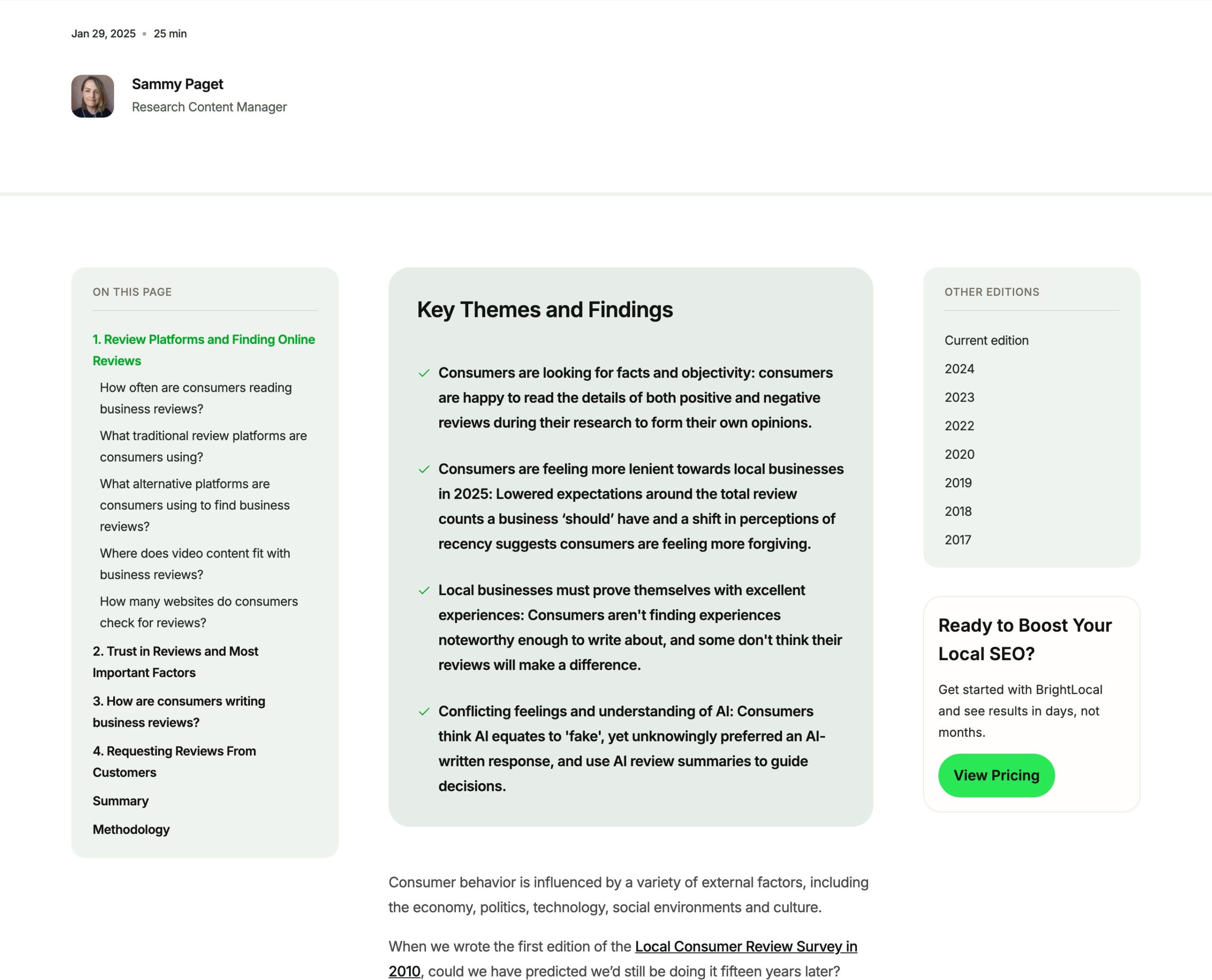
One last useful signal on the perception side: distrust now extends to content. 46% of consumers are suspicious of AI-written reviews (BrightLocal, Local Consumer Review Survey 2025, published on January 29, 2025). If you use AI to draft your review replies, proofread, personalise, own it: an authentic customer review deserves an answer that does not read like a template.
Customer reviews: the goldmine almost nobody goes after
Now for the second half of the question: making your AI chatbot a customer-review engine. The key figure is a gap. In its yearly survey (1,026 US consumers, published on January 29, 2025), BrightLocal measures that 96% of consumers are open to writing a review for a business, but only 29% wrote one in the past twelve months. Customers do not refuse to leave reviews: hardly anyone ever asks, or they ask at the wrong time, or on a channel customers no longer open.
The second figure to know: 42% of consumers trust online reviews as much as personal recommendations today, down from 79% in 2020 (same BrightLocal survey). Trust in reviews is declining, because fake reviews have multiplied and everybody can see it. The direct consequence for your strategy: authentic, verifiable, dated reviews gain relative value. A modest volume of true reviews beats a wall of suspicious praise: we come back to this in the legal part.
Why a chatbot is the right channel to ask for reviews
The ideal solicitation window is short. BrightLocal measures that, in food and drink, 48% of consumers expect a review request no later than the day after the experience (a quarter of them on the very same day). Three weeks later, in a cold email, the response rate has collapsed. A chatbot removes both obstacles at once:
- Timing. Triggered right after an interaction (delivery confirmed, ticket closed, appointment completed), it asks for the review while the experience is fresh.
- The channel. On WhatsApp or Messenger, the question lands in a messaging app the customer checks several times a day, with open rates no email ever reaches. That is the core idea of our multi-channel approach: meet the customer where they already are.
- Friction. Answering two questions inside the conversation, then tapping a link to the review page, takes less effort than opening an email, looking up the business on a platform, and writing.
Asking all your customers for a review: legal and healthy. Sorting your customers before giving access to the public review platform (only offering the link when the internal rating is above 4 stars): that is review manipulation, and it falls under the bans on fake reviews and misleading practices. The right reflex is routing, not filtering: everyone can post a public review; below the target, you also open an internal complaint channel, you never close the public door.
Collecting customer reviews: what the law requires
French law has regulated the collection and publication of online reviews for years, and the rules have grown stricter. Here they are, in the order they concern you when you plug a chatbot into your review strategy.
Transparency on collection and moderation (mandatory since 2018)
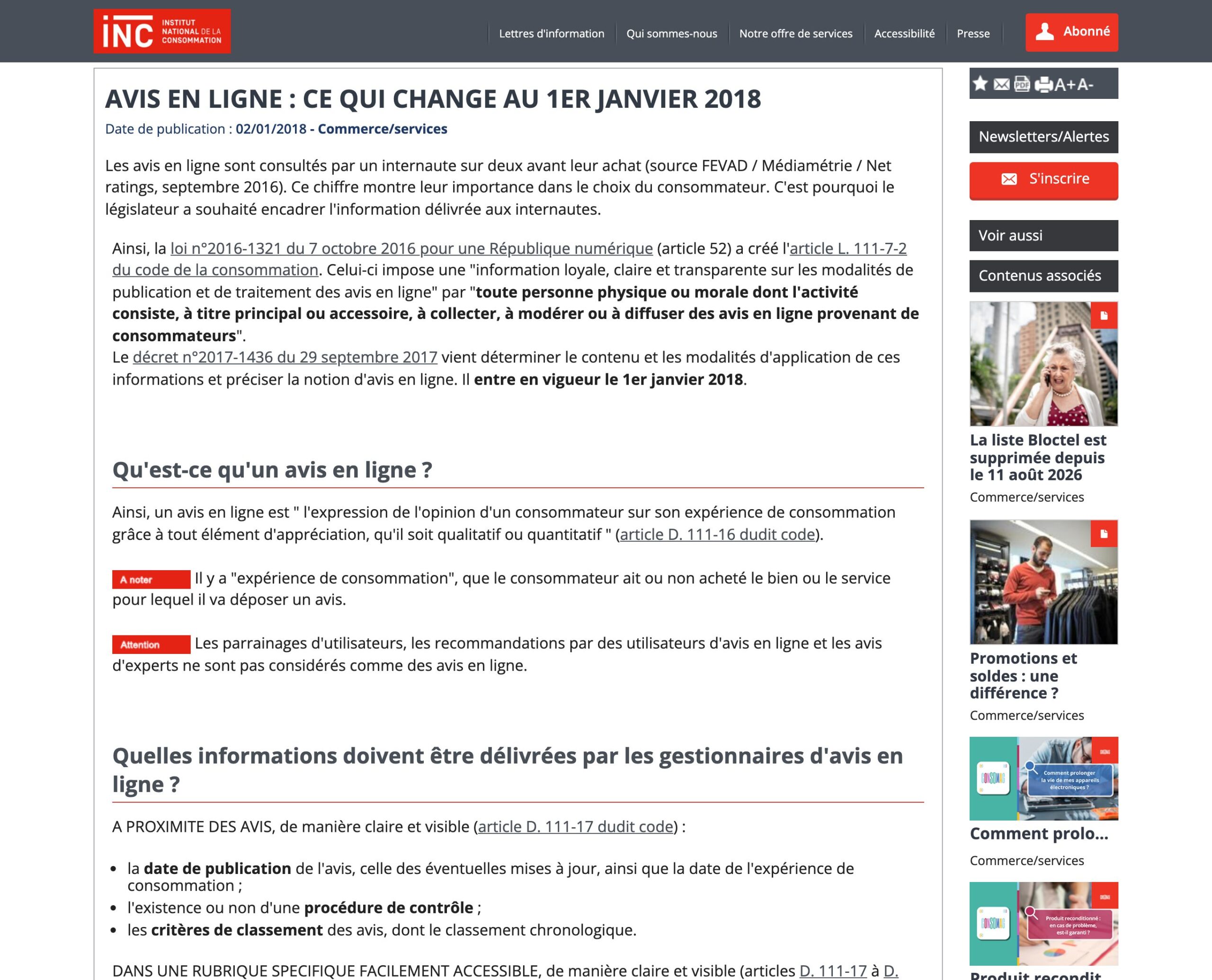
Article L111-7-2 of the French consumer code, created by the law for a digital republic of October 7, 2016 and applicable since January 1, 2018 (decree n° 2017-1436 of September 29, 2017), targets anyone who collects, moderates or publishes consumer reviews. It requires “loyal, clear and transparent information on the publication and processing of reviews”, an explicit mention of whether reviews are checked, the display of the review date and its updates, the reasons for rejecting a review, and a free flagging feature for doubts about a review’s authenticity. Breaching it costs up to €75,000 for individuals and €375,000 for legal entities (article L131-4 of the same code). The text is available on Légifrance (published in French only), and the French consumer institute details the mandatory mentions on inc-conso.fr (in French).
Fake reviews: a general ban (since 2022)
Since May 28, 2022, the 28th item of article L121-4 of the French consumer code has banned, in all circumstances, “de diffuser ou faire diffuser par une autre personne morale ou physique des faux avis ou de fausses recommandations de consommateurs ou modifier des avis de consommateurs ou des recommandations afin de promouvoir des produits” (publishing or having a third party publish fake reviews or fake consumer recommendations, or altering consumer reviews or recommendations, to promote products). The provision was created by ordinance n° 2021-1734 of December 22, 2021, which transposes the European “Omnibus” directive (directive (EU) 2019/2161), applicable across the EU from that date. Full text on Légifrance (in French). For your chatbot, three concrete bans follow: never generate fake reviews, never have providers write reviews, never alter a review (including “to fix the spelling”) without saying so.
Criminal penalties: the amount depends on the channel
A misleading commercial practice is punishable by two years’ imprisonment and a €300,000 fine (article L132-2 of the French consumer code), an amount that can rise to 10% of average yearly turnover or 50% of the expenses incurred for the practice. And the text contains an aggravation that directly concerns our topic: when the offence is committed “by using an online public communication service or through a digital or electronic medium”, the penalties rise to five years’ imprisonment and a €750,000 fine. The DGCCRF, the French consumer authority, recalls these sanctions and lets people report fake reviews on its official platform (SignalConso, in French).
Voluntary standards: a trust signal
Next to hard law there is a voluntary framework: the French standard NF Z74-501 (“online consumer reviews”, published by AFNOR in July 2013), which became the international standard ISO 20488 in 2018. It sets requirements for traceability (each review tied to a real experience), transparency of collection and moderation processes, and the right of reply. Borrowing its principles costs nothing and builds solid ground: exactly the kind of “verified reviews” statement that regulation asks you to justify.
| Obligation | Reference text | Since | What it changes for you |
|---|---|---|---|
| Transparent information on review collection, moderation and control | French consumer code, art. L111-7-2 (law n° 2016-1321, decree n° 2017-1436) | January 1, 2018 | Display review dates, say whether you check them, publish your processes |
| Ban on fake reviews and altered reviews | French consumer code, art. L121-4, item 28 (ordinance n° 2021-1734, directive (EU) 2019/2161) | May 28, 2022 | No generated, bought or retouched reviews, even “improved” ones |
| Penalties for misleading commercial practices | French consumer code, art. L132-2 | in force (toughened by law n° 2024-420 of May 10, 2024) | 2 years and €300,000; 5 years and €750,000 when committed online |
| Specific fine for failing review-information duties | French consumer code, art. L131-4 | in force | Up to €75,000 (individuals) or €375,000 (legal entities) |
| Voluntary quality framework | NF Z74-501 (AFNOR, 2013), became ISO 20488 (2018) | voluntary | Trace every review, publish your processes, offer a right of reply |
A compliant collection scenario, step by step
Here is what it looks like plugged into a real customer journey. The following scenario works on a WhatsApp, Messenger or web chatbot, and it complies with every rule above: the bot is announced, reviews are requested from everyone, verbatims are kept, and the public review is never conditional.

- 1. Trigger at the right moment. The chatbot sends its message within 24 hours of the experience: order delivered, ticket closed, appointment completed. That is the window customers expect, and it is already closed a few days later.
- 2. Introduce yourself, then ask one open question. “I am [company]’s assistant, did everything go well with your order?” The customer’s first free answer is your verbatim: it feeds your quality analysis directly.
- 3. Rate internally. One closed question (1 to 5 stars) inside the conversation. This internal rating is used for routing, never for filtering: it stays in your back office.
- 4. Route, without conditions. Happy customer: the chatbot offers the link to your public review page (Google listing, marketplace). Unhappy customer: the chatbot opens an internal complaint channel (advisor call-back, form). In both cases the public review remains possible: the door is never closed, one more door is simply opened.
- 5. Publish with the mentions. On your site, collected reviews display with dates, with the statement of the control performed (“reviews from customers who actually purchased” or equivalent) and a link to your publication policy. That is the requirement of article L111-7-2.
| Sector | Chatbot trigger | Key question | Route to |
|---|---|---|---|
| E-commerce | Parcel marked delivered + 24 h | “Does the product match what you expected?” | Online product review; complaint channel if disputed |
| Restaurants | Booking completed + 12 h | “Will you come back? Anything to improve?” | Google listing; front-of-house follow-up |
| Services / trades | Job closed + 24 h | “Is the work what you asked for?” | Google review; warranty claim |
| SaaS / B2B | Support ticket resolved | “Is your issue solved, first time?” | Customer testimonial; support escalation |
| Healthcare, practices, public services | Appointment completed + 24 h | “Were the welcome and the wait satisfactory?” | Internal survey (public reviews are more constrained there) |
The step-2 verbatim is often worth more than the step-3 star: it says what to improve, in the customer’s own words. Treat those verbatims as an asset: export them monthly, count recurring themes, hand three of them to the product team. On the technical side (collecting, storing, exporting answers), our e-commerce chatbot does exactly that, and the online FAQ can take over the most frequent questions.
Calculator: how many reviews separate you from your target rating
Once collection is running, the question becomes arithmetic: how many reviews does it take to move a rating from 3.7 to 4.5? The answer depends on three numbers: your current rating, the number of reviews behind it, and the average rating of your upcoming reviews. The formula is a weighted average: if you have N reviews at A and receive K new reviews at B, your rating becomes (N × A + K × B) ÷ (N + K). Inverting that formula for a target rating T gives: K = N × (A − T) ÷ (T − B). The calculator below applies this formula and names the rule that applies to your situation.
How many customer reviews to reach your target rating?
Pick your four values: the calculation updates on every click, and the applied rule is written in the result panel.
1. Your current rating
2. The number of reviews behind that rating
3. Your target rating
4. Expected average of your upcoming reviews (a hypothesis you can adjust)
Your situation: 3.7 out of 5, 150 reviews in total, 4.5 out of 5, a 4.9 expected average.
With upcoming reviews at your hypothesis average, you need about 300 extra reviews to reach the target, that is 2 times your current review pool. The average hypothesis is the most sensitive variable: at 4.6 instead of 4.9 the count changes dramatically, run the calculation again.
Your current rating is already above the chosen target. The topic is no longer volume: it is consistency. Keep collecting regularly (recent reviews carry more weight in consumer decisions) and watch negative verbatims, which become your best source of improvement.
At the chosen hypothesis rate, even a very large number of reviews would not lift your rating to the target: their expected average is too low. The priority is not collection but the experience: fix what negative verbatims point at first, then restart collection. Buying or filtering reviews to “speed things up” is banned (article L121-4 of the French consumer code) and consumers spot it.
| Value | Default | How to adjust it |
|---|---|---|
| Current rating | 3.7 | Your public rating (Google listing, marketplace), as it is, with no flattering rounding |
| Review pool | 150 | The number of reviews behind that rating, visible on the platform |
| Target rating | 4.5 | The threshold that matters to your customers; set it honestly |
| Average of upcoming reviews | 4.9 | Estimated from your last 20 reviews; if you route unhappy customers internally it rises, and the calculation should reflect it |
One honest caveat: this calculation says how many reviews, not how long it will take. The pace depends on your customer volume and on your scenario’s response rate: that is the gap between the 96% of consumers open to writing a review and the 29% who write one in a year (BrightLocal, 2025). A well-tuned scenario narrows that gap; no scenario removes it.
The five mistakes that cost reviews (and sometimes more)
- Asking cold, three weeks later. The “we value your feedback” email sent a month after purchase lands in a window that has already closed: 48% of consumers expect a request no later than the next day (BrightLocal, 2025). Trigger while it is hot, inside the conversation the customer already opened.
- Hiding that it is a robot. 72% of French consumers would feel deceived facing an undisclosed AI (Ipsos BVA, 2025). Transparency in the very first message is the condition for everything else, customer reviews included.
- Filtering the unhappy before publication. Only offering the public review platform to satisfied customers distorts what is published: that is the exact ground of the 2022 bans, and consumers detect it (a business with 500 five-star reviews and no mixed ones inspires less trust than an honest rating).
- Forgetting the mandatory mentions. Reviews without dates, without a statement of control, without published processes: that is a breach of article L111-7-2, fined up to €375,000 for a legal entity.
- Never answering reviews. Only 7% of consumers do not expect an answer to the review they left, and 63% expect one within a few days (BrightLocal, 2025). Answering reviews, positive or negative, is part of the job; AI can draft the replies, a human proofreads and signs.
Frequently asked questions
Is it legal to ask customers for reviews?
Yes, solicitation is perfectly legal, provided it is open to everyone and free of conditional incentives. What is banned: buying reviews, generating fake ones, altering them, or passing off non-customers as reviewers (article L121-4 of the French consumer code, since May 28, 2022). Asking the customer you have just served, through a chatbot announced as such, is the healthiest practice there is.
Can you ask only satisfied customers for a review?
This is the grey zone where many businesses get lost. Hard filtering (only happy customers receive the public link) distorts the published picture and borders on misleading practice. Transparent routing is different: everyone gets the possibility to post a public review, and in addition, unhappy customers are offered an internal complaint channel. The public rating then reflects the real, complete experience, and your teams catch problems before they become humiliating reviews.
WhatsApp, Messenger or email to collect reviews?
The winning channel is the one your customer already opens, at the moment their experience is fresh. Instant messaging meets both conditions (reading time in minutes, an ongoing conversation), email rarely meets the second. The three channels can coexist: the chatbot routes to WhatsApp for one customer, Messenger for another, and keeps email for profiles using neither. That is the multi-channel logic detailed on our channels page.
Can an AI chatbot answer customer reviews for me?
It can draft personalised replies from the review’s verbatim, but two precautions apply. First, 46% of consumers distrust AI-written content (BrightLocal, 2025): a detectable generic answer does more harm than no answer. Second, review replies commit your business: a human proofreads, adjusts and publishes. The right use of AI is a blank-page breaker, not an answering machine.
How long does it take to see my rating move?
Use the calculator above: it gives the missing number of reviews, and your collection pace gives the time. Example: 300 missing reviews at 25 collected per month is a year; at 60 per month, five months. The pace lever is the timing-plus-channel pair described in this article, not solicitation intensity: asking the same customer twice annoys more than it yields.
Should I publish every review I receive, including 1-star ones?
Your publication policy decides, and it must be published (article L111-7-2). A moderation that excludes abusive, off-topic or non-experiential content is legal, provided its rules are public and applied as written. A moderation that would exclude negative reviews would amount to altering consumer information, with the corresponding sanctions. Publishing a negative review with a serious answer often sells better than a wall of 5 stars.
The right chatbot, for the right reviews
The answer to “AI chatbot customer reviews” fits in one sentence: users distrust robots that hide and reviews that cheat, and they reward businesses that ask for reviews at the right time, on the right channel, and treat unhappy customers as customers. Your chatbot can carry exactly that approach: announced, useful, connected to your tools, with a routing that respects your customers and the law.
Your customers are on WhatsApp, Messenger or your website?
Build your review-collection scenario yourself on the platform (the free plan lets you test with no credit card), or hand it to our chatbot-building experts for a setup connected to your tools. Our teams both build the platform and deliver custom chatbots: the same people for both.
Go deeper with our sector and product pages: helpdesk chatbot, e-commerce chatbot, WhatsApp, Messenger and web channels, they trust Botnation, chatbot for e-commerce and lead generation.
Sources and records: Observatoire des services clients 2025, Ipsos BVA × Élu Service Client de l’Année (sample of 5,000 people representative of ages 18 and over, fieldwork August 25 to September 7, 2025, published on November 21, 2025): ipsos.com (page in French) ; BrightLocal, Local Consumer Review Survey 2025 (1,026 US consumers, published on January 29, 2025): brightlocal.com ; French consumer code, articles L111-7-2, L121-4 (item 28), L131-4 and L132-2, texts read on Légifrance through the codes.droit.org mirror on September 2, 2026 (versions in force, L111-7-2 last amended by law n° 2024-449 of May 21, 2024 and L132-2 by law n° 2024-420 of May 10, 2024) ; INC factsheet “online reviews: what changes on January 1, 2018” (inc-conso.fr, retrieved on September 2, 2026, in French) ; SignalConso page on fake customer reviews (signal.conso.gouv.fr, retrieved on September 2, 2026, in French) ; Botnation pricing grid retrieved from /en/pricing/ on September 2, 2026 (FOR FREE €0, BASIC €39/month, PRO €59/month, ENTREPRISE on demand, prices in euros).