




In short. A chatbot does not replace a call center, it removes contacts from it. How many? That barely depends on the bot: it depends on the mix of your inbound flow. In French outsourced contact centers, AI agents accounted for 8.7% of revenue in 2025 and the phone still concentrated 73% of it (SP2C and EY barometer, 2026 edition). And two deadlines land this week in Europe: the duty to tell people they are talking to an AI has applied since 2 August 2026, and French outbound calling moves to prior consent on 11 August 2026.
Search for “call center chatbot” and you land on two families of pages. On one side, rankings of customer service software that never mention a call center. On the other, voicebot vendors promising to automate “up to 80%” of requests without ever saying what that percentage is a percentage of. Between the two, the one thing a contact center manager actually needs is missing: how many calls and conversations a bot will really pull out of the queue, and which ones.
This article answers that question with an explicit model, a simulator you drive with your own assumptions, and the two legal texts that have framed the subject in Europe and in France for the past few days.

Chatbot, callbot, voicebot: what you are buying is not the same thing
The first misunderstanding on this topic is lexical, and it is expensive at tender stage. In a call center, four different objects hide behind the word “bot”, and they do not act at the same point in the chain.
Contact center chatbot: a written conversational agent, placed on the website, the app or a messaging channel, whose primary job in a call center is not to answer the call but to stop the call from happening. It works upstream of the phone queue, not inside it.
| What you are buying | Channel | Where it acts | Measurable effect on the floor |
|---|---|---|---|
| Written chatbot | Website, app, WhatsApp, Messenger, Instagram | Before the call | Fewer inbound contacts on repetitive reasons |
| Callbot or voicebot | Telephone | Instead of the call | Calls handled without an agent, or pre-qualified |
| Interactive voice response | Telephone | Before queueing | Routing, no resolution |
| Agent assist or copilot | Agent workstation | During the call | Shorter handling time, unchanged volume |
The most common confusion sets the chatbot against the callbot. The first writes, the second speaks: the definition of a callbot and its benefits and the one for a voicebot show that the speech recognition layer changes cost, latency and error rate, not the conversational logic. The point that matters for a call center lies elsewhere: a written chatbot and a callbot do not compete for the same contacts. The first takes requests that would have become calls; the second takes calls that have already been placed.
An agent assist that saves 40 seconds of average handling time deflects no contact at all. It increases the capacity of the floor at constant headcount. That is a genuine gain, but it does not show up in the same indicator, and it does not simply add up with deflection.
The figure that reframes the topic: AI accounts for 8.7% of revenue
The SP2C, the French professional union of contact centers, publishes an annual sector barometer with EY Consulting. The 2026 edition, titled “IA et Relation Client externalisée : vers une performance augmentée”, was presented on 9 July 2026. It measures, across the union’s members, the share of revenue generated depending on the use of AI. The result is worth reading before any scoping meeting.
The barometer states, on page 26, that in 2025 revenue is still very largely carried by human agents at 90.4% (“En 2025, le chiffre d’affaires reste très majoritairement porté par les conseillers humains (90,4 %)”). It adds that AI solutions still account for a limited share of 8.7%, while hybrid agents remain marginal at 0.9%, confirming the dominant place of humans in customer relations (“Les solutions d’IA représentent une part encore limitée (8,7 %), tandis que les agents hybrides demeurent marginaux (0,9 %), confirmant la place prépondérante de l’humain dans la relation client”). The sample is 58 respondents among SP2C members.
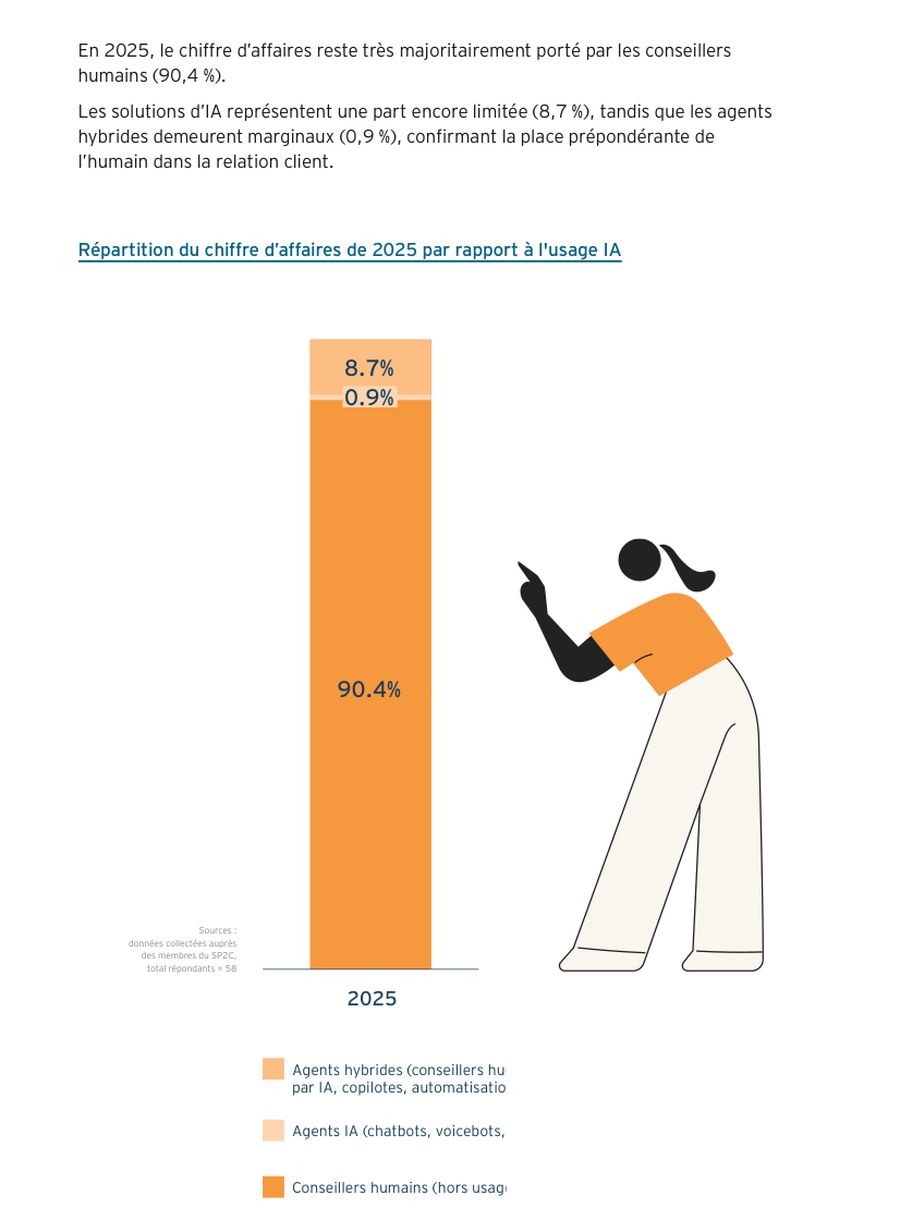
This is not slow adoption. It is the structure of the job. The same barometer notes that in 2025 the phone confirmed its pre-eminence by concentrating 73% of French market revenue despite a slight erosion of 1% (“En 2025, le Téléphone confirme sa prééminence, en concentrant 73 % du chiffre d’affaires du marché français, malgré une légère érosion (-1 %)”), and that flows remain overwhelmingly inbound, between 83% and 84% depending on whether you read the chart or the text of the barometer. In other words: the raw material of a French call center is still a human picking up the phone, and a written chatbot only attacks the fraction of that material that could have been handled another way.
When a vendor announces “80% automation”, read the denominator. It almost always means 80% of eligible conversations, that is, of those already about a reason the bot handles. Related to the total flow of the floor, the same figure usually lands between 15% and 35%.
The deflection rate is not a property of the bot, it is a property of your flow
Two call centers that buy exactly the same solution do not get the same result, and the gap has nothing to do with product quality. It comes from the mix of contact reasons. An e-commerce after-sales team is dominated by “where is my parcel”; a health insurance platform is dominated by “am I entitled to this reimbursement”. The first flow is massively automatable, the second barely at all.
Three questions are enough to settle each reason, and they come in this order.
- Does the person have to be authenticated to get an answer? If so, the bot is useless until it is connected to your systems. Without that connection it can only redirect, so it deflects nothing.
- Is a judgement call involved? A goodwill gesture, an exception to the rule, an arbitration between two versions of the facts: as soon as a discretionary decision is at stake, the request goes back to an agent, whatever the quality of the model.
- Does the answer already exist, in writing, somewhere? A procedure, terms and conditions, a product sheet, a help article: this is the bot’s natural ground, and this is where most of the deflection is won.
Applied to a standard contact center flow, the grid gives this.
| Contact reason | Authentication | Judgement | Documented answer | What the bot can do with it |
|---|---|---|---|---|
| Opening hours, addresses, terms and conditions | No | No | Yes | Handled end to end |
| Order or parcel tracking | Yes, light | No | No, system data | Handled if the bot reads your systems |
| Duplicate invoice | Yes | No | No, system data | Handled if the bot reads your systems |
| Lost password or access | Yes, strong | No | Partly | Handled if a reset journey exists |
| Booking or moving an appointment | Yes, light | No | No, calendar | Handled if the calendar is connected |
| Pricing or eligibility question | No | On edge cases | Yes | Standard case handled, exception transferred |
| Fault or technical incident | Yes | Yes | Partly | Pre-qualification only |
| Complaint, dispute, goodwill gesture | Yes | Yes | No | Context capture, then an agent |
| Cancellation | Yes | Yes | Partly | Agent, for legal reasons |
Then count the real monthly volume of each line. The sum of the “handled end to end” and “handled if connected” lines, divided by total volume, gives your eligible share. That value, and not a sales promise, is what goes into the simulator below. If you have never done that count, it almost always exists in your ticketing tool as reason codes; it is the first deliverable to ask for before any product demo.
Simulator: how many contacts your chatbot will really deflect
The model holds in five inputs and one idea that vendor calculators systematically forget: a bot failure does not cost zero, it sometimes costs one extra contact. When a conversation stops without an answer and without a transfer, some customers come back through another channel, and that second contact adds to the first.
The formulas are published, you can redo them by hand:
- eligible contacts = total volume x share of the flow the bot can take;
- absorbed contacts = eligible contacts x bot resolution rate;
- returning contacts = bot failures x re-contact rate, itself driven by the quality of the handover;
- net deflection = (absorbed contacts minus returning contacts) / total volume.
Call center deflection simulator
Five settings, no data sent anywhere. The default values match an average floor with a properly connected bot.
Monthly volume of inbound contacts, all channels
Share of that flow the bot can take on (the count from the table above)
Bot resolution rate on those eligible requests
What happens when the bot fails?
Average handling time of one contact by an agent
That leaves 7,188 contacts to be handled by an agent, out of 10,000 inbound.
Below 15%, the project does not pay for itself through workload reduction. It can be justified by availability outside opening hours or by capturing contacts that would never have called, but not by a headcount plan. Redo the contact reason count before going any further.
Between 15% and 30% is the range most floors actually reach in the first year. The gain shows up first on peaks and on the most repetitive reasons, much less on the payroll. The next lever is not a better model, it is one more contact reason wired into your systems.
Between 30% and 45%, the bot changes how the floor is steered: sizing, opening hours and agent profiles all need review, because what remains in the queue is mechanically more complex and longer. Expect the residual average handling time to rise.
Above 45%, check two things before believing it: that the eligible share you entered comes from an actual reason code count and not from an optimistic estimate, and that the resolution rate is measured on real conversations, not on a test set. A resolution rate self-declared by the tool often counts as “resolved” any conversation the customer simply abandoned.
Run one instructive test: keep every default value and change only the fourth line. Moving from a live transfer to “nothing, the conversation stops” costs about ten points of net deflection. To win those ten points back through the resolution rate alone, you would have to push it from 70% to nearly 85%. Handover quality is therefore worth about fifteen points of resolution rate, and it is infinitely cheaper to obtain.
The handover to a human agent is where the money is lost

In the SP2C barometer, Zoran Jelkic, CEO of the Bluelink group, sums up the condition in one sentence: automation must reduce customer effort, fit naturally into an end-to-end journey and allow a smooth escalation to a human agent (“Elle doit réduire l’effort client, s’intégrer naturellement dans un parcours global et permettre une escalade fluide vers un conseiller humain”). His peer Younes Jabri, deputy chief executive of Outsourcia, puts it differently: a customer accepts a bot for a parcel of socks, and demands a human voice for the delivery of a work of art (“Un client accepte un bot pour un colis de chaussettes, exige une voix humaine pour la livraison d’une œuvre d’art”).
In practice, a successful handover passes four things to the agent, and not one fewer.
What the handover must pass on
- The full transcript of the exchange, not a summary
- The identity already verified, so it is not asked again
- The detected reason and the exact point of failure
- The actions the customer has already tried
The four ways to get it wrong
- The agent starts from scratch and asks the same questions again
- The transfer only exists during opening hours
- The bot loops on its answer instead of handing over
- The customer has to re-authenticate after the transfer
The most underestimated point is the third. A bot that cannot say “I do not know” traps the customer in a loop, and that loop turns a neutral contact into a complaint. It is one of the mistakes listed in our guide to the most common chatbot creation mistakes, and it is the only one that degrades deflection and satisfaction at the same time.
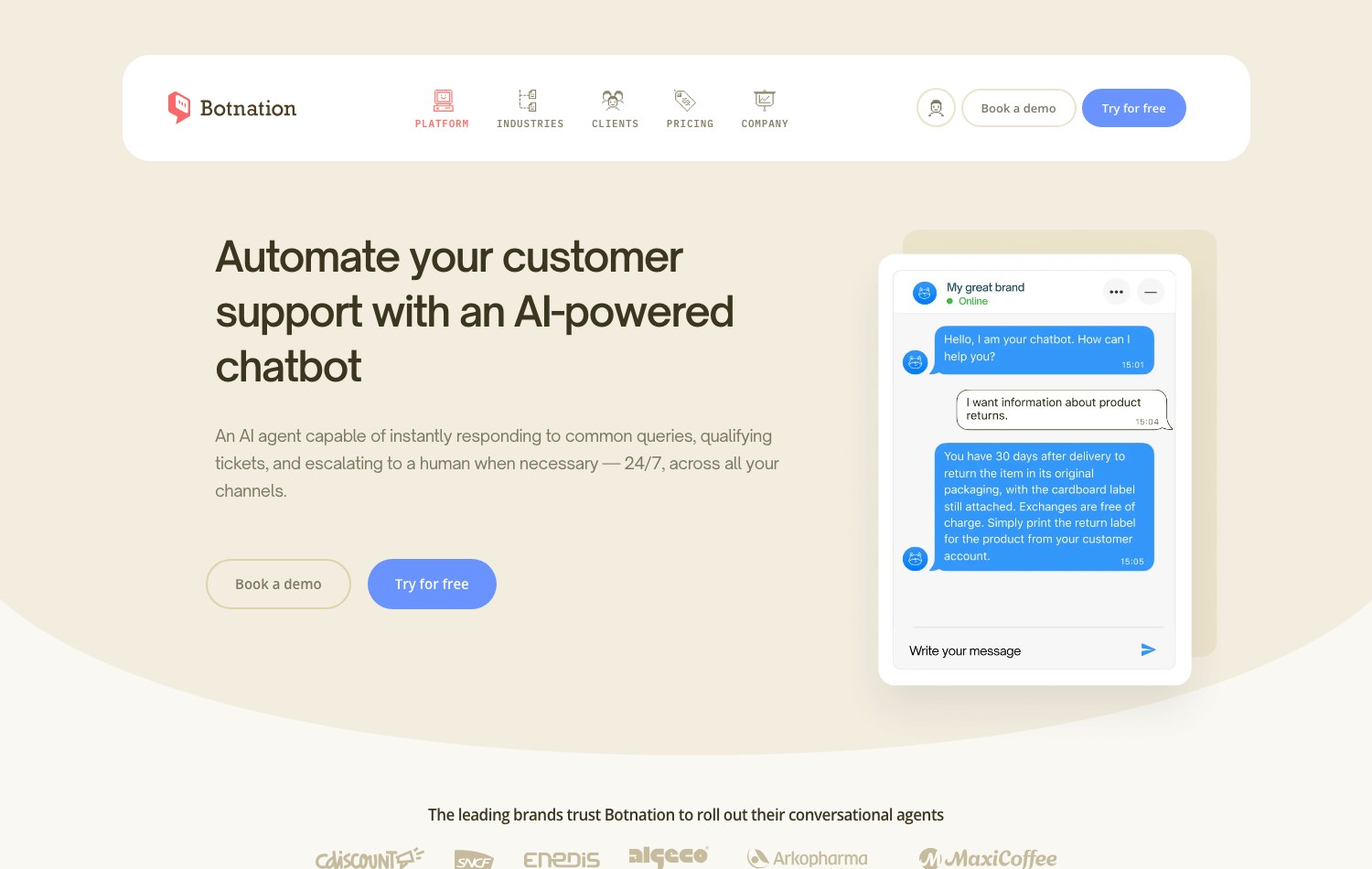
Note the wording used on that page. It describes an AI agent “capable of instantly responding to common queries, qualifying tickets, and escalating to a human when necessary”. All three verbs matter, and the third is the one people forget to specify in their requirements documents.
Two dates that change the game for a call center in 2026
The subject has stopped being purely operational. Two texts apply within days of each other, and both hit a French phone platform directly.
Since 2 August 2026: say that it is an artificial intelligence
Article 50 of Regulation (EU) 2024/1689 on artificial intelligence has applied since 2 August 2026, under its Article 113, which states that the regulation “shall apply from 2 August 2026”, the exceptions listed afterwards not covering Chapter IV. Paragraph 1 is short and unambiguous:
“Providers shall ensure that AI systems intended to interact directly with natural persons are designed and developed in such a way that the natural persons concerned are informed that they are interacting with an AI system, unless this is obvious from the point of view of a natural person who is reasonably well-informed, observant and circumspect, taking into account the circumstances and the context of use.”
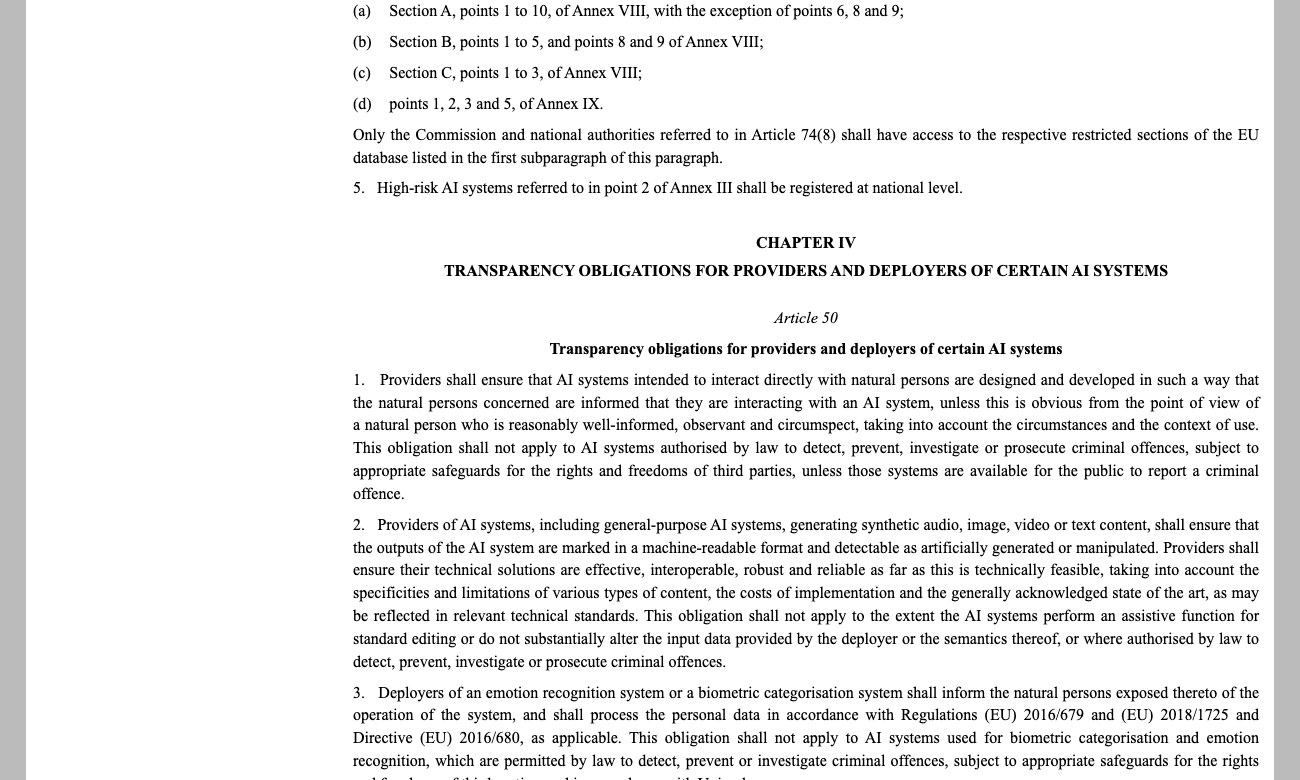
For a contact center, the consequence is practical. The notice has to appear at the first interaction, not inside a privacy policy. On a written channel, that is one line in the welcome message. On a callbot, that is one sentence in the entry announcement. And the penalty is not symbolic: Article 99(4) of the same regulation provides, for these breaches, “administrative fines of up to EUR 15 000 000 or, if the offender is an undertaking, up to 3 % of its total worldwide annual turnover for the preceding financial year, whichever is higher”.
From 11 August 2026: no outbound call without consent in France
The second text is French and it hits the other half of the job. Article L223-1 of the French consumer code, in the version introduced by Article 13 of Law no. 2025-594 of 30 June 2025, enters into force on 11 August 2026. It bans cold calling a consumer who has not given prior consent to commercial prospecting by that means:
“Il est interdit de démarcher par téléphone, directement ou par l’intermédiaire d’un tiers agissant pour son compte, un consommateur qui n’a pas exprimé préalablement son consentement à faire l’objet de prospections commerciales par ce moyen.” (It is forbidden to canvass by telephone, directly or through a third party acting on its behalf, a consumer who has not previously expressed consent to being the subject of commercial prospecting by that means.)
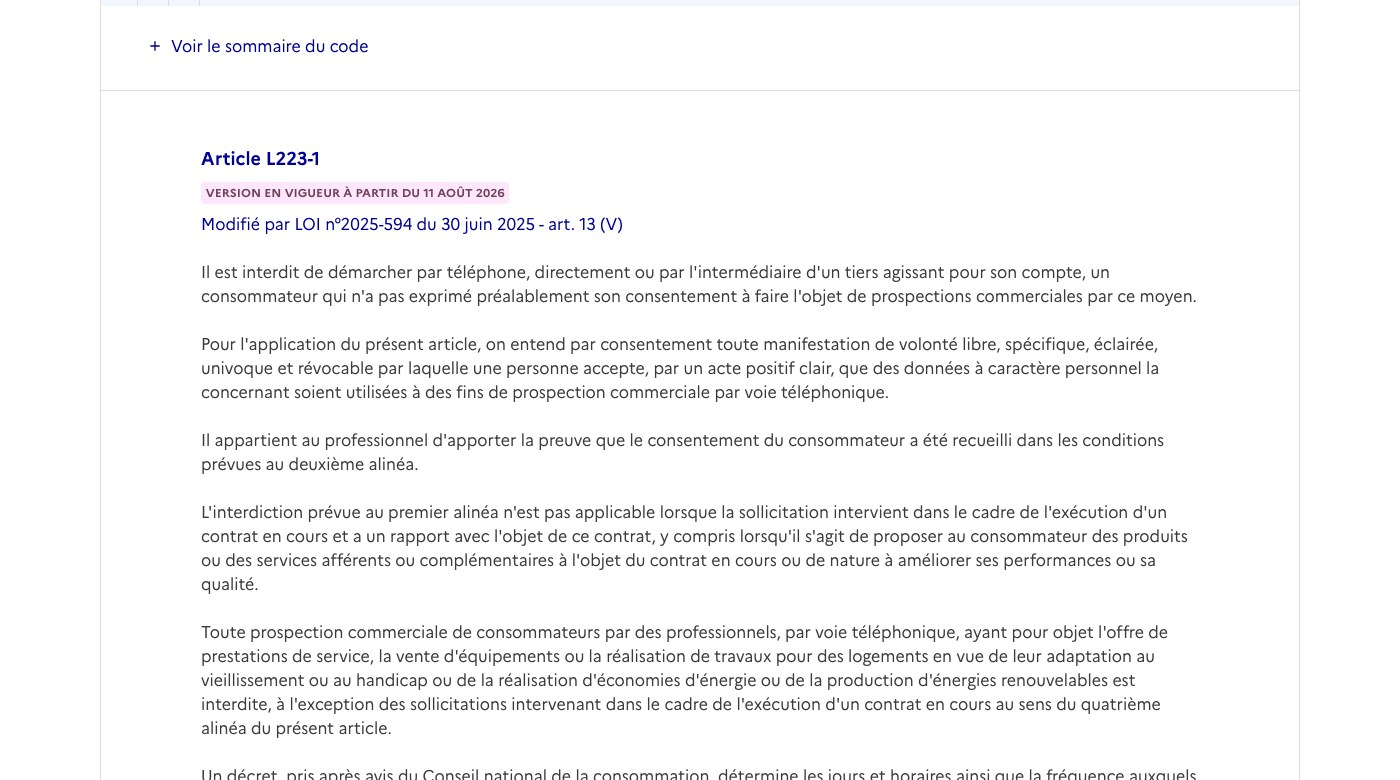
Three points deserve a contact center manager’s attention. The text states that it is up to the professional to prove that consent was collected (“il appartient au professionnel d’apporter la preuve que le consentement du consommateur a été recueilli”): the burden of proof falls on the caller, not the person called. It keeps an exception for an ongoing contract, where the solicitation takes place as part of performing that contract and relates to its subject matter (“lorsque la sollicitation intervient dans le cadre de l’exécution d’un contrat en cours et a un rapport avec l’objet de ce contrat”). And it provides that any contract concluded with a consumer following non-compliant canvassing is void (“tout contrat conclu avec un consommateur à la suite d’un démarchage téléphonique réalisé en violation des dispositions du présent article est nul”). The Bloctel opt-out list disappears on the same date, canvassing becoming forbidden by default rather than refusable case by case.
The link with the chatbot is not obvious at first glance, yet it is direct. A floor that loses part of its outbound activity has to rebuild a base of traceable consents and pull more contacts inbound. A written conversation is precisely where a consent can be collected through a clear positive act, time-stamped and attached to a conversation, which an outbound call no longer allows.
Putting a chatbot into a call center: the method in six steps

- Pull twelve months of reason codes. Volume per reason, average handling time per reason, seasonality. Without that file, everything else is a conversation about opinions.
- Classify each reason with the three questions. Authentication, judgement, documented answer. You get your real eligible share, the one to enter in the simulator.
- Pick three reasons, not ten. The three largest volumes among the fully automatable reasons. A narrow, well-handled scope deflects more than a broad, approximate one.
- Wire the knowledge base before the model. Help articles, procedures and terms are the raw material of the answers. That is the principle of a RAG chatbot: the model knows nothing, it reads your documents.
- Specify the handover in as much detail as the answers. Who receives it, with what, in which tool, during which hours, and what message the customer sees at the moment of transfer.
- Measure on real conversations. Resolution rate measured, not self-declared; seven-day re-contact rate; satisfaction on transferred conversations, separately from the rest.
On step 3, one field observation: the floors that fail are almost always the ones that tried to cover the entire catalogue of reasons in the first version. If you are hesitating between building in house and having it built, the comparison of the three routes to developing a chatbot and the overview of AI chatbot agencies detail the trade-offs, costs and lead times of each option.
What it costs, per deflected contact
The right unit of measure for a call center chatbot is not the monthly subscription, it is the cost per deflected contact. On Botnation’s public grid recorded on 6 August 2026, the free plan is 0 €, Basic is 39 € per month, Pro is 59 € per month, and the Enterprise plan is “on demand”, with chatbot creation services and a dedicated account manager. Both paid plans include unlimited agents and a one-off AI credit, of 500 requests on Basic and 1,000 on Pro.
| Item | What it covers | Order of magnitude |
|---|---|---|
| Platform | Subscription, agents, channels, analytics | From 0 to 59 € per month on the public grid |
| AI credits | Requests to the model, beyond the free credit | Billed on usage, depending on the model called |
| Connection to your systems | Order tracking, billing, calendar | The most variable item, and the one that unlocks deflection |
| Design and scripting | Conversation tree, knowledge base, handover | On quotation for a supported engagement |
| Operations | Reviewing conversations, fixes, adding reasons | A few hours a week, in house |
Prices for a bespoke creation engagement are not public and are given on quotation: they depend on the number of reasons, the number of connections to your systems and the level of support. The ranges you will find elsewhere are market orders of magnitude, not Botnation rates.
The calculation that decides works the other way round. Take the simulator output: if your floor deflects 3,150 contacts a month and frees 234 agent hours, the full cost of the setup compares to those 234 hours, not to the advertised price of a subscription. That same ratio also tells you when it becomes worth wiring one more reason into your systems rather than improving the answers of the ones already covered.
Frequently asked questions
What is the difference between a callbot and a chatbot?
The channel, and therefore the moment it steps in. A chatbot is written and lives on the website, the app or a messaging channel: it acts before the call exists. A callbot answers the phone: it acts instead of the call. The second adds a speech recognition and synthesis layer, which raises cost, latency and misunderstanding rate. On a floor, the two do not compete for the same contacts and are rarely rolled out at the same time.
Can a chatbot replace a call center?
No, and the sector figures say so. In the SP2C and EY barometer, 2026 edition, AI agents accounted for 8.7% of the revenue of French outsourced contact centers in 2025, against 90.4% for human agents. A chatbot removes contacts from the queue, it does not remove the queue. What remains after it is mechanically more complex, and therefore longer to handle.
What is a contact center chatbot?
A conversational agent connected to customer service tools, able to answer recurring requests, look an information up in your systems and hand the conversation over to an agent with its context. The difference with a brochure-site chatbot lies in those last two abilities: without a connection to your systems and without a handover, a bot deflects almost nothing on a floor.
Do you have to tell callers they are talking to an AI?
Yes. Article 50 of the European regulation on artificial intelligence, applicable since 2 August 2026, requires that people be informed they are interacting with an AI system, unless that is obvious from the context. The information has to be given at the first interaction. Breaches fall under Article 99(4), which caps the fine at 15 million euros or 3% of total worldwide annual turnover, whichever is higher.
What deflection rate should you target in the first year?
Between 15% and 30% of total flow is the realistic range for a first scope of three properly connected reasons. Above 45%, check the measurement method: many tools count as “resolved” any conversation the customer simply abandoned, which mechanically inflates the resolution rate and hides re-contacts.
Does a chatbot lower customer satisfaction?
Not on its own. What lowers it is the absence of an exit. A bot that answers badly but immediately transfers to an agent with the transcript costs little in satisfaction; a bot that loops on its answer without ever handing over turns a neutral contact into a complaint. Measure satisfaction separately on transferred conversations and on conversations resolved by the bot: that is the only split that shows where the problem sits.
Chatbot or interactive voice response?
They are not alternatives. An interactive voice response routes calls, it does not resolve them: it moves the wait, it does not remove it. A chatbot resolves requests on another channel and therefore reduces the number of calls to route. On a saturated floor, the useful question is not “which of the two”, but “which reasons can leave the phone”.
Automate the repetitive part, keep your agents for the rest
Botnation publishes a no-code platform to build your own support chatbot, and also builds bespoke chatbots for its clients with its chatbot creation experts. Website, WhatsApp, Messenger, Instagram, with the handover to a human agent planned from day one.
Sources: SP2C and EY Consulting, Baromètre des impacts économiques, sociaux et territoriaux des centres de contact externalisés en France, édition 2026, presented on 9 July 2026 (pages 22 to 29, published in French) ; Regulation (EU) 2024/1689 on artificial intelligence, Articles 50, 99 and 113, as published in the Official Journal of the European Union ; Article L223-1 of the French consumer code, version in force from 11 August 2026, amended by Law no. 2025-594 of 30 June 2025, Article 13 ; Botnation public pricing grid recorded on 6 August 2026.