




In short. An AI chatbot agency rarely sells a chatbot: it sells scoping, conversation design, integrations with your tools and an ongoing run. The rate cards published by French providers in July 2026 range from €500 for a simple bot to more than €100,000 for a project wired into the information system.
That gap is not an anomaly: these are not the same products. The real questions are not “which agency?” but “what level of project do I actually have?” and “do I need a middleman between me and the platform?”. The estimator below answers in six questions, and the rest of this guide gives you the criteria, the questions to ask and the contract clauses you should never let slide.
You type “AI chatbot agency” into Google and you get twenty pages of agencies all promising the same thing: an assistant available around the clock, fewer calls, more leads. Not one of them shows a clear price. Not one of them tells you when you don’t need it.
This guide does the opposite. It describes what an agency actually delivers, what it costs in 2026 using ranges taken from the providers themselves, how to compare the five ways of getting a chatbot (agency, freelancer, no-code platform, the platform vendor’s own team, in-house team), and what to lock down in the contract.
Full disclosure: Botnation is both the publisher of a no-code platform for building chatbots and a provider that builds custom chatbots for its clients, through the Enterprise plan, delivered by our chatbot creation experts. So we are on the market this page describes, and we have a bias. Better to state it than to dress it up. Further down you will see the cases where hiring a third-party agency is clearly the right call (they exist, and there are plenty of them), and the cases where nobody, us included, needs to sell you anything.
AI chatbot agency: what it really does
An AI chatbot agency is a service provider that designs, builds, deploys and maintains a conversational agent on behalf of a company. It usually does not publish the technology itself: it assembles a language model, a platform (often an off-the-shelf one) and your business data to deliver one specific use case.
That is the part most agency pages leave in the dark. You are not buying “AI”. You are buying expert time across seven fairly standard deliverables.
The seven deliverables of an agency project
- Scoping. Which use cases, in what order, for what measurable gain. It is the piece with the most value and the one that gets skipped most often.
- Conversation design. The structure of the journeys, the tone, the fallback messages, the moments when the bot hands over to a human.
- The knowledge base. Gathering, cleaning and structuring your content so the model answers from your information rather than from its general knowledge.
- Integrations. CRM, ticketing tool, calendar, product catalog, messaging apps. This is where budgets either explode or stay sane.
- Deployment. Going live, load testing, access management, compliance.
- The run. Reading real conversations every week, fixing missed answers, growing the knowledge base. A chatbot is never “finished”.
- Handover. Training your team so they can change an answer without raising a purchase order.
Out of those seven lines, only two call for rare technical skill: deep integrations and retrieval architecture. The rest is method work, which you can learn, outsource, or pay a premium for.
What a project actually looks like
- Scoping (1 to 2 weeks)Workshops with your teams, an inventory of the questions people really ask, prioritization, success metrics and the scope of version 1.
- Build (3 to 8 weeks)Journeys, knowledge base, tool connections, internal testing, fixes. The French agency Webotit advertises 8 to 12 weeks to launch a first scope; simpler projects ship in 2 to 3 weeks.
- Staged launchOpen to part of your traffic, watch the conversations, adjust the answers before opening to everyone.
- Run and optimization (ongoing)Monthly review of unresolved conversations, knowledge base updates, new journeys. Billed as a monthly retainer or by the day.

No agency can write your knowledge base for you. It can structure it, clean it, index it. But the raw material (procedures, terms of sale, exceptions, edge cases) has to come from your own team. Budget that internal time: it is the first line everyone underestimates.
How much does an AI chatbot cost in 2026?
Search for the price of an AI chatbot and you will find everything and its opposite: €500, €39 per month, €25,000, €150,000. Those figures do not contradict each other. They describe four different products sold under the same word.
Here are the orders of magnitude recorded in July 2026 in the rate cards published by French providers, sorted by project level.
| Level | What you get | Setup | Recurring cost | Time to launch |
|---|---|---|---|---|
| 1. FAQ widget | Answers to frequent questions, redirects, contact capture. One channel only. | €0 (1 to 3 days of your own time) | €0 to €60/month | 2 to 5 days |
| 2. AI chatbot on your data | Answers generated from your content, 1 to 2 channels, simple connections (calendar, spreadsheet, email). | €0 to €3,000 | €40 to €300/month + AI credits | 1 to 4 weeks |
| 3. Scoped agency project | Scoping, conversation design, structured knowledge base, CRM integration, production rollout. | €8,000 to €25,000 | €300 to €2,000/month | 6 to 12 weeks |
| 4. Project wired into the information system | Several business journeys, ERP and internal applications, multilingual, service level commitments, governance. | €30,000 to €100,000 and up | €1,000 to €5,000/month | 3 to 9 months |
What the providers themselves publish
These ranges did not come out of thin air. They line up with what the players in the market display publicly: the agency IA Agency advertises €500 to €2,000 for a simple conversational agent and €5,000 to €30,000 for an advanced chatbot, with subscriptions from €290 per month. YouFeel puts custom work on a limited scope between €8,000 and €25,000, complex multichannel work between €30,000 and €100,000, and maintenance between €500 and €2,000 per month. Yield Studio, further up the market, estimates the budget for an enterprise AI chatbot at €30k to €150k, with a return on investment in 5 to 8 months.
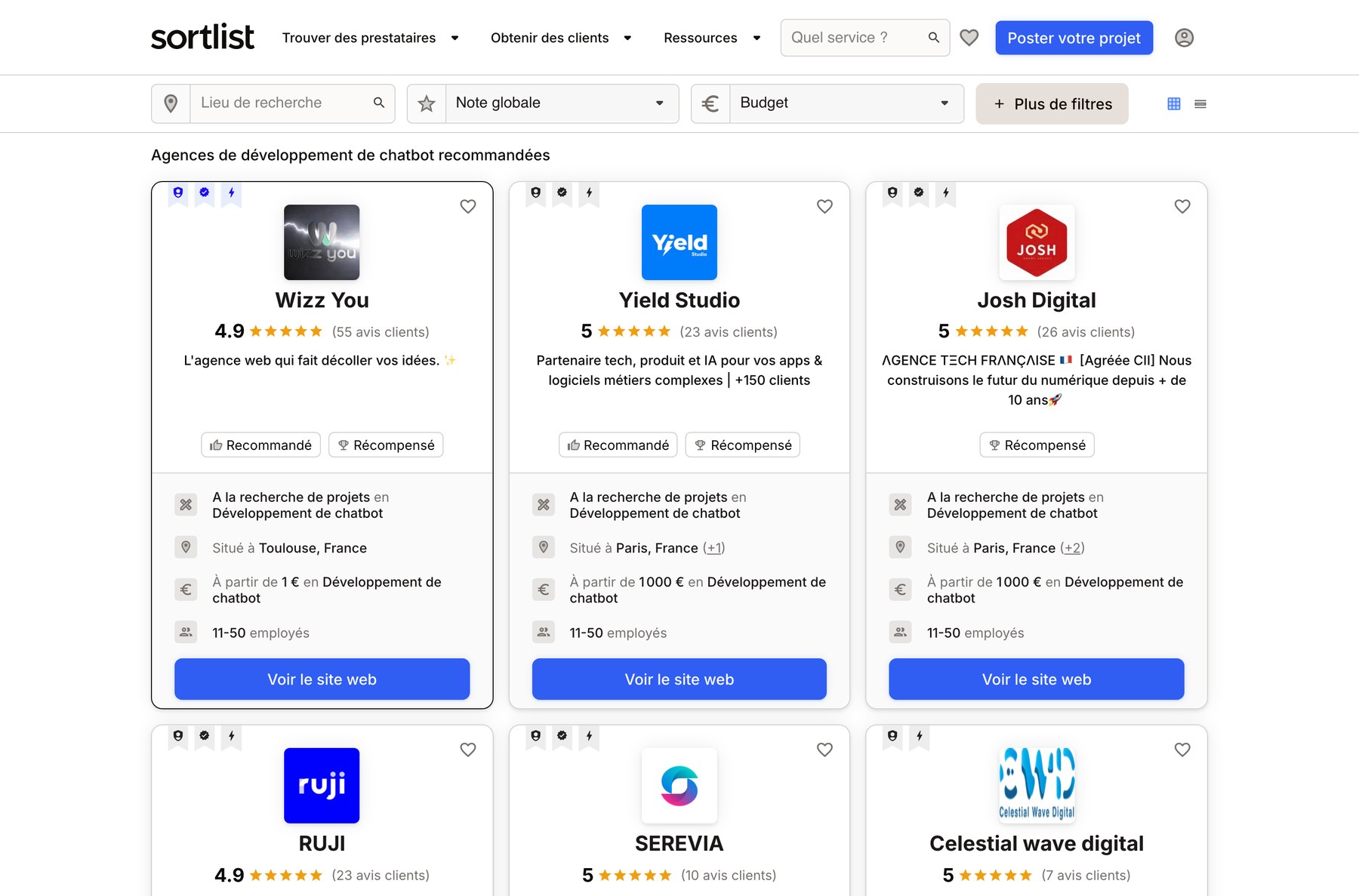
On the agency directory Sortlist, the French agencies listed under chatbot development most often show an entry budget of “from €1,000”. Those floors are self-declared: they exist to attract quote requests, not to describe a complete project.
AI credits. Every generated answer burns tokens billed by the model provider. On a high-traffic bot, that line overtakes the subscription fast. Content updates. A price changes, a procedure evolves: someone has to fix the knowledge base, every month. Integrations. Plugging into a proprietary CRM often costs more than the whole rest of the chatbot.
Estimator: agency, freelancer, platform or vendor?
Six questions about the real scope of your project. The tool works out the matching level, a market budget range and an indicative timeline, then recommends the most coherent of the five routes. The figures are orders of magnitude collected from third-party providers, not a quote.
What level of project do you actually have?
1. What should the chatbot do?
2. What information should it rely on?
3. On how many channels?
4. Which connections to your tools?
5. Who will look after it on your side?
6. What compliance constraints?
Recommended route: the no-code platform, on your own
Your project fits inside a no-code tool. Any provider, us included, would mostly bill you for assembly time that you can put in yourself in two or three days. Start with a narrow scope (the ten most frequent questions), put it live, then widen it based on real conversations.
Recommended route: the no-code platform, with a hand on the scoping
You have a genuine need for AI on your content, but no heavy technical complexity. The best result-to-price ratio is a platform you keep in your own hands, plus a few days of support on the scoping, the knowledge base and the first integration: a freelancer, or the platform vendor’s own experts. Keep the account in your name.
Recommended route: a build by the vendor’s team, on a limited scope
The complexity justifies delegating the build, but not necessarily leaving the platform. Having the bot built by the experts who publish the tool (here, the Enterprise plan, on quote) removes the middleman and hands you back the keys in the no-code editor the day it ships. A third-party agency is still the right call when the project demands very specific industry expertise, or has to go through an integrator already working with you. Either way: one measurable use case first, with reversibility in writing.
Recommended route: a paid scoping phase, then a build by the vendor’s team
Heavy integrations, multichannel, compliance: this is an information systems project, not a widget. Start with a paid scoping phase, kept separate from development (a few thousand euros), which leaves you free to choose another provider afterwards. For the build, the vendor’s Enterprise plan (on quote) removes one link between you and the platform; a third-party agency keeps all its value if you need an on-site team, a highly specialized industry skill set, or the integrator already installed at your company.
Indicative market ranges, built from the public rate cards of French providers collected in July 2026. They match no Botnation price: our Enterprise plan is “custom”, so it is priced on quote. A quote always depends on your own context.
Agency, freelancer, platform, vendor or in-house team?
The word “agency” covers only one of the five ways to get a chatbot. Compare them on what really counts: the time before you go live, who keeps control, and what happens when you want to change something.
| Criterion | No-code platform | Platform + vendor’s team | Freelancer | Agency | In-house team |
|---|---|---|---|---|---|
| Starting budget | €0 to €700/year | On quote, Enterprise plan | €1,000 to €6,000 | €8,000 to €100,000 | Salary cost |
| First bot live | 2 to 5 days | Depends on the scope in the quote | 1 to 3 weeks | 6 to 12 weeks | Varies |
| Who edits an answer | You, in one minute | You, in the same editor | You, or they do on a retainer | The run contract | You |
| Lock-in | Low | Low: nothing custom-built | High, on one person | Varies with the contract | None |
| Good for | FAQ, leads, appointments, 1 to 2 channels | Complex project, no internal time, kept in your hands | A first AI bot with one integration | Information systems, multichannel, formal tenders | Strategic, permanent use |
| Main risk | The internal time never appears | Scope bounded by the platform | The freelancer becomes unavailable | Cost, slowness, loss of control | Fixed cost that is hard to absorb |
An agency is the right call when…
- The bot has to read from or write to an internal system (ERP, business tool, in-house API).
- You need to cover three channels or more, with a consistent experience.
- The subject is sensitive: healthcare, finance, personal data, regulated industry.
- You are going through a formal tender and need a partner who commits contractually.
- Nobody in-house can spend any time on it, however little.
- You need an outside audit of your existing journeys before you decide.
It is not when…
- Your need fits into an FAQ, an appointment booking or a conversational form.
- You first want to test whether your visitors will even use a chatbot.
- Your content changes often: every edit would go through a quote.
- The quote does not separate scoping, build and run.
- The agency refuses to give you access to the platform account.
- Your total budget is under €3,000: you would be funding sales effort, not a product.
The useful shortcut: an agency mainly sells integration and taking the project off your hands. If your project needs neither, you are paying a premium for work the platform already does. And if it needs the second without needing the middleman, the next section describes the fifth route. To frame your need before you call anyone, our guide to the three main types of chatbot will stop you from ordering an over-engineered system for what is really an FAQ.
The fifth route: have the platform vendor build your chatbot
Between “I build the whole thing myself” and “I hand the whole thing to an agency”, there is a route the comparisons almost always forget: asking the team that publishes the platform to build the chatbot. That is what Botnation offers with its Enterprise plan and its chatbot creation experts, our botmakers, in-house. We are judge and jury on this point, so here is exactly how it works, and you can judge on the evidence.
The principle fits in one sentence: the chatbot is built by specialists, but it is built inside the no-code editor you will be using after delivery. No custom code to take over, no proprietary component to maintain, no purchase order to fix one sentence.
The seven deliverables, vendor version
Let us take the seven deliverables of an agency project described above, one by one. The exact scope is always set in the quote: this table describes how the roles split, not a contractual commitment.
| Deliverable | Handled by the vendor’s team | What stays on your side |
|---|---|---|
| Scoping | Yes, with a dedicated account manager, on the scope agreed in the quote. | The real use cases and the success metrics. |
| Conversation design | Yes: structure of the journeys, tone, fallback messages, handover to a human. | Signing off on the tone and the sensitive messages. |
| Knowledge base | Yes: collection, structuring, wiring into the answer engine. | The raw material: procedures, prices, terms, real answers. |
| Integrations | Within the limits of the platform’s connectors and the scope of the quote. | Opening up access to your tools. |
| Deployment | Yes, on the channels the platform covers; unlimited chatbots on the Enterprise plan. | Acceptance testing before you open to the public. |
| Run | Premium client support, analytics and updates included in the plan. | The weekly read-through of conversations: nobody can do it for you. |
| Handover | Personalized onboarding, though there is nothing to “hand over”: the bot lives in the no-code editor, on your account. | Actually using it. |
What changes compared with a third-party agency
No middleman
The team that builds is the team that writes the platform. A product limitation, a missing connector, an unexpected behavior: it gets handled internally, not through tickets bouncing between you, the agency and the vendor.
No dependency after delivery
The bot rests on no custom development. Adding an answer, correcting a price or plugging in another channel depends neither on a quote nor on a provider’s availability.
The account is yours from day one
The ownership, reversibility and account access clauses detailed below do not have to be wrung out of a negotiation: your journeys and your knowledge base live in your account, exportable, exactly as in self-service.
What it does not replace
Highly specialized industry expertise, an on-site team, an integrator already installed at your company, or a need that falls outside the platform’s scope: in those cases a third-party agency is still the right choice, and we will tell you so.
How you get it, and what it costs
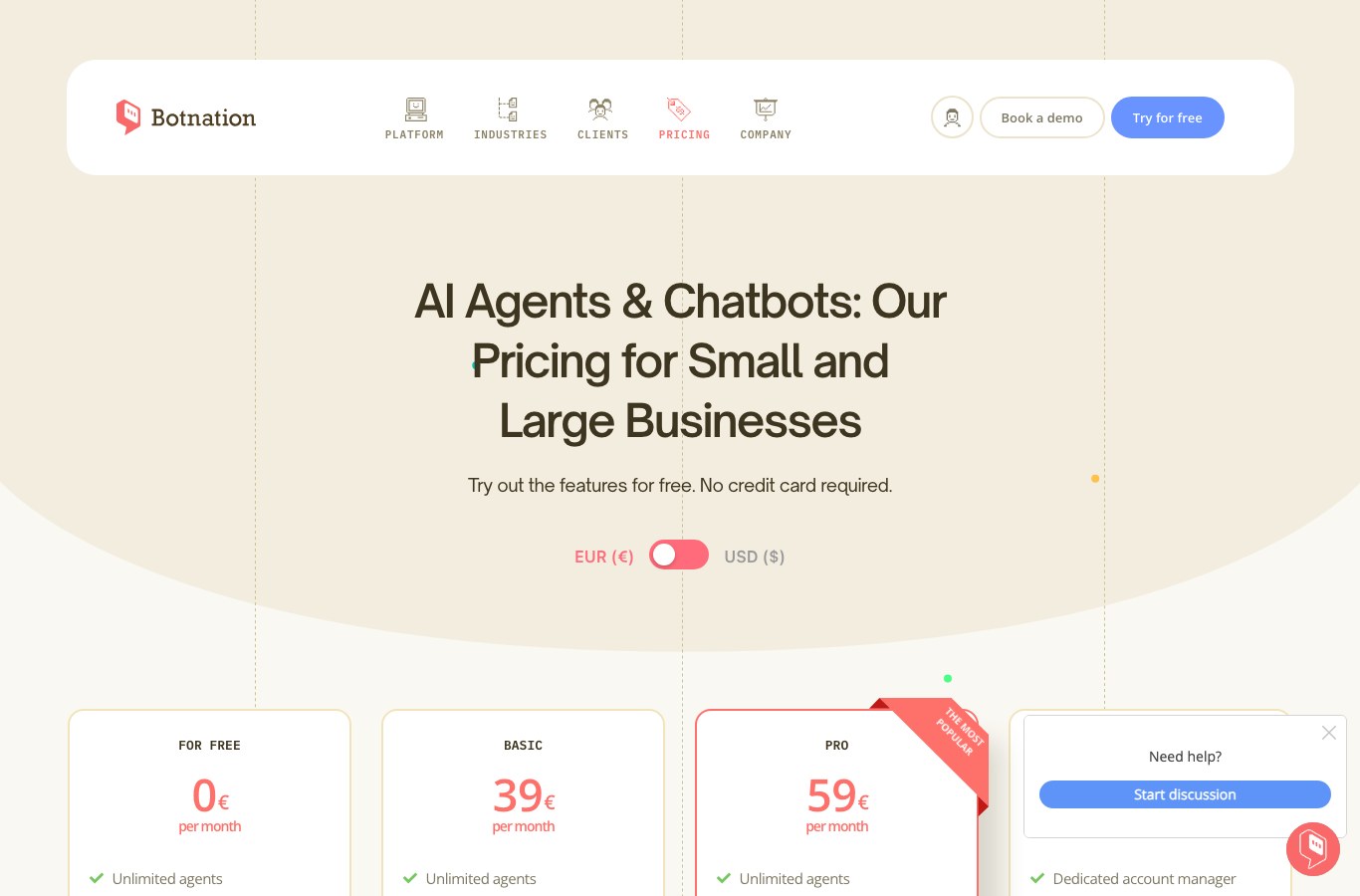
Let us be precise about what is public and what is not. The self-service plans are published: €0 for the Free plan, €39 per month for Basic, €59 per month for Pro. A build by our experts falls under the Enterprise plan, listed as “custom”: it is priced on quote, because the price depends on the number of journeys, the integrations and the volume, exactly as at an agency.
We publish neither a price nor a timeline for custom builds, and we are not going to invent one in an article that criticizes agencies for hiding theirs. The ranges quoted above are market figures, collected from third-party providers: do not transpose them to our offer. The only honest answer here is a quote drawn up on your own scope.
Three ways in, depending on what you are looking for: the pricing page, where the Enterprise plan opens onto “Contact sales team”; the quote request form for the creation of your chatbot; or the contact page, where our chatbot creation experts answer directly online, and by phone at +33 9 74 59 58 72 (standard rate).
Have your chatbot built by the team that publishes the platform
Describe your scope and we come back to you with a quote. The bot is built in the no-code editor: on delivery, the account, the journeys and the knowledge base are yours.
How to choose an AI chatbot agency: 8 criteria
Sales pages all look the same. These eight criteria, on the other hand, cleanly separate the serious providers from the sellers of promises. To get a feel for what a good chatbot actually produces, start by browsing our twelve examples of chatbots in production: you will know what to ask to see.
Live bots you can test
Ask for three URLs of chatbots in production, not screenshots. Ask them an awkward question. You will learn more in five minutes than from ten pages of references.
A written scoping method
A serious agency sends you its workshop framework before talking price: priority use cases, metrics, what is deliberately out of scope. Without that, the quote is a bet.
How the bot is fed
Answers written by hand, or generated from your documents? Both are defensible, but the maintenance costs are nothing alike. Get it in writing.
The technical foundation
Off-the-shelf platform or custom development? Custom code costs more, ages worse and ties you long term to the agency that wrote it.
The cost of AI tokens
Who pays for the calls to the language model, at what price, with what cap? An agency that resells tokens without a rate card is keeping an adjustment lever at your expense.
Hosting and GDPR
Where do the conversations live, for how long, with which subprocessors? Demand a data processing agreement and the list of hosts, including the one running the language model.
Measurement
Answer rate, escalation rate to a human, unresolved questions, satisfaction. If the agency offers no dashboard, nobody will ever know whether the project worked.
Skills transfer
At the end of the project, will you be able to correct a wrong answer without an email and a purchase order? If the answer is no, the real cost of your chatbot is not the one on the quote.
The ten questions to ask before signing
- Who owns the journeys, the knowledge base and the conversations?
- Which platform is the bot built on, and is the account in my name?
- What happens if I end the contract in six months? What can I take with me, and in what format?
- What is included in maintenance, and what triggers an extra quote?
- How much does it cost to add a new journey after launch?
- Who pays for the language model tokens, and at what rate?
- Where is the data hosted, and for how long?
- Which metrics will be tracked, and how often do we review them together?
- Can I talk to two clients with a project comparable to mine?
- What scope are you refusing to cover in version 1?
The tenth is the most revealing. A provider who agrees to everything has scoped nothing; the one who says no on two or three points has understood the project. Our ten most common chatbot creation mistakes will give you more angles for that meeting.
A fixed-price quote with no scoping workshop first. The phrase “autonomous AI agent” without a single action actually being demonstrated. A refusal to give access to the platform account. No mention of AI tokens in the price. And a quantified automation rate promised before anyone has read your conversations.
The contract: six clauses not to let slide
This is the part nobody reads, and the one that decides everything two years later, the day you want to change provider.
| Clause | What to insist on |
|---|---|
| Ownership | The journeys, the knowledge base and the content produced belong to you unconditionally, including if the contract ends. |
| Reversibility | Export of the journeys, the knowledge base and the conversation history, in a readable format, at any time and at no cost. |
| Accounts and access | The platform account is opened in your company’s name, with an administrator on your side. The agency is invited, not the owner. |
| Cost of AI | The token price, any markup the agency adds and a monthly cap, in writing. |
| Maintenance | The explicit line between fixes (included) and changes (billed), with a response time. |
| Personal data | A data processing agreement under Article 28 of the GDPR, the hosting location and the retention period for conversations. |
Article 50 of the European AI Act requires that anyone interacting with an AI system be informed of it, “unless this is obvious” to a reasonably observant user. That transparency obligation applies from August 2, 2026 and covers every consumer-facing chatbot, whatever the size of the company. In practice: your bot has to say it is an AI in its very first message. Check that your provider has planned for it, and that the disclosure is not billed as an option.
Beware the calendar mix-up. The Digital Omnibus, adopted by the European Parliament on June 16, 2026 and confirmed by the Council on June 29, did push some deadlines back, but not this one: the obligations for Annex III high-risk systems move to December 2, 2027, and those of Annex I to August 2, 2028, while Article 50 still applies from August 2, 2026. Only the machine-readable marking of generated content gets an extension, until December 2, 2026, and only for systems already in service. A provider who tells you that “everything has been postponed” is reading the wrong text.
The penalty figures are just as often wrong. A breach of Article 50 falls under a cap of €15 million or 3% of worldwide annual turnover, whichever is higher (whichever is lower for an SME). The €35 million and 7% figures doing the rounds apply to the prohibited practices of Article 5, not to a transparency obligation.

Doing without an agency: the no-code route in five steps
If the estimator pointed you to level 1 or 2, here is the shortest path. It calls for no technical skill, and it has the advantage of producing real data before any heavy investment.
- List your twenty most frequent questionsPull them out of your inbox, your chat and your phone line. Those are the ones that cover most of the volume, not the rare cases that keep you up at night.
- Pick a scope you know you can handleA chatbot that is excellent on ten questions beats a mediocre one on a hundred. Write down what the bot will not do, and who it hands over to.
- Feed it your contentImport your website, your documents or a simple file of questions and answers. That work, not the choice of model, is what determines the quality of the answers. Our guide to training a chatbot on your own data walks through the method.
- Go live on a single channelYour website first. Messaging apps come once the answers are stable. Adding a channel takes a few minutes; repairing a bad reputation takes months.
- Read the conversations every weekThirty minutes a week is enough to spot the missed questions and fix them. That is exactly the work an agency bills inside its run retainer.
On the question of return on investment, better to decide on numbers than on a sales promise: our chatbot versus form comparison quantifies the conversion gaps actually observed, with the studies to back them up.
And if you want both?
That is exactly the fifth route described above: the platform stays in your name, but the vendor’s experts build the chatbot. At Botnation that comes under the Enterprise plan (dedicated account manager, personalized onboarding and chatbot creation management), while the self-service plans run from €0 to €59 per month with no commitment. The right reflex: build the simple version yourself first, and you will know exactly what to have priced in the quote.
Build a simple version in-house first, imperfect as it may be, before you consult agencies. You will walk into the meeting with real conversations, a rate of unresolved questions and a quantified scope. The quotes you get back will be more precise, often cheaper, and you will spot the one selling you a scoping phase you have already done.
Frequently asked questions
How much does an AI chatbot cost?
From €0 to more than €100,000, depending on the level. An FAQ widget built on a no-code platform costs between €0 and €60 per month. An AI chatbot fed with your content, with one or two integrations, runs between €40 and €300 per month plus €1,000 to €3,000 of optional support. A scoped agency project starts around €8,000 of setup, and a chatbot wired into the information system frequently passes €30,000.
Do you really need an agency for an AI chatbot?
No. It becomes useful when the bot has to connect to an internal system, cover several channels, meet strict regulatory constraints, or when nobody on your side can follow the project. And even then: in that last case, the platform vendor can build it for you without adding a middleman. For an FAQ, lead qualification or appointment booking, a no-code platform produces the same result in a few days, for a fraction of the price.
Can the platform vendor build your AI chatbot for you?
Yes, and it is often the shortest path when the project is complex but fits inside a platform. At Botnation, the Enterprise plan includes chatbot creation management, a dedicated account manager and personalized onboarding: our experts build the bot, then you take it over in the no-code editor, on your own account. The price is “custom”, so it is set by quote, exactly as at an agency. The difference is that there is no middleman between you and the platform.
How long does it take to build an AI chatbot?
Two to five days for an FAQ bot built in-house. One to four weeks for an AI chatbot fed with your documents. Six to twelve weeks for an agency project on a scoped perimeter: the French agency Webotit advertises 8 to 12 weeks to launch a first scope. Beyond that, count three to nine months for a rollout wired into the information system.
Agency or freelancer: which one should you pick?
A freelancer costs two to five times less and often moves faster on a simple scope, but you depend on one single person for maintenance. An agency brings a team, continuity of service and a contact who commits contractually, which becomes decisive as soon as there are integrations, a formal tender or compliance requirements. On a first project under €5,000, the freelancer is almost always the better result-to-price ratio.
Who owns a chatbot created by an agency?
That depends entirely on the contract, and the default is not always in your favor. Insist in writing that the journeys, the knowledge base and the conversations belong to you, that the platform account is opened in your company’s name and that export is possible at any time. Without those three lines, changing provider means rebuilding everything.
Does a chatbot have to say it is an artificial intelligence?
Yes, in the European Union. Article 50 of the AI Act requires informing people that they are interacting with an AI system, unless that is obvious to a reasonably observant user. The obligation applies from August 2, 2026, with no company size threshold. A simple line in the bot’s first message is enough to comply.
How do you find a serious AI chatbot agency?
Specialized directories (Sortlist, HelloDarwin) let you filter by location, size and budget, but the ratings there are self-declared. The best filter stays operational: ask for three chatbots in production that you can test yourself, two client references on a comparable project, and the written framework of their scoping workshop. Three requests that eliminate half the candidates in a week.
How much does AI chatbot maintenance cost?
Between €500 and €2,000 per month at an agency for a custom project, according to the rate cards published by French providers. On a no-code platform, maintenance comes down to the subscription (€0 to €60 per month) plus the AI credits consumed, with the update work done in-house. Either way, budget at least half a day a month to read back through the conversations.
What to take away
“AI chatbot agency” does not name a product, it names a way of buying, one of five. Before comparing providers, compare the routes: most FAQ, lead qualification and appointment booking needs are handled in a few days on a no-code platform, for the price of one lunch a month.
When the agency is justified (integration with the information system, multichannel, strong compliance requirements), three rules are enough to avoid nasty surprises: have a scoping phase separate from development paid for and delivered, limit version 1 to a single measurable use case, and lock down ownership, reversibility and account access before you sign.
And ask the middleman question before signing: if your project fits inside a platform, having it built by the team that publishes that platform removes a link in the chain, leaves the account in your name and hands you the editor from the day it ships. On our side, that is the Enterprise plan, on quote.
And in every case, the quality of your chatbot will depend less on the provider than on the material you give it: your real questions, your real answers, reviewed every week.
Test it, or have it built
Build a first AI chatbot on your own content in a few hours, free and with no credit card. Or hand the build to our chatbot creation experts, in the same editor, on quote. Either way, you are the one who keeps control afterwards.
Sources. Public rate cards collected on July 27, 2026: IA Agency (AI chatbot quote), YouFeel, Yield Studio, Webotit, Radiank, the Sortlist directory. Transparency obligation: Regulation (EU) 2024/1689 on artificial intelligence, Article 50, applicable from August 2, 2026; Digital Omnibus adopted by the European Parliament on June 16, 2026 and confirmed by the Council on June 29, 2026, which postpones the “high-risk” obligations without touching Article 50; penalty cap in Article 99. Botnation plans recorded on July 27, 2026 on the pricing, chatbot quote and contact pages; the Enterprise plan is shown there as custom, with no public price or timeline. The ranges quoted are market orders of magnitude and do not replace a quote.