



- A chatbot for the air transport industry is not about answering practical questions faster: it is about absorbing the contact spikes that a disruption triggers within hours, when phone lines and inboxes explode.
- Passengers are already equipped for this channel: 78% say they are willing to pay for end-to-end baggage services and over half of travelers want to deal directly with their airline (SITA 2025, IATA 2025).
- The law frames the response window: Regulation EC 261/2004 requires airlines to inform every passenger of a cancelled flight or a delay of at least two hours, and the EU AI Act has required, since August 2, 2026, telling people they are talking to a bot.
- On the budget side, the no-code route starts at €0 (Botnation’s Free plan), the grid moving up to €39 then €59 per month, while custom builds remain quoted on demand.
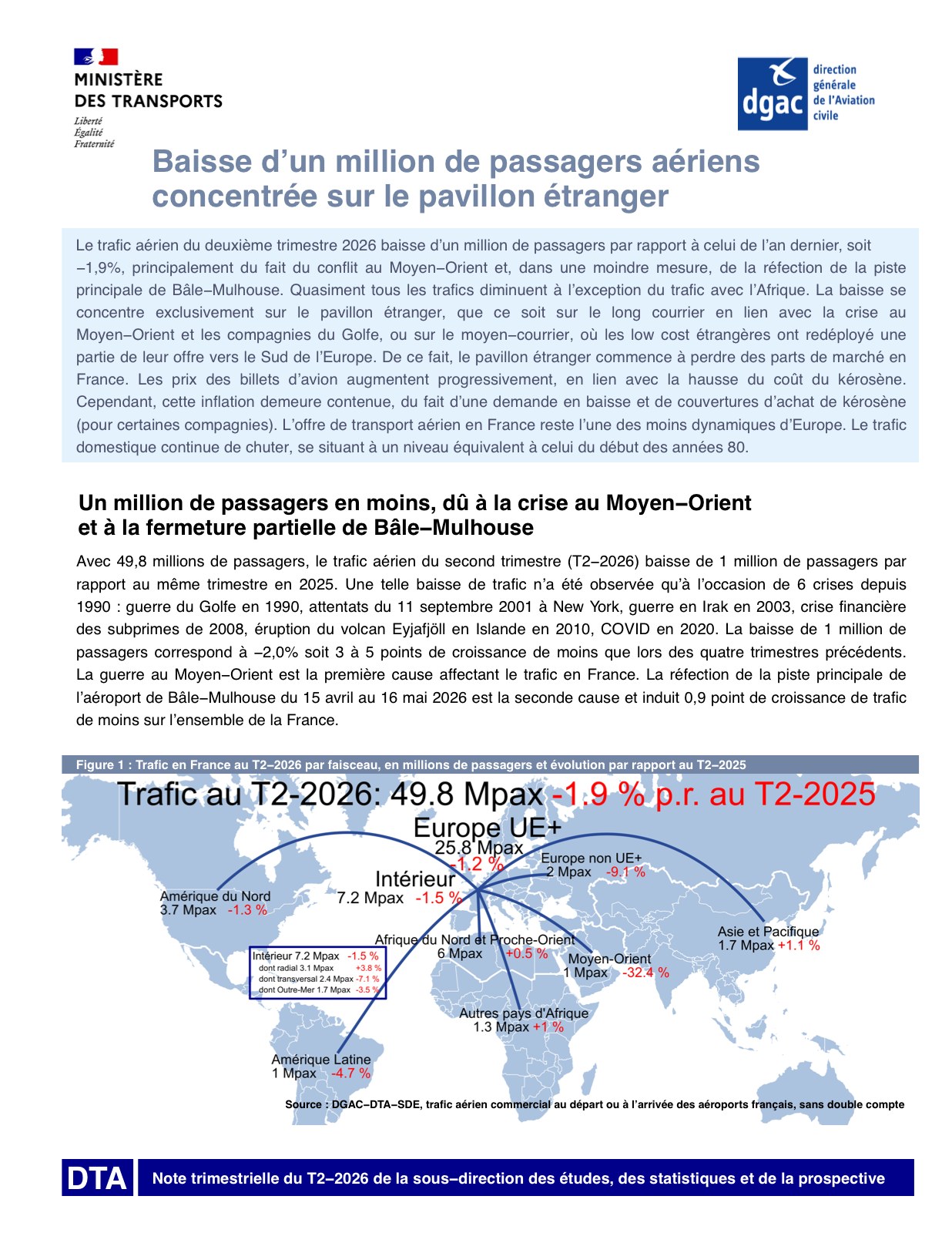
A flight gets cancelled because of a storm, and within the hour several thousand passengers want the same thing at the same time: to know whether their flight is leaving, where to spend the night, and who refunds what. French airports handled 49.8 million passengers in the second quarter of 2026 alone, and the DGAC, which publishes that figure, also notes that domestic traffic in France has fallen back to its early-1980s level (Q2 2026 quarterly note, retrieved September 7, 2026). Demand contracts and shifts; contact volume, however, never spreads itself out. It arrives in waves.
This is where the chatbot changes nature. On an e-commerce site, a bot handles a steady flow of questions. In aviation, it absorbs brutal variance: two quiet weeks, then a weather disruption that multiplies inbound requests tenfold in a single morning. A call center staffs for the average and suffers at the peak; a conversational agent sizes for the peak at no marginal cost. Provided you know precisely where the line sits between what the bot closes on its own, what requires a transactional integration, and what must escalate to a human with the right attachments.
This article reviews the whole topic with industry figures: what passengers expect, the seven use cases that pay off, the technical boundary (PNR, DCS, APIs), the legal information duties, field evidence such as Air Caraibes’ Camille assistant, a contact-spike simulator you can run with your own volumes, and a real cost grid.
Air transport, the champion of contact spikes
The first characteristic of the sector fits in one sentence: demand for air travel is volatile, and demand for contact is even more so. The DGAC quarterly note covering Q2 2026 describes a one-million-passenger drop in three months, attributed to the Middle East crisis and the partial closure of Basel-Mulhouse, and compares that decline to only six crises since 1990, from the Gulf War to the Eyjafjoll eruption. For an airline customer service team, each such episode is an explosion of contacts concentrated within a few hours: cascading delays, stranded connecting passengers, diverted baggage.
Second characteristic: the industry has already invested massively in AI, which changes the question asked of the chatbot. In its Air Transport IT Insights 2025 survey, SITA reports that 83% of airlines use AI for operational decisions and passenger services, and that 51% use it to predict delays and disruption, within an annual IT spend of about 36 billion dollars. Predicting the disruption is well on its way to being industrialized; answering the passengers it upsets remains the link that overflows.
Third characteristic, the most important one for what follows: in aviation, a late answer is not just a poor customer experience, it is a missed legal obligation. European regulation requires informing the passenger of a cancelled flight or a delay of at least two hours, with specific content. We come back to this below, because it is what turns a chatbot project into a compliance project.
What passengers accept (and refuse) in 2026
Passenger surveys published since the fall of 2025 converge: travelers are equipped, mobile, and asking for self-service, with one caveat that deserves a close reading of the numbers.
SITA’s Passenger IT Insights 2025 survey (“The Travelers’ Voice”, published on October 6, 2025 from more than 7,500 passengers surveyed in 25 countries) measures that 78% of passengers would be willing to pay for end-to-end baggage services, and that nearly 80% would accept storing their passport on their phone. The same survey has two travelers out of three asking for faster airport processing. The demand is there, including on the commercial side.
The 2024 IATA Global Passenger Survey (published on October 30, 2024) adds a decisive data point for the conversational channel: 70% of passengers would be more likely to check in a bag if they could do so in advance, and they set tight time ceilings: 74% allow at most 45 minutes before boarding with a checked bag, and 70% allow 30 minutes without one. The 2025 edition of the same survey (November 5, 2025, over 10,000 respondents in more than 200 countries) adds that 54% of travelers want to deal directly with their airline, and that half of passengers have already used biometrics at an airport.
The correct reading of these three figures is not “passengers want a chatbot”. It is: passengers want tasks done (checking in, tracking a bag, being notified), on their phone, without queuing. The bot is the cheapest channel to give them that, but it is judged on the task completed, not on the conversation. An assistant that chats without closing the ticket is one more cost.
The seven use cases that pay off
Cross-referencing the passenger expectations above with what airlines actually deploy, seven use cases stand out. Their common point: each one replaces a queue or an inbound call with a measurable automated task.
| Use case | What the chatbot does | Entry condition |
|---|---|---|
| Flight status and boarding gate | Reports departure, gate and delay; sends a proactive notification as soon as things change | Flight status data feed (airline or handler API) |
| Check-in and boarding pass | Guides check-in, reminds passengers of slots, resends the boarding pass link | Light link to the existing check-in journey |
| Baggage before the flight | Explains the rules, sells the baggage option, confirms bag check-in | FAQ + online payment |
| Delayed or damaged baggage | Takes the declaration, issues a file number, keeps the passenger informed | Connection to the baggage tracing system (WorldTracer type) or substitute procedure |
| Claims and passenger rights | Qualifies the request, gathers the documents, writes up and routes the file | EC 261 rules frozen in the knowledge base + human escalation |
| Airport services | Answers on PRM assistance, parking, lounges, minimum connection times | Up-to-date editorial content |
| Loyalty program | Checks the miles balance, explains redemptions, sends offer reminders | Program connection or member identification |
Two of these use cases (flight status, baggage) gain from being designed as outbound notifications rather than inbound questions: the bot contacts the passenger when the flight changes or the suitcase is found. Half of airlines plan to give passengers real-time baggage updates anyway, according to SITA’s Baggage IT Insights 2026 report (20th annual edition, 2025 data). A conversational agent covers both directions of the flow within the same scenario count, which is the real economy of the model: the same “baggage” scenario serves the inbound question and the outbound notification.
To place these use cases in the broader transport landscape (rail, bus, logistics), our article on the transport chatbot details the sector’s six typical missions, including the SNCF passenger-messaging case; this article focuses on aviation specifics. For travelers as such, the logic is close to the tourism chatbot, with one extra regulatory constraint.

The transactional boundary: PNR, DCS and integrations
Here is the distinction that separates a project achievable in weeks from a months-long build. A bot can inform without touching the airline’s systems: it reads a knowledge base, schedules, rules. It enters the transactional zone as soon as it must write somewhere: issuing a ticket, modifying a PNR (the booking reference), reissuing after a change, filing a claim with contractual value.
That write goes through specific systems: the PNR lives in the reservation system, flight operations in the DCS (the departure control system), baggage in ground-handling tracing systems. No chatbot vendor “drives” those systems for you: the bot connects to them through APIs or webhooks, where an opening exists, or stays in delegation mode where it does not, meaning it assembles the complete request and hands it over to the entitled team.
On this point, honesty beats a promise: a no-code platform like Botnation covers information, qualification and notification use cases on its own, with the API connectors available in the catalog. For a bot to actually issue or modify a ticket, you need an integration project with the airline’s systems, run with the IT teams and, most often, a scoping phase first: this is exactly what Botnation’s Enterprise offer takes on, quoted on demand, from design to build. The dividing line is easy to set in committee: read-only first, write later, never the other way around.
If your technical team wants to see what such a connection looks like, our article on the chatbot webhook shows the mechanism step by step, reusable to connect a bot to an internal flight-status or baggage API.
Start with read-only intents: flight status, gates, baggage rules, airport services, loyalty lookup. They account for most inbound contacts and require no write into the PNR. The well-built EC 261 claim comes next, in delegation mode first.
Delays and cancellations: what the law requires you to communicate
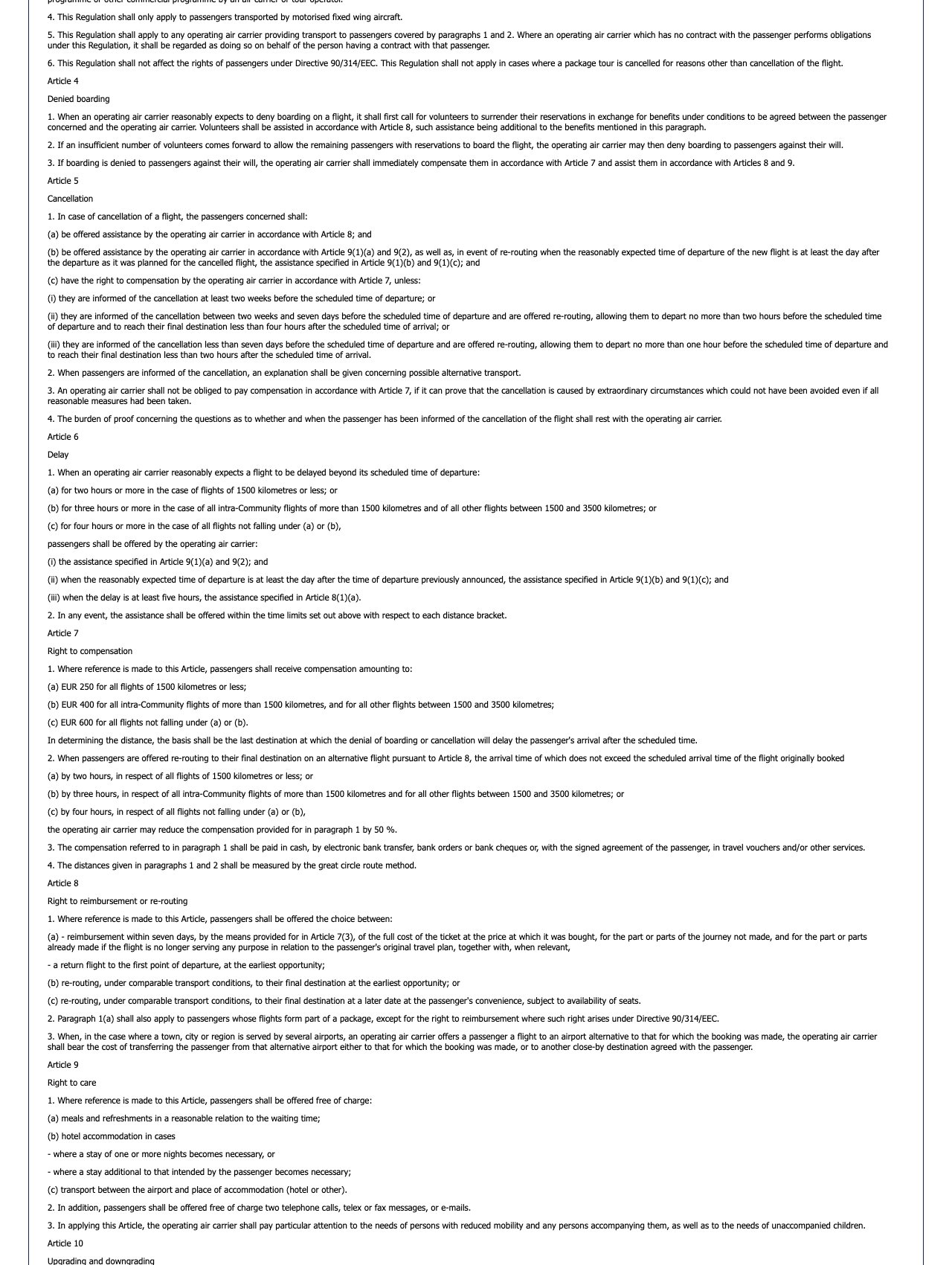
In few industries is the duty to inform as precise as in European aviation. Regulation (EC) No 261/2004 of February 11, 2004, applicable as such in every Member State, sets three blocks of rights, two of which directly concern communication.
First block, information itself. Article 14 requires a notice to be displayed at check-in, with wording written by the regulation itself:
“If you are denied boarding or if your flight is cancelled or delayed for at least two hours, ask at the check-in counter or boarding gate for the text stating your rights, particularly with regard to compensation and assistance”.
The same Article 14 requires the air carrier that cancels a flight, or suffers a delay of at least two hours, to hand each affected passenger a written notice setting out the rules for compensation and assistance, together with the contact details of the national enforcement body. Second block, care (Article 9): meals and refreshments in reasonable relation to the waiting time, hotel accommodation when an extra night is necessary, transport between the airport and the hotel, plus two free phone calls or electronic messages, with particular attention to persons with reduced mobility and unaccompanied children. Third block, the fixed compensation (Article 7), whose amounts depend on flight distance and can be halved when a fast re-routing is offered.
| Flight distance | Fixed compensation (Article 7) |
|---|---|
| 1,500 kilometers or less | EUR 250 |
| Intra-Community flights over 1,500 km and other flights between 1,500 and 3,500 km | EUR 400 |
| Beyond (all other flights) | EUR 600 |
Those amounts are reduced by 50% when the offered re-routing arrives within a bounded delay (two, three or four hours depending on distance), and compensation can be excluded if the airline proves the cancellation stems from extraordinary circumstances, a notion strictly framed by case law. This is precisely why a chatbot can relay these rules without risk: it recalls the thresholds, it does not rule on the file.
The bot relays information and helps assemble the file; it does not decide compensation or whether a circumstance is extraordinary. Those decisions stay human and documented. A bot that “computes” an entitlement to compensation based on circumstances it has not verified creates legal risk, not a service.
Second legal layer, more recent: Regulation (EU) 2024/1689 on artificial intelligence, whose Article 50(1) has applied since August 2, 2026. It requires that people interacting with an AI system intended to dialogue directly with them be informed of that interaction, unless it is obvious to a reasonably attentive person. In practice: a clear “you are talking to an automated assistant” mention at the start of the conversation, and a simple path to a human. The official English wording of the Official Journal keeps it as a design requirement: AI systems must be designed and developed “in such a way that the natural persons concerned are informed that they are interacting with an AI system”.
Air Caraibes, SITA: what the field already measures
The industry is past the confidential-pilot stage, and two sets of published facts show it.
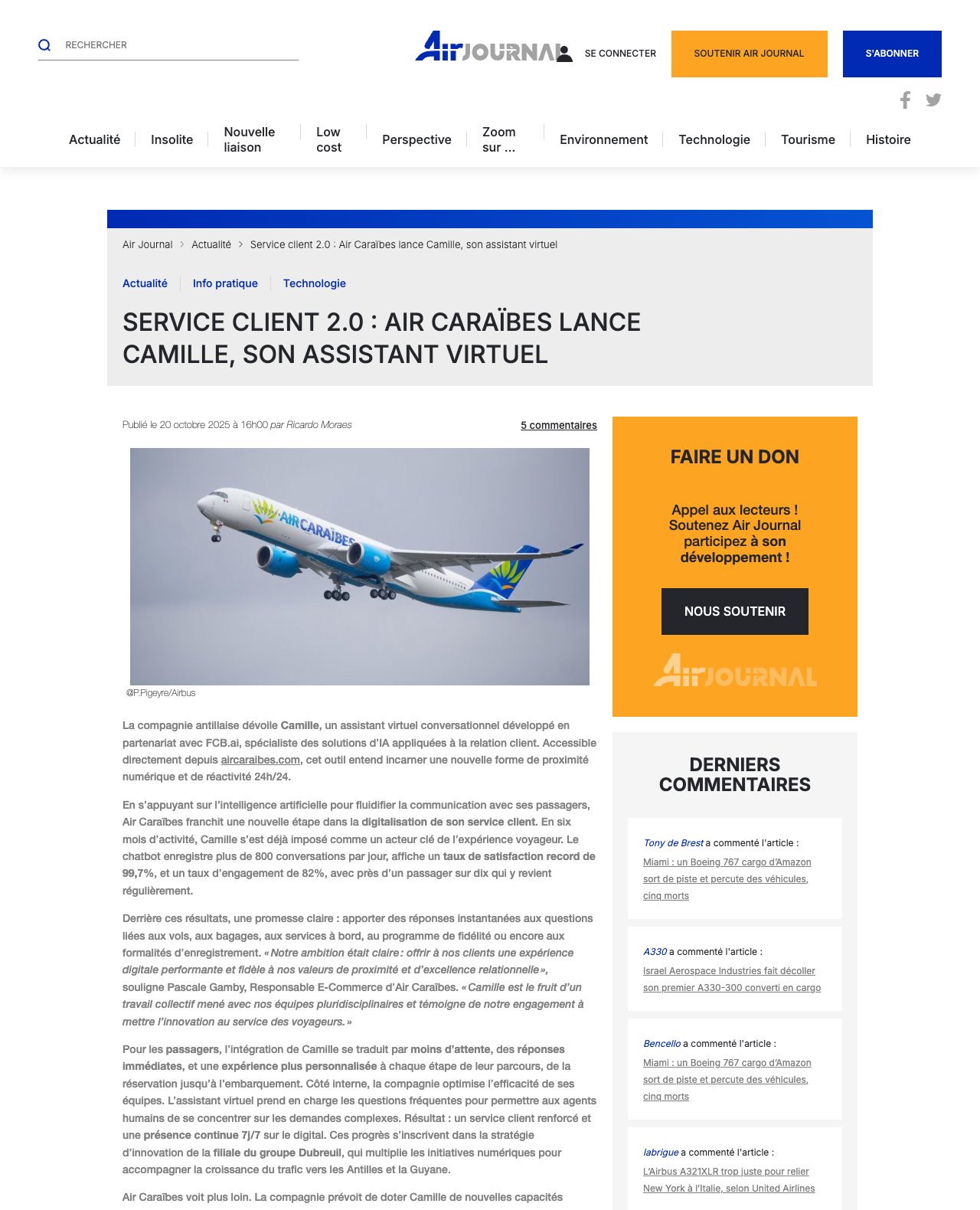
First example, a French one: Air Caraibes has deployed an assistant named Camille on its website, built with specialist FCB.ai. Relaying the airline’s announcement on October 20, 2025, Air Journal reports that after six months of operation Camille handles more than 800 conversations a day, with a claimed satisfaction rate of 99.7% and an engagement rate of 82%, with 24/7 availability on digital channels. The topics covered are exactly those of our use-case table: flights, baggage, onboard services, loyalty program and check-in formalities, with the stated goal of freeing human agents from frequent questions so they can focus on complex requests. The last two figures are company claims, not independent measurements; they stand as the order of magnitude of a successful deployment at a mid-size airline.
Second series, the industry’s baggage measurement, the best tracer of operational irregularity. SITA’s Baggage IT Insights 2026 report, the 20th edition of the industry benchmark, puts 2025 numbers as follows: a mishandled baggage rate down 23% over the year, still 24 million suitcases mishandled for about 5 billion passengers, and a cost of 6.3 billion dollars a year, that is 260 dollars per affected bag. The report translates that cost into management language: with an average net profit of 8 dollars per passenger, a single mishandled bag wipes out the profit of more than thirty seats sold. Transfers remain the leading cause (39% of cases in 2025), and the report notes that three airlines in four plan to invest in AI over the next two years.
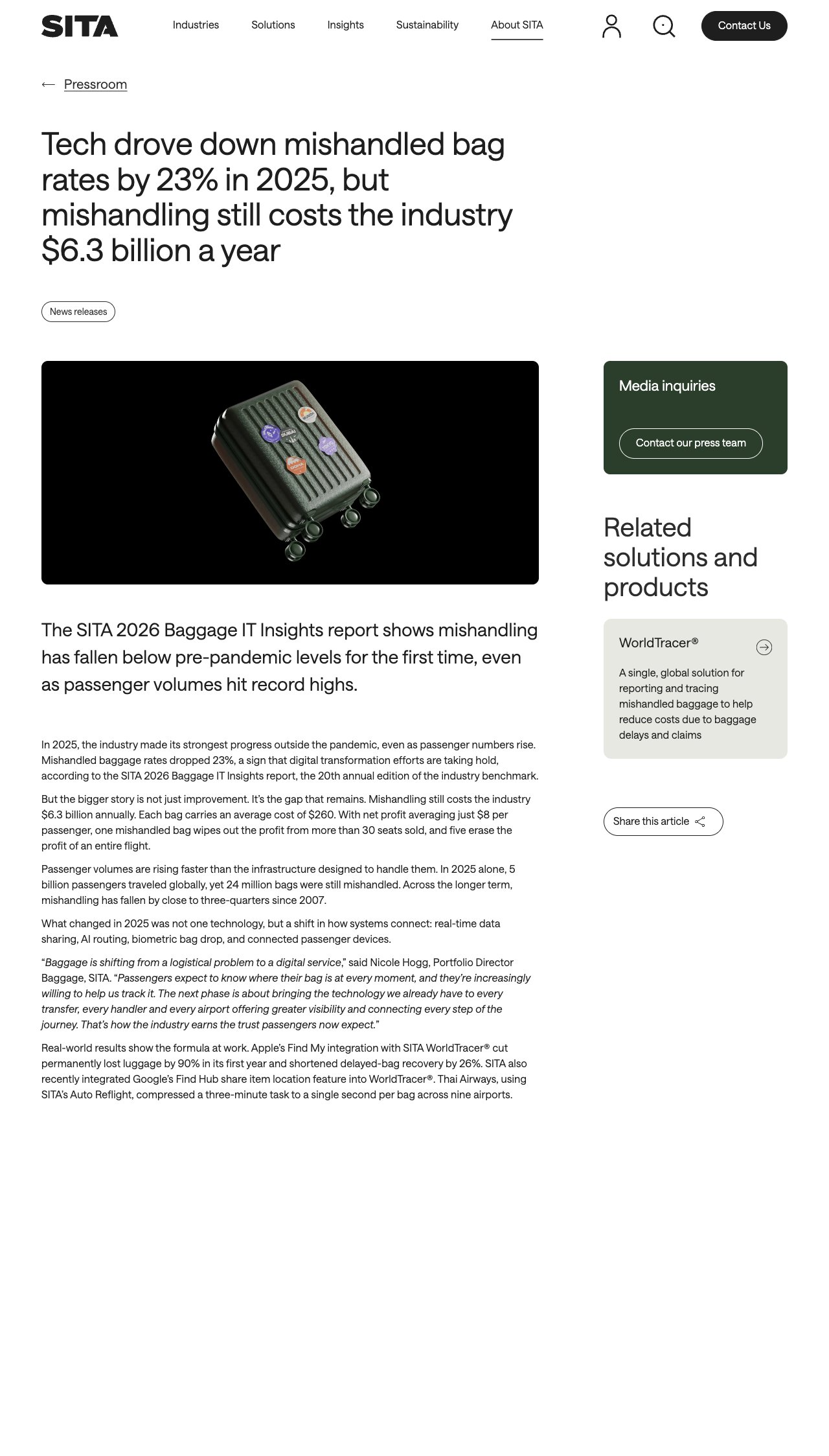
In the same source, two measured results show what connected data changes for the passenger: the Apple location-sharing integration into SITA’s WorldTracer cut 90% of permanently lost luggage in its first year and shortened recovery of delayed bags by 26%, and Thai Airways’ Auto Reflight turned a three-minute re-routing task into one second per bag across nine airports. In conversational terms: the “tell the passenger where their bag is” part becomes automatable end to end, and that is exactly the scenario where the chatbot absorbs the most inbound contacts.

The simulator: how many contacts will your next disruption generate?
The question raised in committee is never “should we get a chatbot” but “what volume must the automated channel absorb on the day”. The simulator below estimates it from four settings: the disruption scenario, the share of affected passengers who get in touch, the number of contacts per passenger, and the share the bot closes without a human. It returns the total volume, the hourly rate at the peak, and the human-agent equivalent over a four-hour window, with and without the bot.
Your next disruption, in contact volume
Set the four questions: the simulator applies an order-of-magnitude model described under the result.
1. Disruption scenario
2. Share of affected passengers who get in touch
3. Contacts per affected passenger
4. Share of contacts the bot closes without a human
With the absorption rate you picked, the remaining human agents hold the disruption window with light backup. This is the typical profile of read-only intents handled by the bot: flight status, gates, baggage questions, airport services.
The bot absorbs a major share of the flow but the residual fraction needs a bounded human backup. This is the cruising regime of a deployment that also handles claims in delegation mode: plan the backup staffing and the virtual queue from this level.
At the absorption level chosen, the residual fraction exceeds what a reasonable one-off human backup can handle in four hours. Two levers exist: raise the bot’s absorption rate (extra scenarios, outbound notifications that cut inbound questions) or smooth the load with a scheduled callback. This is the regime of disrupted days with 30 flights and more.
Model assumptions: a 4-hour disruption window; 6 minutes of human handling per contact; average passengers per flight of 180, 150 and 140 depending on the scenario; one agent handles at most 40 contacts per window. These are sizing hypotheses, to be replaced by your own measurements from the first pilot onward.
Two lessons come out of playing with the settings. First, the lever is not volume but the absorption rate: moving from 40% to 80% of contacts closed by the bot cuts the backup staffing by three, for the same disruption. Second, the outbound notification acts on the second question: informing before the passenger reaches out reduces the share who writes in, and that is often the most profitable gain of an aviation conversational project.
Six steps to a deployment that holds the peak
- Count the intents over twelve months. Call center logs, emails, social media messages: rank them by intent and spot the seasonality. In aviation the distribution is double: a steady base (baggage, check-in, loyalty) and spikes (disruption). The peak sizes the project, not the base.
- Split read-only from write. Tag every intent: pure information, or an operation that touches the PNR or the DCS. The first ones go into the launch batch, the second ones into the integration project, with a delegation mode in the meantime.
- Write the twenty day-of scenarios. A two-hour delay, a cancellation the night before, a gate change, a bag that did not arrive, a missed connection, a hotel night: these are the ones that arrive in bursts. Test them in bursts too, not one by one.
- Connect the sources of truth. Flight status, baggage system, FAQ base: an aviation bot that answers from a frozen PDF manufactures errors at the exact moment the passenger is most tense. Every real-time data point must come from its source.
- Engrave the legal frame. A “you are talking to an automated assistant” mention, the EC 261 notice content within reach of the conversation, documented human escalation, quoted amounts without invention. The bot informs, it does not rule.
- Rehearse the peak before it happens. Load testing of the channel, a mock-cancellation exercise with the service team, measured no-human closure rate, first-response time and reuse rate. Then widen the intents, in that order.
This sequence matches the six-step method detailed in our transport chatbot article, written for the whole transport sector; the aviation difference sits in step 5, where the regulatory window is tighter, and in step 6’s load test, where variance is far more brutal.
The four aviation-specific traps
- Letting the language model invent passenger rights. The amounts and deadlines of Regulation EC 261 are public, bounded and stable: they belong in the knowledge base, never generated. A generative model that “computes” a compensation entitlement invents litigation. Answers with legal stakes are scripted, not generated.
- Forgetting that the PNR holds personal data. Name, itinerary, contact details, sometimes health data tied to an assistance request: the bot that qualifies a request handles that data. Minimization (ask only what the scenario handles), a defined conversation retention period, an updated processing register: that is the entry ticket, not an option.
- Testing the bot on a quiet Tuesday. The credibility of an aviation channel is lost on the day of the storm: slow answers, saturated scenarios, lost escalations. The step-6 mock-disruption exercise exists for that reason, and it must reproduce the hourly rate of the peak, not just the volume.
- Ignoring the multilingual dimension. An international passenger on a European flight does not always write in the site’s language. Modern platforms handle language detection, but sensitive scenarios (claim, baggage) get proofread in every language, and legal amounts get written without ambiguity. Our translation chatbot article compares the three possible architectures for this need, from the multilingual base to the connected translation engine.
How much does a chatbot for air transport cost?
The cost range depends above all on the transactional boundary described above: an omnichannel information assistant gets built on a no-code platform with no integration budget, a bot connected to the reservation system gets priced like an IT project. On the platform side, Botnation’s public grid, retrieved on September 7, 2026, fits in four lines:
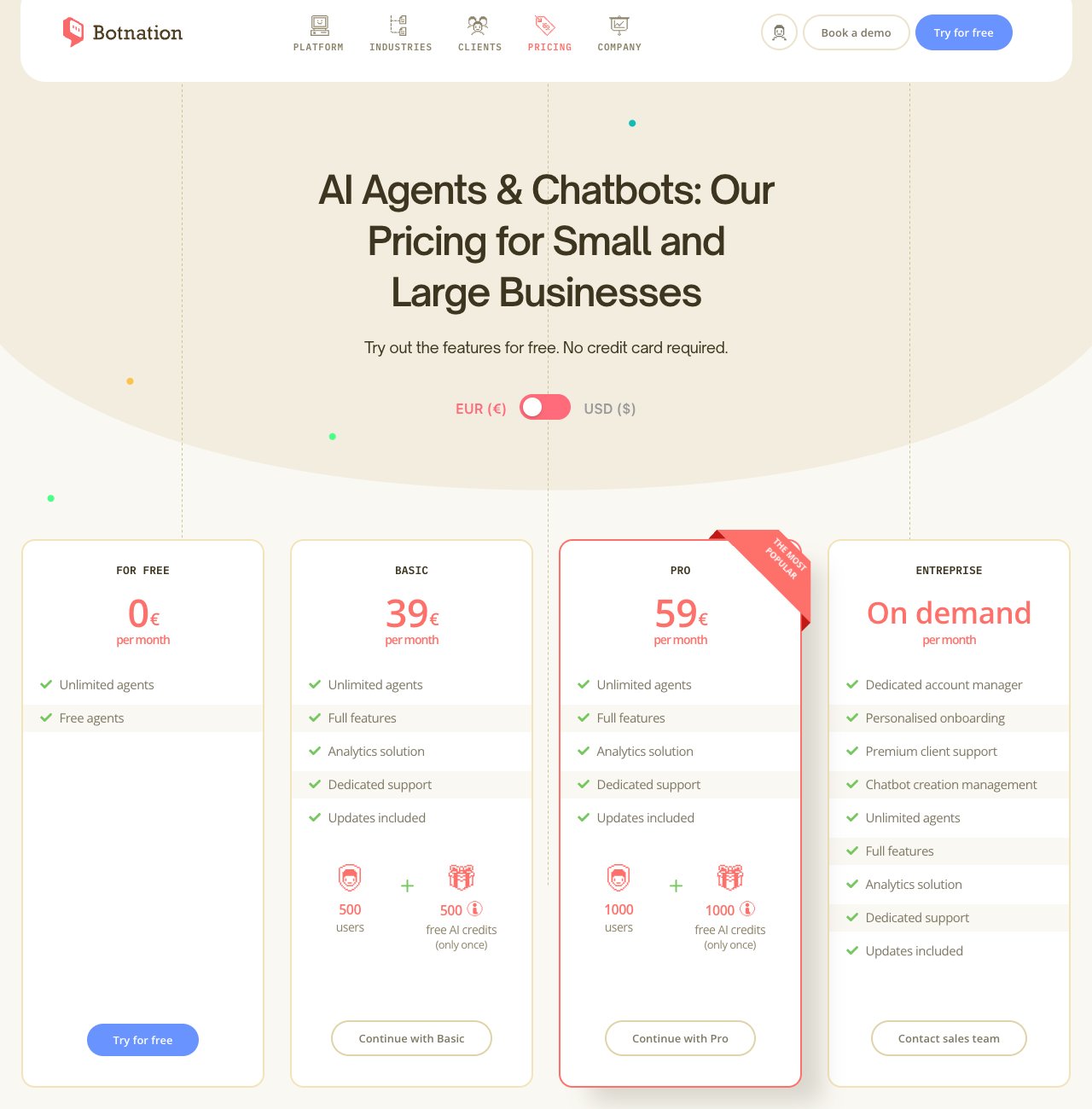
| Plan | Monthly price | What it includes |
|---|---|---|
| For Free | €0 | Unlimited agents, free agents |
| Basic | €39 | 500 users, full features, analytics, dedicated support, 500 free AI credits (once) |
| Pro | €59 | 1,000 users, same features, 1,000 free AI credits (once) |
| Entreprise | On demand | Dedicated account manager, personalised onboarding, premium client support, chatbot creation management, unlimited agents |
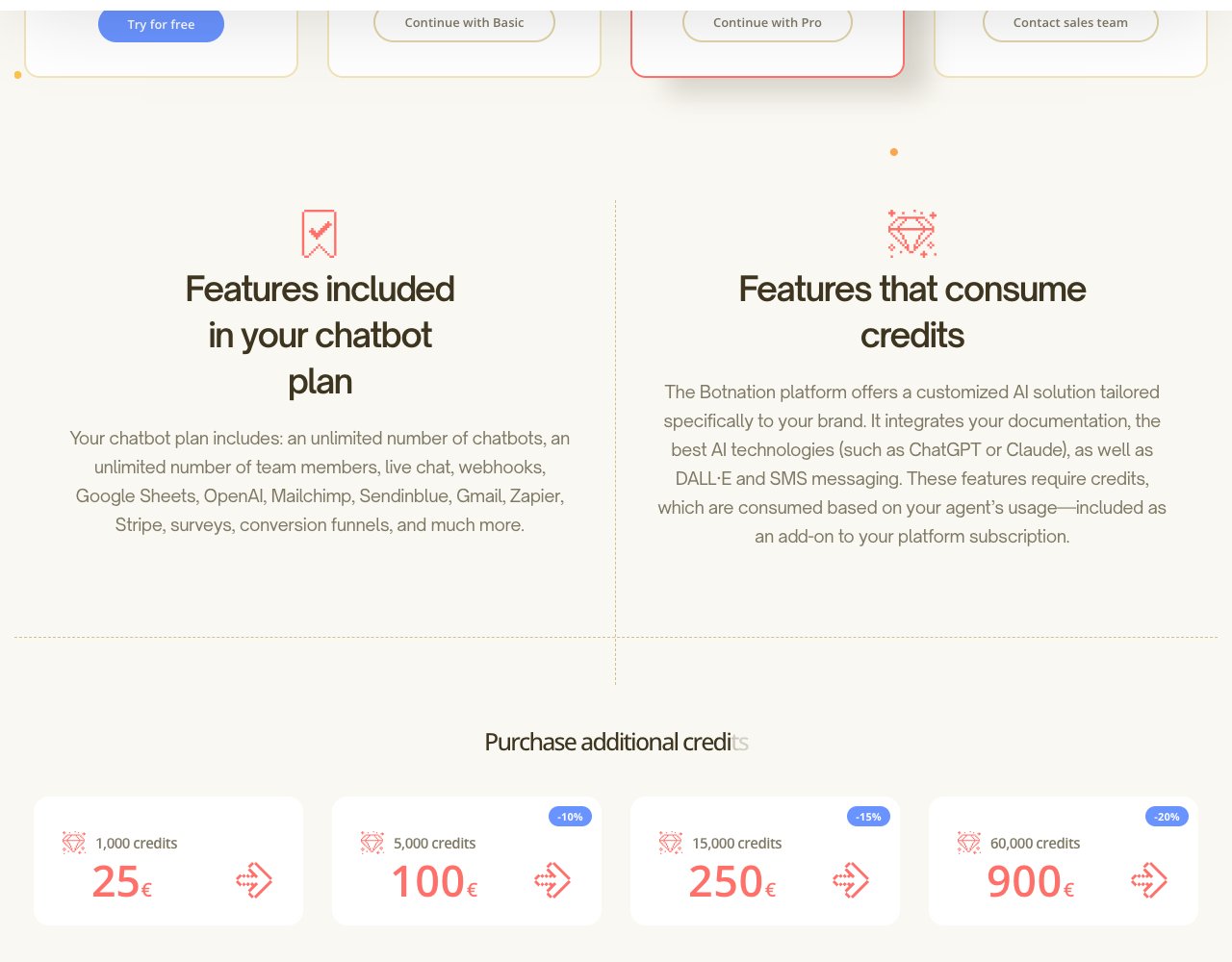
Prices exclude taxes. AI usage is consumed as credits, bought on top: 1,000 credits for €25, 5,000 for €100, 15,000 for €250 and 60,000 for €900 (retrieved the same day), an extra user beyond the plan costing €0.05 per month. Credits pay for the platform’s AI features (GPT agents, image generation, SMS sending), not for the running of classic scenarios. For an airline or an airport, the budget line to fund first is neither the license nor the credits: it is writing and maintaining the peak scenarios, on which every gain quantified above depends.
The custom build service (Enterprise plan) is quoted on demand: the range depends on the integration scope, the number of languages and the systems to connect. Nobody can quote it honestly without that scoping, and a generic range published on the web is no better than a horoscope estimate.
Frequently asked questions
Can a chatbot book or change a ticket on its own?
Not without an integration. Booking and changing a ticket writes into the airline’s reservation system (the PNR), which requires an API opening and an integration project scoped with the IT teams. Without that integration, the bot runs in delegation mode: it assembles the complete request (flight, passenger, requested change) and hands it to the entitled team, which already cuts human handling time.
What happens on the day 10,000 passengers write in at once?
That is precisely the scenario this channel is sized for. A conversational platform scales elastically, where a call center caps at its number of positions. The two things to check upstream: the throughput of the connected data sources (flight status, baggage), and the routing of the residual fraction to agents, with a virtual queue that calls the passenger back rather than making them wait.
Must the bot tell the passenger it is an AI?
Yes: since August 2, 2026, Article 50(1) of Regulation (EU) 2024/1689 requires that people be informed they are interacting with an AI system, unless that is obvious from the context. A mention at the start of the conversation and a simple route to a human satisfy this design requirement.
On which channels do passengers expect the bot?
On the ones they already use: the airline’s website and app remain the base, but WhatsApp and Messenger carry a growing share of travel contacts, especially flight and baggage notifications. A single Botnation scenario deploys on all these channels without being rewritten, so you never pay for the scenario twice.
How much does an aviation chatbot on Botnation cost?
The For Free plan (€0) lets you prototype the first scenarios. Basic (€39/month) and Pro (€59/month) cover a full information deployment with analytics and dedicated support; advanced AI features consume credits sold from €25 to €900 per pack. For an airline that wants its systems connected or the project built for it, the Enterprise plan prices the project on demand.
Do you need a language model or written scenarios?
Both, but not in the same place. Written scenarios carry the sensitive journeys: the EC 261 claim, baggage, changes, where the answer must be exact and stable. The language model serves the long tail of free questions and rephrasing, connected to the same knowledge base. Any answer with legal stakes gets scripted, not generated.
Can the bot handle an EC 261 claim?
It can receive it and prepare it: qualify the flight, the date, the disruption, gather the documents and write up a complete file handed to the entitled service. It cannot decide the entitlement to compensation on its own, notably because assessing “extraordinary circumstances” stays a documented judgment. That split, preparing bot and deciding human, is also what data protection authorities expect from automated processing.
How long does it take to put an aviation chatbot into service?
For a read-only scope on a no-code platform, the twenty peak scenarios get built in a few weeks, the constraint being the quality of the content you provide rather than the technology. A connection to the airline’s systems adds the integration project lead time, driven by the IT teams. The right sequence remains: information first, claims in delegation next, transactions once the API opening is ready.
What to remember
A chatbot for the air transport industry is not justified by the fashion for assistants, but by the very shape of the sector’s demand: contact volumes that arrive in waves, equipped passengers asking for tasks to be done, and a law that sets the deadline and the content of the information to deliver. The serious project starts with read-only intents, measures its no-human closure rate, then pushes the transactional boundary with the IT teams, keeping decisions with legal stakes on the human side.
Air Caraibes announces more than 800 conversations a day, SITA counts 24 million mishandled bags for 5 billion passengers: the field where the bot absorbs the variance already exists. What remains is to write the day-of scenarios before the day arrives.
Start with the twenty requests of your next disruption
Create your first agent for free, connect your flight and baggage FAQ, and measure what the bot closes without a human before widening the scope. Our chatbot creation experts can also build the project with you, from design to integration.
Sources. DGAC, Q2 2026 quarterly note of the statistics and forecasts sub-directorate (49.8 million passengers in Q2 2026, down 1.9% year on year, domestic traffic back at its early-1980s level), retrieved on September 7, 2026, published in French only; SITA, Baggage IT Insights 2026 report (20th edition, 2025 data: mishandling rate down 23%, 24 million bags, 6.3 billion dollar cost, 260 dollars per bag, average net profit of 8 dollars per passenger, transfers at 39% of cases, three airlines in four ready to invest in AI) and associated press release, retrieved on September 7, 2026; SITA, Air Transport IT Insights 2025, airline chapter (83% AI usage for operational decisions and passenger services, 51% for delay prediction, 36 billion dollars of IT spend); SITA, Passenger IT Insights 2025 (“The Travelers’ Voice”, 7,500 passengers, 25 countries, published on October 6, 2025: 78% willing to pay for end-to-end baggage services); IATA, Global Passenger Survey 2024 (published on October 30, 2024: 70% advance bag check-in, 45- and 30-minute ceilings) and 2025 (published on November 5, 2025, over 10,000 respondents: 54% dealing directly with the airline, 50% biometrics usage); Regulation (EC) No 261/2004 of February 11, 2004, Articles 7, 9 and 14, English text read on EUR-Lex on September 7, 2026; Regulation (EU) 2024/1689 of June 13, 2024, Article 50(1), applicable since August 2, 2026, English text read on EUR-Lex on September 7, 2026; Air Journal, “Service client 2.0 : Air Caraibes lance Camille, son assistant virtuel”, October 20, 2025 (figures announced by the airline); Botnation pricing grid and credit packs, retrieved on September 7, 2026.