




- Chatbot translation hides two different questions: which words to use when your bot speaks another language, and how to make it answer in several languages at all. This article answers both.
- On the wording side, the Journal officiel settled the matter in 2018: the recommended French word for chatbot is dialogueur. Paris advises against « agent conversationnel », which Quebec puts first in its own list.
- On the technical side there are three architectures, and one question decides between them: translate once and for all, translate every single message, or let the model answer directly in the language it received.
- The machine translation bill is trivial on one side and proportional to traffic on the other. Across the 162 combinations of the tool below, translating an entire scripted bot always costs less than 26 days of conversations translated on the fly.
- Of the 19 organic results recorded on 12 August 2026 for this query in French, none quotes a price per million characters and none uses the word « processor » in the data protection sense.
A visitor opens your chatbot and writes in Spanish. What happens? In most projects the honest answer is: nobody planned for it. The script exists in one language, the understanding engine was trained on phrasings in that language, and the Spanish message lands in the fallback reply.
Making a chatbot multilingual is not a checkbox. It is an architecture decision that commits your budget, your maintenance workload and, more recently, your compliance. The pages competing on this topic almost all sell a translation service without ever saying what the thing costs or where it breaks. This article takes the opposite route: the published prices of the translation engines, the three possible designs, what stays untranslated when you think everything is done, and a tool to place your own case.
Chatbot translation: two questions in the same query
The results page for this topic is split in two, and that is what makes it interesting. On 12 August 2026, on Google France, the 19 organic results recorded fall into three families, counted one by one.
Five are terminology resources: Reverso Context, PONS, the Larousse dictionary, the Vitrine linguistique of the Office québécois de la langue française, and a blog devoted to the French language. They answer a wording question: what is the French word for chatbot?
Eight are about translating a chatbot: Translated, BigTranslation twice, Smartling, Traduc, Botpress, a comparison published by SAWL, and a teaching handout in PDF form. They answer a project question.
The remaining six answer neither: they are general definitions of the word chatbot, or pages for AI tools, pulled up by the presence of the word alone.
| What the reader wants | What the results page serves | What is missing |
|---|---|---|
| The right word in the target language | Six dictionary entries, two of them bilingual | The official term and its source, which 18 pages out of 19 never cite |
| Making a bot speak several languages | Service pages and one technical tutorial | A price, a comparison of architectures, a limit |
| Knowing what it costs | Nothing | Not one of the 19 pages prices a million translated characters |
| Knowing where the messages go | Almost nothing | Not one of the 19 pages uses the word « processor » |
The count was made page by page, after downloading the 19 results, which correspond to 18 distinct addresses, one of them appearing twice on the same results page. Four pages use the word dialogueur, only one points to the body that recommended it, only one names a translation engine, and none gives a rate. That is the space left open.
If your bot speaks French, the Journal officiel settled the word in 2018
The question looks trivial. It stops being trivial the moment you write a public tender document, a notice aimed at a French administration, or simply the labels inside your own bot. It deserves better than an approximate synonym, and there is an official, dated answer that almost nobody quotes. For the rest of the vocabulary, our chatbot definition with examples covers the ground in detail.
Dialogueur, masculine noun: « Logiciel spécialisé dans le dialogue en langage naturel avec un humain, qui est capable notamment de répondre à des questions ou de déclencher l’exécution de tâches. » In English: software specialised in natural language dialogue with a human, able in particular to answer questions or to trigger the execution of tasks. Synonym: agent de dialogue. Foreign equivalents: chatbot, conversational agent. List « Vocabulaire de l’intelligence artificielle », published in the Journal officiel no 0285 of 9 December 2018.
The official record carries three notes. The first two describe the uses, from sales to home automation. The third is the one nobody quotes: « On trouve aussi l’expression “agent conversationnel”, qui est déconseillée. » The expression « agent conversationnel » is, in other words, advised against.
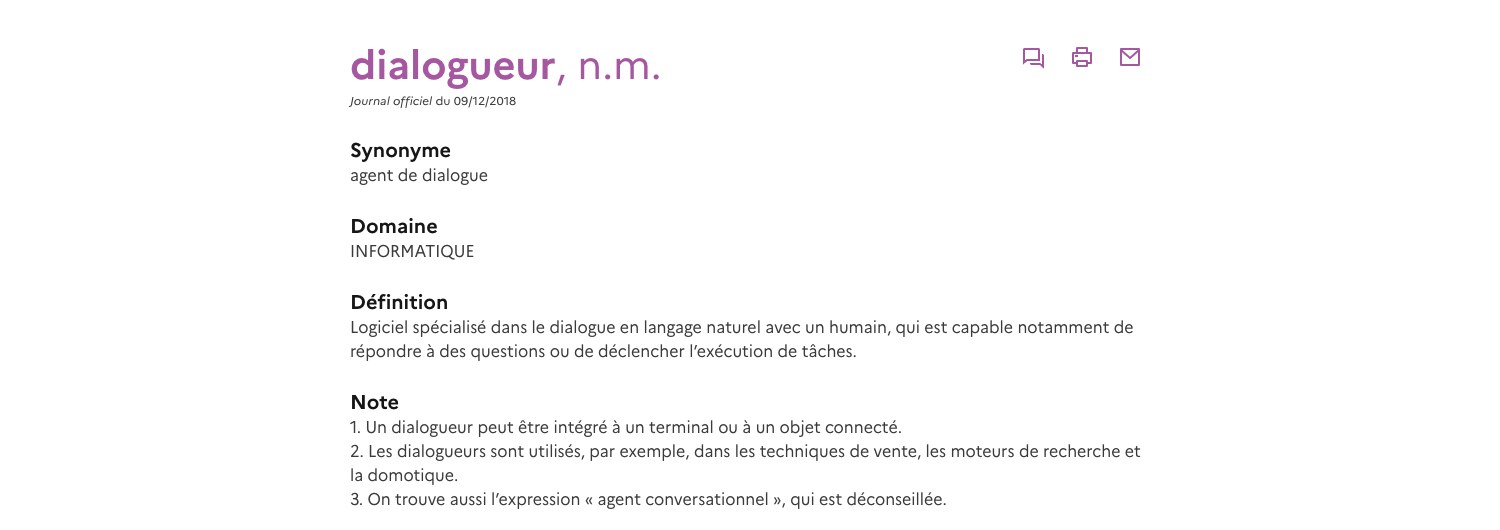
The Office québécois de la langue française, whose record sits at the 5th organic position on that same results page, does the exact opposite. Its record, updated in 2025, puts agent conversationnel first among its preferred terms, ahead of agent de dialogue and dialogueur. It reserves robot conversationnel for simple agents, and it advises against… chatbot itself: « L’emprunt intégral chatbot, en usage en français depuis la fin des années 1990, est déconseillé puisqu’il n’est pas légitimé dans l’usage. » The borrowing, in use in French since the late 1990s, is advised against because it is not established in usage.
| Source | Term put forward | Term advised against | Date |
|---|---|---|---|
| Journal officiel (France) | dialogueur, agent de dialogue | agent conversationnel | 9 December 2018 |
| Office québécois de la langue française | agent conversationnel, agent de dialogue, dialogueur | chatbot | record updated in 2025 |
| Larousse | chatbot as the main entry, dialogueur as the official recommendation | none | online edition consulted on 12 August 2026 |
| Reverso Context | agent conversationnel, robot conversationnel, assistant virtuel, agent de dialogue, dialogueur | none | consulted on 12 August 2026 |
The two French-speaking authorities contradict each other on the same word: the term France advises against is the one Quebec puts first. In a document aimed at a French administration, write dialogueur or agent de dialogue. In a text aimed at Canada, agent conversationnel reads perfectly well. And in marketing copy, chatbot remains the word your readers actually type into Google. The same arbitration exists in every language you deploy, and nobody but you will make it.
The three ways to make a chatbot multilingual
Now the real subject. There are only three designs, and they have nothing in common in terms of budget or maintenance. The choice depends as much on the type of chatbot you run as on your traffic volume.
Fixed translation
One version of the script per language
You duplicate your conversation tree, you translate every message once, and the bot switches to the right version based on the detected language. Nothing is translated during the conversation: everything is written in advance, proofread, approved.
On the fly translation
A translation API sitting in the middle
The bot stays in a single language. At every turn, the user message is translated into the bot language, processed, then the answer is translated back. This is the design Botpress documents in its tutorial, the only page in the top of this query to name an engine, in this case DeepL.
Direct generation
The model answers in the language it received
No translation happens at all: a generative AI chatbot reads the question in Polish and writes its answer in Polish, from the same knowledge base queried through RAG. Language becomes a property of the model rather than a layer of the system.
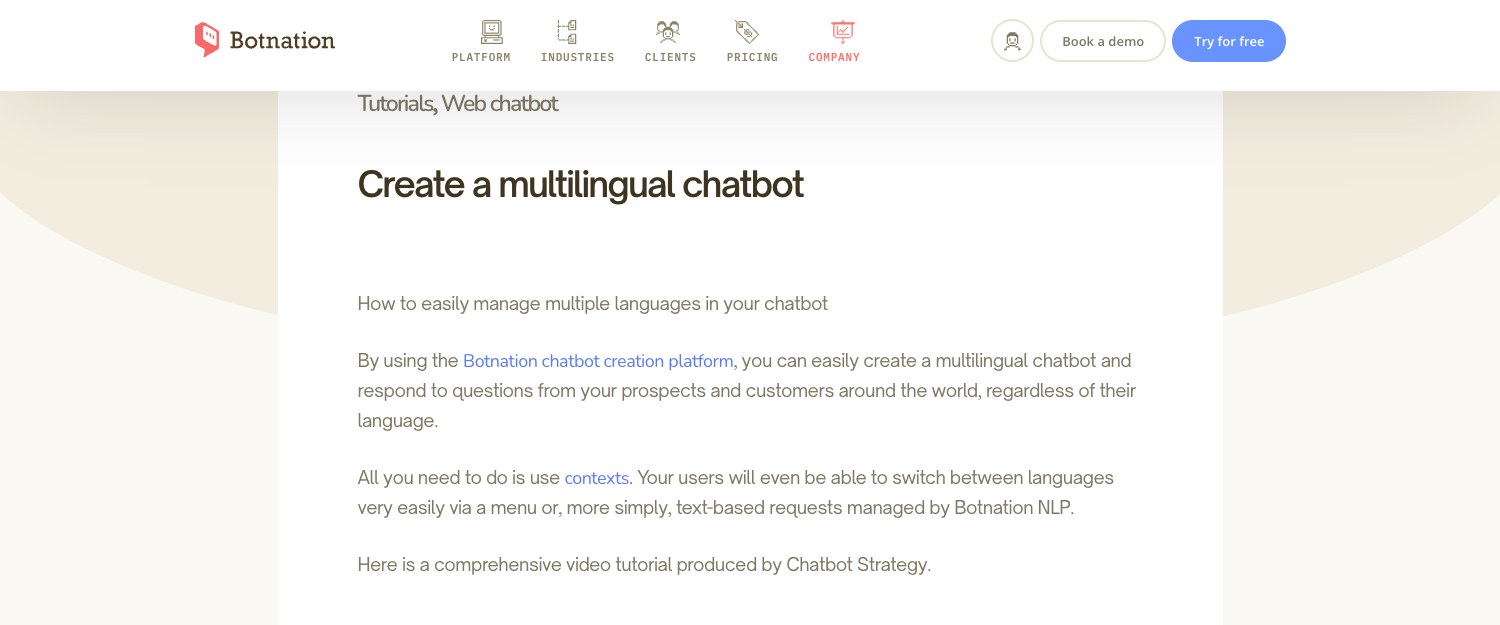
What a no-code platform actually does
On Botnation, multilingual support goes through contexts: one version of the script per language, with a switch at the entry point. The help page describes it in three lines, and the user can change language mid conversation, through a menu or a plain text request.
The automatic switch relies on a variable, {{LANGUAGE}}, whose documentation publishes the exact list of possible values: 30 codes in ISO 639-1 format, from EN to VI. And one rule that deserves a careful read before you draw your tree: « Any other language will return the code EN (English). »
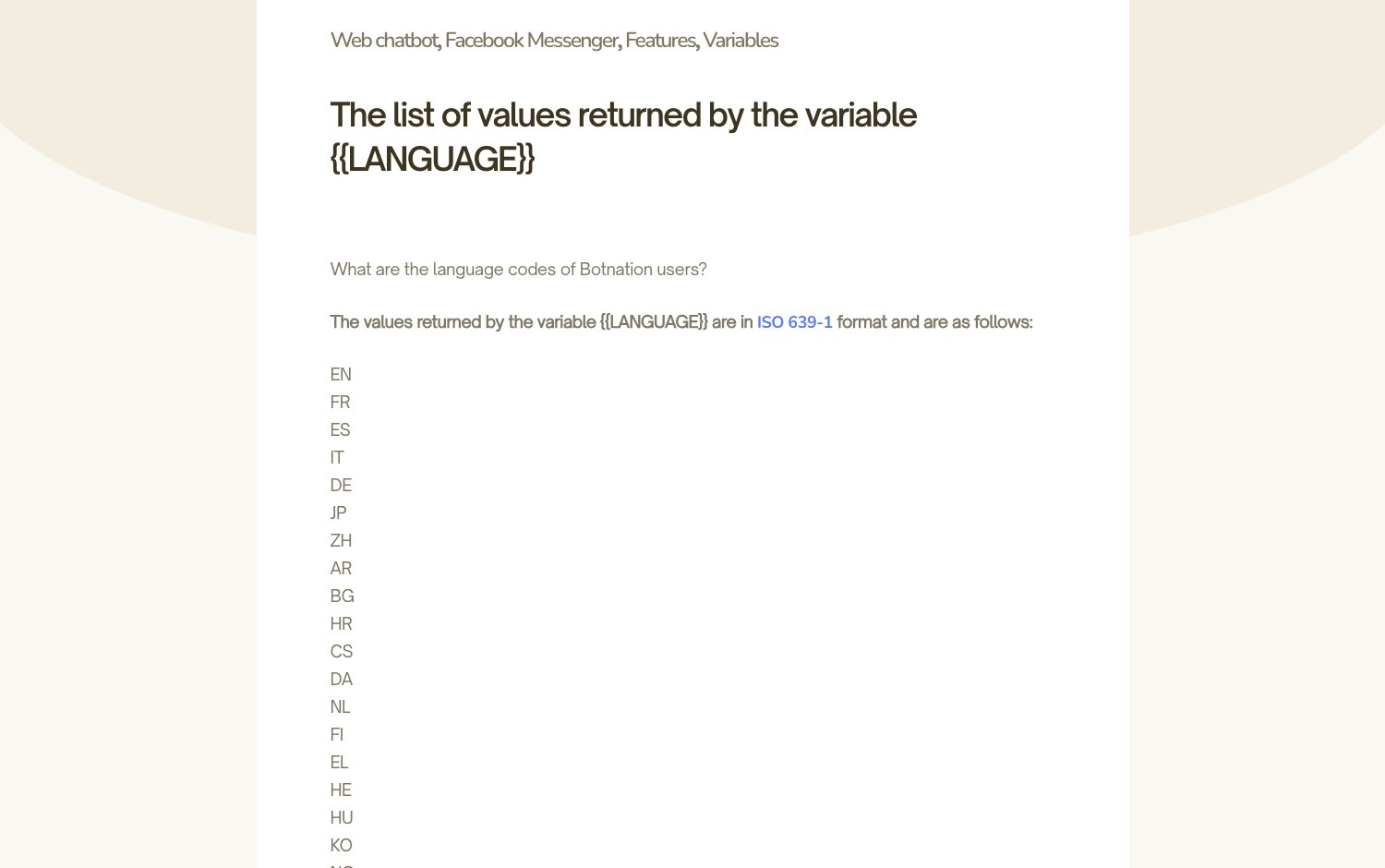
{{LANGUAGE}} variable, in ISO 639-1 format. Anything outside that list falls back to EN, so your default branch is the one that has to absorb it.That fallback rule is good news in disguise. It tells you there are only two cases to handle: the languages you planned for, and a single branch for everything else. If that branch settles for an error message, you lose the visitor. If it offers a language choice or a handover to a human, you keep them.
What each route really costs
The prices of translation engines are public, and nobody in the top of this query quotes them. Recorded on 12 August 2026:
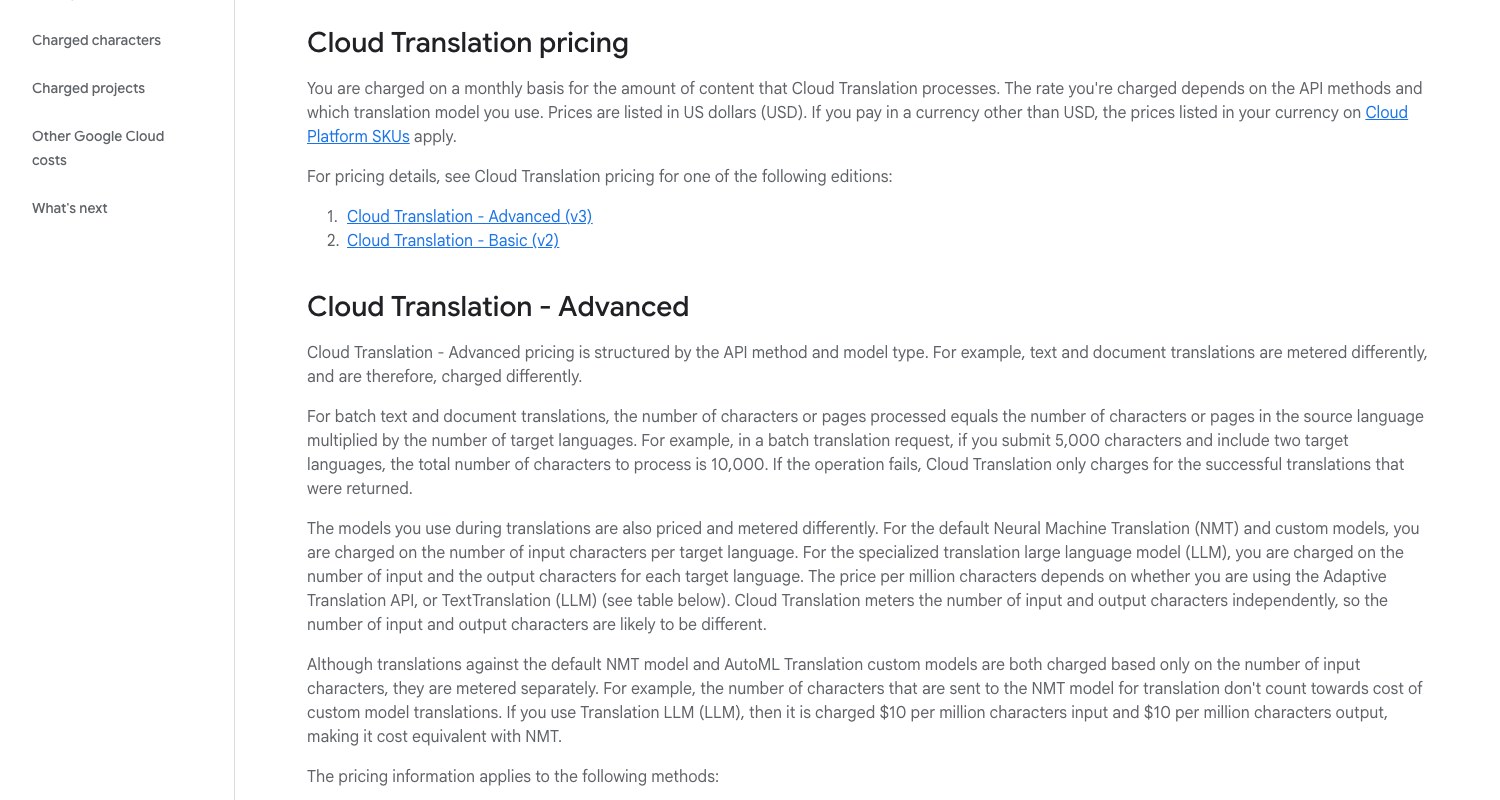
- Google Cloud Translation, neural translation model: the first 500,000 characters of each month come free as a 10 dollar credit, then it is 20 dollars per million characters. The specialised model built on a large language model is billed at 10 dollars per million characters of input and 10 dollars per million of output.
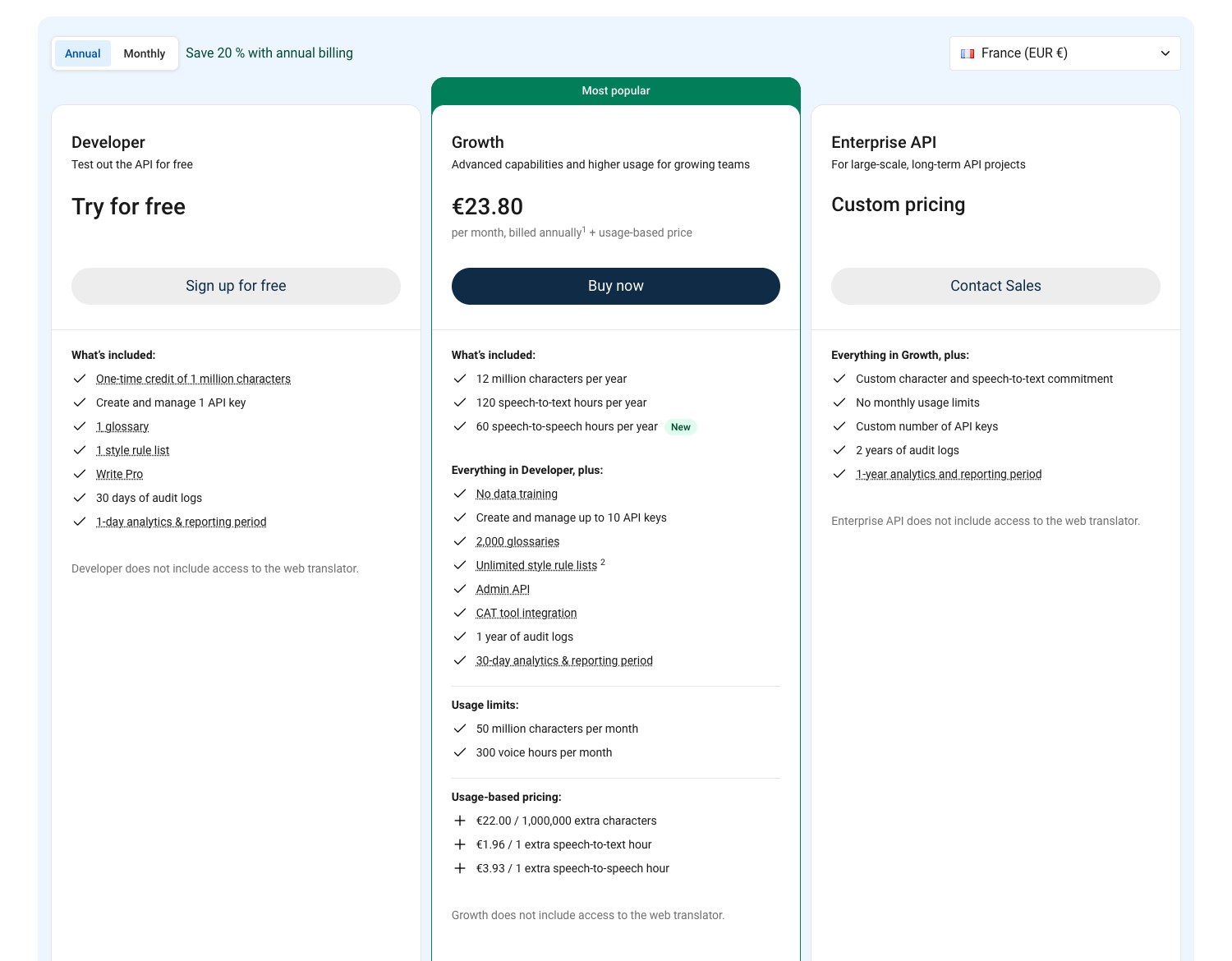
- DeepL API: the Developer plan is free with a one-time credit of one million characters; the Growth plan shows €23.80 per month billed annually, includes 12 million characters per year, then bills €22.00 per million extra characters.
At the European Central Bank reference rate of 11 August 2026, one euro was worth 1.1540 dollars, which puts Google’s million characters at €17.33. Both rates are therefore of the same order of magnitude, which simplifies the decision: it is not settled on unit price.
One billing rule deserves a careful read, because it is counter-intuitive and it is written in plain sight in Google’s documentation: for batch translation, the number of characters billed is the source text multiplied by the number of target languages. Translating 5,000 characters into two languages bills 10,000. Every language you add is a multiplication, not an addition.
The calculation nobody publishes
Put those figures end to end and the result is surprising. Translating an entire 100 message script into 3 languages amounts to 66,000 characters, that is to say a little over one euro of machine translation. A single day of foreign traffic translated on the fly costs more than that as soon as the bot passes a few hundred conversations a month.
The tool below runs that calculation on your own case, and shows the crossover point in plain words. Across the 162 combinations it covers, machine translating the whole script is always overtaken by on the fly translation in less than 26 days, and sometimes in minutes.
Fixed, on the fly or generated: where does your project sit?
Four answers, and the tool prices both paid routes, the yearly maintenance load and the moment the second overtakes the first.
How many messages does your script contain?
How many languages on top of your own?
How many foreign language conversations per month?
How often does the content of the bot change?
Which translation engine should the pricing use?
On the fly translation, with a glossary
Your fixed version would demand more than two thousand segment revisions every year, while on the fly translation stays under €150 a month. Here the human work costs more than the API bill.
Plug in a translation API, and invest the time you save into a glossary: that is what locks down your product names, your plan names and your industry vocabulary, which engines otherwise translate very diligently.
A hybrid design, there is no other way out
Both routes are expensive for you: too many segments to maintain to freeze everything, too much traffic to translate everything on the fly. Neither wins on its own.
Freeze the core: greeting, main menu, legal notices, handover message, the twenty most requested answers. Leave on the fly translation on the long tail, which carries little volume and many languages.
Fixed translation, without hesitation
Your script barely moves and your foreign traffic is significant: the fixed version maintains itself without much effort, while on the fly translation would bill you every month an amount that will never come back down.
This is the most comfortable case. Translate once, have it proofread by someone who knows the business, and keep control over every sentence your customers will read.
Fixed translation, because it is the only one that guarantees the exact wording
At this level both routes are cheap: price decides nothing. The only criterion left is editorial control, and only one route gives it to you.
Start fixed on one or two languages, measure what visitors actually write, and open on the fly translation only the day an unplanned language shows up in your statistics.
Calculation assumptions, stated so the result is reproducible: 220 characters per script message, 2,100 characters per conversation, public rates from the table below. The two thresholds in the rule, 2,000 segments a year and €150 a month, are reading benchmarks specific to this article, not an industry standard.
| Engine | Published rate used | What is included | Recorded on |
|---|---|---|---|
| Google Cloud Translation | 20 dollars per million characters, that is €17.33 | 500,000 characters per month free | 12 August 2026 |
| DeepL API, Growth plan | €22.00 per million characters | 12 million characters a year, for €23.80 per month | 12 August 2026 |
What stays in the source language when you think everything is translated
This is the real trap of multilingual projects, and it only shows up in production. A chatbot is not made of answers alone: it is made of everything nobody counts.
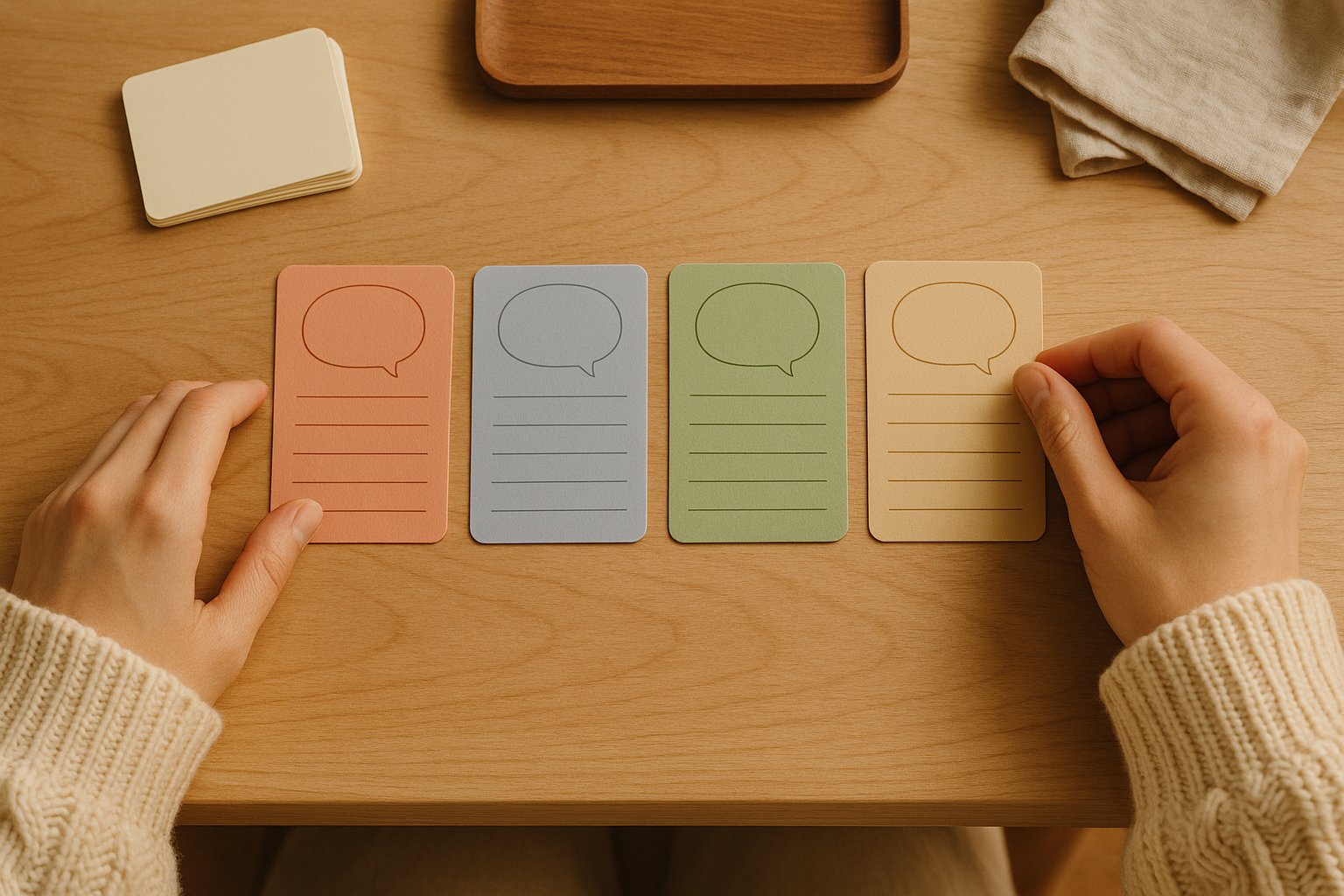
- Buttons and quick replies. They are short strings with no context, which makes them exactly what machine translation gets wrong most often: « Next », « Back » and « Order » have no single equivalent.
- The fallback message. The one shown when the bot has not understood. It is written once, at the start of the project, and forgotten everywhere else.
- Handover messages, and the opening hours notice, which often quotes a time zone the visitor is not in.
- Formats. A date written 03/04 does not read the same way in Paris and in New York, and a price shown as « 1,200.50 » becomes « 1 200,50 » elsewhere. No translation engine fixes that: your code has to.
- Formality. French picks between tu and vous in every single sentence, English never picks. A translation from English therefore chooses for you, and not always the same way from one message to the next.
- The understanding engine. This is the most expensive point, and the least visible. It is not part of the displayed text, but it conditions everything else, as the detail of how chatbots work shows.
An engine that recognises an intent from keywords is not translated, it is rewritten. The phrasings your customers use in German are not the translation of the ones they use in English, the stop words are different, and word collisions do not happen in the same places. Translating the example list of an understanding model produces a model that looks right and recognises poorly. The only method that works is to take the real sentences of real users in each language, which means having opened the bot in that language first.
The practical consequence is simple: translating a chatbot is not a batch of text to send to a vendor, it is an inventory to draw up first. Count the messages, yes, but also count the buttons, the variables, the notification templates, the interface labels and the training examples. That total is what decides the architecture, as the tool above shows.
Where the messages go when an API translates them
On the fly translation has one consequence that none of the 19 top pages names: the content of your conversations leaves your systems. Whatever the visitor writes, including an order number, an address or the reason for a complaint, is passed to a third party editor to be translated.
Under the European General Data Protection Regulation, that vendor processes personal data on your behalf: it is your processor, and the relationship has to be governed by a contract, under article 28 of regulation (EU) 2016/679. This is not a formality: that document is what sets out what the vendor may do with your conversations.
The CNIL, the French data protection authority, published a note on chatbots on 19 February 2021 that recalls that these tools process personal data « par exemple pour conserver une trace de la conversation, même si le service est disponible sans créer de compte ou sans fournir d’informations directement identifiantes », that is to say, for example, to keep a record of the conversation, even where the service works without an account and without directly identifying information. It also recalls that a conversation with a chatbot, without human intervention, cannot on its own lead to a decision with significant effects on a person.
Three questions to ask any translation engine before wiring it into a bot: are the transmitted messages used to train models, how long are they kept, and in which country are they processed? The answers are usually in the pricing table itself. DeepL, for instance, advertises « No data training » as a benefit of its Growth plan, which implies it is not the rule everywhere.
Fixed translation raises none of these questions: the translation happened once, outside production, on text you wrote yourself. It is a compliance argument that is rarely made and yet decisive in regulated sectors, from insurance chatbots to public services.
The method, in order
- Measure before you translate. Open your conversation statistics and look at which languages actually arrive. Plenty of projects translate into five languages a bot whose traffic is overwhelmingly in one. The two sectors where the opposite holds are tourism and online retail.
- Draw up the full inventory. Messages, buttons, quick replies, fallback message, notifications, interface labels, training examples. That number is the only one that matters when choosing an architecture.
- Settle the architecture with a figure. Segments to maintain every year on one side, monthly on the fly translation bill on the other. The tool above gives both.
- Write the glossary first. Product names, plan names, industry vocabulary, terms never to be translated. It serves a human translator just as well as an API, which usually accepts a custom glossary.
- Handle the unplanned language. Decide what the bot does when a language outside your list turns up: offer a choice, fall back to English, or hand over. Do not leave that case to chance.
- Test in the target language, with real sentences. Not yours translated: the ones your users write. That is the only test that exposes an understanding engine that was carried over badly.
Frequently asked questions
How do you say chatbot in French?
The official term in France is dialogueur, with agent de dialogue as its synonym, published in the Journal officiel of 9 December 2018. The expression « agent conversationnel » is explicitly advised against there, while it sits first among the preferred terms of the Office québécois de la langue française. In everyday and commercial usage, chatbot remains by far the most common.
Can a chatbot translate conversations automatically?
Yes, by inserting a translation API between the user and the bot: the incoming message is translated into the bot language, and the answer is translated back. It is a classic design, billed by the character, and it adds latency at every turn. A chatbot built on a large language model can also answer directly in the language it received, with no translation step at all.
How much does it cost to machine translate a chatbot?
Translating the text of a script costs a few euros: 100 messages into 3 languages amount to roughly 66,000 characters, that is a little over one euro at the published rates recorded on 12 August 2026. It is on the fly translation that weighs, because it is proportional to traffic: 3,000 foreign conversations a month come to about €109 with Google and €139 with DeepL. The real cost of the fixed version is not the translation, it is the human proofreading and the maintenance.
How many languages can a chatbot handle?
Technically, as many as the translation engine offers, which means dozens. Practically, the limit is editorial rather than technical: every language added multiplies the number of segments to maintain. On Botnation, the {{LANGUAGE}} variable distinguishes 30 language codes, any other value falling back to EN.
Should you translate, or let the AI answer in the user’s language?
It depends on what you accept never to proofread. A script translated in advance guarantees the exact wording, which is essential as soon as a sentence carries a legal commitment. An answer generated in the language received reads more fluently and costs nothing in translation, but you will never see it before it is displayed. Many projects combine the two: a fixed script for messages that commit, generation for the rest.
Does machine translation raise a GDPR problem?
It does if it is not governed. Sending user messages to a translation engine means entrusting personal data to a third party acting on your behalf: that is a processor under article 28 of regulation (EU) 2016/679, and the relationship must be covered by a contract. Also check the retention period, the country of processing and any use of the messages to train models. Fixed translation avoids the question entirely.
How do you detect the user’s language?
Two mechanisms coexist, and they do not give the same result. The first reads the language declared by the device or the channel, which is what the {{LANGUAGE}} variable does: it is instant and free, but it reflects the browser setting rather than the language the person is writing in. The second analyses the text of the message, usually through the translation API itself. At Google, language detection is not billed on top of translation.
What to take away
Chatbot translation is not decided on the price of a million characters, which is negligible on both sides. It is decided on two quantities nobody calculates: the number of segments you will have to maintain every year if you freeze, and the monthly bill you will pay indefinitely if you translate on the fly. Put those two numbers side by side and the architecture picks itself.
The rest is a matter of inventory. A multilingual bot that fails rarely fails on its answers: it fails on a button left in the source language, a forgotten fallback message, a date in the wrong format, or an understanding engine that was translated instead of rewritten.
Open your chatbot to one more language
Create an agent for free, duplicate your script into a second language with contexts, and watch what your foreign visitors actually write to it. That record, and only that record, tells you whether to freeze or to translate on the fly.
Explore the deployment channels
Or have our chatbot creation experts price your multilingual project
Sources. Commission d’enrichissement de la langue française, list « Vocabulaire de l’intelligence artificielle », Journal officiel of 9 December 2018, record for dialogueur consulted on FranceTerme and on Légifrance on 12 August 2026, published in French only; Office québécois de la langue française, Vitrine linguistique, record for agent conversationnel, updated in 2025; Larousse, entry « chatbot », online edition; Google Cloud, Cloud Translation pricing page; DeepL, API pricing table displayed for France; European Central Bank, reference exchange rate of 11 August 2026; CNIL, Chatbots: les conseils de la CNIL pour respecter les droits des personnes, 19 February 2021, published in French only; regulation (EU) 2016/679, article 28; botnation.ai help pages on multilingual chatbots and on the {{LANGUAGE}} variable, consulted on 12 August 2026. The record of the nineteen organic results for the query « chatbot traduction » was made on 12 August 2026 on Google France, each page then being downloaded and analysed: seventeen fetched directly, one through a rendering engine because of a consent banner, and one in PDF form, from which the text was extracted.