




- The query “chatbot recommendation” covers two different needs: getting a reliable chatbot recommendation, or equipping your site with a chatbot that can recommend products. This guide answers both, with a free recommendation simulator.
- Choosing a chatbot comes down to 7 criteria: actual use case, channels, AI architecture, available data, budget, autonomy, compliance. Everything else is sales theater.
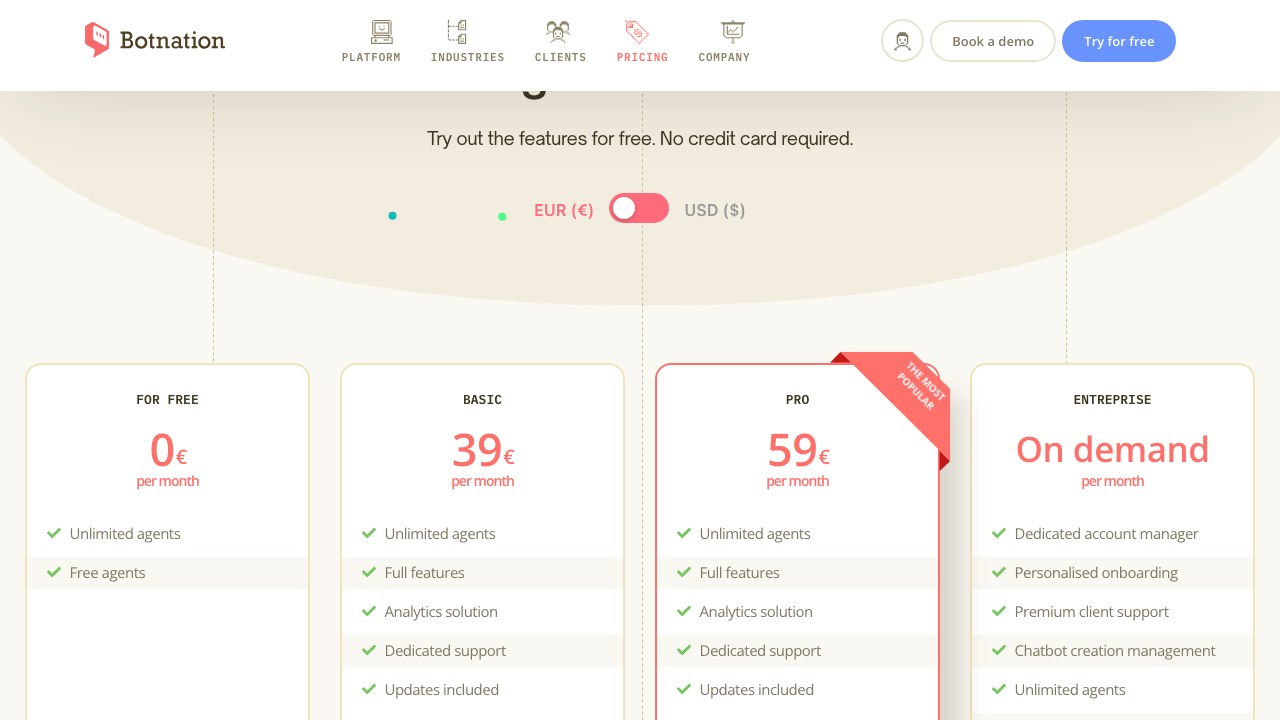
- Prices collected on botnation.ai on September 8, 2026: Free plan at 0 €, Basic at 39 € per month, Pro at 59 € per month, Entreprise on quote. AI credits are itemized in the grid, nothing is hidden.
- Product recommendation is not a gimmick: back in October 2013, McKinsey attributed 35% of Amazon purchases to algorithmic recommendations. A chatbot properly connected to the catalog brings that logic into the conversation.
You typed “chatbot recommendation”. Behind those two words live two very different readers: the one looking for a chatbot recommendation (“which chatbot should I choose for my business?”) and the one looking for a recommendation chatbot (“a bot that recommends the right products to my customers”). The pages you will find mix both freely, and rightly so: the query itself is ambiguous. Rather than impose one reading, this guide handles both questions, in the order they arise: first how to choose (with a simulator that applies explicit rules), then how to build a chatbot that recommends your products. In both cases, the prices, features and limits cited are those we collected from Botnation’s public pages on September 8, 2026, and external statistics carry their source and date. What you will get is a reasoned decision, not a sales funnel in disguise.
“Chatbot recommendation”: one query, two needs
Need 1: getting the right chatbot recommended to you
You run a website, a support team, an online store or a practice. You want to automate part of your conversations, and the market drowns you: no-code editors, AI agents, rule-based chatbots, open source building blocks, custom build agencies. Every vendor promises you “the best chatbot of 2026”. A universal ranking does not exist: the right chatbot for a 200-ticket-per-day support desk has nothing in common with the one for a 40-product Shopify store. What does exist, however, is a stable selection method: seven criteria, a real budget, honesty about limits. That is what the next two sections are about.
Need 2: a chatbot that recommends products
The second meaning, more precise and often searched by e-commerce managers: the product recommendation chatbot, the one that talks with your visitor, understands the need, and suggests the right item instead of a list of 200 results. This is conversational recommendation, a cousin of the recommendation engines that populate product pages and emails. The difference: here the recommendation is fed by a dialogue, that is, by criteria the customer states, rather than being inferred solely from browsing history. The topic deserves its own architecture (rules, catalog, generative AI): we cover it in detail below.
If you are choosing a chatbot: read sections 1, 2, 3, 5, 6 and 8. If you want products to be recommended: jump straight to section 4, then come back to pricing in section 5. The simulator in section 3 serves both readings.
Choosing a chatbot: the 7 criteria that decide

1. Start from the use case, not the technology
The first question is not “rules or AI?” but “what volume of conversations, on which topics, with which measurable goal?”. A chatbot that must resolve 60% of recurring support questions is not specified like a chatbot that must qualify B2B leads or recommend products. List your ten most frequent contact reasons over the last three months (emails, calls, messages): they define 80% of the bot’s actual workload. If you do not know them, measuring them is the first thing to do, before any tool choice.
2. Channels: where your customers already write
A chatbot is not a channel, it is a brain you plug into channels: website, WhatsApp, Messenger, Instagram, SMS. The decisive criterion is knowing where your customers already speak up. A young B2C audience writes on Instagram and WhatsApp; an e-commerce site visitor accepts the chat widget; a B2B prospect usually goes through the site then a form. Check that the platform covers your channels and maintains a single content base adapted per channel, otherwise maintenance becomes a nightmare. On WhatsApp, keep the channel’s rules in mind: prior customer opt-in, 24-hour service window, per-message marketing billing since July 2025 under Meta’s grid.
3. Architecture: rules, generative AI, RAG or catalog
This is the most misunderstood criterion, because “AI” is used as a catch-all. In practice, four architectures coexist, detailed in our guide to chatbot types:
- The scenario chatbot (rules): you draw the conversations, the bot follows them. Predictable, controllable, unbeatable for known paths (qualification, appointments, short FAQ).
- The generative AI chatbot: a large language model writes the answers. Flexible, but without guardrails it invents things: reserve it for uses where creativity matters more than exactness.
- The AI + RAG chatbot: the model draws from your content (FAQ, docs, pages) to answer, with sources. The right support architecture. Our RAG chatbot article details how it works, what it costs and where it breaks.
- The AI + product catalog chatbot: recommendation in conversation, the topic of section 4. The bot searches your product sheets, compares, suggests.
4. Your data: it decides the pace of the project
A chatbot lives on your content. Three situations: you have a structured catalog (products with attributes, prices, stock), you have an FAQ or documentation (RAG feeds on it), or you have nothing structured (it will have to be written first, nobody will do that work for you). The state of your data determines the real timeline far more than the choice of vendor: a RAG bot on a messy document base produces messy answers.
5. Budget: the real grid, not the entry price
Compare complete grids: user caps, included AI credits, the cost of an over-cap user, what each feature consumes. Section 5 of this article details Botnation’s public grid as collected on September 8, 2026, credit packs included. Be wary of pricing that hides AI consumption: that is where the real bill plays out once the bot answers thousands of conversations.
6. Your autonomy: self-service or guided
Two profiles exist, and offers should distinguish them honestly. The self-service profile wants to build, edit and steer everything itself: it needs a no-code editor, templates, documentation. The guided profile wants a delivered outcome: it needs a team that designs, deploys and optimizes, with a dedicated contact. At Botnation, both officially exist: the no-code platform on one side, the Entreprise offer on the other, which literally includes “chatbot creation management” with a dedicated account manager and personalized onboarding (pricing page, collected September 8, 2026). If your need is a very specific trade (proprietary line-of-business software, physical on-site process), a specialized integrator remains perfectly legitimate: what matters is that the choice be a conscious one.
7. Compliance: GDPR and AI transparency by design
A chatbot collects personal data (name, email, conversation history): this is ordinary GDPR. The CNIL, the French data protection authority, in its “Chatbots” guidelines of February 19, 2021, recalls the principles: defined purpose, minimization, set retention period, informing people. Added to this since August 2, 2026 is the application of the transparency obligations of Article 50 of the European AI Regulation (Regulation (EU) 2024/1689): a user must be able to know they are interacting with an AI, not a human. A good vendor helps you on both fronts instead of leaving you alone with compliance.
| Criterion | The question to ask yourself | What should warn you |
|---|---|---|
| Use case | Which contact reasons, what volume, which measurable goal? | A spectacular demo that never discusses your real topics. |
| Channels | Where do my customers already write today? | A great tool on a channel your customers do not use. |
| Architecture | Rules, generative AI, RAG or catalog: which one serves the use case? | “It’s AI” as the only technical answer. |
| Data | Are my catalog and documentation clean and structured? | A project started without an inventory of available content. |
| Budget | What full cost at 6 months, AI credits and volume included? | An entry price without a published consumption grid. |
| Autonomy | Do I want to build it myself or have it delivered turnkey? | A “custom” offer with no identified build team, or the reverse. |
| Compliance | GDPR and AI transparency: who does what, concretely? | No mention of minimization, retention, Article 50. |
Your personalized recommendation in 30 seconds
The simulator below applies criteria 1, 2, 5 and 6 to your situation: four questions, a recommended architecture, a starting plan in the Botnation grid and the watch-out for your channel. Everything is computed in your browser, no data is sent. The decision rules are written in black and white below the tool: no magic score, readable logic.
The chatbot recommender
Check one answer per question: the recommendation updates instantly.
1. Your number-one priority
2. Your main channel
3. Your monthly budget
4. Your autonomy
Answer the four questions: your recommendation will appear here, with the starting plan and the next step.
The recommendation stays indicative: a final choice is validated against your real data (conversation volumes, content quality, internal constraints). Here is the grid the tool relies on, and the exact decision rules.
| Botnation plan | Price collected on September 8, 2026 | Key contents of the public grid |
|---|---|---|
| Free | 0 € per month | Unlimited agents, feature testing, no credit card required |
| Basic | 39 € per month | 500 users + 500 AI credits offered once, dedicated support, updates included |
| Pro | 59 € per month | 1,000 users + 1,000 AI credits offered once, full features, analytics |
| Entreprise | On quote | Chatbot creation management, dedicated account manager, personalized onboarding, premium client support |
How the tool decides
- Architecture: the “sell and recommend” priority gives the AI + catalog chatbot; the “support” priority gives the AI + knowledge base (RAG) chatbot; the “leads” and “appointments” priorities give the scenario chatbot.
- Plan: with guided support requested or a project budget, the tool points to the Entreprise plan (on quote); a zero budget to the Free plan; otherwise a sales or multi-channel priority to Pro (1,000 users and 1,000 AI credits offered versus 500 in Basic), and everything else to Basic.
- Watch-out: the caution follows the chosen channel (widget placement, WhatsApp rules, Messenger and Instagram visuals, single content base across channels).
The other meaning: the chatbot that recommends your products

Why it works: what the numbers say
Product recommendation is one of the best documented mechanics in e-commerce. In its October 2013 report “How retailers can keep up with consumers”, McKinsey already put at 35% the share of Amazon purchases coming from algorithmic recommendations, and at 75% the share of content watched on Netflix. Those figures concern “classic” recommendation engines (history, similarity, popularity), not chatbots: they measure customers’ appetite for being offered something, rather than being left to search alone. At the other end of the funnel, the Baymard Institute, in its meta-analysis of 50 studies updated in September 2025, puts the average documented cart abandonment rate at 70.22%, and at 85.65% on mobile. Between discovery and payment, a huge friction margin remains: that is precisely the workspace of a recommendation chatbot.
The three architectures of a conversational recommendation
Having products recommended by a chatbot is not just “plugging in AI”. Three architectures exist, often combined:
| Architecture | How it recommends | Strengths | Limits |
|---|---|---|---|
| Scenarios and keywords | Hand-written rules: if the customer looks for a “gift under 50”, the bot shows the matching selection. | Predictable, quick to set up, perfect for a small catalog and seasonal offers. | Degrades as references and request subtlety grow. |
| Conversational catalog search | The bot queries the structured catalog (attributes, price, stock) from the criteria stated in the dialogue. | Always current if the catalog is synced; exact answers on price and availability. | Requires a clean catalog: filled attributes, consistent variants, reliable stock. |
| Generative AI + RAG on product sheets | The model reformulates the request, draws from the product sheets and argues the recommendation. | Understands fuzzy requests, explains why an item fits the need. | AI credit cost, and guardrails needed so it never invents a product or a price. |
Guided selling in practice: a sample dialogue
Guided selling is the honest version of the sales funnel: instead of trapping the visitor in a form, you help them decide. The golden rule: two to four questions, one recommendation, one reason. Example on a coffee store:
The chatbot: Hi! What will the coffee be for: a morning espresso, or rather an afternoon filter brew?
The customer: Morning espresso, but I use a reusable-pod machine.
The chatbot: Roast on the intense or the fruity side?
The customer: Intense, but not bitter.
The chatbot: Two references match: the “Santos intensity 8”, a dark roast without bitterness, 11 € for 250 g, and the “Espresso Bar” from the same roaster, 9.50 €, rated 4.6 out of 5 by 312 customers. I recommend the Santos for a pod machine: its grind is calibrated for it. Want to add it to the cart?
Four exchanges, two argued products, one explicit decision criterion. No customer suffers through this dialogue: they leave whenever they want, and the bot lands on its feet. That is the difference between recommending and pushing.
Upsell, cross-sell and abandoned cart follow-up
Once recommendation is in place, three mechanics extend the conversation. Upsell (suggesting the higher range when the need justifies it), cross-sell (the coherent accessory: the water filter with the machine) and abandoned cart follow-up, where the bot picks the conversation up where the customer left it, with the product context. At Botnation, the public page of the e-commerce module (collected September 8, 2026) describes exactly that scope: connecting the catalog to “search for products, recommend the best options, suggest upsells, answer product FAQs and follow up on abandoned carts in real time”, with native integrations for Shopify, Magento, WooCommerce and Prestashop, and a hybrid livechat that hands over to a human advisor when the conversation calls for it. The natural continuation (selling in conversation, from first message to payment) is detailed in our sales chatbot article, and the full landscape of e-commerce use cases in our e-commerce chatbot guide.
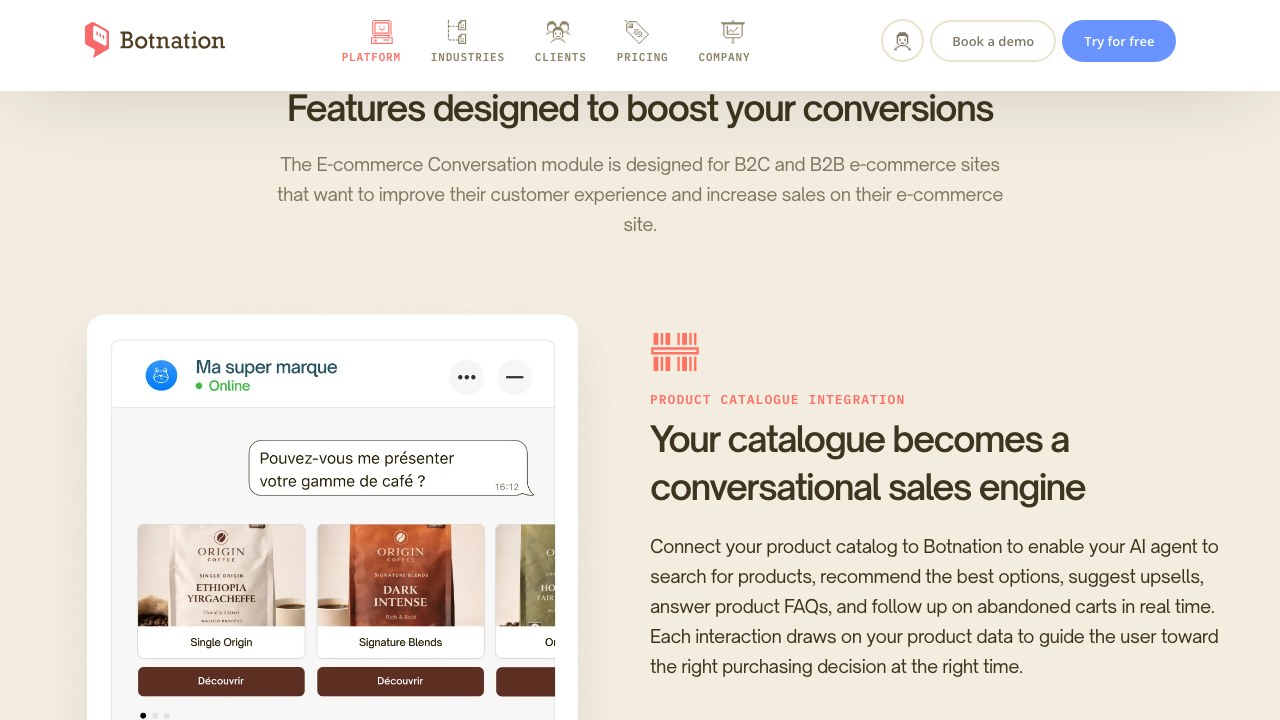
The quality of a chatbot recommendation is capped by the quality of your catalog. Empty attributes, out-of-sync prices, fantasy stock levels: the AI will amplify your gaps instead of fixing them. Before buying anything, audit your product sheets.
Chatbot recommendation: the real cost in 2026
Here is Botnation’s public grid as served on September 8, 2026, with no arrangement: the four subscription plans, then the side consumptions. AI credits cover model requests (500 Basic and 1,000 Pro credits are offered once at sign-up; the page breaks them down, for example 500 GPT-3.5 requests or 250 advanced requests or 50 GPT-4.0 requests for the Basic plan).
| Cost line | Price collected on September 8, 2026 | What to remember |
|---|---|---|
| Free plan | 0 € per month | Unlimited agents for testing, no credit card required. |
| Basic plan | 39 € per month | 500 users + 500 AI credits offered once. |
| Pro plan | 59 € per month | 1,000 users + 1,000 AI credits offered once. |
| Entreprise plan | On quote | Chatbot creation management, dedicated account manager, personalized onboarding. |
| 1,000-credit pack | 25 € | Unit refill, 10% discount shown on the pricing page. |
| 5,000-credit pack | 100 € | 15% discount shown. |
| 15,000-credit pack | 250 € | 20% discount shown. |
| 60,000-credit pack | 900 € | The high conversational volume tier. |
| Over-cap user | 0.05 € per user per month | The overage rule beyond your plan’s user cap. |
For custom builds, no serious price can be promised online: ours is discussed on quote, after understanding your context. And if you want to compare vendor approaches before deciding, our overview of chatbot solutions remains a good entry point.
The 5 most common selection mistakes
- Choosing on a spectacular demo. A studio-conditioned demo says nothing about your real traffic, your content, your customers. Always ask for a trial on your own data.
- Forgetting the main channel. A flawless chatbot on the website while 80% of your customers write on WhatsApp is a useless chatbot. Channel first, tool second.
- Underestimating the content work. The bot lives on your FAQs, your product sheets, your scenarios. That work is most of the project; the subscription, a minority.
- Believing AI replaces the scenario. Generative AI handles the unexpected, but critical paths (quotes, payment, appointments) remain scenarios: predictable, testable, fixable.
- Negotiating price before use case. A tariff negotiated on the wrong architecture costs more than a full-priced grid on the right one. Fix the use case, then the budget.
Our honest recommendation (including when it is not us)
Botnation publishes a no-code platform for building chatbots and AI agents across channels (website, WhatsApp, Messenger, Instagram), and also builds custom chatbots for its clients through the Entreprise offer: the team that builds is the team that publishes the platform, which avoids taking over a third-party development after delivery, and you keep your hands on the scenarios in the editor. That is our positioning, and it has a flip side: we are not the right answer everywhere, and saying so beats a promise that will break at the first obstacle.
- You want to animate a Discord community: there is no native Discord channel at Botnation. Our Discord chatbot article details the possible routes and their limits, including bots dedicated to that platform.
- You are after outbound voice telephony: a voice agent that calls customers is a different craft (real-time speech synthesis and recognition); some players devote themselves entirely to it.
- Your need touches proprietary line-of-business software or an on-site physical process: the integrator who already knows your information system will often deliver faster. Having a custom chatbot built by the platform publisher only makes sense if the build team leaves you autonomous afterwards: that is exactly our model, but it is not the only one.
For everything else (support, lead qualification, e-commerce, FAQ, appointment booking), the platform covers the need, and the Free plan lets you verify on your own data before any commitment: that is the best recommendation we can make, yours.
Get started in 15 minutes
- Create your free account on botnation.ai: 0 €, no credit card asked (pricing page, collected September 8, 2026).
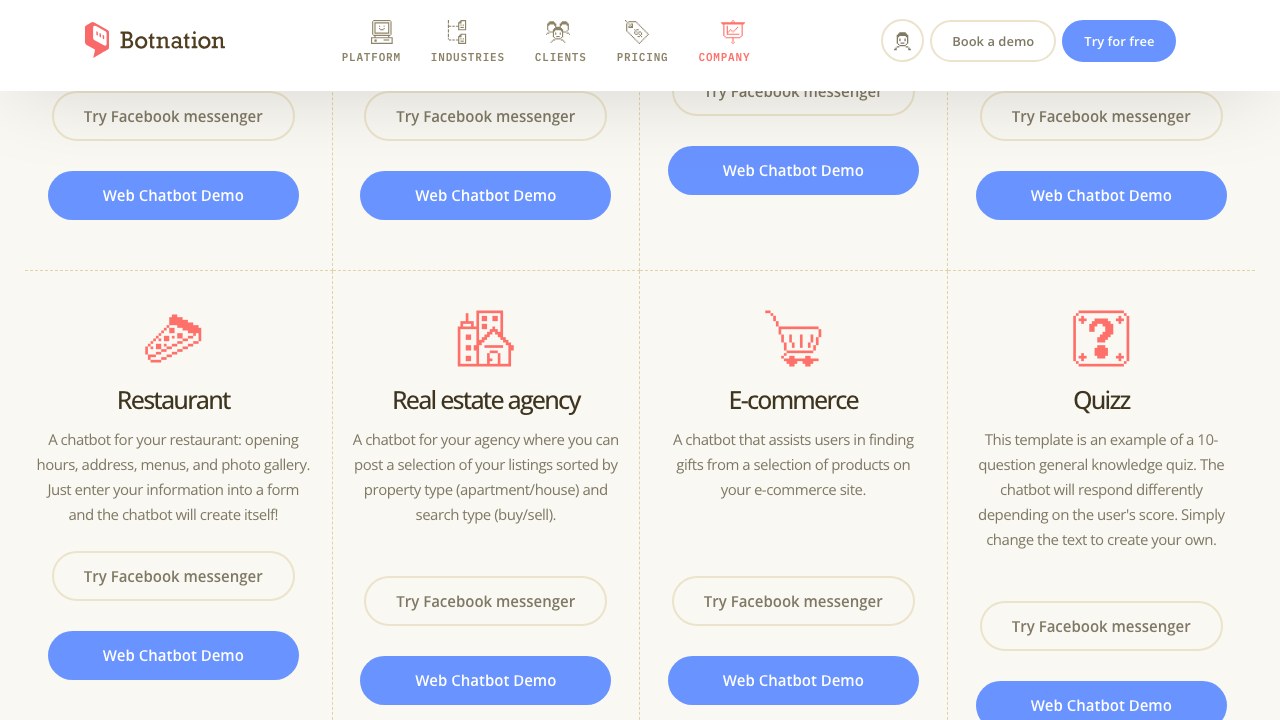
- Start from a template close to your use case (e-commerce, support, qualification) rather than a blank page: the demos gallery offers them for every family.
- Connect your content: import the FAQ or connect the catalog (Shopify, Magento, WooCommerce, Prestashop) depending on the target architecture.
- Publish on one channel only, measure (resolution rate, missed questions, satisfaction), then extend to other channels with the same content base.
FAQ: chatbot recommendation
What is the best chatbot in 2026?
There is no universally best chatbot: the right choice depends on your use case (support, leads, sales), your channels, your data and your budget. The 7 criteria in this article, applied honestly, will give you a better answer than any ranking. If you keep one rule: start with the free plan of a vendor that covers your channels, test on your real conversations, then move up.
How much does a recommendation chatbot cost?
At Botnation, entry is at 0 € (Free plan), then 39 € per month in Basic and 59 € per month in Pro (public grid collected on September 8, 2026), plus AI credits depending on your consumption: packs from 1,000 credits at 25 € up to 60,000 credits at 900 €, and 0.05 € per user beyond your plan’s cap. A chatbot fully designed for you goes through the Entreprise plan, on quote: no serious price can be promised without knowing your context.
Should I pick a rule-based chatbot or an AI chatbot?
Both, usually. Rule-based scenarios guarantee the predictability of critical paths (quotes, appointments, payment), while AI (generative or RAG on your content) absorbs unexpected questions and product recommendation. The hybrid architecture, where AI handles the open field and rules handle the sensitive ones, is the de facto standard in 2026.
Can a chatbot recommend products and stay GDPR-compliant?
Yes, provided you apply the principles recalled by the CNIL (the French data protection authority) in its “Chatbots” guidelines of February 19, 2021: defined purpose, data minimization (only ask what serves the recommendation), set retention period, clear information. Since August 2, 2026, Article 50 of the European AI Regulation additionally requires telling the user they are interacting with an AI. A recommendation can also run on the sole criteria stated in the dialogue, without purchase history: it is even the simplest model to keep compliant.
How long does it take to put a chatbot online?
In self-service, count from 15 minutes (a template published as is) to a few days (custom scenarios, imported FAQ, connected catalog). In custom builds, the calendar is built with the project team: specification, content, integrations, acceptance testing. In both cases, the state of your content is the real driver of the timeline.
Does Botnation fit every use case?
No, and we say so. The platform covers website, WhatsApp, Messenger and Instagram, with or without AI; it has no native Discord channel, does not do outbound phone voice agents, and a need tightly coupled to proprietary line-of-business software often belongs to the specialized integrator. Our Discord chatbot article details that use case, limits included.
Conclusion: the right recommendation is the one you can verify
“Chatbot recommendation” sets a trap: believing a list or a score will decide for you. In reality, the choice boils down to seven verifiable criteria, a readable price grid and a trial on your own data. And if your need is the other meaning of the query, the chatbot that recommends, the recipe is just as concrete: a clean catalog, two to four questions per dialogue, an argued recommendation, and guardrails on the AI. In both cases, you can start today, for free, and judge on the merits.
Try your future chatbot, free
Create your Botnation account at 0 €, no credit card, and verify on your own conversations. Or request a quote if you prefer to be supported by our build team.
Sources and method: readings from botnation.ai pages (pricing, e-commerce module, demos) collected on September 8, 2026; McKinsey & Company, “How retailers can keep up with consumers”, October 2013 (35% of Amazon purchases and 75% of Netflix viewing come from recommendations); Baymard Institute, meta-analysis of 50 studies on cart abandonment, September 2025 update (70.22% on average, 85.65% on mobile); CNIL (French data protection authority), “Chatbots” guidelines, February 19, 2021; Regulation (EU) 2024/1689 on artificial intelligence, Article 50, obligations applicable since August 2, 2026. The simulator in this article runs entirely in your browser and sends no data.