


Companies are increasingly faced with the question of whether or not to create a chatbot to enrich the user experience on company websites or for customer support services.
But what do consumers (really) think of chatbots? 🤔
That’s what we wanted to find out with this survey conducted by Botnation. We questioned 1,984 professionals and 2,041 consumers to find out how they view these new conversational tools. The figures reveal that chatbots are becoming increasingly popular, with customers and brands alike.
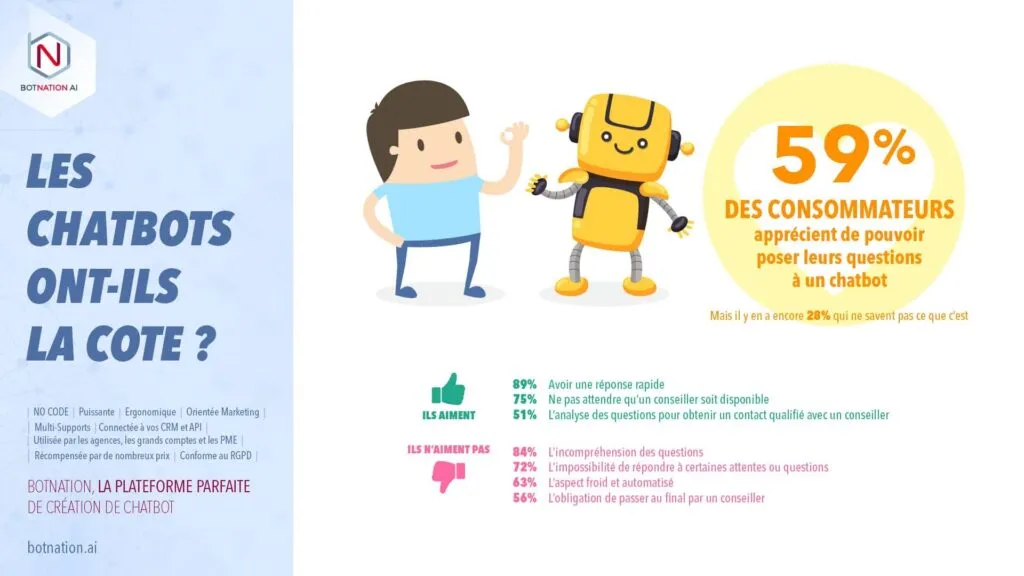
Infographic: Are Chatbots popular?
Interview Video analysis of the Botnation study
Detailed results
59% of consumers enjoy asking questions to a sculpin
89% love a quick answer, but 84% hate being misunderstood
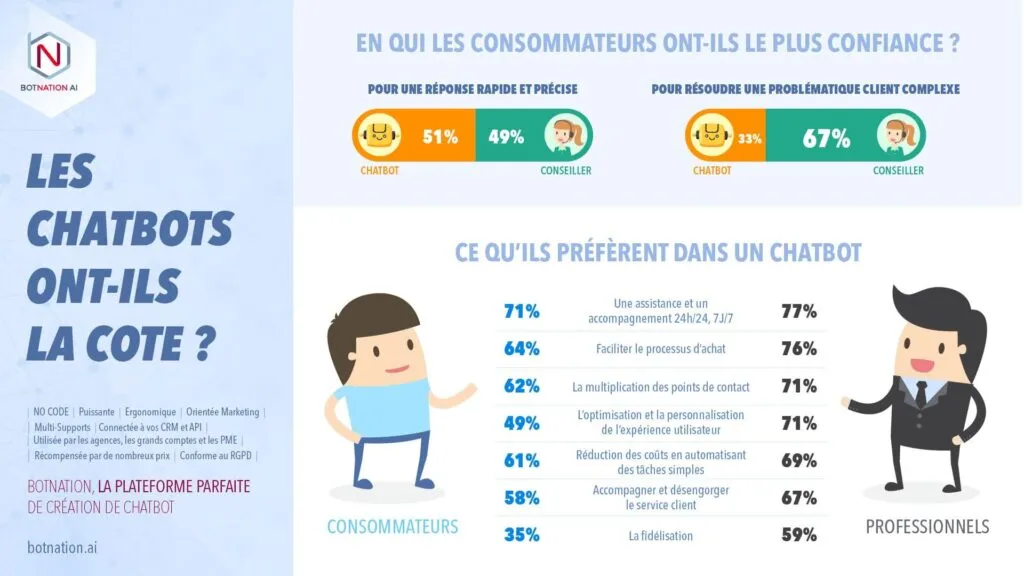
51% trust chatbots more for precise answers, but 67% prefer a human advisor for complex issues
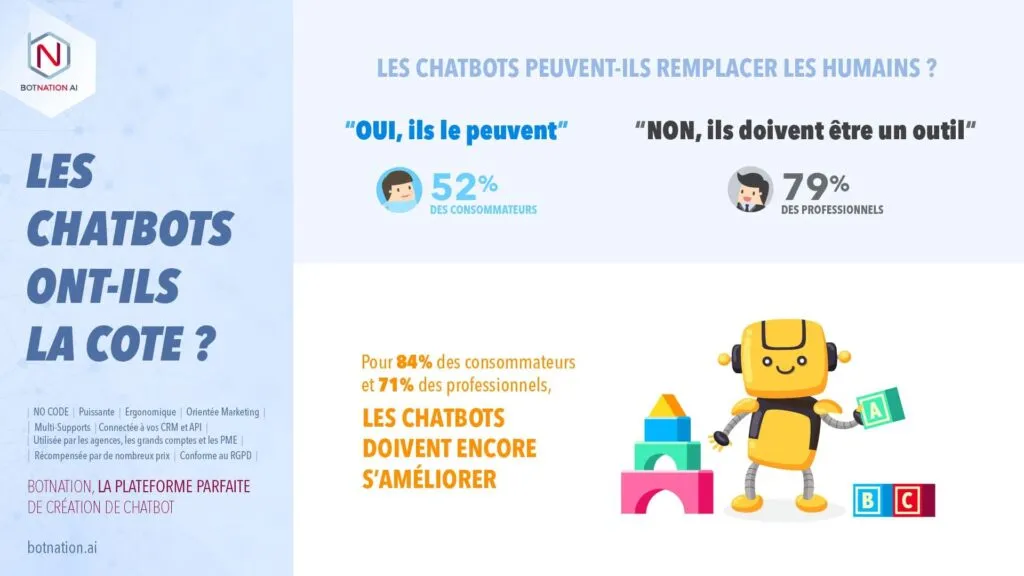
Chatbots still need to improve for 84% of consumers and 71% of professionals.
52% of consumers think chatbots can totally replace humans in relationships, while 79% of professionals think they are more of a complement.
” More and more, websites are offering interactive, automated communication tools. What we call “chatbot” and comes from the term “bot”, short for “robot” and the English word “chat” for “to discuss”. Talking with a bot therefore refers to a program designed to converse with users via a messaging platform or application such as Facebook Messenger or WhatsApp. But what do consumers and professionals really think of these conversational agents? That ‘s what we wanted to determine with this survey, to find out more about this conversational relationship, often the first contact with the brand or company “, commented Emmanuel Françoise, co-founder of Botnation.
Chatbot in love
While 28% of French consumers are still unaware of chatbots, the vast majority particularly appreciate being able to ask a conversational agent questions. More than 59% of consumers like this experience, compared with only 13% who are reluctant.
“When you’re looking for information on a website, do you appreciate being able to ask a chatbot your questions?”
| Answers | Percentages |
| Yes | 59 % |
| No | 13 % |
| I don’t know what a chatbot is | 28 % |
I like/dislike…
Among the features most appreciated by consumers, having a quick answer to their question tops the ranking with over 89% of representativeness. In second place, not having to wait for an advisor to be available obtained 75% of votes, well ahead of analyzing questions before obtaining a qualified human contact at 51%.
On the other hand, 84% of consumers dislike the fact that their questions are misunderstood by the chatbot, and 72% that some even go unanswered. The cold, automated aspect puts off 63% of respondents, and 56% think it’s a shame to go through an advisor in the end.
“What do you appreciate most about a chatbot?”
| Answers | Percentages |
| Quick response | 89 % |
| Don’t wait for an advisor to be available | 75 % |
| Analysis of my questions to obtain a qualified contact with an advisor | 51 % |
“What do you like least about a chatbot?”
| Answers | Percentages |
| Not understanding my questions | 84 % |
| Inability to meet certain expectations or answer certain questions | 72 % |
| The cold, automated look | 63 % |
| The obligation to go through an advisor in the end | 56 % |
In Bot we trust!
Surprising as it may seem, 51% of consumers trust chatbots more when it comes to getting fast, accurate answers to their questions. But 67% still prefer to go through a human advisor when it comes to resolving more complex issues.
“Who do you trust most to respond accurately and quickly?”
| Answers | Percentages |
| A chatbot | 51 % |
| An advisor | 49 % |
“Who do you trust most to solve a complex customer problem?”
| Answers | Percentages |
| An advisor | 67 % |
| A chatbot | 33 % |
“We shouldn’t be afraid to deploy the chatbot across all channels to kick-start the relationship with the prospect or customer. Users are now used to having instant conversations with both their families and brands. They no longer want the static contact forms of websites of yesteryear. However, the human relationship must by no means disappear – quite the contrary. The chatbot must provide a reliable, instant response, but it must also transfer the conversation to a human if it identifies a case that is too complex or has very high added value. The chatbot can even automatically arrange an appointment if the human is not immediately available. This is a point not to be overlooked,” explains Emmanuel Françoise, co-founder of Botnation.
And for the pros?
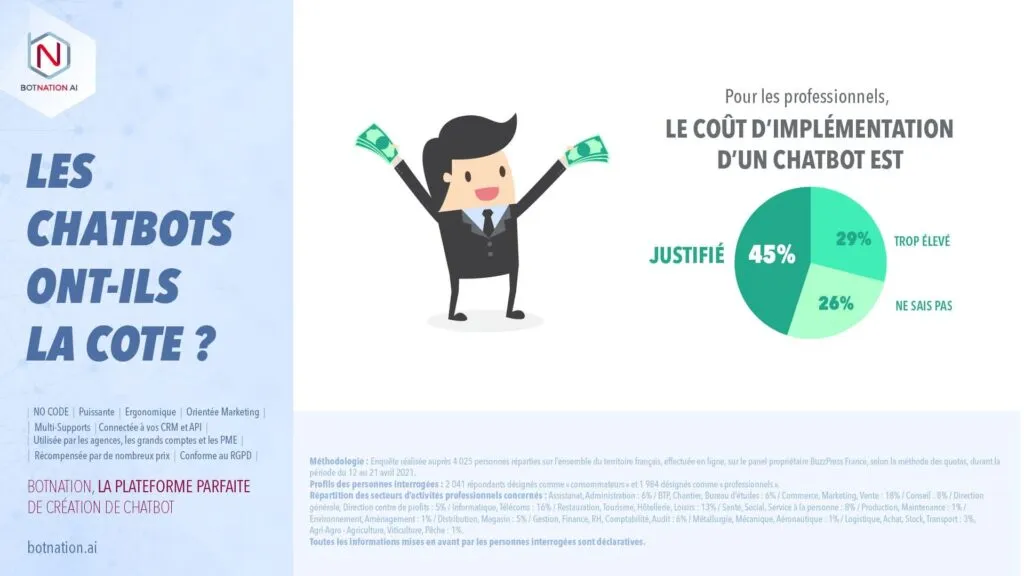
As far as professionals are concerned, the cost of implementing a chatbot doesn’t seem to be a particularly strong brake, since 45% consider it to be justified, and 26% have no opinion on the subject. Only 29% find it too high.
“What do you think about the cost of implementing a chatbot?”
| Answers | Percentages |
| It is justified | 45 % |
| It is too high | 29 % |
| I don’t know | 26 % |
“No-code (no programming) and self-service (SaaS) platforms are democratizing access to conversational agents equipped with Artificial Intelligence. Today, even small businesses and organizations can easily set up a chatbot. With this in mind, Botnation offers free chatbot templates for a variety of use cases. We want every company, even the smallest, to have access to these powerful tools. We’re often referred to as the WordPress of chatbots,” says Botnation co-founder Emmanuel Françoise.
Consos VS Pros
Do consumers and professionals appreciate the same things? When it comes to chatbots, both particularly like 24/7 assistance and support. This is stated by 71% of consumers and over 77% of professionals. Facilitating the purchasing process comes second with 64% and 76% respectively, just ahead of multiplying contact points with 62% and 71%. On the other hand, optimizing and personalizing the user experience is of greater interest to professionals (71%) than to consumers (49%).
“What criteria do you prefer with a chatbot?”
| Answers | Consumers | Professionals |
| 24/7 assistance and support | 71 % | 77 % |
| Facilitating the purchasing process | 64 % | 76 % |
| The multiplication of contact points | 62 % | 71 % |
| Optimizing and personalizing the user experience | 49 % | 71 % |
| Reduce costs by automating simple tasks | 61 % | 69 % |
| Supporting and relieving customer service bottlenecks | 58 % | 67 % |
| Loyalty | 35 % | 59 % |
Can do better…
To the question “Do you think chatbots still need to improve?”, over 84% of consumers and 71% of professionals answered in the affirmative.
“Do you think chatbots still need to improve?”
| Answers | Consumers | Professionals |
| Yes | 84 % | 71 % |
| No | 16 % | 29 % |
“Whether manual or automated, the transfer of knowledge must take place with a chatbot, just as it does when a new human employee arrives, and he too must be trained regularly when the company offers new services or products. Tools are available to keep the chatbot informed in real time of cases where it lacks knowledge, so that it can quickly perfect its skills, and then hand over to a human so as not to leave the user without an answer”, commented Emmanuel Françoise, co-founder of Botnation.
Humans versus robots?
Over 52% of consumers believe that chatbots can totally replace humans in customer relations. Professionals refute this, with only 21% believing so.
“At Botnation, we’re convinced that chatbots are incredibly effective tools, but that they must stay in their place, and in no way replace humans, who will always be able to support customers in their thinking. Chatbots are there to help humans, and they will do so better and better,” concludes Emmanuel Françoise, co-founder of Botnation.
“Do you think chatbots should replace humans in customer relations?”
| Answers | Consumers | Professionals |
| Yes they can | 52 % | 21 % |
| No, they must be a tool | 48 % | 79 % |
Methodology: survey of 4,025 people throughout France, conducted online, on the BuzzPress France proprietary panel, using the quota method, during the period from April 12 to 21, 2021.
Respondent profiles: 2,041 respondents designated as “consumers” and 1,984 designated as “professionals”.
Breakdown of professional sectors concerned: Assistanat, Administration : 6% / BTP, Chantier, Bureau d’études : 6% / Commerce, Marketing, Vente : 18% / Conseil : 8% / Direction générale, Direction center de profits : 5% / Informatique, Télécoms : 16% / Restauration, Tourisme, Hôtellerie, Loisirs : 13% / Santé, Social, Service à la personne : 8% / Production, Maintenance: 1% / Environment, Planning: 1% / Distribution, Warehousing: 5% / Management, Finance, HR, Accounting, Auditing: 6% / Metallurgy, Mechanics, Aeronautics: 1% / Logistics, Purchasing, Inventory, Transport: 3%, Agri-Agro – Agriculture, Viticulture, Fishing: 1%.
All the information provided by respondents is declarative.
About Botnation
Founded in 2017 by Emmanuel Françoise, Botnation is a chatbot creation platform based on proprietary AI. Botnation offers a freemium, ergonomic and “nocode” package including free tutorials and templates. The platform simplifies chatbot creation for all websites, WordPress, Facebook Messenger and Whatsapp.
The platform can be used live by companies, agencies and even students wishing to discover the power of artificial intelligence developed by Botnation.
The Botnation team consists of 10 people, divided between Paris and Rennes. The company already has several hundred customers, including major accounts such as Cdiscount, Enedis, Keolis, Société Générale and Facebook, as well as hundreds of SMEs. Botnation was also part of the prestigious Arsenal Innovation Lab program.
In just 4 years, Botnation has generated tens of millions of conversations and billions of exchanged messages.