




In short. Chatbot Arena (today LMArena / Arena) is the reference platform for ranking conversational AI models. The principle: people ask a question, get two anonymous answers, vote for the better one, and those millions of blind votes produce an Elo-style leaderboard. Born at UC Berkeley, it now holds more than 7 million votes and 360+ models.
This guide covers how it works, how to read the 2026 leaderboard, how to use it yourself, its limits (the “Leaderboard Illusion” controversy), and above all what it does not tell you when you pick a model for your own chatbot.
Since 2023, the same question comes up with every new AI release: “which one is the best?” Academic benchmarks grade models on exams, but not on what actually matters day to day: how good a conversation feels. That is exactly the gap Chatbot Arena fills. French tech outlet Blog du Modérateur even nicknamed it “the TripAdvisor of AI”: a leaderboard built by the crowd, out of real preferences. Here is how it works, without the jargon.
Chatbot Arena, LMArena, Arena AI: what is it?
Chatbot Arena is an open platform that evaluates large language models (LLMs) by human preference. It was launched in 2023 by the LMSYS research collective, which came out of the SkyLab at UC Berkeley. The founding idea, laid out in a paper cited more than 1,700 times (Chiang et al., 2024): instead of grading an AI on an exam, you make it face another AI on real user questions, and let the public decide.
Chatbot Arena / LMArena / Arena: a leaderboard for conversational AI built on anonymous “battles” between two models, settled by the votes of millions of users. The same project has changed names three times: Chatbot Arena (the original), then LMArena when it spun out as an independent company, and now simply Arena since January 2026 (official address: lmarena.ai).
From research project to billion-dollar startup
What started as a university demo turned into a business. Chatbot Arena split off from LMSYS to become a standalone company, took the name LMArena, then completed its rebrand to “Arena” on January 28, 2026. The funding trajectory is spectacular: $100 million raised in May 2025 (at a valuation of roughly $600 million), then a $150 million Series A in January 2026, pushing the valuation close to $1.7 billion (rounds led notably by Andreessen Horowitz, then Felicis and UC Investments). A sign that the “referee” of the AI race has become a coveted strategic asset.
How the leaderboard works (Elo score explained)
The mechanism is brutally simple, and that is exactly its strength. Everything rests on the blind battle: at no point does the voter know which models they are comparing, which neutralizes brand bias (nobody votes “for ChatGPT” out of habit).
- You ask a question. Any prompt, in any language, just like with a regular chatbot.
- Two AI models answer, anonymously. The platform draws two models at random (labeled “Model A” and “Model B”) without revealing which ones.
- You vote. You pick the better answer, call it a tie, or say both are bad.
- The identities are revealed. Once your vote is recorded, you find out which models were competing.
- The leaderboard updates. Every battle adjusts the score of both models involved.
Elo, Bradley-Terry: where does the score come from?
People usually say “Elo score”, after the chess rating system. In practice, Arena has used a related but more robust statistical model since 2024, the Bradley-Terry model, fitted by maximum likelihood across all the votes. The idea stays the same: the more a model wins its duels against strong opponents, the higher its score climbs. A score gap translates into a win probability: a model ranked clearly higher will statistically beat a lower-ranked one more often.
Voters tend to prefer answers that are long and nicely formatted, even when they are not any more accurate. To correct that bias, Arena applies a statistical filter called Style Control, which strips out the effect of length and formatting. The result: two leaderboards coexist, “raw” and “with Style Control”, and the order can shift slightly between them.
The Arena leaderboard in 2026 (interactive snapshot)
Here is a snapshot of the “text” leaderboard as of July 1, 2026. Filter by provider, search for a model, or sort the columns. The scores are indicative: the ranking moves constantly, and the live version is on lmarena.ai.
Arena leaderboard explorer: text models
Indicative snapshot from July 1, 2026 · ~7.1M votes · 369 models. Click a column header to sort.
| Rank | Model | Provider | Score |
|---|---|---|---|
| 1 | Claude Fable 5 | Anthropic | 1509 |
| 2 | Claude Opus 4.6 (thinking) | Anthropic | 1504 |
| 3 | Claude Opus 4.7 (thinking) | Anthropic | 1502 |
| 4 | Claude Opus 4.6 | Anthropic | 1499 |
| 5 | Claude Opus 4.7 | Anthropic | 1494 |
| 6 | Muse Spark | Meta | 1487 |
| 7 | Gemini 3.1 Pro Preview | 1486 | |
| 8 | Gemini 3 Pro | 1486 | |
| 9 | Claude Opus 4.8 (thinking) | Anthropic | 1484 |
| 10 | GPT-5.5 (high) | OpenAI | 1481 |
| 11 | Gemini 3.5 Flash | 1479 | |
| 12 | GPT-5.4 (high) | OpenAI | 1478 |
Source: snapshot of the Arena text leaderboard (lmarena.ai), July 1, 2026. Scores are rounded and indicative only. Check the site for the live ranking and the other categories.
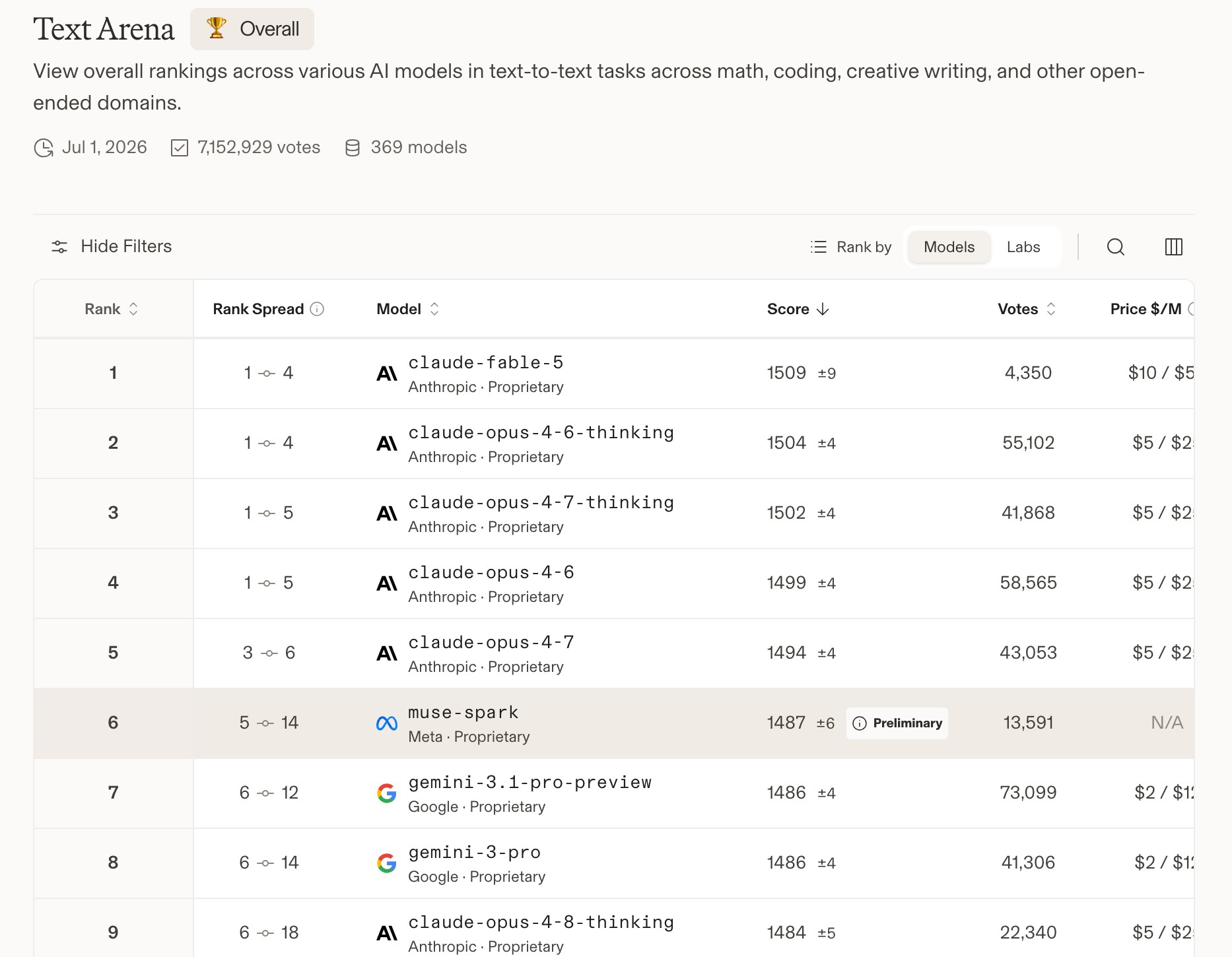
The best models sit within a few dozen points of each other. An AI ranked “#4” is not perceptibly “worse” than the “#1”: the gap is often inside the margin of error. The leaderboard separates very close champions, not a good model from a bad one.
The 9 arenas: text, code, vision, video, and more
Arena is no longer a single leaderboard. The platform now runs public votes across nine categories, because “the best AI” depends entirely on the task. A model that writes beautifully can be mediocre at coding an interface.
| Arena | What it measures |
|---|---|
| Text | General conversation: writing, reasoning, answering questions. |
| Code | Generating and fixing programming code. |
| WebDev | Building working web interfaces and mini apps. |
| Vision | Understanding images supplied along with the question. |
| Image Edit / Multi-Image | Generating and editing images from written instructions. |
| Search | Answers grounded in a real-time web search. |
| Text-to-Video / Image-to-Video | Generating video from text or from images. |
How to use Chatbot Arena yourself
Good news: it is free and needs no account. You can both feed the leaderboard and use it as a comparison tool.
- Battle mode: ask a question, then vote blind between two answers. This is how you feed the collective ranking.
- Side-by-side mode: pick two specific models yourself and compare their answers on your actual use case. Ideal for choosing between two AI models before you pay for one.
- The leaderboard: browse the tables by category to spot the rising models and see where the race stands.
Side-by-side mode is the most useful one in practice. Before paying for an AI subscription, run your real work questions through it: the ones from your job, in your own vocabulary. The global ranking matters less than performance on your actual use case, a habit that also heads off plenty of classic chatbot-building mistakes.
The limits: the “Leaderboard Illusion” controversy
Chatbot Arena is the reference, but it is not perfect, and you should know that before trusting it blindly. In April 2025, a high-profile study titled “The Leaderboard Illusion”, run by researchers at Cohere Labs with AI2, Princeton, Stanford, Waterloo and the University of Washington, flagged several structural biases.
According to the authors, the big labs could test many variants privately of the same model and publish only the best one. Meta reportedly tested up to 27 variants before releasing Llama 4. The study also estimates that Google and OpenAI each received roughly 19 to 20% of the arena’s data, against about 30% for 83 open models combined. Access to that preference data could inflate scores artificially, with gains estimated at up to +112% on the arena distribution.
Arena, for its part, responded publicly to the criticism: the platform says its testing policy is fair and that any lab can submit as many variants, public or private, as it has the capacity to run. The debate illustrates a classic problem (Goodhart’s law): once a measure becomes a target, it stops being a good measure. French trade magazine L’Usine Digitale summed up the risk bluntly, arguing that these testing practices mainly benefit Amazon, Google and Meta.

What the Arena leaderboard does NOT tell you about your chatbot
This is the part that matters most for a business. Chatbot Arena measures one precise thing: the general preference of internet users for a conversational answer, in a lab setting. That is very useful for tracking the race between frontier models. But it does not answer your real question: “which model is the right one for my company’s chatbot?”
Because for a professional chatbot, the raw model is only one ingredient among several. An assistant that answers perfectly on the Arena can be unusable for your customer support if it does not know your products, your pricing or your procedures. The right choice depends first on the type of chatbot you are building, not on the top of a general-purpose leaderboard.
What the Arena measures
- Generic conversation quality, out of context.
- Voter preference on open-ended questions.
- A global ranking, at a single point in time.
- The “race” between the frontier models.
What counts for YOUR bot
- That it knows your data (products, FAQ, procedures).
- The right balance of cost / speed / accuracy.
- Guardrails and a tone that fits your brand.
- Deployment on your channels (website, WhatsApp, and more).
In other words: the top model on the leaderboard is not necessarily the best choice for you. A high-performing business chatbot is a good model + your data (through RAG, the technique that “feeds” the AI your own documents) + orchestration (scenarios, handoff to a human, connections to your tools). That is exactly what a platform like Botnation is for: you build your agent in no-code, plug it into your own content, and stay free to switch the underlying model, without betting on whichever model is #1 this month. To go further, see how to train a chatbot on your own data, or browse real chatbot examples built that way.

Frequently asked questions about Chatbot Arena
What exactly is Arena AI?
“Arena AI” (at lmarena.ai) is the new name of Chatbot Arena, adopted in early 2026. It is the same platform for ranking AI models through blind human votes, now run by an independent company. The names “Chatbot Arena”, “LMArena” and “Arena” all refer to the same project at different stages of its history.
Is Chatbot Arena free?
Yes. Using the arena (voting blind, comparing two models side by side) and browsing the leaderboards is entirely free and requires no account. That openness is what made it possible to gather several million votes.
Which AI chatbot is the best in 2026 according to Arena?
The top of the leaderboard changes very fast, and it is decided by a handful of points between the frontier models from Anthropic (Claude), Google (Gemini), OpenAI (GPT) and Meta. As of July 1, 2026, the Claude family held several of the very top spots on the text arena, but the gap to the models behind stayed minimal. For today’s exact standings, check lmarena.ai, and above all, test your finalists on your own questions.
How is it different from classic benchmarks (MMLU, etc.)?
Academic benchmarks (MMLU, GPQA and the like) grade models on exams with verifiable answers: they measure knowledge and reasoning under test conditions. Chatbot Arena measures human preference on open-ended conversations. The two are complementary: one tells you who knows the most, the other who people actually prefer to use. Neither is enough on its own.
Is the leaderboard enough to choose the model for my chatbot?
No. The leaderboard helps you shortlist good models, but a high-performing business chatbot depends mostly on your data, your scenarios, cost, latency and the channels you target. The world #1 can be overkill, too expensive or useless if it knows nothing about your business. Always compare your finalists on your real use case before deciding.
Can you “game” the Arena leaderboard?
The study “The Leaderboard Illusion” (2025) showed that large labs can optimize their position, notably by testing many private variants and by exploiting preference data. Arena disputes any unfairness and points out that its policy is open to everyone. The takeaway: the leaderboard is a solid indicator, not an absolute truth.
Your chatbot deserves better than a bet on the #1 of the month
With Botnation, build an AI chatbot fed by your own data and deploy it on your website, WhatsApp or Messenger, in no-code, without depending on a single model. Try it for free.
Sources: Chiang et al., “Chatbot Arena: An Open Platform for Evaluating LLMs by Human Preference” (2024); Singh et al., “The Leaderboard Illusion” (Cohere Labs et al., 2025); Arena’s official response; Blog du Modérateur, L’Usine Digitale, InformatiqueNews (French tech press). Leaderboard snapshot: lmarena.ai, July 1, 2026 (indicative).