


ELIZA is the first chatbot in history. Built between 1964 and 1966 by Joseph Weizenbaum at MIT, the program imitates a psychotherapist by turning your own sentences back into questions. It understands nothing: it spots keywords and returns the ball. Yet the earliest users grew attached to it, to the point of confiding in it. That is the ELIZA effect.
In this guide: its history, exactly how it works, an interactive demo so you can talk to it, and what separates this pioneer from today’s AI chatbots.
Long before ChatGPT, Gemini or the conversational agent on your bank’s website, a machine convinced human beings that it was listening to them. It was called ELIZA, it fit into a handful of grammar rules, and it kicked off the whole chatbot story without meaning to. Sixty years later, it is still the best lesson in humility, and in clear thinking, about the way we relate to machines that talk.
What is ELIZA?
ELIZA is a natural language conversation program, the first of its kind. It was written by the German American computer scientist Joseph Weizenbaum, a professor at the Massachusetts Institute of Technology (MIT), and described in a paper published in January 1966 in the journal Communications of the ACM. The original program ran on an IBM 7094 under MIT’s time-sharing system, and was written in a language called MAD-SLIP.
Its name comes from Eliza Doolittle, the heroine of George Bernard Shaw’s play Pygmalion, a flower girl who is taught to speak “properly”. The wink was deliberate: like her, ELIZA produces the illusion of polished conversation without mastering any of the substance.
A chatbot (or conversational agent) is a piece of software that talks with a human in natural language, in writing or by voice. ELIZA is its ancestor: it introduced the idea that a machine can hold a credible conversation without “understanding” a thing.
How does ELIZA work?
The principle is disarmingly simple. ELIZA does not understand what your sentences mean: it applies rules of pattern matching and reformulation. In practice, it works in three steps.
- It looks for a keyword. Every sentence you type is run against a list of trigger words (“I”, “mother”, “always”, “dream”…), ranked by priority.
- It applies a response template. Each keyword maps to a sentence pattern. “I am…” triggers “How long have you been…?”.
- It hands your own words back. ELIZA re-injects the tail of your sentence with the pronouns swapped: “I” becomes “you”, “my” becomes “your”. Your statement returns to you as a question.
The whole thing is driven by a “script”, an interchangeable set of rules. The most famous one is called DOCTOR: it casts ELIZA as a Rogerian psychotherapist, the school of therapy that consists precisely of reflecting patients’ own words back at them to keep them talking. A shrewd choice. As Weizenbaum wrote in 1966, the psychiatric interview is one of the rare exchanges in which one of the two parties is “free to assume the pose of knowing almost nothing of the real world”. In that setting, ignorance passes for attention.
| You write | ELIZA replies | Rule applied |
|---|---|---|
| I am unhappy | How long have you been unhappy? | Keyword “I am”, reformulation |
| My mother doesn’t understand me | Tell me about your family. | Keyword “mother” |
| I think you are wrong | So you believe I am wrong? | Pronoun swap |
| bfjkls (gibberish) | Tell me more. | No keyword: neutral fallback |
ELIZA has no memory of the conversation and “knows” nothing: every reply depends only on the last sentence you typed. The entire impression of being listened to comes from the reformulation.

Demo: talk to ELIZA right now
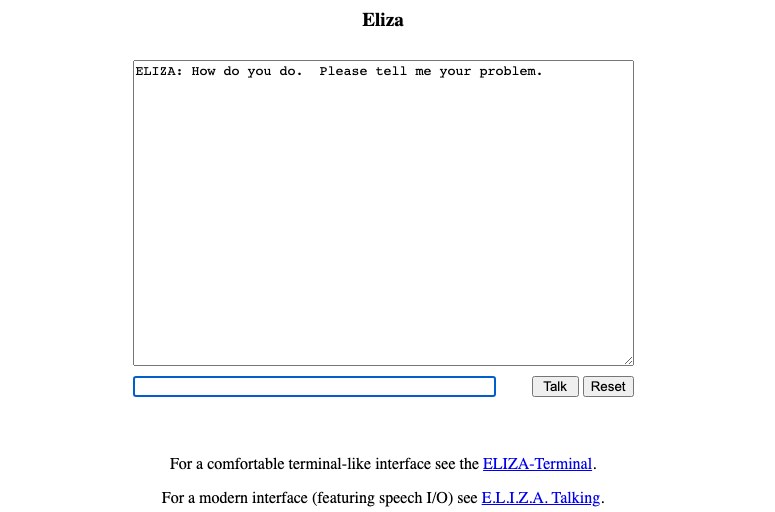
The best way to understand ELIZA is to talk to it. Below is a faithful reconstruction of its DOCTOR engine, in English, running entirely in your browser. Hand it a thought, a worry, a question, and watch how it hands them straight back. Tip: start a sentence with “I…”, or mention your “mother” or your “dreams” to see the rules fire.
ELIZA, your therapist from 1966
A reconstruction of the DOCTOR script. Everything runs in your browser, nothing is sent anywhere or stored.
An educational demo that reproduces ELIZA’s logic (keywords plus reformulation). It is not a mental health support tool.
The ELIZA effect: when we lend a soul to the machine
Weizenbaum had not seen what came next. As he let colleagues and his own secretary try the program, he ran into something unsettling: his secretary, who knew perfectly well that this was nothing but a piece of software, one day asked him to leave the room so she could talk to ELIZA “in private”. Users confided in it, projected empathy onto it, credited a program with an understanding it simply did not have.
The phenomenon has a name today: the ELIZA effect. It is our tendency to attribute understanding, intentions, even feelings to a machine as soon as it produces language that resembles our own. The illusion does not come from the machine. It comes from us.
The ELIZA effect has not faded, it has grown. Faced with generative AI infinitely more convincing than the 1966 program, the same caution applies: a chatbot that writes “I understand” feels nothing at all. It is a tool, not a confidant.
Deeply shaken, Weizenbaum became one of the first serious critics of triumphant computing. In 1976 he published Computer Power and Human Reason, in which he warned against the idea that humans and machines are interchangeable, and refused to hand over to programs the decisions that call for human judgment. The creator of the first chatbot became its most clear-eyed opponent.
ELIZA next to today’s chatbots
Between the DOCTOR script of 1966 and a modern conversational agent, the gap is enormous, but the goal has not moved: hold a useful conversation. Here is what changed.
| Criterion | ELIZA (1966) | Generative AI chatbot (LLM) | No-code chatbot (Botnation, for example) |
|---|---|---|---|
| Technology | Keywords plus reformulation | Large language model trained on billions of texts | Visual flows plus AI plus your own data (RAG) |
| Understanding | None (pure illusion) | Statistics of language, with no awareness | Framed by your business and your approved answers |
| Memory | None | The context of the conversation | History plus a connection to your tools |
| Reliability of answers | Off topic the moment things get complicated | Fluent, but can hallucinate | Anchored in sources you control |
| Setup | Programming on a mainframe | APIs and prompts | No code, in a few hours |
ELIZA’s lesson still holds: a good chatbot does not need to think, it needs to answer well. The best tools today are not trying to imitate a human, they are trying to solve one precise problem, booking a slot, answering a question, qualifying a lead, by leaning on the right data. That is the whole difference between a parlor trick and a service. If the mechanics are still fuzzy, our guide to the types of chatbot breaks down every major family, from the simplest to the generative.
From PARRY to ChatGPT: the ELIZA legacy
ELIZA opened a door that nobody has closed since. As early as 1972, psychiatrist Kenneth Colby built PARRY, a program that simulated a patient with paranoia this time, and a “conversation” between ELIZA and PARRY was even staged over ARPANET, the ancestor of the internet. Then came voice assistants, customer service chatbots, and finally generative AI such as ChatGPT, which blew past every assumption about what a machine could write.
A measure of its place in history: in 2025, a team of researchers including Jeff Shrager found ELIZA’s original source code in the MIT archives, in MAD-SLIP, DOCTOR script included. They got it running again on an emulator of the 1966 system. The first chatbot in the world, revived sixty years later, on the first time-sharing system ever built. A book, Inventing ELIZA, is out from MIT Press in 2026.

Frequently asked questions about ELIZA
What is ELIZA?
ELIZA is the first chatbot in history, created by Joseph Weizenbaum at MIT and presented in 1966. It is a natural language conversation program that imitates a psychotherapist by turning the user’s sentences back into questions, using a set of keywords.
When was the ELIZA chatbot created?
Weizenbaum developed ELIZA between 1964 and 1966. The reference date is January 1966, the year his founding paper appeared in the journal Communications of the ACM. In 2026, ELIZA turns 60.
What is the ELIZA effect?
The ELIZA effect is our tendency to credit a machine with understanding, intentions or feelings simply because it produces human language. It takes its name from Weizenbaum’s secretary, who confided in the program while knowing full well it was only software. The effect is even stronger with today’s AI.
Was ELIZA a real artificial intelligence?
No, not in the modern sense. ELIZA understands nothing and learns nothing: it applies fixed rules for keyword matching and reformulation. It belongs to the early “symbolic” AI, a long way from the neural networks and large language models of today.
Can you still talk to ELIZA today?
Yes. Many ports exist, notably in JavaScript, and you can try our English reconstruction of the DOCTOR script directly on this page. Since 2025, the original source code has even been put back into service on an emulator that reproduces the 1966 MIT machine.
What does ELIZA have to do with a modern business chatbot?
ELIZA proved that a credible conversation could come out of simple rules. Today’s chatbots keep that scripted logic but add AI and your own data on top, so they give real answers. With a platform like Botnation, you build that kind of agent without coding. To go further, see what an automated FAQ chatbot can handle, or browse concrete examples that work.
Build your chatbot without writing a line of code
ELIZA showed the way 60 years ago. Today you can launch a genuinely useful conversational agent for your website, your customer support or your sales team, in a few hours, with AI and your own data.
Sources: J. Weizenbaum, “ELIZA: A Computer Program For the Study of Natural Language Communication Between Man and Machine”, Communications of the ACM, 1966; J. Weizenbaum, Computer Power and Human Reason, 1976; Rupert Lane, Anthony Hay, Arthur Schwarz, Jeff Shrager, “ELIZA Reanimated” (arXiv 2501.06707, 2025); Wikipedia, “ELIZA” entry.