



- The format follows the visitor: a guide, a checklist, a webinar or a meeting.
- Before a commercial email, CAN-SPAM asks for no opt-in; for a text sent by an autodialer, the FCC asks for written consent.
- The contact you collect feeds your CRM; a salesperson takes over.
A free white paper behind a long form, and visitors who close the tab. At Essentiel Patrimoine & Viager, the whole journey ran through a detailed web form, “sometimes perceived as too engaging too soon.” A lead magnet changes hands differently: in a conversation, one question at a time.
What is a lead magnet, and which formats can it take?
A lead magnet is a trade: the visitor receives something useful for free, the company receives a contact it may use afterwards.
The product page names several through its ready-made scenarios: content to download for a guide or an ebook, event registration for a webinar, meeting booking for a demo.
The sector guides add the checklist and the template, plus quizzes, calculators and case studies.
Choose the format according to the visitor’s goal
The right format answers what the visitor came to do.
| Format | What the visitor gets | In a Botnation chatbot |
|---|---|---|
| Guide, ebook or white paper | A document to read | Yes: the “download content” scenario |
| Checklist or template | A framework to fill in | Yes: the same scenario |
| Webinar | A seat at an online event | Yes: the “register for an event” scenario |
| Meeting or demo | A time slot with your team | Yes: the chatbot “can offer meeting booking, call requests” |
The question to ask yourself
What does your visitor want now: something to read, or a person to talk to? The first calls for a guide, the second for a meeting.
Give the content inside the conversation, not behind a form
-
Engage the visitor at the right moment
The bot can act when interest is there, including as the visitor is about to leave: the product page speaks of “capture leads that would otherwise leave”.
-
Offer the content with a ready-made scenario
Nothing to build: “Activate ready-to-use scenarios: request a quote, make contact, B2B qualification, register for an event, or download content.”
-
Ask one question at a time
The conversation stays on the essentials: “Engage your visitors through natural conversations to gather the right information: needs, budget, timing, role, project.”
-
Pass the contact to the CRM, then to a salesperson
The contact lands in your CRM, assigned to the right team: “Leads are automatically synchronized, enriched, and assigned to the right teams.” When a prospect warms up, the conversation moves from the AI agent to a human.
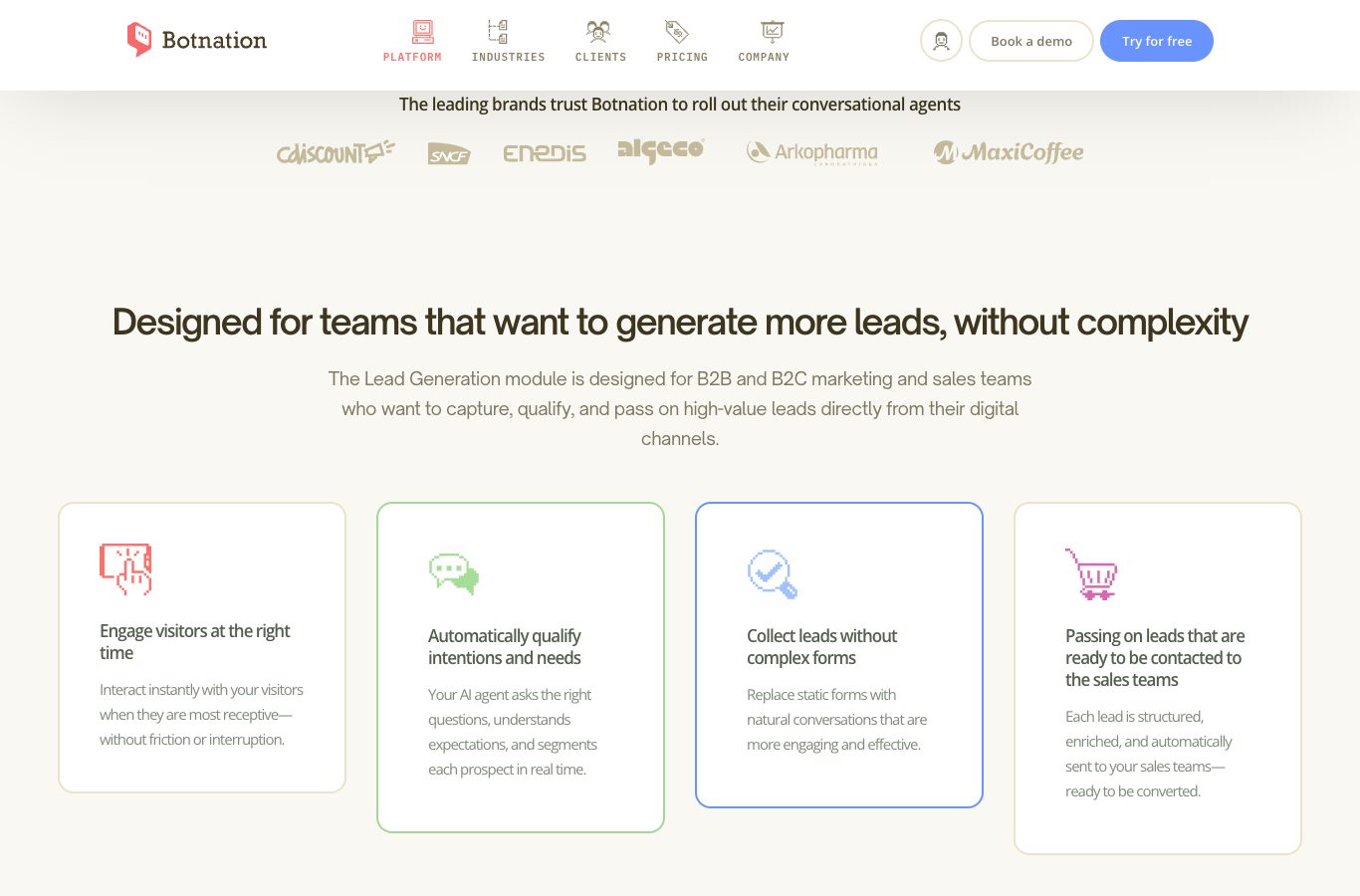
The Botnation product page dedicated to lead generation describes these four moments.
“Before Botnation, the entire process was based on a detailed web form,” recounts the Essentiel Patrimoine & Viager client case. There, the bot opens the exchange with a “priority collection of telephone numbers”, “to facilitate rapid human contact”.
“When I call back, half the time, prospects have already spoken to the bot.”
With Botnation
Offer your content in a conversation, receive the contact in your CRM
The Lead Generation module engages visitors, qualifies them in the exchange, passes on leads that are ready to be contacted and hands over to a salesperson. HubSpot and Salesforce are among the CRM integrations.
- Qualification happens in the exchange itself.
- A free trial: “No credit card required.”
What the law asks, from the free offer to the follow-up email
Giving content opens an exchange; what you may send afterwards has its own rules.
What the law says
The FTC’s guide to the CAN-SPAM Act opens with its scope: “It covers all commercial messages”, and business-to-business email is no exception. In 2015, its blog “Candid answers to CAN-SPAM questions” added: “The CAN-SPAM Act doesn’t require initiators of commercial email to get recipients’ consent before sending them commercial email. In other words, there is no opt-in requirement.”
- A postal address that checks out: “Your message must include your valid physical postal address.”
- A way out, explained clearly: “Your message must include a clear and conspicuous explanation of how the recipient can opt out of getting marketing email from you in the future.”
- An advertisement, named as such: “you must disclose clearly and conspicuously that your message is an advertisement”. Consent gathered in advance removes only this duty: “All other CAN-SPAM requirements still apply.”
- A subject line that matches the message: “The subject line must accurately reflect the content of the message.”
- An opt-out honored promptly: “You must honor a recipient’s opt-out request within 10 business days”, and the mechanism must keep working “for at least 30 days after you send your message”.
- A costly slip: “Each separate email in violation of the CAN-SPAM Act is subject to penalties of up to $53,088, so non-compliance can be costly”, the FTC’s guide warns.
For texts, the rule tightens: “Commercial texts require written consent; for informational texts, your consent may be oral”, writes the FCC on its page updated on November 20, 2026. In California, a business that meets the CCPA thresholds owes a “notice at collection” to the people whose data it takes, “at or before the point at which the business collects your personal information”, says the California Attorney General’s CCPA page. For EU visitors, the GDPR weighs the exchange itself: consent can be withdrawn as easily as it is given, and Article 7(4) states: “When assessing whether consent is freely given, utmost account shall be taken of whether, inter alia, the performance of a contract, including the provision of a service, is conditional on consent to the processing of personal data that is not necessary for the performance of that contract.” The EDPB considers tying consent to a service that does not need it “highly undesirable” (Guidelines 05/2020). The reading these texts support: keep marketing consent as its own, separate choice, for marketing emails to EU visitors as for commercial texts; under CAN-SPAM, it remains a choice. Nothing here makes a gated download illegal.
Our guide to the chatbot for lead generation takes the method further.
The three indicators that tell whether the offer works
The appeal
Sign-up rate
Sign-ups counted against the visitors of the page.
The cost
Cost per prospect
The advertising budget divided by the sign-ups, if you run ads.
What follows
Conversion to customers
The buyers that came from the offer, counted against its sign-ups.
These numbers come together in the CRM, where Botnation synchronizes the leads.
Frequently asked questions
Lead and prospect: is there a difference?
No difference to manage: the trade uses lead and prospect interchangeably, two names for the same contact.
Do you need consent to send the requested guide?
For the delivery itself, the European guidance answers: “If a controller seeks to process personal data that are in fact necessary for the performance of a contract, then consent is not the appropriate lawful basis.” The marketing that follows is another matter: in the EU, it asks for consent; for commercial email in the United States, the FTC noted in 2015 that none is required.
Can a chatbot replace the contact form?
That is Botnation’s bet: “Replace static forms with natural conversations that are more engaging and effective”, says its Lead Generation page. In the Essentiel Patrimoine & Viager case, the bot even opens by asking for the phone number.
Can I try Botnation without paying?
Yes: the pricing page says, “Try out the features for free. No credit card required.” And the same page’s FAQ adds: “No, we only need you to log in with your Facebook, Google, or email account.”
Sources
- “CAN-SPAM Act: A Compliance Guide for Business”, FTC. “Candid answers to CAN-SPAM questions”, FTC blog, August 18, 2015.
- “Stop Unwanted Robocalls and Texts”, FCC, page updated on November 20, 2026.
- The CCPA page of the California Attorney General, updated on August 28, 2026.
- Regulation (EU) 2016/679 (GDPR), EUR-Lex. “Guidelines 05/2020 on consent under Regulation 2016/679”, EDPB, version 1.1, 2020.
Offer your first piece of content in a conversation.
Botnation has a free plan, with no credit card.