


There have never been so many enquiries sent to local councils. What if a council chatbot could be the answer?
Between phone calls, emails, forms and dealing with visitors in person, reception staff at town halls now have to handle a constant stream of enquiries, many of which are repetitive.
At the same time, users’ expectations are changing: they want quick responses, without being tied to specific opening hours.
In response to these developments, chatbots are emerging as an effective solution for providing citizens with a more efficient and pleasant experience.
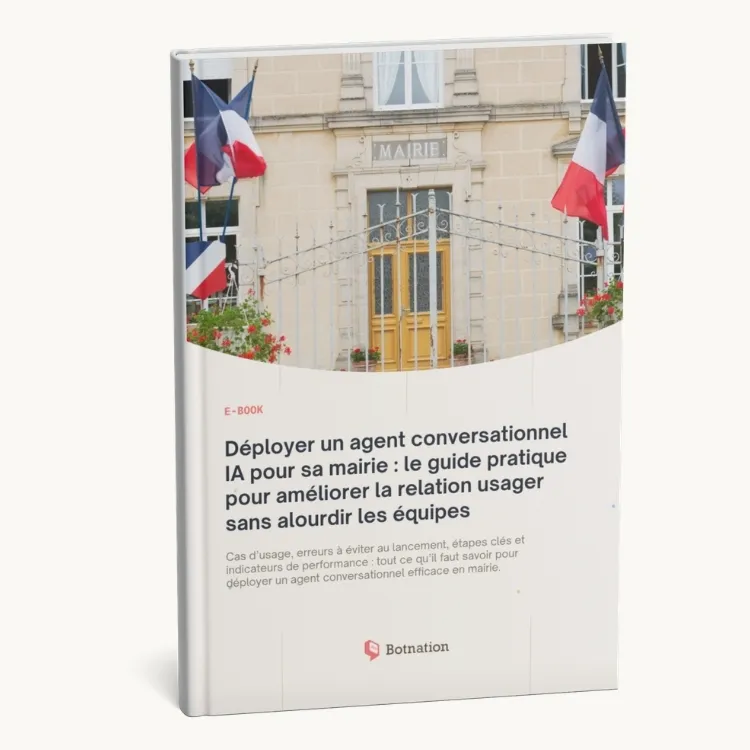
We have compiled the lessons learnt from our deployments in local authorities into a practical guide to help you launch a useful chatbot within the first few weeks.
This e-book contains everything you need to know to successfully deploy a chatbot for users without any mistakes. It is available to download free of charge.
What is a chatbot for a local council?
A chatbot for a town hall is an online conversational assistant that allows users to get immediate answers to their questions, without having to make a phone call or visit in person 🤗
In practical terms, it is integrated into the local authority’s website (or other channels) and enables users to find answers to frequently asked questions (opening hours, procedures, documents required) and be directed to the right department.
By providing round-the-clock support, it guides users through their administrative procedures.
It is a single, simple and accessible point of contact that complements traditional channels (telephone, email, in-person reception).
Why local councils are adopting chatbots today
Chatbots are becoming increasingly common in local councils 🏛️
It is, in fact, a direct response to pressure that has become difficult to cope with on a day-to-day basis.
Customer service teams are currently facing constant pressure. The volume of enquiries is increasing across all channels, whilst human resources are struggling to keep pace.
Agents spend a large part of their time dealing with simple, often urgent, enquiries, at the expense of more complex issues that genuinely require their expertise.
Added to this is a well-known phenomenon: repetitive requests 😵💫
The same questions come up every day, sometimes dozens of times. Opening hours, procedures, documents to provide…
These requests take up a great deal of time, even though they could be processed automatically without any loss of quality.
In practical terms, this situation means that traditional channels are becoming overwhelmed. Telephone lines are jammed, inboxes are overflowing, and response times are getting longer.
For users, this causes frustration. For staff, it creates tension and a loss of efficiency.
At the same time, public expectations have changed significantly. In their daily lives, people are used to receiving immediate answers, at any time of day, with minimal effort. This level of expectation naturally extends to public services, including at local level.
It is precisely at the intersection of these challenges that the chatbot comes into its own. It helps to handle a large proportion of simple enquiries, streamline access to information and free up staff time, without compromising the user experience.
Where does a chatbot fit into a town hall?
A chatbot can be deployed across multiple touchpoints, depending on how users interact with it.
The main channels:
- Town hall website: main entry point
- WhatsApp: for more direct and instant communication
- Messenger or other messaging apps
- User portals / extranet
The key is not simply to have a presence on a particular platform, but to engage with users where they are already active.
A well-implemented chatbot thus becomes a central hub for user interactions, accessible at all times, regardless of the channel used.
Practical examples of how a chatbot is used in a town hall
A chatbot at the town hall is a highly practical tool, capable of handling a large proportion of day-to-day enquiries.

In most communities, a few use cases account for the bulk of the value.
Answers to frequently asked questions
A large proportion of the enquiries concern simple, recurring issues.
You will usually find opening hours, the documents required for a particular procedure, processing times and practical information.
However, these requests take up a lot of the teams’ time.
A chatbot can respond instantly, without the need for human intervention, providing reliable and consistent answers.
Fewer interruptions for staff, and customers getting an immediate response: it’s a win-win situation!
Guide people towards the right steps
Users don’t always know which department to contact, what steps to take, or simply where to start.
The chatbot acts as a guide here.
Starting with a simple question, it can identify the need, provide an initial response, direct the user to the right department, suggest the relevant link or form, or explain the steps to follow.
This prevents misrouting and unnecessary back-and-forth journeys.
Reduce incoming calls
In many town halls, the phone lines are overwhelmed. And a large proportion of the calls are about repetitive enquiries.
The chatbot allows these enquiries to be captured at an early stage, directly on the website or via messaging services.
In practical terms, with a chatbot dedicated to council matters, we are seeing
fewer calls for staff, shorter waiting times for users and a higher standard of service for complex enquiries.
It is a direct way of reducing the workload on the telephone helpline.
Supporting users 24/7
Users’ expectations have changed. They want to be able to access information at any time, without being restricted by opening hours.
A chatbot is available outside opening hours, in the evenings and at weekends. It even proves invaluable during busy periods.
This ensures that a consistent level of service is maintained, even when staff are unavailable.
How to set up a town hall chatbot (a simple method)
Setting up a chatbot at a town hall does not require a lengthy or complex project. The most effective implementations are based on a simple, step-by-step, and practical approach.
The first step is to start with real-world usage 👍

The aim is to identify the most common queries from users – those that come up every day at reception, over the phone or by email.
It is these requests that account for the largest volume… and therefore have the greatest potential impact.
Once these needs have been identified, it is essential to define a clear scope.
There’s no point in trying to cover everything right from the start.
Successful projects are those that start with a few well-defined use cases where the chatbot can deliver immediate value.
Next comes the task of drafting the answers. This is a crucial step. It is not simply a matter of reproducing existing content, but of adapting it to make it clear, accessible and understandable to everyone.
Frontline teams play a key role here, as they have a thorough understanding of users’ concerns and expectations.
Once this foundation is in place, the chatbot can be launched quickly ⏰
Inline corrections
The aim is not to wait for a perfect version, but to launch an initial, usable version that can meet the main requirements. It is in real-world conditions that the chatbot will begin to deliver value.
Finally, the project doesn’t end with the launch.
An effective chatbot is a tool that evolves over time. By analysing the questions asked, misunderstandings and unmet requests, it is possible to gradually enhance the responses and improve the user experience.
It is these ongoing adjustments that enable a simple chatbot to be transformed into a genuine tool for enhancing the user experience.
Mistakes to avoid
Deploying a chatbot at a town hall can quickly deliver value – provided you avoid certain common pitfalls.
The first is trying to cover everything right from the start.
If the scope is too broad, the project becomes difficult to implement and manage. The most effective roll-outs start with a few well-targeted use cases, addressing the most common requests.
Another common mistake: underestimating the work involved in creating content
A chatbot relies not just on technology, but on the quality of the responses it provides. Poorly structured or overly administrative content immediately undermines the user experience.
It is also essential not to overlook the human element.
A council chatbot should never be a stumbling block. If a user cannot find the answer they are looking for, they should be able to be easily redirected to a member of staff.
Many projects also fail due to a lack of follow-up.
A chatbot is not a static tool. Without analysing unaddressed queries and without regular updates, its performance declines rapidly.
Another key point: working in silos.
A chatbot involves several departments and requires coordination to ensure that responses are consistent and reliable.
Finally, a fundamental mistake is to think about the tool before considering its use.
The choice of solution should be made only after the users’ actual needs have been understood.
Successful projects are those that remain simple and practical, and evolve over time.
Conclusion
Local authorities that successfully roll out a council chatbot are not simply testing the technology.
They are trying to solve a very specific problem: too many requests, too repetitive, with teams already under pressure.
A chatbot offers a simple solution to this problem, provided it is properly set up from the outset. There’s no need for a major project or a complex overhaul.
By starting with the most common requests and taking a step-by-step approach, it is possible to quickly make a visible difference, both for users and for the teams.
It is this pragmatic approach that makes all the difference and enables us to address the vast majority of the public’s queries.