



In short. A sales chatbot does not sell by magic. It makes money at four precise moments in the journey: qualifying a contact right away, recommending a product, clearing an objection before payment, and booking an appointment. Everywhere else, it is useless.
This guide puts a number on the real gain using your own data with a calculator, gives the prices charged in 2026, says when you should not install one, and covers the European transparency obligation that applies from 2 August 2026.
The promise is always the same: install a chatbot and your sales take off. Percentages circulate without a source, and nobody says where the money comes from. That is a problem, because the question a business owner asks is not does it work, but how much does it bring in, on what budget, and at exactly which point of my funnel.
We publish a chatbot building platform, and we also build chatbots for our clients. So let us be upfront: we have a stake in this answer. All the more reason to give verifiable figures, and to also say when a sales chatbot is worth nothing.
What exactly is a sales chatbot?
A sales chatbot is a conversational agent placed on a buying journey, whose goal is measured in orders, quotes or appointments, not in resolved tickets. It engages the visitor, works out what they are looking for, helps them decide, then hands over a usable contact or triggers the order.
That distinction matters, because it changes everything else. A customer support chatbot is judged on its self-service resolution rate: the fewer human contacts it creates, the better. A sales chatbot is judged on the revenue it influences. It is perfectly entitled to hand over to a salesperson, as long as it passes on a warm contact.
The practical consequence: the two are not configured the same way, and above all they do not sit in the same place. The first lives in the help centre and after the purchase. The second lives on product pages, the pricing page, the checkout funnel and paid landing pages.
The three families the market calls by the same name
| Family | What it does | Where it lives | What you measure |
|---|---|---|---|
| Scripted bot | A sequence of questions and buttons written in advance | Landing pages, campaigns, replaced forms | Qualified leads, completion rate |
| Catalogue connected bot | Queries stock, sizes, delivery times and prices in real time | Product pages, category pages | Add to cart, assisted orders |
| AI bot on your documents | Answers in free language from your own content, using a language model | Complex pre-sales, B2B, technical products | Quotes requested, appointments booked |
None of these families is superior to the others. A well written scripted bot often converts better than a badly fed AI bot, because it never gets a price wrong. We go into these differences in our guide to the types of chatbot.
The four moments where a sales chatbot really pays off
There is no diffuse gain spread across the whole site. There are four places where a conversation creates measurable value, and all the rest of the journey where it creates none. Here they are, in funnel order.
Qualifying the contact while they are still there
Top of funnel · B2B and high value purchases
A visitor who fills in a form waits. A visitor who answers three questions in a conversation has already given their need, their budget and their timing, and they know when they will be called back. The value does not come from the channel, it comes from the delay: a contact handled within the minute is worth far more than a contact handled the next day.
Recommending a product when the catalogue is too big
Mid funnel · E-commerce with a large catalogue
A shop’s internal search engine answers a keyword. It does not answer I am looking for a present for a seven year old who rides a bike. A conversation does, because it can ask one more question. It is the only place on the site where you can ask a customer to narrow down their request without putting them off.
Clearing the objection that blocks payment
Bottom of funnel · Where the money is lost
The Baymard Institute compiles 50 studies on cart abandonment and publishes an average of 70.22%. Part of those abandonments is structural: people comparing, saving ideas, never intending to buy. But another part comes down to three questions left unanswered at the moment of paying: when will I get it, how do I return it, is this payment safe.
A chatbot placed on the cart page answers those three questions in a single sentence. It is the most profitable placement, and the one most rarely done.
Booking the appointment instead of the form
Long cycles · Services, real estate, health, B2B
When the sale closes on the phone or in a branch, the chatbot does not have to sell. It has to fill a calendar. It checks two or three eligibility criteria, offers real slots and confirms. The gain is measured in appointments kept, not in messages exchanged.
The conversion uplifts announced by vendors, often between 10 and 30%, are commercial orders of magnitude, not independent studies. They almost always cover only the visitors who engaged the conversation, on hand picked sites. Treat them as an upper bound, never as a forecast.
How much can a sales chatbot bring you?
Rather than hand you a percentage, here is the honest calculation. The gain does not apply to all your traffic: it applies only to the visitors who actually open the conversation. That is what this calculator does. The starting values match a small online shop, with the average basket derived from the French e-commerce federation’s figures.
What a sales chatbot can bring you
Move the sliders to match your situation. The gain only covers visitors who engage the conversation.
Deliberately conservative: the gain applies only to engaged visitors, and it does not account for the revenue a bad bot can cost you. Always compare the yearly result with the price of the subscription and the time it takes to set up.
Two lessons almost always come out of this calculation. First, below a few thousand visitors a month, the gain is measured in tens of euros: your priority lies elsewhere, in acquisition or on the product page. Second, it is the share of visitors who engage the conversation that drives the whole result, far more than the uplift percentage. A well placed, well triggered bot beats a very clever bot that nobody opens.
B2B and B2C, two very different sales chatbots
Most articles treat the subject as a single object. In practice, a B2B sales bot and an e-commerce sales bot share neither the same goal, nor the same tone, nor the same measure of success.
| What changes | B2B and long cycles | E-commerce and instant purchase |
|---|---|---|
| Goal | An appointment or a quote | An order within the session |
| Number of questions | 3 to 5, you qualify | 1 to 2, never slow the purchase down |
| Data to connect | CRM, calendar, price list | Catalogue, stock, delivery times, order tracking |
| Handover to a human | Systematic and fast | Only for high value carts or a stuck customer |
| The metric that counts | Appointments kept, sales conversion rate | Assisted orders, recovered carts |
| Classic mistake | Trying to sell instead of qualifying | Asking too many questions before add to cart |
If your business straddles both, do not build one bot that does everything. Build two journeys in the same tool, triggered on different pages. Our dedicated guides to the B2B chatbot and the e-commerce chatbot go into the detail of each case.

Market solutions and what they really cost
The budget for a sales chatbot breaks down into three lines, and the second one is almost always left out of comparisons.
- The platform subscription. From 0 to a few hundred euros a month depending on conversation volume and the number of channels.
- Design time. Writing the scripts, gathering the answers, connecting the catalogue. This is where most of the effort goes, whether you do it in house or hand it to a provider.
- Upkeep. Reading real conversations every month and fixing what the bot gets wrong. A sales chatbot left alone loses its value within months.
What the main approaches cost
| Approach | Indicative budget | Time before going live | Who it suits |
|---|---|---|---|
| No-code platform, you build it | 0 to 60 euros a month | A few hours to a few days | Small businesses and online shops |
| Platform plus support from the vendor | On request | A few weeks | Companies with no team available |
| Agency or systems integrator | Several thousand euros to set up | One to three months | Projects connected to core systems |
| In-house development | The cost of your own team | Several months | Very specific technical constraints |
The last two lines are market orders of magnitude, collected from third party providers: they are not Botnation prices. Our guide to the price and scope of an AI chatbot agency details those ranges and where they come from.
What Botnation publishes
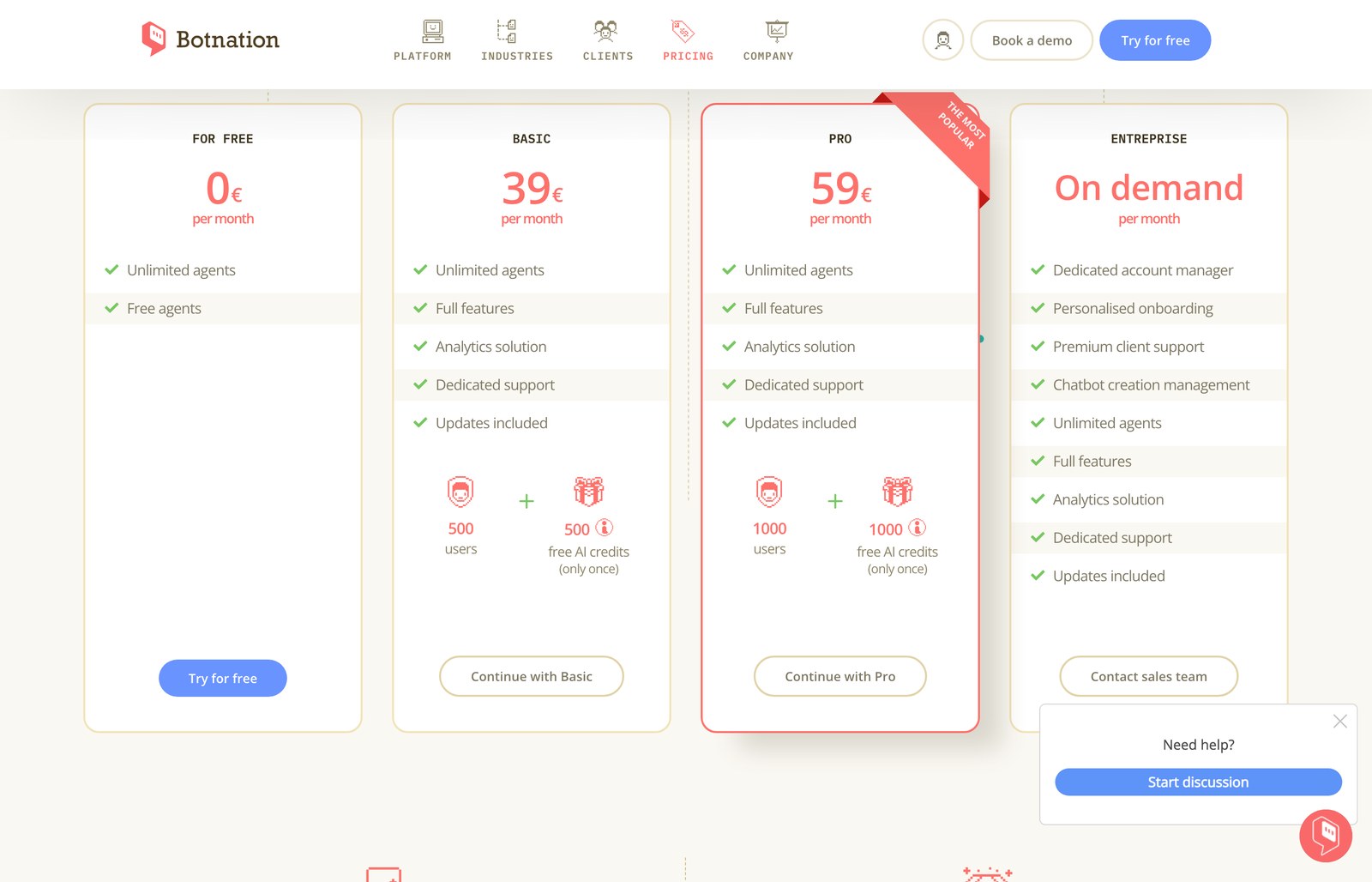
Our prices are public, and that is useful information to get your bearings even if you pick another tool. The free plan lets you test a complete sales chatbot with no credit card, the Basic plan is 39 euros a month and the Pro plan 59 euros a month. The Enterprise offer, which includes chatbot creation services by our own teams, is priced on request.
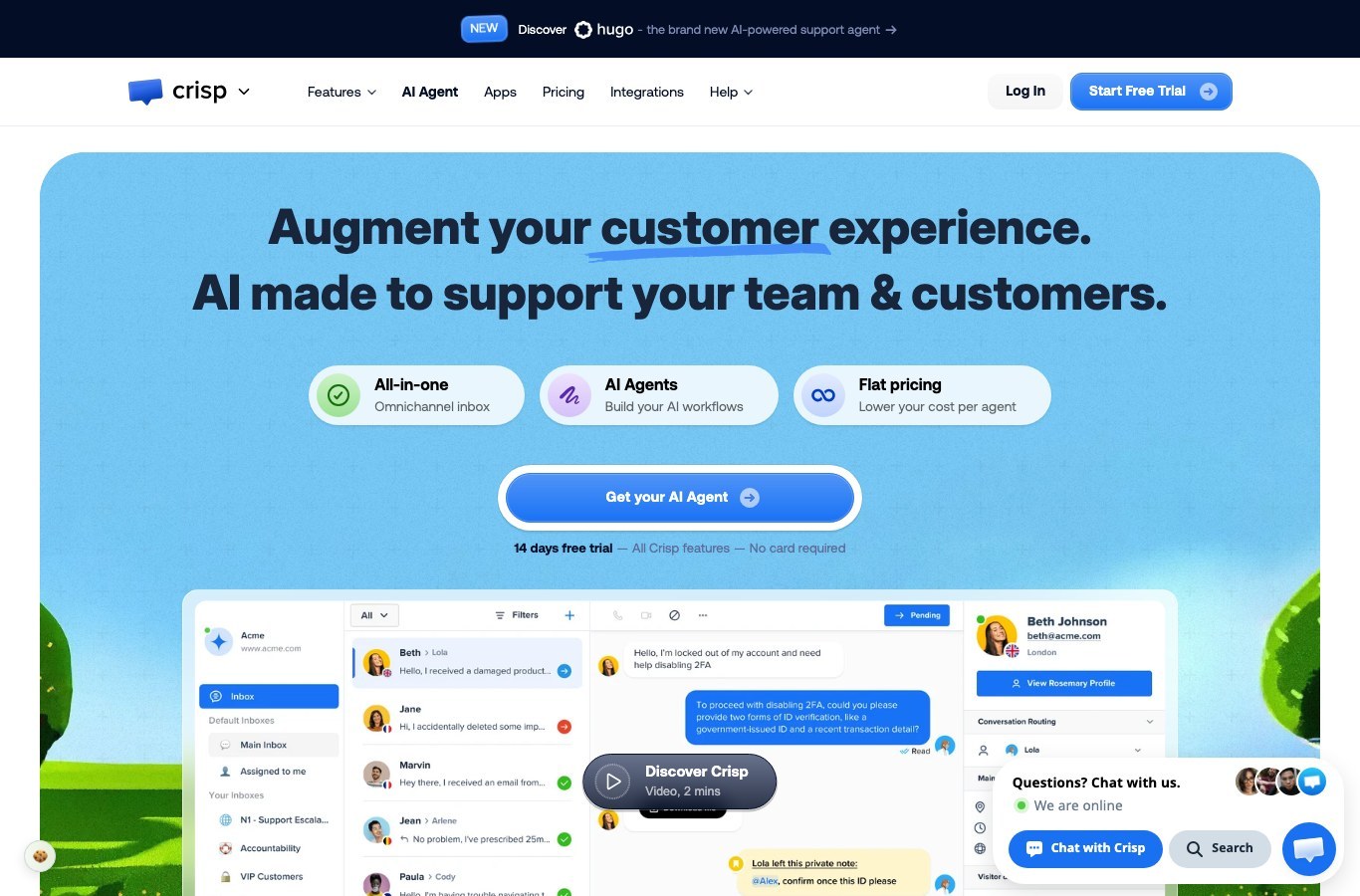
There are other serious vendors on the European market. Crisp, for instance, positions its messaging and AI agent on European hosting and a per licence price rather than a per conversation one. The thing to check with each of them is the same: where your data is hosted, and how the bot reaches your catalogue.
Which sales chatbot fits your situation?
Five questions, one recommendation. If two profiles tie perfectly, the answer leans towards the option that is simplest to put in place. That is a deliberate choice, and worth saying out loud.
The selector
1. How does a sale close in your business?
2. How big is your offer?
3. Where do you lose the most people today?
4. What would your bot need in order to answer well?
5. Which team will look after the bot once it is live?
Answer the five questions, then click the button.
A qualification and appointment booking bot
Your sale closes off the site. The bot should not sell, it should sort and fill a calendar: three to five questions, real slots, a handover to a human as soon as the contact is warm. Start by replacing the contact form on your most visited pages, and measure appointments kept, not conversations.
A product advice bot connected to the catalogue
Your problem is a choice problem, not a trust problem. The bot should ask one or two questions at most, then offer three references with a direct link to the product page. Put it on category pages and on empty internal search results, not on the home page. Measure add to cart events coming from the conversation.
A checkout assistance bot
Your visitors are convinced by the product, not by the conditions. The bot should live on the cart page and in the checkout funnel, and answer in one sentence the three questions that block a purchase: delivery time, return conditions, payment methods. It is the most profitable placement, because it works on traffic you have already paid for.
An AI bot fed with your own data
Your questions are too varied for a script written in advance. You need a bot that reads your spec sheets, your conditions and your catalogue, and answers in free language grounded in your own content. Above all, plan for the data preparation work: that is what determines the quality of the answers. Our guide explains how to train a chatbot on your own data.
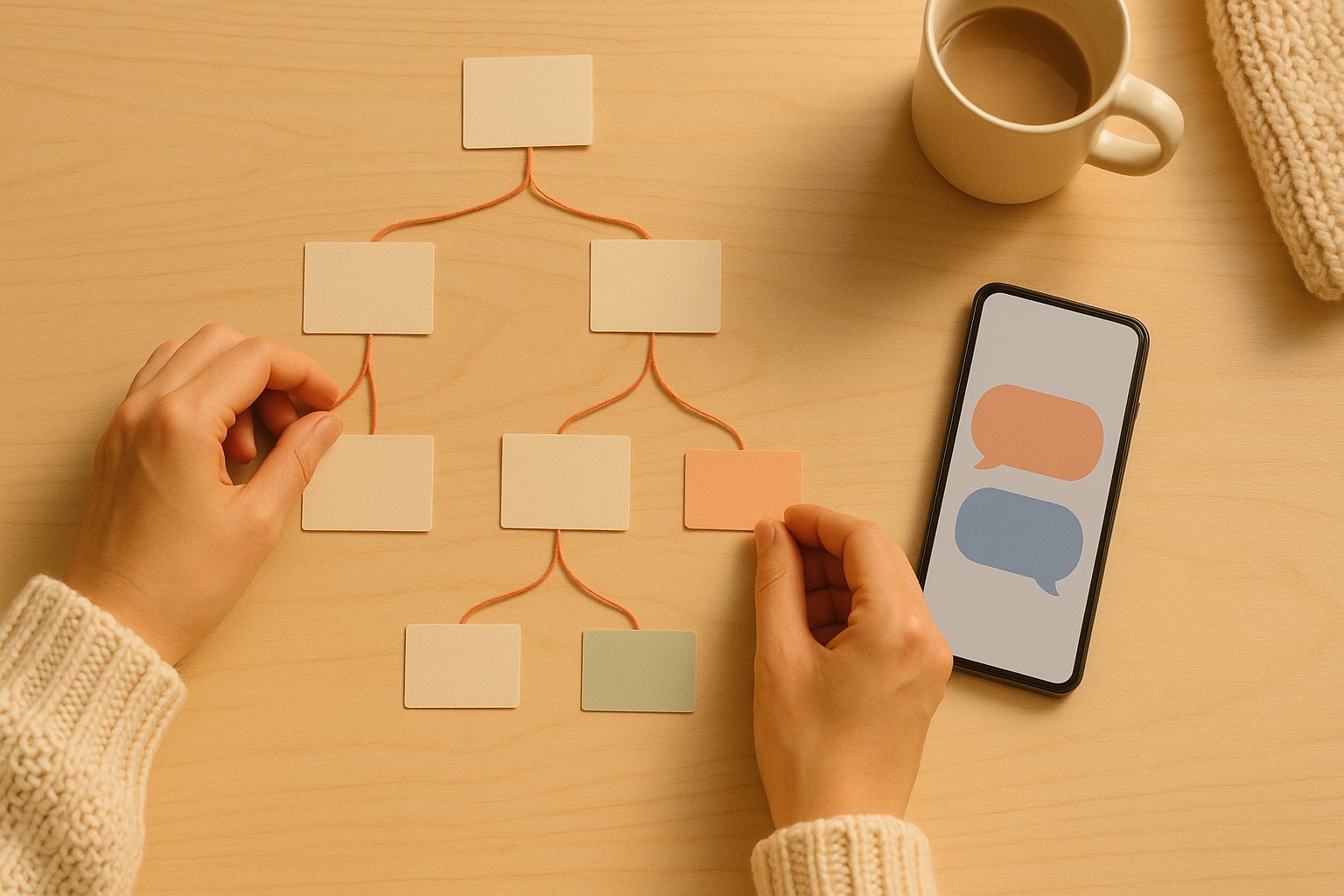
Setting up a sales chatbot in seven steps
- Pick a single page to start with. Your most visited product page, the cart page or a campaign landing page. A bot dropped across the whole site with no goal cannot be measured.
- Write the goal as one measurable sentence. For example: collect a qualified phone number, or get an item added to the cart. That sentence decides everything else.
- List the twenty real questions. They are already in your inbox, your live chat and your customer service. Do not invent them.
- Write the shortest possible script. Every extra question loses people. Three questions beat seven.
- Connect whatever has to be up to date. Stock, prices, delivery times, calendar. A bot that announces a product as available when it is not costs more than it earns.
- Plan the way out to a human. A visible button from the first message, and a clear message when nobody is available.
- Read the conversations every week during the first month. This is the one step that separates a bot that pays from a bot that gets uninstalled after three months.
Do not trigger the conversation the moment someone lands on the page. Wait for a hesitation signal: fifteen seconds on the product page, a step back from the cart, a second visit to the pricing page. The same bot, triggered at the right moment, often doubles its open rate.
What a sales chatbot must never do
This is the part commercial pages avoid. It deserves to be read first, because a bad sales bot does not score zero: it loses you money.
What works
- Stating clearly that the visitor is talking to an automated assistant
- Offering a way out to a human from the very first message
- Saying “I do not know” rather than inventing a delivery time or a price
- Triggering on a signal, not on an aggressive timer
- Staying on the pages where a question genuinely blocks the purchase
What costs you dearly
- Letting the visitor believe they are talking to a human adviser
- Inventing a promotion, a stock level or a delivery date
- Manufacturing false urgency, such as “only two left in stock”
- Blocking access to the product until an email address is handed over
- Covering the product page on mobile with a chat window
The first lines in the right hand column are not merely clumsy commercial moves. Some of them fall under misleading commercial practices, and one of them is about to become a very concrete regulatory problem within days. We have gathered the other pitfalls in our article on chatbot creation mistakes.
Transparency becomes mandatory from 2 August 2026
Article 50 of the European artificial intelligence regulation requires that AI systems intended to interact directly with people be designed so that those people are informed they are interacting with an AI system, unless this is obvious. This obligation applies from 2 August 2026, and it covers anyone serving users in the European Union.
For a sales chatbot, the reading is simple. An assistant that introduces itself with a first name, a profile picture and a human tone is not a case where this is obvious. So it has to be said, and said at the start of the conversation, not in a legal notice in the footer.
In practice, three settings are enough: an assistant name that does not suggest a human, an opening sentence that announces the automated nature of the exchange, and visible access to an adviser. None of the three costs you any conversion. The first actually gains some, because a visitor who knows who they are talking to asks more direct questions.
If your current sales chatbot carries a first name and a human avatar without ever saying it is automated, that is the first thing to fix. This page is general information and does not replace legal advice on your own situation.
Where the market actually stands
The context has changed far faster than the articles describing it. In the 2026 edition of its key figures, published on 1 July, Fevad, the French e-commerce federation, reports that 94% of French online retailers now use generative artificial intelligence tools, and that nearly one online shopper in three already uses AI somewhere in their buying journey, mainly to look for information, compare products or prepare a decision. Among regular AI users, that proportion rises to nearly three in four.
In other words, the question is no longer whether your customers will accept talking to a machine: some of them already do it elsewhere, before they even reach your site. The same edition measures a market worth 196.4 billion euros in 2025, up 7%, across 3.2 billion transactions and 42.2 million online shoppers, that is 80% of French people aged 16 to 74.
One figure to help calibrate your calculator: French shoppers make 75 online purchases a year on average, for an annual spend of 4,657 euros, which puts the national average basket around 62 euros. If your average order value is much higher, every order recovered at the payment stage is worth proportionally more, and the checkout assistance bot becomes your priority.
Frequently asked questions
What is a sales chatbot?
It is a conversational agent installed on a buying journey, whose performance is measured in orders, quotes or appointments. It differs from a customer support chatbot, which is judged on how many requests it resolves without human help. The first lives on product pages and the cart, the second in the help centre.
Does a sales chatbot really increase conversions?
For visitors who engage the conversation, yes, and vendors routinely announce uplifts of 10 to 30%. Those figures are commercial orders of magnitude, not independent studies. Spread across all your traffic, the real gain is much more modest, since only a fraction of visitors opens the chat. The calculator on this page does that full calculation.
How much does a sales chatbot cost?
On a no-code platform, from 0 to about sixty euros a month. At Botnation the free plan is 0 euros, the Basic plan 39 euros a month and the Pro plan 59 euros a month, prices taken from the pricing page on 29 July 2026. If you hand the design to an agency or an integrator, expect several thousand euros to set up, depending on how many connections to your core systems are needed.
Do you need generative AI for a sales chatbot?
Not always. On a short journey, a script with buttons often converts better, because it never gets a price or a delivery time wrong. Generative AI becomes useful when the questions are too varied to be anticipated, and provided you connect it to your own content rather than letting it improvise.
Do you have to tell visitors they are talking to a bot?
Yes. Article 50 of the European artificial intelligence regulation requires informing people that they are interacting with an AI system, unless it is obvious, and that obligation applies from 2 August 2026. It is also good commercial practice: a visitor who knows who they are talking to gets straight to the point.
Where should a sales chatbot sit on a website?
On the pages where a question blocks the decision: product pages, the pricing page, the cart page and paid landing pages. Not on the home page, where the visitor has no precise question yet, and not on editorial pages, where it gets in the way.
Sales chatbot or form, which one should you choose?
Both, in different places. The form is unbeatable when the visitor has already decided and wants to move fast. The conversation takes over when they hesitate, or when they need qualifying. We compared the two, figures in hand, in our article chatbot or form.
How long does it take to put a sales chatbot online?
On a no-code platform, a first qualification script takes about half a day of work. What takes time is not the tool, it is gathering your customers’ real questions and your company’s real answers. Allow one to two weeks for a clean, connected and tested setup.
Test a sales chatbot on your site, for free
Build a qualification script in a few minutes, with no code and no credit card. Our chatbot creation experts can also build it with you.
Sources for the figures quoted: Baymard Institute, cart abandonment average calculated across 50 studies; Fevad, Key figures of e-commerce, 2026 edition, press release of 1 July 2026; European regulation 2024/1689 on artificial intelligence, article 50; botnation.ai pricing page taken on 29 July 2026.