



In short: Tidio is a SaaS customer service platform combining live chat, a multichannel inbox (email, Messenger, Instagram, WhatsApp), an AI agent named Lyro, and a no-code scenario builder (Flows). The Free plan stays free for life with 50 billable conversations per month; paid plans start at €29 per month on monthly billing (€24.17 on annual), as of 22 September 2026. The tool is quick to pick up, but the so-called “billable” quota covers human conversations and tickets alike: it gets consumed even when the AI is not answering, and building the scenarios remains your job.
“Tidio chatbot”: that search is having a moment. The tool shows up in every WordPress and Shopify chatbot comparison, and its Lyro AI agent sits on page one of the search results. But between the marketing promises, the overlapping quotas, and the prices that change with your billing cycle, it is hard to tell what the tool actually does, what it costs, and where its limits are.
This article is a complete tour of the Tidio chatbot: what the platform contains exactly, how Lyro and the Flows work, what each plan costs (prices checked on 22 September 2026 on the vendor’s official pages), and the limits to know before committing. We close with the question nobody asks: who builds the chatbot, and how long it takes. Spoiler: the answer depends far more on the model you choose than on the tool itself.
What exactly is Tidio?
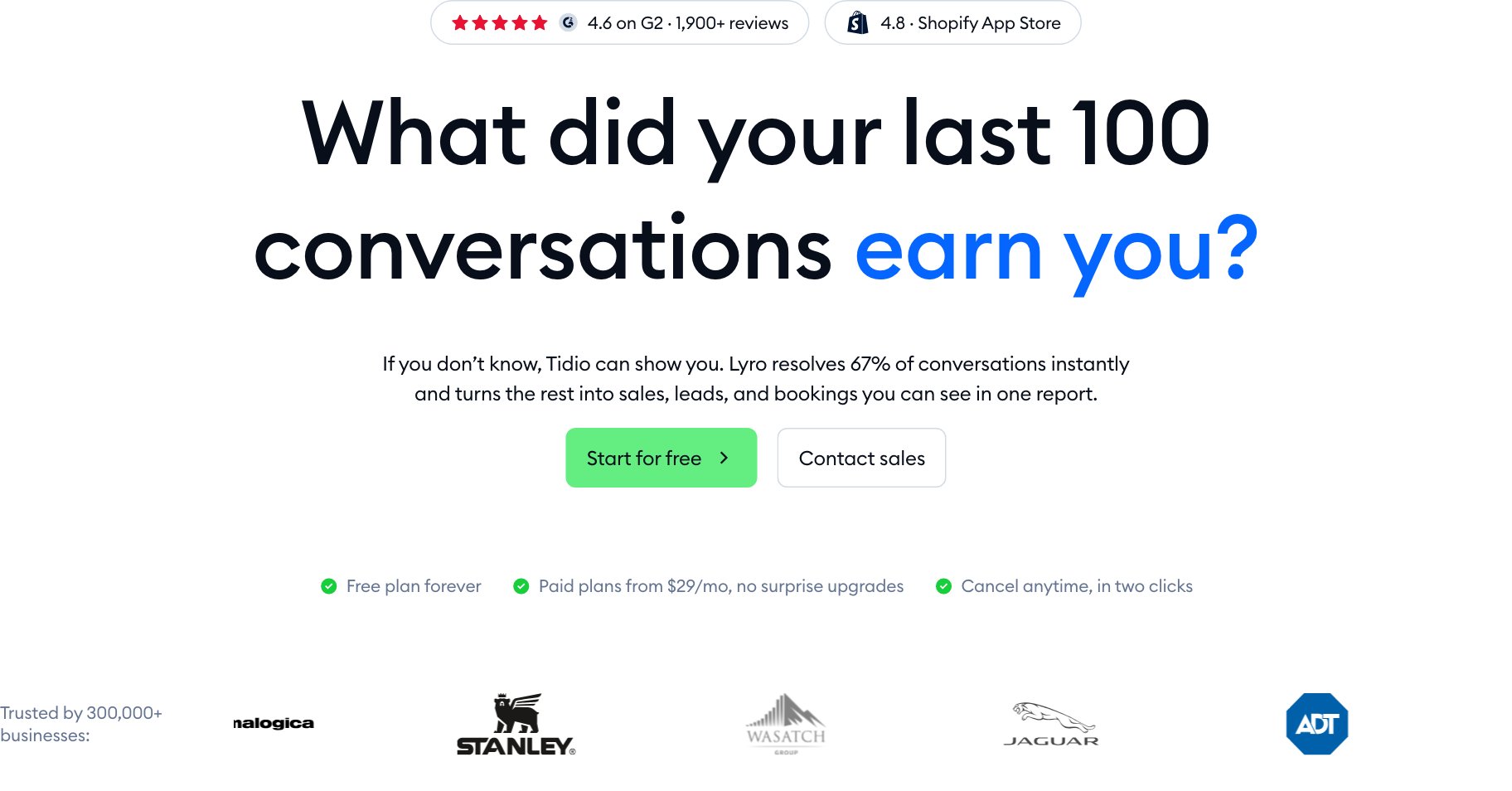
Tidio is an all-in-one customer service platform published by the company of the same name. Its pitch, taken from its homepage: bring together “human and AI” conversations in a single tool, with 300,000+ client businesses according to the vendor. In practice, the platform is built around four blocks, each also sold as a stand-alone product:
- live chat: the conversation widget your visitors see on your site;
- Lyro AI Agent: the AI agent that answers automatically from your knowledge base, with handover to a human when it does not know;
- Flows: the no-code scenario builder, that is, the “classic” tree-based chatbot (data collection, qualification, guided FAQ);
- the Help Desk: ticketing and the multichannel inbox that gathers “Live Chat, email, Instagram, Messenger and WhatsApp” into one view, with a single customer history.
The platform plugs into mainstream e-commerce and CMS ecosystems: Shopify, WordPress (official plugin), and Wix are named first, and the vendor ships desktop and mobile apps to handle conversations on the go. Lyro also exists as a stand-alone module “to Zendesk, Salesforce, or any other help desk software”, as the pricing page puts it: a genuine peculiarity of Tidio, which sells as much an AI add-on as a full platform.
One last element, often overlooked: Tidio does not only sell software. The site navigation lists “Tidio Labs”, described as a “custom AI solution designed by experts”, and the Premium plan includes an accompaniment where the vendor’s team deploys and maintains the AI for you. In other words, the vendor knows the line between tool and service, like every serious player in this market.
How a Tidio chatbot works
In the field, a Tidio chatbot combines two very different engines. Flows structure the deterministic journeys; Lyro answers in natural language. Understanding who does what avoids 80% of the disappointments found in customer reviews.
Lyro, the AI agent that answers in natural language
Lyro is an AI agent powered by your knowledge base: FAQ, product pages, help articles. The vendor presents it as an agent trained on verified data sources so that its answers stay faithful to your content: the principle of a RAG chatbot, which grounds its answers instead of inventing. On its homepage, Tidio claims that “Lyro resolves 67% of conversations instantly”; the pricing page for its part promises to “Solve up to 67% of customer problems”. That is a vendor claim, not an independent measurement: retain the order of magnitude (two thirds of common requests) rather than the exact figure.
Three useful details checked on the pricing page on 22 September 2026:
- “Your first 50 conversations are free (lifetime)”: enough to test Lyro without commitment, since no credit card is required for the Free plan;
- beyond that, the Lyro quota climbs in steps from 50 to 1,000 conversations per month;
- on the Premium plan, Lyro becomes a managed service with a “Guaranteed 50% Lyro AI resolution rate” and pay-per-resolution billing: you pay for what the AI actually resolves.
Lyro can also hand over to a human, customize its communication style, and trigger “Actions” (check an order, update a customer record): the first Action is free, full access requires a paid Lyro quota.
Feeding Lyro comes down to three moves described by the grid: an “FAQ scraper” importing your existing questions and answers, a “Website scraper” going through your pages, and “Import Zendesk articles” to bring an existing help base over. Around that base, the detailed grid provides “Lyro product recommendation” delivered “with the purchase of a paid Lyro AI Agent quota”, a number of guidances capped (5 on the low-end plans, “Up to 10” then “10+” on the higher ones), and, at the very top, “Lyro Connect”, the “Lyro custom name” and the “100mb file upload size”. The agent is therefore first fed by what you already publish, then personalized as the plan climbs: the same movement governs the price.
Flows, the no-code scenario chatbot
Flows are Tidio’s historical “chatbot” block: a drag-and-drop visual editor where you build journeys triggered by a click on the widget, a visited page, or a detected intent. Typical use cases listed on the vendor’s page: collect data, answer quote requests, handle missed conversations (the visitor who left without buying). The vendor’s quantified promise: “Increase conversions by 26% with contextual Flows”, again a house claim to take as an order of magnitude.
On volume, “Your first 100 visitors reached via Flows are free”, and the limit then climbs from 2,000 up to 100,000 visitors per month. Watch the vocabulary: a visitor “reached” by a Flow does not consume a billable conversation, it is a separate counter. The two counters (billable conversations, visitors reached) get consumed in parallel.
The official definition of the main quota, on the pricing page: “Live conversations and tickets handled by your team make up your monthly billable conversations limit”. Translation: every conversation a human agent replies to, and every ticket the team handles, consumes this quota. An active support team can exhaust its plan without ever activating Lyro.
Tidio chatbot: what are the concrete use cases?
Crossed with the available channels, the Tidio chatbot covers four well-identified use case families:
- e-commerce customer support: order tracking, returns, product questions, with the Shopify and WordPress integrations leading the way;
- lead qualification: a Flow collects the need and the contact before offering a meeting, while the team keeps control of the chat;
- automated FAQ: Lyro absorbs recurring questions, and the FAQ scraper can import your existing content (down to Zendesk articles);
- multichannel presence: the same inbox receives the site widget, Messenger, Instagram, WhatsApp, and email, so you stop answering tool by tool.
On the team side, the operator workstation tools weigh on the final choice as much as the AI: the “Live typing preview”, introduced on the homepage in these terms: “See what visitors are typing before they hit send”, the “Viewed pages history”, “Visitors info” and “Visitor notes”, “Automatic chat assignment”, “Macros”, “Automatic reply” and “Operating hours”. The underlying promise stays the homepage’s: one shared inbox “with one customer history behind every conversation”. These human-assistance features climb with the plan: they explain why a team might prefer Growth even at a low conversation volume.
If you are starting from scratch on the question “which type of chatbot for which need”, our article on chatbot platforms details the tool families and their cost models; and if your site runs on WordPress, Tidio appears in our comparison of the 15 best WordPress chatbots, alongside a dozen alternatives.
How much does a Tidio chatbot cost?
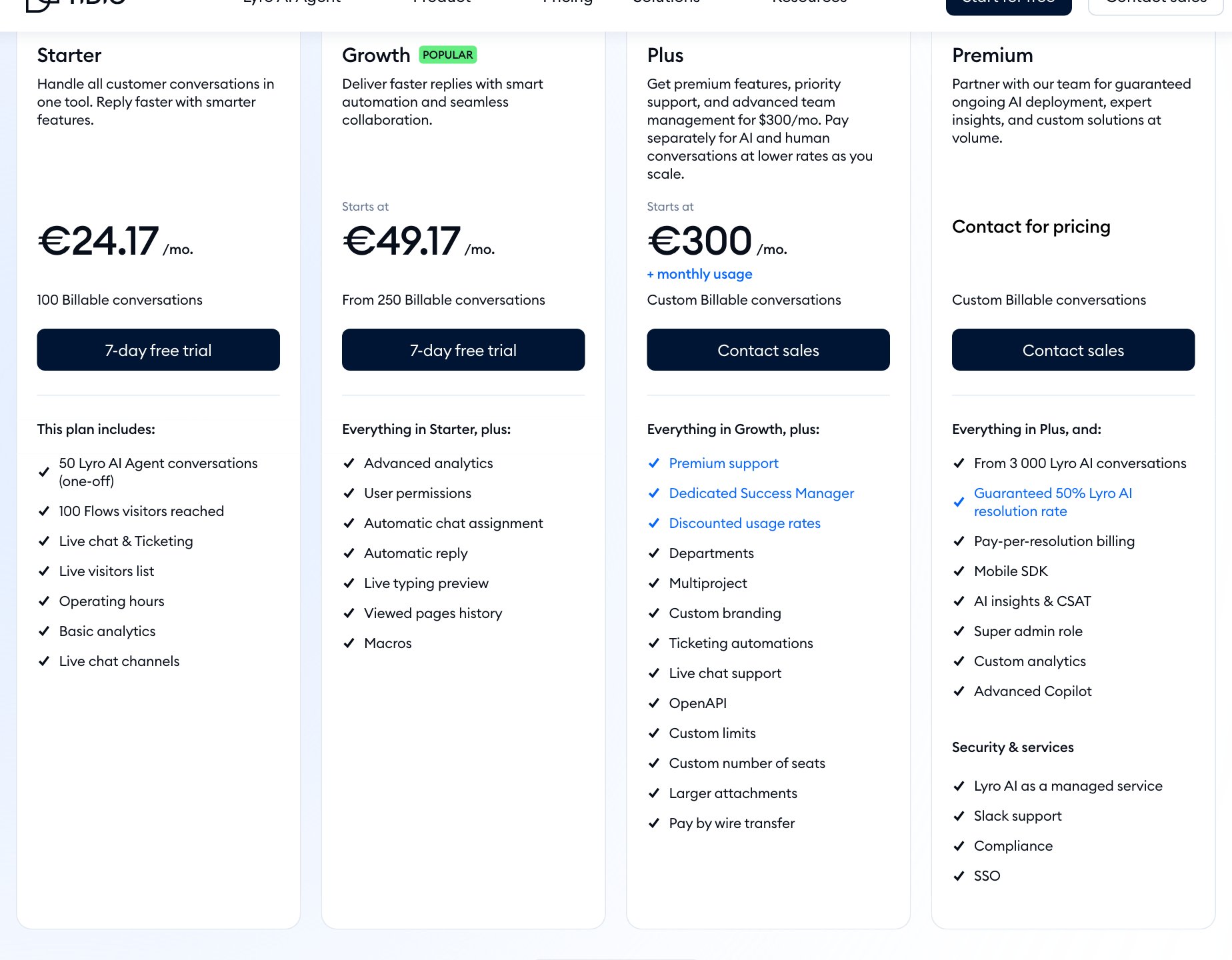
Full snapshot taken on 22 September 2026 from the official pricing page. The grid displays annual prices by default (two months free); we give both regimes. All amounts are those shown on the vendor’s site, in euros, when opened from the European Union.
| Plan | Monthly price | Annual price (2 months free) | Billable conversations | Seats |
|---|---|---|---|---|
| Free | €0 | €0 | 50 per month | 10 |
| Starter | €29 | €24.17 | 100 per month | 10 |
| Growth | from €59 | from €49.17 | from 250, up to 2,000 | 10 |
| Plus | from €300 | from €300 | custom | custom |
| Premium | by quote | custom | custom | |
The two low-end plans are complemented by paid modules, sold separately and usable even without the full platform:
| Module | Monthly billing | Annual billing | Entry threshold |
|---|---|---|---|
| Lyro AI Agent | from €39/month | from €32.50/month | 50 AI conversations (then in steps up to 1,000) |
| Flows | from €29/month | from €24.17/month | 2,000 visitors reached per month |
Three honest readings of this grid:
- the entry level is genuinely free, with no end date: 50 billable conversations, 100 visitors reached by Flows, and the first 50 Lyro conversations free for life. The vendor’s FAQ does note that the free live chat is limited to “only 100 unique visitors per month”: beyond that, you pay;
- the jump to the Plus plan is brutal: from €59 (Growth) to €300 per month (Plus), the gap is explained by custom seats, OpenAPI, departments, and “Discounted usage rates”. In between, no intermediate step;
- the displayed price climbs with usage: Growth and Plus display “from” prices because the quota is set in a configurator (250 to 2,000 billable conversations, 50 to 1,000 Lyro conversations, 2,000 to 100,000 Flows visitors). The exact price depends on your volume, hence the simulator below.
The exact contour of the quota sits in the pricing page FAQ, and it deserves quoting because it changes the math. Rule 1: “A conversation is only billed as a Billable conversation once you reply using Tidio or proactively initiate a conversation with your visitor”; a spam conversation left unanswered will not be deducted from your monthly limit, the same FAQ says. Rule 2: responses from Flows and Lyro AI Agent are not counted as agent replies: a conversation fully resolved by the AI weighs on the Lyro quota, not on billable conversations. Rule 3: a conversation answered by a human agent still “counts as a single conversation”, however many messages the thread carries. The quota therefore follows human activity and the team’s initiatives, the AI is paid separately: that is the separate-counters model the pricing page configurator prices line by line.
Which Tidio plan for your volume?
This configurator reproduces the public logic of the grid: it indicates the plan where your volume sits comfortably, its starting price by billing cycle, and the matching Lyro line. Thresholds and prices are those checked on 22 September 2026; the intermediate steps of the vendor’s own configurator are not public, so no amount is extrapolated here.
Configurator: your volume, the indicative plan
1. Billable conversations per month (human + tickets)
2. Conversations handled by the Lyro AI agent
3. Agents (seats)
4. Billing
Reminder: billable conversations cover live conversations and the tickets handled by your team. The quota gets consumed even when the AI is not answering. The intermediate steps of the official configurator are not public: beyond the displayed thresholds, the price is calculated on the vendor’s site.
Pick one answer in each of the 4 questions, then click “See my indicative plan”.
| Plan | Monthly price | Annual price | Included (checked 22/09/2026) |
|---|---|---|---|
| Free | €0 | €0 | 50 billable conversations, 100 Flows visitors, 10 seats, live chat limited to 100 unique visitors per month |
| Starter | €29 | €24.17 | 100 billable conversations, 50 Lyro conversations included (one-off), 100 Flows visitors, 10 seats |
| Growth | from €59 | from €49.17 | from 250 up to 2,000 billable conversations, advanced analytics, automatic assignment, 10 seats |
| Plus | from €300 | from €300 | custom quotas and seats, OpenAPI, departments, custom branding, + monthly usage |
| Premium | by quote | from 3,000 Lyro conversations, guaranteed 50% Lyro AI resolution rate, pay-per-resolution billing, managed service, Slack support, SSO | |
The limits of Tidio to know before choosing
No tool is neutral: here are the friction points documented by the pricing grid itself, without exaggeration or complacency.
- The quota follows human activity. That is the number one limit: every conversation your team replies to, and every ticket handled, consumes the quota, automation being billed on separate counters (Lyro conversations, Flows visitors). A site receiving 400 conversations per month, 300 of them handled by the team, mechanically leaves the Starter plan (100 conversations) for Growth;
- 10 seats maximum up to Growth. Beyond 10 agents, you need the Plus plan from €300 per month, with no intermediate step;
- you build the chatbot yourself. The Flows editor is genuinely no-code, but designing the scenarios, writing Lyro’s knowledge base, setting up Actions, and maintaining all of it over time remains work. “Assistance for Flows creation and strategy” only appears on the high-end plans, and the custom build service (Tidio Labs or managed Premium) is handled by quote;
- no self-hosting. Tidio is SaaS: conversations transit through the vendor’s infrastructure, which raises the usual questions of data location and compliance to validate with your DPO;
- usage pricing can drift. Three separate counters (billable conversations, Lyro conversations, Flows visitors) move with your traffic: an e-commerce seasonal peak is billed at full rate if the quota was not sized up in advance.
Tidio or a no-code platform with custom build: how to decide
The real question is not “which tool” but “who does the work”. Three configurations stand out:
| Your situation | The model that holds | Why |
|---|---|---|
| Small self-sufficient team, low volumes, standard e-commerce | Self-service SaaS (Tidio, Free or Starter plan) | Quick setup, Shopify and WordPress plugins, zero-to-low entry cost |
| Significant volume, several channels, AI trained on your content needed | Platform + sized quotas, or Lyro as a module on your existing help desk | Usage pricing becomes negotiable (Plus, Premium), the AI adds to your stack |
| Strategic project, SI integrations, no in-house expert available | No-code platform with custom build by the vendor | The scenario and the knowledge base are built and maintained by professionals, and you keep hands on the tool |
If you are still hesitating over the architecture (guided scenarios, generative AI, hybrid), our Genesys chatbot fact sheet details the same trade-off against a legacy customer service player, and our customer support chatbot page reviews the business use cases.
How Botnation answers the same need
Botnation publishes a no-code platform for building chatbots and multichannel AI agents (website, WhatsApp, Messenger, Instagram), and also builds custom chatbots for its clients through its Enterprise plan: the two models deliberately coexist. Here is, honestly, where the difference with Tidio lies.
On the software, the platform covers the same functional spectrum: no-code scenarios, AI trained on your content, multichannel distribution, integrations. The grid is public and flat: a Free plan at €0, Basic at €39 per month, Pro at €59 per month, then Enterprise “on demand”; the subscription includes an unlimited number of chatbots and collaborators. There is no human conversation meter: the quota applies to AI credits (the requests to the models), which completely changes the equation for a heavily solicited support team.
On the service, that is the core difference: at Botnation, the Enterprise plan literally includes “Chatbot creation management”, a dedicated account manager and a personalized onboarding, and our chatbot creation experts are available online directly on the interface. Concretely, the team that builds your chatbot is the team that publishes the platform: no intermediary to coordinate, and once delivered, the account, the scenarios and the knowledge base stay in your name in the editor, where you can keep changing them yourself. A third-party agency remains legitimate for a very specific craft or an integration already in place at your company; on custom builds, however, having the editor itself do the building avoids redeveloping what the platform already does.

Price ranges for a custom build by a third-party provider belong to the market, not to a vendor: they are negotiated per project. On the Botnation side, custom work is handled by quote, with no invented amount here.
Frequently asked questions about Tidio
Is Tidio really free?
Yes, for a defined scope: the Free plan is free for life with 50 billable conversations per month, 100 visitors reached by Flows, 10 seats, and the first 50 Lyro conversations free. The vendor’s FAQ notes that the free live chat is limited to “only 100 unique visitors per month”. Paid plans start at €29 per month (checked 22 September 2026) with a 7-day free trial.
Does Tidio work with WordPress and Shopify?
Yes: Tidio has an official WordPress plugin and a Shopify app, with Wix also named by the vendor. For WordPress, our comparison of the 15 best WordPress chatbots positions Tidio among a dozen tested solutions, with up-to-date prices.
What is the difference between Lyro and Flows?
Flows are deterministic scenarios you draw: same questions, same journey, ideal to collect and qualify. Lyro is an AI agent answering in natural language from your knowledge base, with human handover. The two complement each other: a Flow structures, Lyro absorbs the unexpected.
What happens when the conversation quota is exceeded?
The Lyro quota climbs through public steps from 50 to 1,000 conversations; billable conversations follow the 50, 100, then 250 to 2,000 steps. Beyond that, the Plus and Premium plans work by quote with “Discounted usage rates” (Plus) or pay-per-resolution billing (Premium). Hence the value of measuring your real volume before picking a plan.
Does Tidio suit a team of more than 10 agents?
Not under the Free, Starter and Growth plans: they all cap at 10 seats. Beyond that, you need the Plus plan (from €300 per month, custom seats) or Premium by quote. Check this early if your support team is growing.
Can experts build your Tidio chatbot for you?
Partly: “Assistance for Flows creation and strategy” and the managed Premium service exist on the high-end plans, and Tidio Labs sells custom AI solutions, by quote. But by default, Tidio’s model remains self-service: you build. At Botnation, the Enterprise plan includes chatbot creation services from the quote onward, with the platform staying in your name afterwards.
How are Tidio conversations actually counted?
Three separate counters coexist, and they are not consumed the same way. First counter, billable conversations: “Live conversations and tickets handled by your team make up your monthly billable conversations limit”. Second counter, Lyro conversations: they are billed separately, with “Your first 50 conversations are free (lifetime)” then steps from 50 to 1,000 conversations per month. Third counter, visitors reached by Flows: “Your first 100 visitors reached via Flows are free”, then steps from 2,000 up to 100,000. Concretely, a month where your team handles 80 conversations without ever activating Lyro consumes 80 billable conversations and zero AI quota; the following month, 60 requests resolved by Lyro and 20 handled by hand hit both counters. It is this superposition you need to simulate before picking a plan, and that is precisely the role of the official “Build your plan in seconds” configurator.
What exactly do the 2 months free of annual billing cover?
The annual discount is a smoothing, not a one-off gift. On monthly billing, Starter costs €29 per month and Growth €59; on annual billing, the grid displays €24.17 and €49.17 (checked 22 September 2026). The arithmetic is transparent: €24.17 is exactly ten twelfths of €29, and €49.17 ten twelfths of €59: you pay ten months out of twelve, so the two free months are spread over the year rather than deducted in one block. Over twelve months, the saving reaches €58 on Starter (€348 monthly versus €290 annual) and €118 on Growth. Two limits to note: the Plus plan displays “from €300” in both regimes, so the discount only applies to Starter and Growth; and the Lyro module follows the same mechanics, €32.50 annually versus €39 monthly, again ten twelfths. One last marker from the homepage: “Cancel anytime, in two clicks”, which limits the commitment of the annual formula.
The final word
The Tidio chatbot is a good self-service product: quick setup, an honest free plan, a credible AI agent, and a solid e-commerce ecosystem. Its limits are those of its model: a quota also consumed by (and mostly by) your human conversations, 10 seats at the low tier, and a build that remains your job as long as you stay off the quote-based plans.
Our advice: first measure your real conversation volume (humans included), test Lyro on its 50 free conversations, then compare the full three-year cost, build included, between pure self-service and the platform with custom build. That second path is the one Botnation carries with its Enterprise plan: a no-code platform you can use on your own, and a team of experts who build, optimize and maintain your chatbot when you would rather focus on your business.
Build your chatbot, or have it built
Test the platform for free, or hand over the construction of your chatbot to our chatbot creation experts.
Sources note. Prices, quotas and quoted wordings checked on 22 September 2026 on the public pages tidio.com (homepage and pricing, English versions), read-only. The “67%” (Lyro) and “26%” (Flows) figures are vendor claims, repeated as such. Botnation prices checked the same day on botnation.ai/en/pricing/: Free €0, Basic €39, Pro €59 per month, Enterprise on demand.