




In short: “genesys chatbot” refers to the chatbots of Genesys, an American contact center software vendor: “native bots” included in its Genesys Cloud CX plans, plus AI “virtual agents” activated with tokens. The public grids captured on August 31, 2026 run from $75 to $240 per user per month (annual commitment, USD view), and from $95 to $135 for the voiceless Digital edition. It is a heavy-duty machine built for contact centers that already run teams of agents; for a website, WhatsApp or support chatbot with no contact center infrastructure, a no-code platform like Botnation deploys faster and bills per conversation. This article covers how it works, the prices captured at the source, a cost-structure simulator and the decision criteria.
Type “genesys chatbot” into Google and you mostly land on the vendor’s own pages: virtual agents, definitions, documentation. No surprise: the query names a specific product, not a generic topic. This guide does the work the official pages do not: explain what exactly the Genesys chatbot offer covers, put real numbers on it (grids captured at the source on August 31, 2026, in dollars and in euros), spell out for which profile it is the right choice, and for which one it is not. Every screenshot reproduced here was taken on the day of the capture, from the vendor’s public pages and from our own pricing page, so that every figure in this article can be verified.
What is the Genesys chatbot?
Genesys is an American vendor specializing in contact center software: call distribution, IVR, omnichannel routing, workforce supervision, quality analysis. Its flagship offer, Genesys Cloud CX, is a SaaS contact center platform. The “Genesys chatbot” is not a standalone product: it is the conversational layer of that platform, which comes in three tiers.
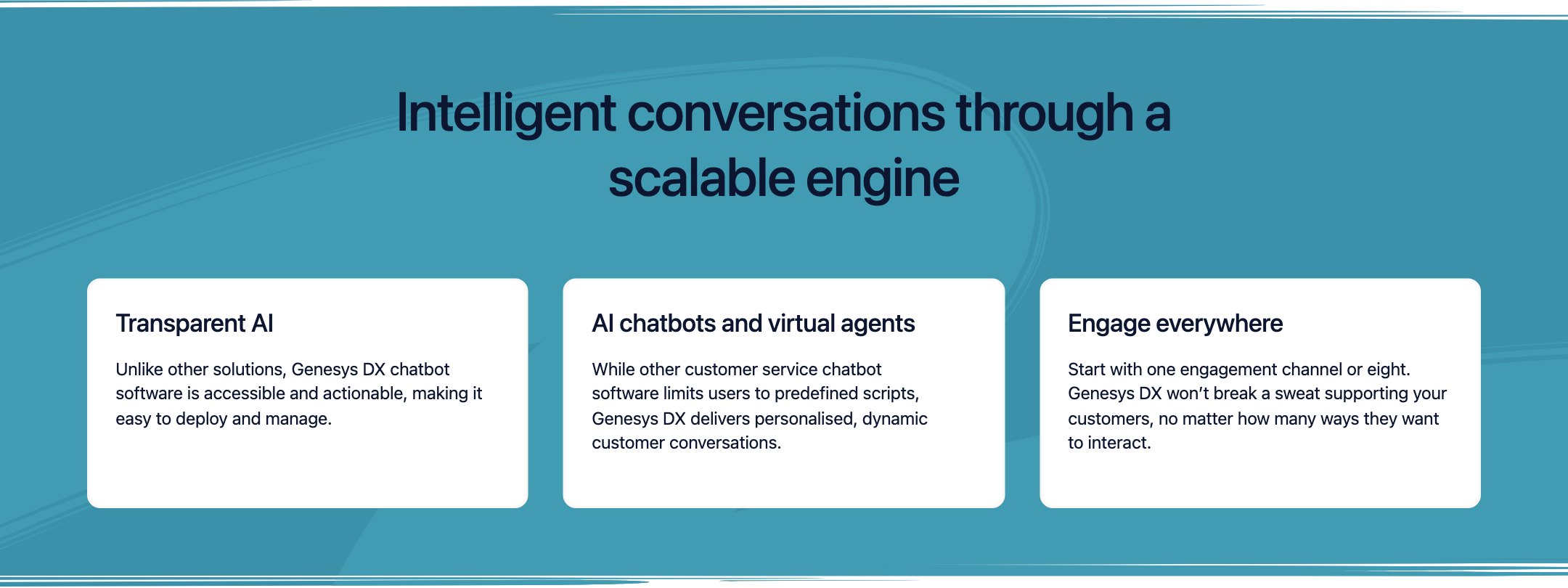
- “Native bots”: the basic chatbots included in the plans (you will see them listed on the pricing cards below). They handle purposeful dialogues and are built with the platform’s own tools.
- AI “virtual agents”: the upper tier, activated through “AI Experience” tokens. The product page puts it this way: “With Agentic Virtual Agent, you go beyond reactive automation. These agents reason, act and adapt at every step of the customer journey.” (quote translated from the French page; original: “Avec Agentic Virtual Agent, vous allez au-delà de l’automatisation réactive. Ces agents raisonnent, agissent et s’adaptent à chaque étape du parcours client.”)
- Orchestrated third-party bots: the platform can also drive bots built elsewhere. The official documentation sums it up: “Genesys Chatbots supports native platform Dialog Engine Bot Flows and third-party platforms such as Amazon, Google etc.”
Definition (vendor’s own words, in French)
“Un chatbot de centre de contact est un assistant virtuel piloté par IA qui automatise les conversations avec les clients sur les canaux digitaux (chat, messagerie, réseaux sociaux, etc.). Il répond aux questions courantes, recueille des informations sur les clients et transmet les problèmes complexes à l’agent humain le mieux adapté pour y répondre.” In English: a contact center chatbot is an AI-powered virtual assistant that automates customer conversations across digital channels (chat, messaging, social networks, etc.). It answers common questions, gathers customer information and hands complex issues over to the best-suited human agent. Published by Genesys on its “contact center chatbot” definition page, captured on August 31, 2026 (page available in French only).
The virtual agent promise rests on what the vendor calls “large action models”: “Au lieu de se baser sur la génération libre ou les scripts, Agentic Virtual Agent est piloté par de grands modèles d’action (LAM).” (translated: instead of relying on free-form generation or scripts, Agentic Virtual Agent is driven by large action models). In other words, the bot does not merely reply: it triggers actions in the company’s systems (check an order, book an appointment, update a record) within pre-defined guardrails, and hands over to a human when needed. The product page also promises “no-code” design inside Genesys Cloud AI Studio and execution across voice and digital channels.
How the Genesys chatbot works in practice
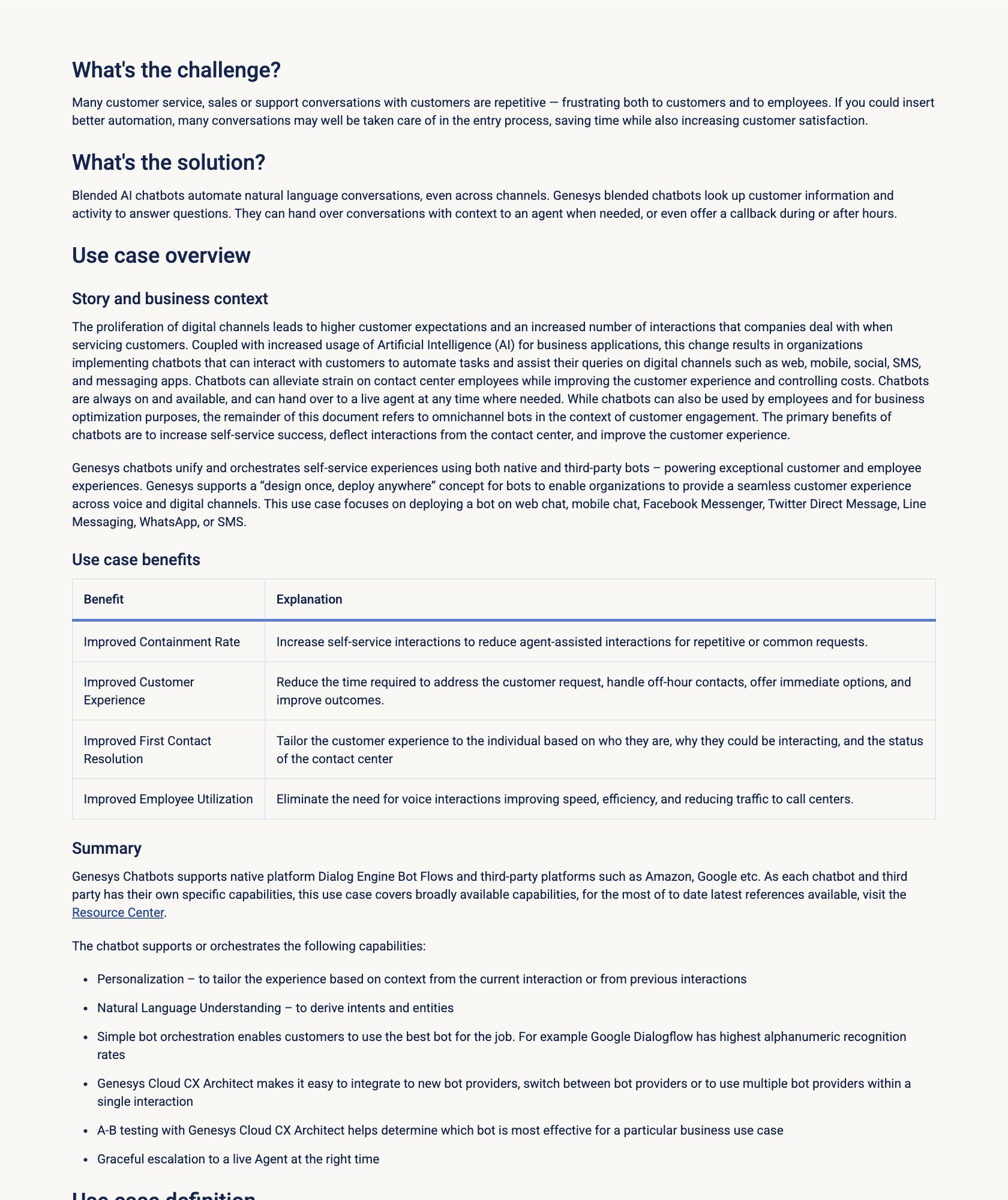
The official documentation (“Genesys Chatbots”, Genesys Cloud Resource Center, page consulted on August 31, 2026) describes an end-to-end flow: “Use chatbots to automate customer conversations and seamlessly hand over to a chat agent when needed.” Behind that sentence, four concrete mechanics.
- Entry from any digital channel. The documentation lists web chat, mobile chat, Facebook Messenger, X (Twitter) direct messages, LINE, WhatsApp and SMS. The bot is the first contact: it identifies the requester, asks qualifying questions and attempts a resolution.
- Natural language understanding. The bot relies on an NLU engine to extract intents and entities from the message. In practice Genesys leans on its own AI engines and on third-party integrations (notably Google Dialogflow), which matches the “third-party platforms” mention quoted above.
- Actions in the back end. A useful chatbot does more than talk: it looks up the CRM, queries the order system, opens a ticket. That is the whole point of “agentic” virtual agents, which execute multi-step workflows in back-office systems, according to the product page.
- Handover to a human, with context. When the bot cannot resolve, the conversation is transferred to an agent with the full history: the “seamless handover” of the documentation. Queuing, routing and resolution statistics are handled by the contact center platform itself.
One vendor-published number sets the tone: “49 % des consommateurs déclarent accorder la plus grande importance à la résolution au premier contact (FCR) lors d’une interaction avec le service client, et 48 % privilégient une réponse rapide.” (from the “State of Customer Experience” study, Genesys, 2025, quoted on the French product page; translated: 49 % of consumers say first contact resolution matters most to them in a service interaction, and 48 % favor a fast answer). The promise is speed of resolution, not conversation for its own sake.

Genesys chatbot pricing: the grids captured on August 31, 2026
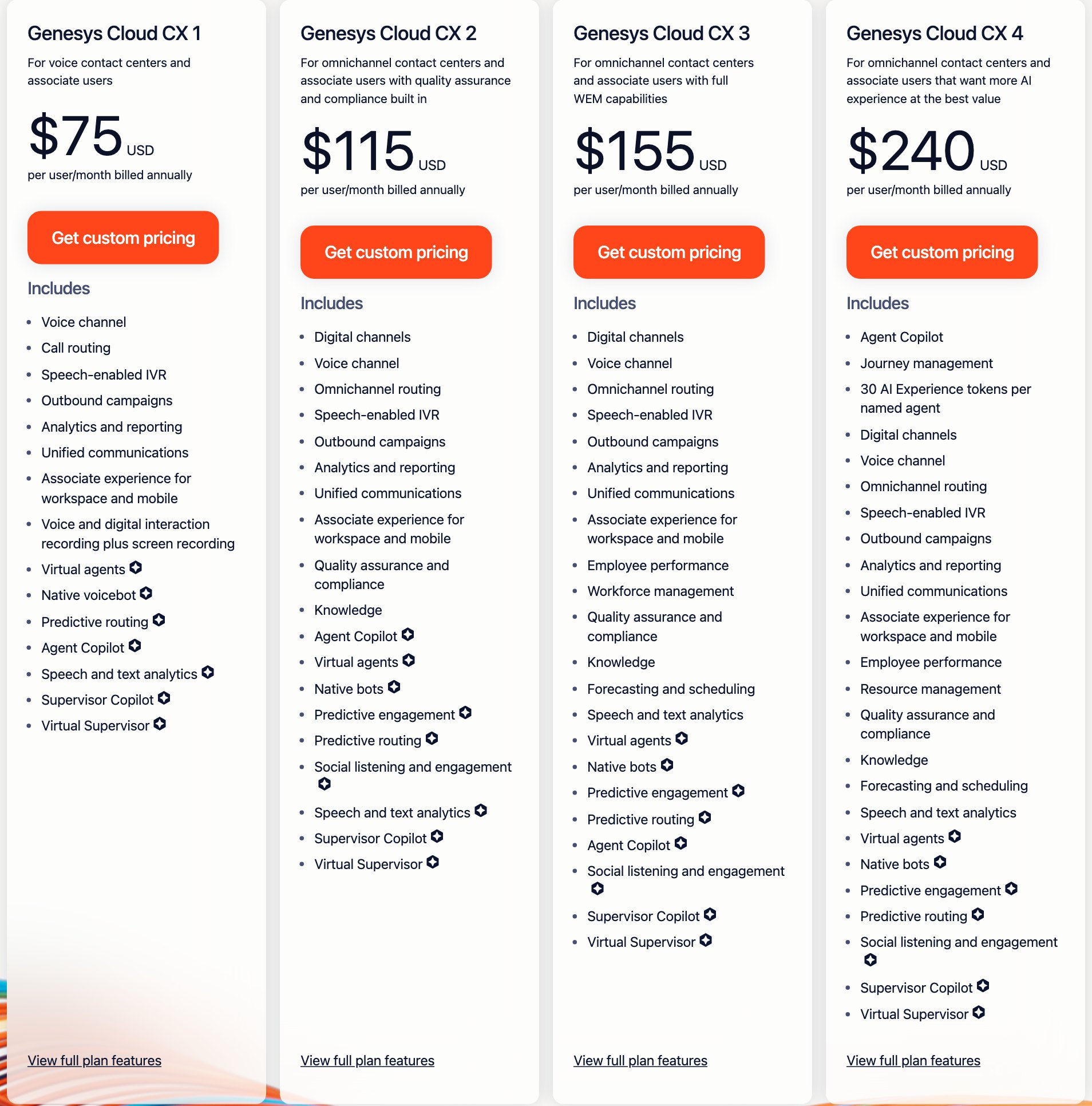
Genesys publishes a public pricing grid, with one quirk: the price is quoted per user and per month, with an annual commitment, and the page offers several licence types (“named”, “concurrent”, “hours of interaction”). Here is the full Genesys Cloud CX grid as displayed in US dollars (USD view served in France, captured on August 31, 2026).
| Plan | Captured price | What the plan includes for the chatbot |
|---|---|---|
| Genesys Cloud CX 1 | $75/user/month (annual) | Voice contact centers. Includes “virtual agents”, “native voicebot”, knowledge, predictive routing, Agent Copilot, speech and text analytics. |
| Genesys Cloud CX 2 | $115/user/month (annual) | Adds digital channels, omnichannel routing, quality assurance and compliance. “Virtual agents” and “native bots” included. |
| Genesys Cloud CX 3 | $155/user/month (annual) | Adds full workforce engagement management (WEM): employee performance, workforce management, forecasting and scheduling, speech and text analytics. |
| Genesys Cloud CX 4 | $240/user/month (annual) | The “more AI” tier: 30 AI Experience tokens per named agent, “virtual agents” included, speech-enabled IVR, social listening, Supervisor Copilot and Virtual Supervisor. |
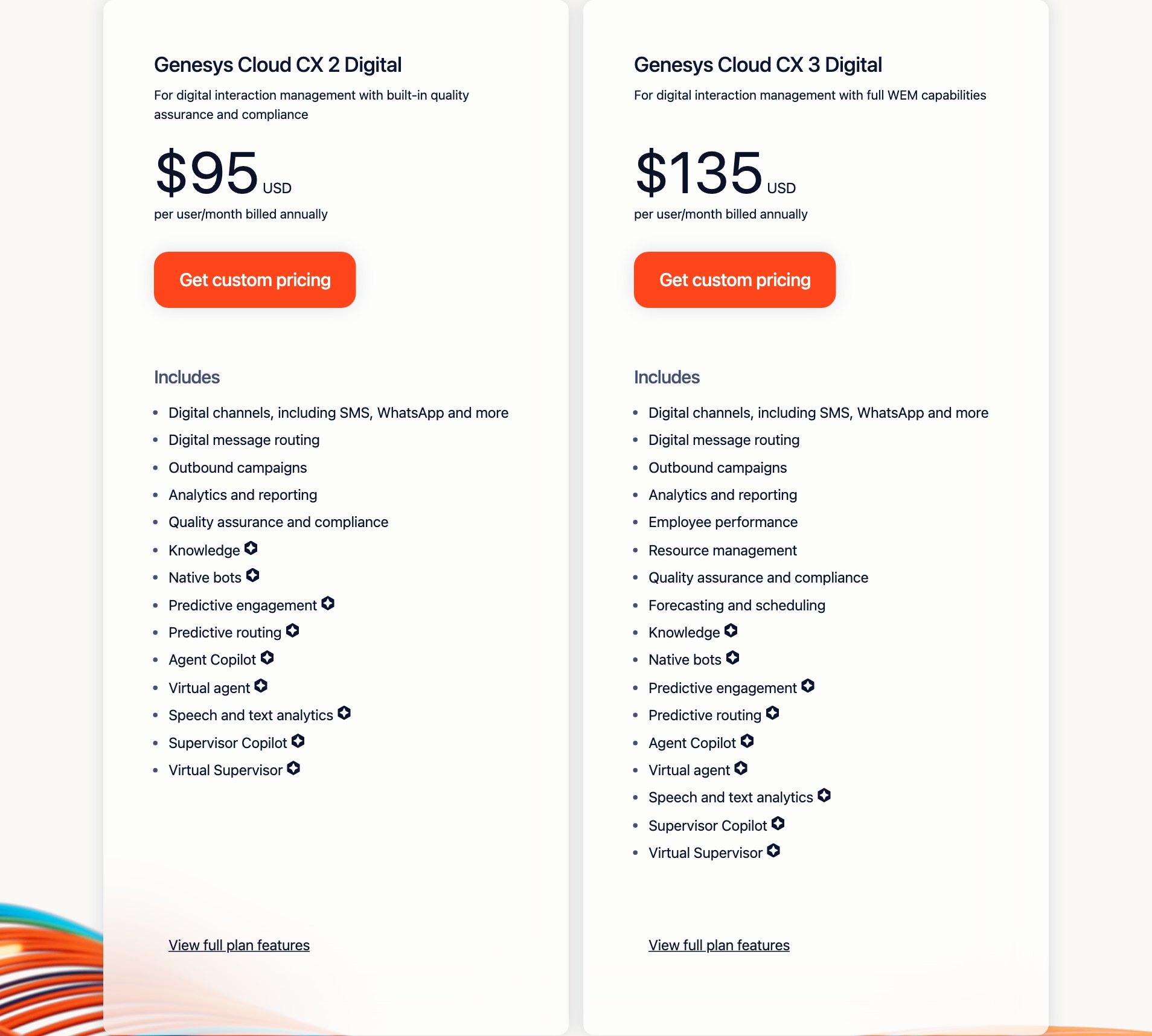
Genesys also sells a Genesys Cloud CX Digital edition, without voice, dedicated to digital interactions: it is the edition that maps most directly to a “chatbot” project in the strict sense.
| Digital plan | Captured price | What the plan includes |
|---|---|---|
| Genesys Cloud CX 2 Digital | $95/user/month (annual) | “Digital channels, including SMS, WhatsApp and more”, digital message routing, outbound campaigns, analytics and reporting, quality assurance and compliance, knowledge, “native bots”, Agent Copilot, “virtual agent”. |
| Genesys Cloud CX 3 Digital | $135/user/month (annual) | The same foundation, plus employee performance, resource management, forecasting and scheduling, speech and text analytics. |
“AI Experience” tokens: the subtlety to know before budgeting
On the same page, a banner states that “All plans natively enabled with ready-to-use Genesys Cloud AI capabilities” and that “Genesys Cloud AI Experience tokens required for certain features.” The comparison table details the allowance as follows (labels of the USD view, captured on August 31, 2026): “250 named / 350 concurrent tokens per org/month included”, then “+30 named / +39 concurrent tokens per agent/month”. In plain terms: the advanced AI features, virtual agents included on plans CX 1 to CX 3, are consumed in tokens, and the included allowance covers an organization up to 250 “named” users; beyond that, each additional agent adds a monthly cost. Only plan CX 4 ships 30 tokens per named agent up front.
What the pricing page says, and what it does not
The pricing page carries this disclaimer: “This page is for information purposes only and subject to change. Prices shown are based on an annual commitment. Usage-based pricing may apply.” The call to action is not “buy” but “get custom pricing”: for a real deployment, the final quote will depend on the licence type, the add-ons and the token consumption.
Another point of vigilance, found by comparing the two language views of the same page: the dollar view does more than convert. Opened from France on August 31, 2026, it showed $75, $115, $155 and $240 for CX 1 to CX 4 (and $95/$135 for the Digital edition), with a different packaging: the CX 1 plan in the English view includes “virtual agents”, which the French CX 1 card did not list. Morale: never price a Genesys project without re-reading the grid in your own currency, and ask for the quote.
Two budget examples to set the order of magnitude
With these public prices alone (USD view, annual commitment): a team of 10 named users on the entry digital plan CX 2 Digital costs 10 × $95 = $950 per month, or $11,400 per year. The same headcount on the omnichannel plan CX 2 costs 10 × $115 = $1,150 per month. Those figures include neither add-ons, nor tokens beyond the allowance, nor any negotiated discount: they are arithmetic floors, not commercial proposals. (In the euro view captured the same day, the same 10-user team on CX 2 Digital came to 10 × 76 € = 760 € per month.)

Simulator: seat, credit or token?
Contact center platforms bill per seat (per named user), mass-market chatbot platforms bill per credit (per AI request). To arbitrate, the right reflex is to pin down two variables: how many users need access to the platform, and how many conversations your bot actually handles per month. The simulator below computes both cost structures on those assumptions, from public data captured on August 31, 2026 only, displayed in the table: the amounts recompute at every click, and the data row in use is highlighted in green. Amounts are the euro figures of the August 31 EUR capture, so that both languages share the same dataset; the dollar grid above serves as a cross-check.
Your cost structure, in two clicks
Two readings of the market, computed on your assumptions (public data, EUR view, prices excluding tax).
| Reading | Reference captured on 08/31/2026 | Value used |
|---|---|---|
| Seats (Genesys) | Genesys Cloud CX 2 Digital: 76 € per user per month, billed annually (EUR view, entry digital plan) | 76 €/user/month |
| AI tokens (Genesys) | “250 named / 350 concurrent tokens per org/month included”, then “+30 named / +39 concurrent tokens per agent/month” | +30 €/agent/month beyond 250 |
| 1,000-credit pack (Botnation) | 1,000 credits: 25 € (public grid, prices excluding tax) | 25 € |
| 5,000-credit pack (Botnation) | 5,000 credits: 100 € (public grid, prices excluding tax) | 100 € |
| 15,000-credit pack (Botnation) | 15,000 credits: 250 € (public grid, prices excluding tax) | 250 € |
| 60,000-credit pack (Botnation) | 60,000 credits: 900 € (public grid, prices excluding tax) | 900 € |
| Monthly plans (Botnation) | BASIC 39 €/month or PRO 59 €/month, AI credits granted once; overage user: 0.05 €/user/month | not used in the computation |
1. How many named users need access to the platform?
2. How many conversations does your bot handle per month?
For 5 named users and 500 AI conversations: 380 € on the seat side versus 25 € on the credit-pack side.
Rule applied: seats at least 2 times the pack. At this headcount, a contact center platform billed per user costs far more than the credits of a standalone bot: that budget is justified by the rest of the suite (routing, IVR, quality, workforce management), not by the chatbot alone.
Rule applied: pack at least 1.5 times the seats. With very few users and many AI conversations, the per-credit reading becomes the main line item: that is the profile of a bot working alone on a website or a messaging app, with no agent team to equip.
Rule applied: neither one dominates clearly (ratio between 1.5 and 2). The real decision criterion then leaves the budget: a contact center to equip favors the full per-seat suite, a website or messaging bot favors the per-credit platform.
Rule applied: more than 250 named users. The August 31, 2026 capture shows an allowance of 250 named / 350 concurrent tokens per organization per month, then +30 named / +39 concurrent tokens per agent per month: the surcharge is added to the seat computation. At that headcount, “AI” becomes a budget line of its own, to be negotiated in the quote.
Assumptions: per-seat reading = entry digital plan Genesys Cloud CX 2 Digital, 76 € per user per month billed annually (EUR view of 08/31/2026); token surcharge applied beyond 250 named users at +30 € per agent per month (same capture); per-credit reading = smallest Botnation credit pack covering the monthly volume, 1 credit = 1 basic AI request (grid equivalences: 1,000 credits also cover 500 advanced requests or 100 GPT-4.0 requests), excluding BASIC and PRO monthly plans whose credits are granted once; Genesys “named users” are users of the contact center platform (human agents, supervisors), not bots; amounts exclude tax, discounts and quotes.
Is the Genesys chatbot right for your situation?
Prices aside, the substance: which problem does this machine solve, and when is it overkill? The answer boils down to one question: do you already run a contact center worth equipping?
The right choice if…
- You already run a contact center (voice and/or digital) with teams of agents to route, supervise and evaluate: the chatbot then plugs into the queue, the statistics and the agent tools already in place.
- You need serious omnichannel: voice, chat, email, SMS, WhatsApp and social networks in a single queue, with context-aware handover to humans.
- Compliance and quality are structural (banking, insurance, healthcare, telecom): recording, quality assurance, workforce management and speech analytics are in the catalogue of the higher plans.
- You want the bot to act in your systems (order status, record updates), not just answer: that is the stated promise of the virtual agents.
Less relevant if…
- You have no agent team to seat: paying a per-user licence for a bot that answers on a website is like renting an office building for one desk.
- Your volume does not justify an annual per-user commitment: in our examples, the entry digital plan starts at $950/month for 10 users, where a per-credit bot bills actual usage.
- You want a first chatbot live within days, run by non-technical teams: the Genesys platform targets customer operations teams that live inside the tool, with a real learning curve.
- Your need is first and foremost local (support, copywriting, experts on the phone): the Genesys ecosystem in most markets runs through system integrators, and the reference documentation is in English.
Side-by-side summary
| Criterion | Genesys (chatbot + contact center) | Botnation (no-code platform + built-for-you offer) |
|---|---|---|
| Natural fit | Equipped contact centers, large accounts, voice and digital omnichannel | Companies of any size wanting a chatbot on their website, WhatsApp, Messenger, Instagram |
| Captured billing | Per user/month, annual commitment: $75 to $240 (full edition) or $95 to $135 (Digital); euro view 60 to 192 € | FOR FREE $0, BASIC 39 €/month, PRO 59 €/month, ENTERPRISE on demand; credit packs from 25 € to 900 € |
| AI consumption | “AI Experience” tokens: allowance of 250 named/350 concurrent per org/month, then a per-agent surcharge | Credits: 1 credit = 1 basic AI request; 1,000 credits also cover 500 advanced requests or 100 GPT-4.0 requests |
| Bot building | Platform tools (AI Studio, Architect, Dialog Engine Bot Flows) or third-party bots (Google, Amazon) | English-language no-code builder; or a chatbot built for you by our chatbot creation experts (Enterprise offer, on demand) |
| Human handover | At the core of the platform: queues, routing, context, supervision | Transfer to your teams or tools (CRM, email, tickets), with no contact center infrastructure |
| Time to launch | Structured project (licence, integration, setup), custom quote | Free account in minutes; built-for-you via a quote and a dedicated account manager |
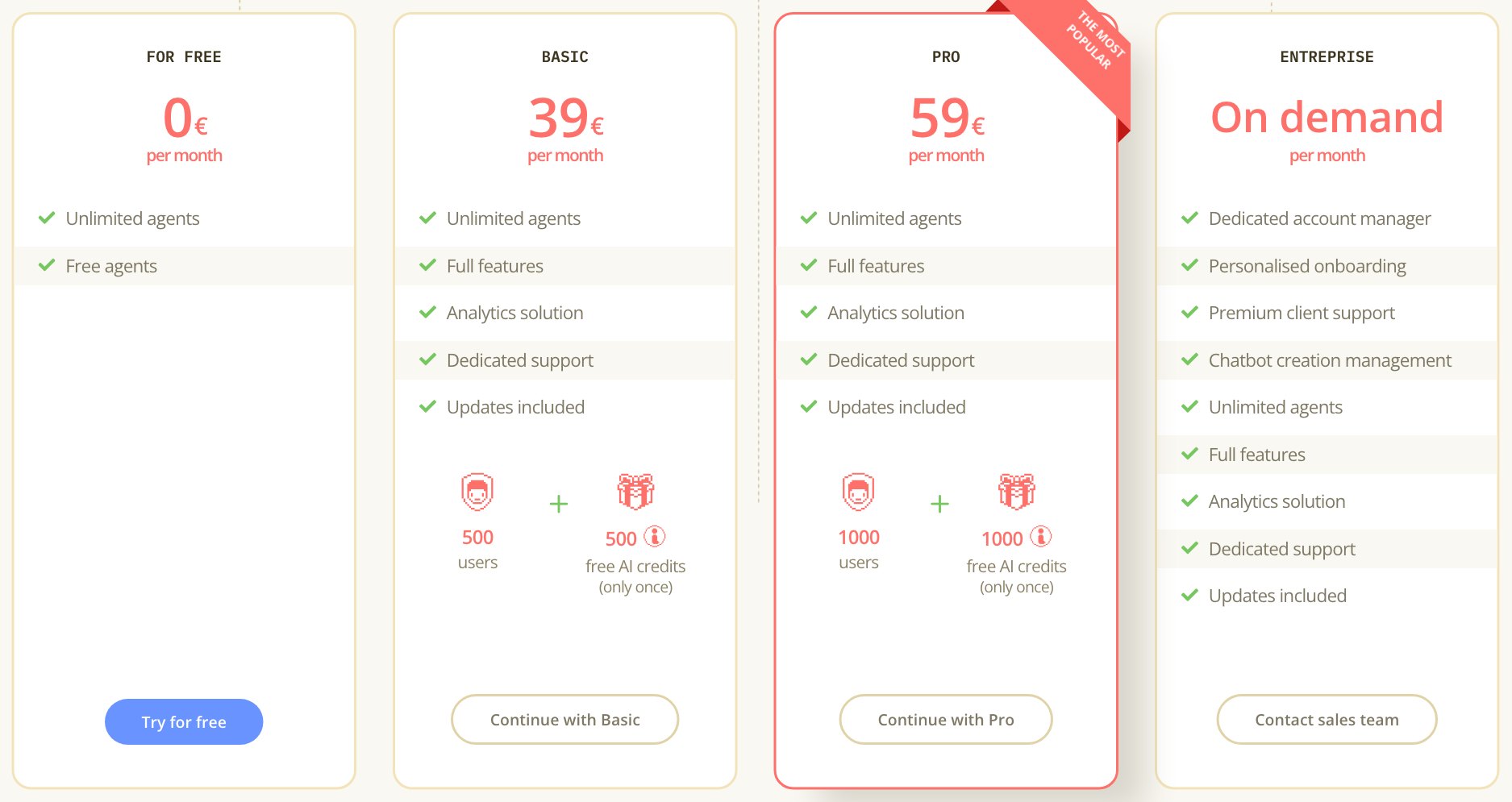
Genesys equips the contact center; Botnation makes your website, your messaging apps and your customers talk, with no infrastructure. And if you want both levels of service, we assume it: the no-code platform for day-to-day autonomy, and a team that builds your chatbot end to end when you would rather delegate (Enterprise offer, on demand: the team that builds is the team that edits the platform, and you keep control of your account after delivery). For an automation example focused on agent teams, see our article on the call center chatbot.
How to try and deploy a Genesys chatbot
Genesys does not sell its plans online in one click: every pricing card leads to “get custom pricing” and a bookable demonstration. The typical path of a project, from the vendor’s public pages and its documentation:
- Frame the use cases and the volumes. Number of named users (agents, supervisors), monthly conversations, channels actually opened: exactly the two variables of the simulator above, and they drive the economics.
- Pick the edition and the licence. Full edition (CX 1 to CX 4) or Digital (no voice); named, concurrent or hours-of-interaction licence; check the currency of the grid (the EUR and USD views diverge, capture of August 31, 2026).
- Build the bot. Native bots for purposeful dialogues, virtual agents (AI Experience tokens) for AI-assisted resolution, or the integration of an existing third-party bot (Google, Amazon) through Dialog Engine Bot Flows.
- Connect the channels and the systems. Web and mobile chat, WhatsApp, Messenger, SMS, email depending on the plan; connections to the CRM and back-office tools so the bot acts, not just answers.
- Design the human handover. Queues, opening hours, waiting messages, transfer with context: this is the most structural part of a deployment, the one that separates a contact center from a plain bot.
- Measure and iterate. Bot containment rate, re-contact rate, satisfaction: the official documentation lists improved containment as the first expected benefit.
For a first trial without a project: the platform is evaluated through a demonstration booked on the vendor’s website. And if your need is a support or sales chatbot on your website and messaging apps, with no contact center infrastructure, you can create a free account on Botnation, explore our channels (website, WhatsApp, Messenger, Instagram), our client support module, or talk to our chatbot creation experts.
FAQ: the questions everyone asks about the Genesys chatbot
What budget for 10 agents?
On the public prices captured on August 31, 2026 (USD view, annual commitment): $950/month on the entry digital plan CX 2 Digital (10 × $95), $1,150/month on the omnichannel plan CX 2 (10 × $115). That floor excludes add-ons, AI tokens beyond the included allowance, and any negotiated discount: the official page invites you to get custom pricing anyway.
Is there a free plan or a no-commitment option?
No free tier is displayed on the Genesys grids captured at the source: public prices start at $75 (full edition) or $95 (Digital) per user per month, billed annually, and the page warns that usage-based pricing may apply. That is a real contrast with mass-market chatbot platforms: at Botnation, a permanent free account (0 €) exists, with plans from 39 €/month and no infrastructure to assemble.
What is the difference between “native bots” and “virtual agents”?
“Native bots” are the basic chatbots included in the plans: purposeful dialogues, Q&A, data collection. “Virtual agents” are the advanced AI tier: language understanding, actions in your systems, replanning. On the captured grid, they appear explicitly on the CX 4 card (“virtual agents” + 30 AI Experience tokens per named agent) and are consumed in tokens on the lower plans. The documentation also mentions support for third-party bots (Google Dialogflow, Amazon) for teams that already invested elsewhere.
How do “AI Experience” tokens work?
According to the pricing page (USD view of 08/31/2026): every organization receives a monthly allowance of “250 named / 350 concurrent tokens” included, and beyond it the grid displays “+30 named / +39 concurrent tokens per agent/month”. The exact label on the page stays summarized (no per-feature unit of consumption), so the real AI cost of a project gets pinned down in the quote: that is precisely the line to have put in writing.
Is Genesys suitable for small businesses?
The platform is built for organizations that run customer service teams and large volumes: annual per-user commitment, entry digital plan at $95/user/month, an integration project. A small business with no existing contact center would pay seats for a need often covered by one website and messaging bot: in that case, a no-code per-credit platform (with local support and an optional built-for-you service) covers the need for a fraction of the budget. Break-even thresholds depend on volumes: test them with the simulator in this article.
Does the Genesys chatbot work in languages other than English?
The vendor serves its site and resources in several languages (the French pages quoted in this article are one example), and its conversational engines handle multiple languages through their NLU layer, including third-party engines. Points to check during a demo: the language of the building tools, the reference documentation (mostly English, like the use case quoted in this article), and the local depth of the integrator ecosystem in your market.
Which alternatives are there to Genesys for a chatbot?
Three families, depending on the problem to solve: contact center suites (Genesys and vendors of the same market) if you equip an agent floor; no-code chatbot platforms (including Botnation) if you want a bot on website and messaging apps with no infrastructure; and subscription AI assistants if the need is individual. The right sorting uses two numbers: your named users and your conversations per month, exactly the inputs of the simulator above.
Conclusion: the right tool depends on the agent floor, not the buzz
The Genesys chatbot is a serious product, publicly priced high but consistent with what it contains: an omnichannel queue, agent tools, compliance, and now a layer of AI virtual agents billed in tokens. The grids captured on August 31, 2026 give clear floors: $75 to $240 per user per month on the full edition, $95 to $135 on the Digital edition, annual commitment, a quote to go further. If your reality is a contact center to equip, it is a legitimate candidate: have the licence, the add-ons and the tokens quoted, and compare the two currency views of the grid. If your reality is a website, a messaging app and the will to automate without a building of licences, the per-credit reading almost always wins: that is our trade, from the free account to the chatbot built end to end by our experts.
A chatbot with no contact center infrastructure?
Tell us your volumes and your channels: our chatbot creation experts will answer, or start for free on the platform.
Sources and captures: public Genesys pages consulted on August 31, 2026 (Genesys Cloud CX pricing in the USD and EUR views, Genesys Cloud CX Digital pricing, the Agentic Virtual Agent page, the “contact center chatbot” definition page in French, the “Genesys Chatbots” use case of the Resource Center); the Botnation pricing grid and credit equivalences captured the same day on botnation.ai (prices excluding tax). The screenshots reproduced in this article come from those pages. Third-party prices move: re-read them before any purchasing decision.