



- A ticketing chatbot is a conversational assistant connected to an event organiser’s schedule, prices and orders: it answers questions before the purchase, absorbs the on-sale peak, then handles after-sales, from the missing ticket to access control on event day.
- Ticketing is not an ordinary support channel: the product has a date, sometimes a name, and a QR code that is legally an access title. Every bot answer touches a right, not just a courtesy.
- Three rules frame its action: no withdrawal right for leisure services supplied on a fixed date (Article L221-28, 12° of the French Consumer Code), habitual unauthorised resale punishable by a €15,000 fine (Article 313-6-2 of the French Penal Code, €75,000 for a legal entity), and the duty to disclose that you are talking to an AI (Article 50 of the EU Artificial Intelligence Regulation, applicable since 2 August 2026).
- The request router in the middle of the article decides 24 real cases (stage × nature × identity verification) between “the bot answers alone”, “verification first”, “the bot informs, a human decides” and “motivated refusal”.
- The cost reads on three lines: the licence (from €39 per month excluding tax on the Botnation grid checked on 1 October 2026), the AI credits (€25 for 1,000), and the build, free in self-service or on quote when delegated to the Botnation team.
Ticketing chatbot vendors all promise the same thing: 24/7 assistance, in fifty languages, able to absorb on-sale peaks. The promise is not false. It is incomplete. A ticket is not an ordinary product: it expires, it is sometimes personal, and its QR code is enough to walk through the door. When a spectator writes “I never received my ticket” the night before the show, the chatbot is not answering a comfort question: it is handling an access title, with law and criminal law behind it.
What is missing almost everywhere is the law: presentations of a ticketing chatbot mention GDPR in passing at best, and rarely the Consumer Code, the Penal Code or the European regulation on artificial intelligence. Yet those are the very texts that decide whether the bot may resend a QR code, what it must answer to “I want to cancel”, and why it must refuse to help resell a seat.
This article therefore takes the subject in the order that matters: what the bot actually absorbs, stage by stage; the three legal rules that bound its right to act; a router to decide real cases; the channels; the costs on the public grid of the day; and the method. Botnation appears on both sides that count: the editor of the no-code platform, and a provider of custom builds through its Enterprise offer.
“Ticketing chatbot”: what exactly are we talking about?
A ticketing chatbot is a conversational agent connected to an event organiser’s information: schedule, prices and seat categories, sales and exchange conditions, access and services, then, after the purchase, the state of orders. It answers spectators on the website, social networks or WhatsApp, points them to the official ticketing system, and escalates to humans whatever exceeds its right to act.
The scope is broad: live shows and concerts, festivals, sport, trade fairs and congresses, museums and monuments, tourist offices, leisure parks, cinema. It also covers transport, where the ticket is the product itself: the subject is covered in depth in our articles on the chatbot for the transport sector and the chatbot for air transport. Here we talk about events and leisure: the logic of the access title tied to a fixed date, which is precisely what makes the subject legally specific.
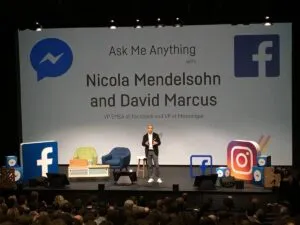
A story that starts in 2016
In France, the first of its kind was announced by Digitick on 15 November 2016: “Digitick lance aujourd’hui en France le premier chatbot de billetterie en France” (Digitick is launching France’s first ticketing chatbot today), writes the press release of its shareholder Vivendi, describing a “véritable assistant de recherche” (a true search assistant) on Facebook Messenger, built with MFG Labs, for a group that then processed “plus de 35 millions de billets par an” (more than 35 million tickets a year). Ten years later, the Messenger search bot has aged, but the insight behind it has not: the spectator is looking for an outing, not a price grid. The conversation has simply become multi-channel, and generative AI has replaced rigid decision trees.

What the chatbot handles, stage by stage
Lumping “ticketing support” into a single category is the most common framing mistake. The question of a spectator hesitating before buying, the panic message the night before the show and the festivalgoer standing in the entry queue have neither the same urgency, nor the same channel, nor the same legal regime. Three stages, three settings.
Before the sale: inform without slowing anyone down
Times and doors, prices and discounts, capacity and categories, wheelchair access, parking, cloakroom, minimum age, collection deadline: these are information questions, identical for everyone, whose answer conditions the purchase. Every minute without an answer is a sale going elsewhere. The chatbot answers immediately, at any hour, and points to the official ticketing system: its job is to bring the purchase to completion inside the organiser’s checkout, never to divert it. It is also the stage where the bot works best for foreign visitors, holding the conversation in their language without recruiting a hotline for three emails a month.
The on-sale peak: the real stress test
A tour announcement or the opening of an edition concentrates thousands of identical questions into a few hours: exact opening time, number of tickets per order, presale access, seat categories, accepted payment methods. No support team sizes itself for three peak hours a year: either it over-invests all year, or it drops the ball on launch night. A conversational agent answers all askers in parallel, with no queue and no temporary reinforcements, and it does not fall apart because it was asked the same question four hundred times. It is the use case where the gap between a saturated hotline and a well-tuned bot shows fastest, from the very first on-sale.
After the sale and on event day: after-sales for the access title
Once the ticket is bought, the nature of requests changes: e-ticket not received, QR code that will not display, a misspelled name, a change of holder, a date exchange, a cancellation, a refund, a resale. The spectator is convinced the seat is lost, so the urgency is real even when the cause is a spam folder. On the day itself come the field questions: site map, stage, doors, rules, cloakroom, contactless top-up. These requests play out on a phone, often while walking, and there is no time left to be wrong.
| Typical request | Stage | What the bot does | What stays human |
|---|---|---|---|
| “What time do sales open? How many tickets per order?” | On-sale peak | Answers instantly, to everyone, without a queue | Nothing: general information |
| “Does the venue offer accessible seating?” | Before the sale | Explains the access procedure and points to the right form | Accessible-seating requests if they require a named handling |
| “I never received my e-ticket” | After the sale | Guides the checks (spam, address, account), offers the resend after matching the order | The resend if the identity cannot be verified |
| “I want to cancel my order” | After the sale | Explains the applicable regime, opens and qualifies the request | The exception decision, under the terms of sale |
| “I’m reselling my seat, can you transfer it?” | After the sale | Refuses to assist the resale, explains the rule, flags the request | The possible transfer authorisation, if the organiser so decides |
| “Where is the stage? What time do doors open?” | Event day | Sends the map, the times, the access routes, on a phone | Nothing: field information |
The three legal rules that bound the bot
This is the part commercial pages skip, and yet it is what decides the real quality of a ticketing chatbot. Three texts, three boundaries.
1. There is no withdrawal right: the bot must not invent one
The fourteen-day withdrawal right, familiar to e-commerce, does not apply to a ticket. The French Consumer Code excludes it explicitly for contracts for “prestations de services d’hébergement, autres que d’hébergement résidentiel, de services de transport de biens, de locations de voitures, de restauration ou d’activités de loisirs qui doivent être fournis à une date ou à une période déterminée” (Article L221-28, 12°), that is, services for accommodation other than residential, transport of goods, car rental, catering or leisure activities that must be supplied on a specified date or period. A show on a fixed date falls into that last category: the buyer has no cooling-off period, unless the organiser’s terms of sale voluntarily offer one.
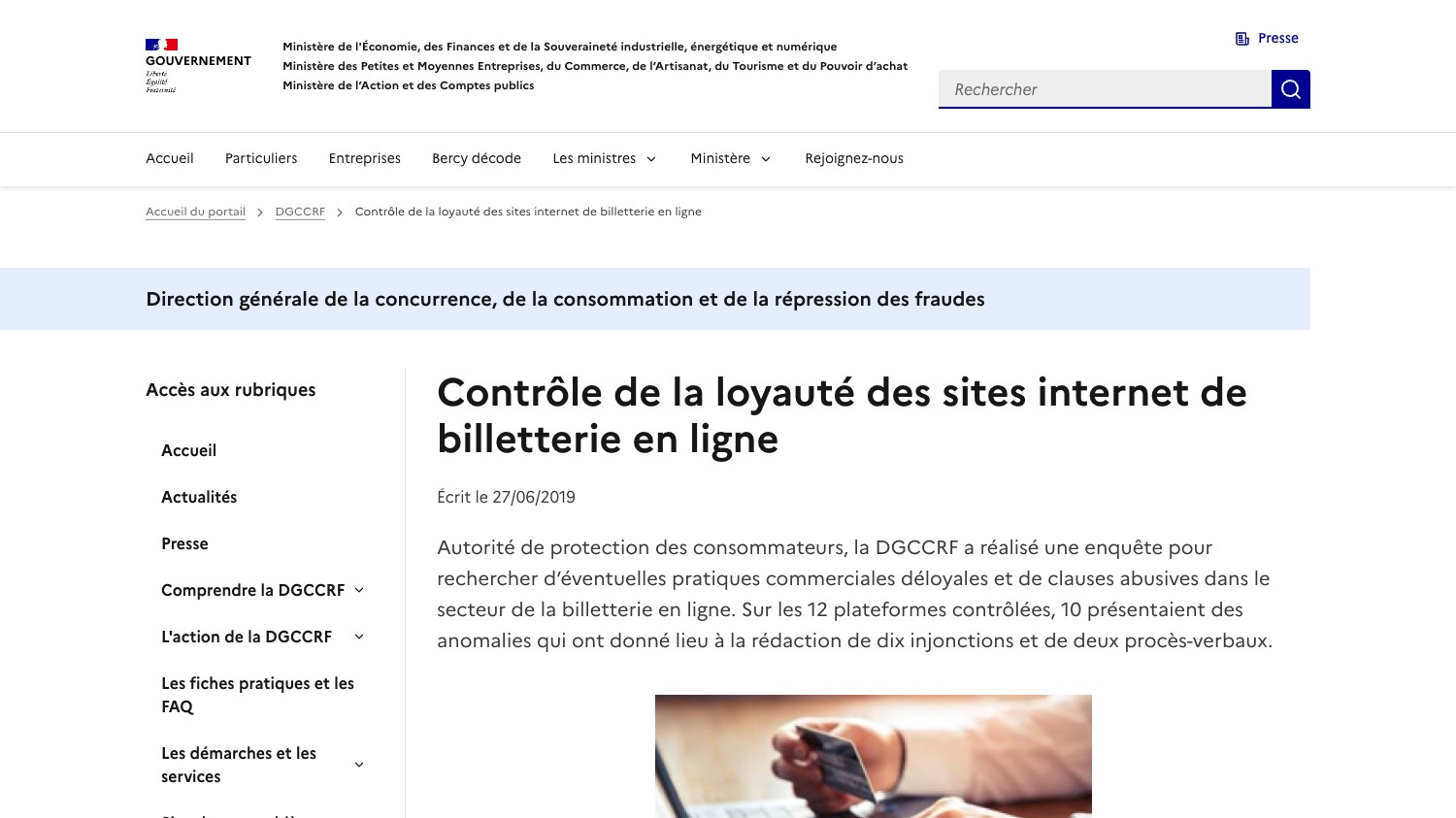
The regulator measured this at scale. In 2019, the DGCCRF, France’s consumer protection and fraud-control authority, audited the loyalty of online ticketing sites: of twelve platforms controlled, ten showed irregularities, sanctioned by ten injunctions and two official reports, in a context of about sixty consumer complaints, mostly after purchases from resellers. Its finding deserves to be quoted in the original French, with our translation:
« Les conditions générales de vente des billets pour des évènements culturels ne prévoient pas de possibilité d’échange ou de remboursement et les assurances annulation, payantes, ont des conditions d’exclusion parfois très larges. De plus, le consommateur ne bénéficie d’aucun droit de rétractation en application de l’article L. 221-28 du Code de la consommation. »
The general terms of sale of tickets for cultural events provide no exchange or refund option, and paid cancellation insurance sometimes has very broad exclusion conditions. Moreover, the consumer benefits from no withdrawal right under Article L. 221-28 of the Consumer Code.
DGCCRF, “Contrôle de la loyauté des sites internet de billetterie en ligne”, page published on 27 June 2019, in French only.
The consequence for the chatbot is direct: to “I bought by mistake, I am withdrawing”, the right answer is neither “of course” nor “never”. The bot explains the regime (no legal withdrawal for a leisure activity on a fixed date), checks what the terms of sale or the cancellation insurance provide, then passes the request to humans. An exact informational answer followed by a human decision, not a refund improvised by a machine.
2. Unauthorised resale is an offence: the bot must refuse cleanly
Ticket resale is the second legal front, and the most sensitive one. Article 313-6-2 of the French Penal Code, created by Law no. 2012-348 of 12 March 2012, provides, in the French original with our translation:
« Le fait de vendre, d’offrir à la vente ou d’exposer en vue de la vente ou de la cession ou de fournir les moyens en vue de la vente ou de la cession des titres d’accès à une manifestation sportive, culturelle ou commerciale ou à un spectacle vivant, de manière habituelle et sans l’autorisation du producteur, de l’organisateur ou du propriétaire des droits d’exploitation de cette manifestation ou de ce spectacle, est puni de 15 000 € d’amende. Cette peine est portée à 30 000 € d’amende en cas de récidive. »
Selling, offering for sale, exposing for sale or transfer, and providing the means for the sale or transfer of access titles to a sporting, cultural or commercial event or a live show, habitually and without the authorisation of the producer, the organiser or the rights holder of that event or show, is punishable by a €15,000 fine. The penalty is raised to €30,000 in case of repeat offence.
The same text defines the access title broadly: “tout billet, document, message ou code, quels qu’en soient la forme et le support” (any ticket, document, message or code, whatever its form and medium). A QR code is therefore a full access title, which lights up both sides of the issue. For a legal entity, the fine incurred rises to five times that amount, i.e. €75,000 (Article 131-38 of the Penal Code). And since Ordinance no. 2021-1734 of 22 December 2021, the Consumer Code deems deceptive the practice of “revendre des billets pour des manifestations à des consommateurs lorsque le professionnel les a acquis en utilisant un moyen automatisé lui permettant de contourner toute limite imposée au nombre de billets qu’une personne peut acheter ou toute interdiction applicable à l’achat de billets” (reselling tickets for events to consumers when the professional acquired them using an automated means to circumvent any limit on the number of tickets a person can buy or any prohibition applicable to ticket purchases), Article L121-4, 26°: the legislator is aiming at purchase bots here, the other use of automation, the one that harms ticketing instead of serving it.
For an organiser’s chatbot, the consequence is a refusal rule: it never facilitates an unauthorised resale, neither holder transfer, nor matchmaking, nor a “workaround”. It explains why, cites the framework if asked, and flags the request. Symmetrically, these texts protect the organiser: they ground purchase limits per order and make it possible to act against professional resellers who drain stocks at the on-sale.
3. The bot must say that it is a bot
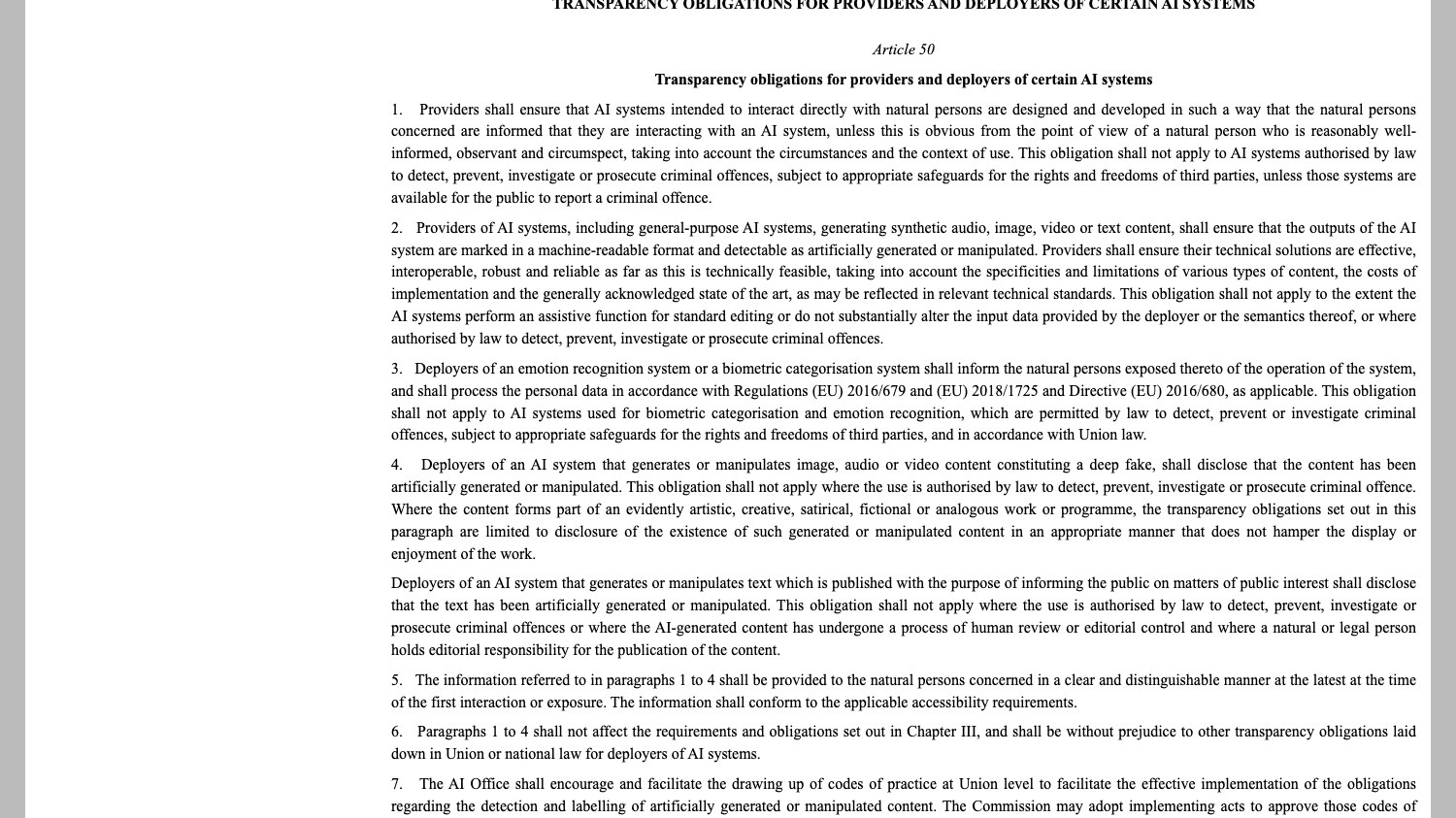
Third boundary, more recent: transparency. Since 2 August 2026, Article 50 of Regulation (EU) 2024/1689 on artificial intelligence requires informing the user that they are interacting with an AI. The European text is explicit:
“Providers shall ensure that AI systems intended to interact directly with natural persons are designed and developed in such a way that the natural persons concerned are informed that they are interacting with an AI system, unless this is obvious from the point of view of a natural person who is reasonably well-informed, observant and circumspect, taking into account the circumstances and the context of use.”
Regulation (EU) 2024/1689, Article 50, paragraph 1, English text from the Official Journal of the European Union.
In practice: one disclosure sentence at the top of the conversation, and clear signage in the purchase funnel. On the data side, a ticketing conversation carries personal information (name, email, order number, sometimes accessible-seating requests that touch on health): the CNIL’s “Chatbots” guidelines of 19 February 2021 recall the usual legal bases, data minimisation, retention periods and the need for a processor contract with the platform editor. Nothing insurmountable, but nothing to improvise on launch day either.
The router: can the bot handle this case?
Three parameters are enough to decide most real cases: the moment of the request, its nature, and whether the requester’s identity has been verified. The router below applies the cascade described in the previous section, with the deciding rule written into each verdict. The reference table underneath reloads the router with ten real requests; then change a single answer and watch the boundary move.

Can the bot handle this request?
Three answers, one verdict, the rule that prevails. Or load a real case from the table below.
1. Where is the spectator in the journey?
2. What are they asking for?
3. Has their identity been verified?
The bot answers alone
Times, prices, access, map, the published exchange policy: the answer is the same for every spectator and commits nothing. This is the core of what a ticketing chatbot absorbs, and the only zone where “answering everyone in parallel” is a sufficient quality bar.
Verification first
A QR code is an access title within the meaning of Article 313-6-2 of the French Penal Code: resending it without matching the order amounts to handing a seat to the first asker. The bot guides the spectator (spam folder, address used, customer account) and asks what is needed to find the order. Nothing goes out before that.
The bot acts, after verification
Order found, identity consistent: resending the ticket or regenerating the QR code can be automated safely. This is the most urgent after-sales request, the one where the spectator is convinced the seat is lost: an answer in minutes is worth every compensation voucher.
The bot informs, a human decides
There is no withdrawal right for a leisure activity supplied on a fixed date (Article L221-28, 12° of the French Consumer Code), so every commercial gesture is an exception governed by the terms of sale. The bot explains the regime, opens the request, qualifies it. The exception itself is decided with a person.
Motivated refusal, scripted answer
Habitual resale without the organiser’s authorisation is an offence (a €15,000 fine, €75,000 for a legal entity): the bot never facilitates a transfer, it explains the rule and flags the request. If the organiser authorises a named transfer, that is a written procedure, not a conversational favour.
The cascade applies in order: resale first (refusal), then the access title (verification), then the contractual decision (human), and information by default. One use case, one boundary: copy this table into your specification.
| Real request | Moment | Expected answer | Load |
|---|---|---|---|
| “What time do doors open?” | Event day | Bot alone | |
| “Is the site wheelchair accessible?” | Before the purchase | Bot alone | |
| “I never received my ticket” (nothing given) | After the purchase | Verification first | |
| “Resend my e-ticket” (order number verified) | After the purchase | The bot acts, after verification | |
| “My QR code will not display” (account signed in) | Event day | The bot acts, after verification | |
| “I want to cancel, I do have 14 days, right?” | After the purchase | The bot informs, a human decides | |
| “Can I switch to the Saturday date?” | Before the purchase | Bot alone (published exchange policy) | |
| “I’m reselling my seat, transfer it to the buyer” | After the purchase | Motivated refusal | |
| “Where exactly do we buy?” | Before the purchase | Bot alone | |
| “Refund me, the artist cancelled” | After the purchase | The bot informs, a human decides |
Which channels to deploy on: the channel follows the moment
The stage also dictates the channel. Before the purchase, the spectator is on the event or venue website: the chatbot lives on the event page and the practical-information page, where the question is born. At the on-sale peak, they are already inside the checkout, and the blocking question is “can I take four tickets?”: the bot must be reachable without leaving the payment page. On event day, everything moves to the phone and messaging apps: the group of friends organising on WhatsApp needs the access map and the door time, not a confirmation email buried in an inbox. One scenario can live simultaneously on the website, WhatsApp, Messenger and Instagram, each channel keeping the conversation history. Our pages on deployment channels and the FAQ module detail these integrations.
Four organiser profiles, four settings
The dominant demand is pre-sale: programme, seat categories, discounts, then after-sales exchanges between dates of the same tour. The critical setting: the exchange policy must be written in black and white in the bot’s answers, because “I cannot come on Tuesday” is the most frequent exception request, and the temptation to settle it automatically is the most dangerous one.
Extreme concentration: three days of field questions (rules, cashless, parking, shuttles, camping) after weeks of presale. Two bots are better than one: a permanent information bot on the website, and on the day, the same scenario available on WhatsApp, where questions arrive from the entry queue. On the day, there is no hotline left.
Here the ticket sits next to the visit: time slots, skip-the-line tickets, temporary exhibitions, but also ticketing for sites and shows run by the tourist office. The DrômArdèche case, a Drôme and Ardèche destination whose office runs a local-products shop and ticketing for sites, shows the variety of requests; our chatbot for tourism page details this setting.
Season tickets, home fixtures, away trips: the same question returns every fortnight with a different date. The critical setting is the link to the official calendar, so that the answer “next home fixture” is computed, never hard-coded. On resale, the framework is the firmest of all: sporting and cultural events are named by Article 313-6-2.
How much does a ticketing chatbot cost?
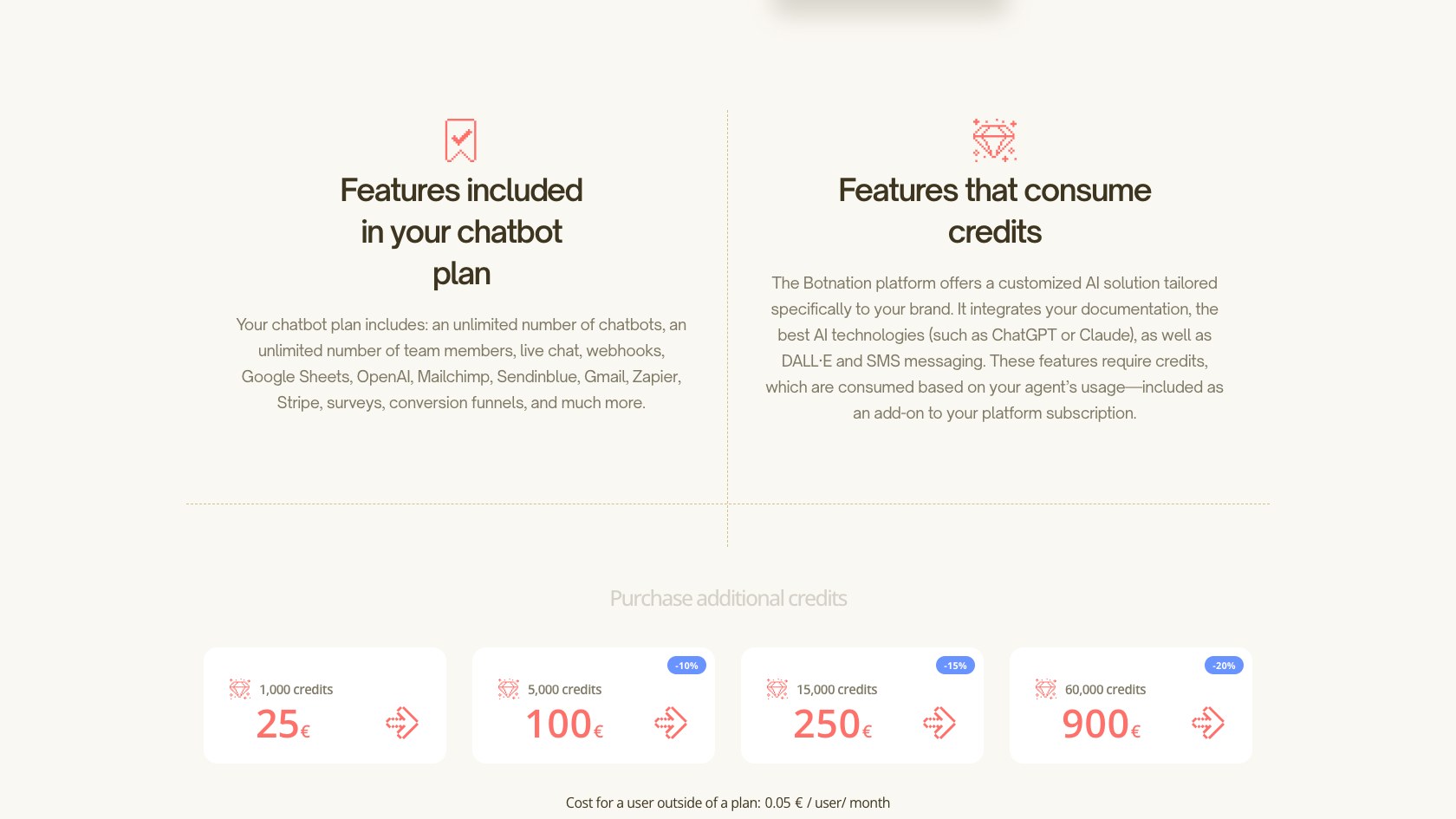
The cost reads on three lines, as for any conversational agent: the platform licence, the credits consumed by the AI features, and the building of the scenario. On the public Botnation grid checked on 1 October 2026: a Free plan at €0 to test, Basic at €39 per month (500 users and 500 AI credits offered once), Pro at €59 per month (1,000 and 1,000), and an Enterprise plan “on demand” that literally includes “chatbot creation management”, a dedicated account manager and premium support; credit packs are bought on the side, from €25 for 1,000 to €900 for 60,000, and one user beyond the plan costs €0.05 per month. All these prices are excluding tax, shown in euros.
| Cost line | Public range | What drives it |
|---|---|---|
| Platform licence | €0 to €59 per month excluding tax, Enterprise on quote (checked 1 October 2026) | Number of tracked users, team features, support level |
| AI credits | €25 for 1,000 credits, up to €900 for 60,000 | The volume of AI requests and the engine called for each |
| Scenario build | Your team’s time in self-service, or a quote with the Botnation team | Number of stages covered, ticketing integrations, languages |
And what if you had a chatbot developed entirely outside the platform? Botnation’s pricing FAQ (in French) puts it plainly: “il vous en coûtera en général entre 5000€ et 30000€, voir bien plus, selon les fonctionnalités dont vous avez besoin. Ces fourchettes de prix sont indicatives” (in general it will cost you between €5,000 and €30,000, or far more, depending on the features you need; these price ranges are indicative). A market order of magnitude, to be compared with your team’s time if you build it yourself in the no-code editor.
Then comes the question of who. Botnation is not only the platform editor: the Enterprise offer includes the custom creation of chatbots, carried out by its chatbot creation experts, on quote. The value of this dual position is simple: the team that builds is the team that edits the tool, and once delivered, the account, the scenarios and the knowledge base stay in the no-code editor, where your team can take over. A third-party agency remains legitimate too, when a very specific trade, a legacy integration or on-site staffing is at stake; what matters is that the platform stays yours in every case.
The method: six steps before sales open
- List the real requests. The last three events: inbox, direct messages, switchboard, queue at the counter. Not the requests imagined in a meeting: the ones that arrived, with their exact words. That is the raw material for everything else.
- Classify them with the router. Every request goes through the stage × nature × verification grid: information, access title, contractual decision, resale. This sort decides what the bot handles alone and what goes up.
- Connect the data. Programme, prices and categories, terms of sale and exchange, access map, FAQ: the bot only speaks about what is up to date. A price that changed this morning is worse than no answer at all.
- Write the on-sale answers. The questions of the sales opening are known in advance: opening time, per-order limit, presale, payment. They are written before the announcement, not during.
- Tune the refusals and the human boundary. The answer to “I am withdrawing” as well as to “I am reselling” is written cold, with the legal framework in view. The handover point to a human is tested before the first on-sale.
- Rehearse before launch. One load run on the full scenario, mobile first, with someone playing the hurried spectator. Then supervision on opening night, when the real questions arrive.
Five mistakes that cost dearly
- Promising a withdrawal right that does not exist. Article L221-28, 12° of the French Consumer Code excludes it for leisure activities on a fixed date: a bot answering “you have fourteen days” creates a legally false expectation and a dispute in the making.
- Resending a QR code without verifying who is asking. The access code is an access title: sending it to the first claimer opens the door to fraud and closes the door on trust. Verification first, sending after, always in that order.
- Letting the bot “help” with resale. Matchmaking, holder transfer, a “trick” to bypass the purchase limit: habitual unauthorised resale is an offence, and a bot that lends itself to it brings its owner within the scope of Article 313-6-2.
- Opening sales without human supervision. The bot absorbs the peak, but the first hour of a launch always brings one unforeseen question: someone must read it, decide it and correct the answer.
- Forgetting to disclose the AI. One sentence at the top of the conversation, required by Article 50 of the European regulation since 2 August 2026, and one more trust factor: the spectator talks to a machine for simple questions, to a human for the rest.
Frequently asked questions
What does a ticketing chatbot cost?
Three lines: the licence (from €0 to test up to €59 per month excluding tax on the standard offers of the Botnation grid checked on 1 October 2026, the Enterprise offer being on quote), the AI credits (from €25 for 1,000), and the building of the scenario, free in self-service or covered by a quote under the Enterprise offer. For a development entirely outside the platform, Botnation’s pricing FAQ cites an indicative range of €5,000 to €30,000 and more.
How long does it take to set up?
In self-service on the platform, a first information scenario (programme, prices, access) is built in a few hours; the fine-tuning of refusals and of the human handover takes as much time as the writing itself. For a custom build by the Botnation team, the schedule is set at the quote stage, depending on the integrations to your ticketing system and the number of languages: no serious figure can be promised before that scoping.
Can the chatbot sell the tickets itself?
The best setting is the safest one: the bot informs, qualifies and walks the spectator to the checkout of your official ticketing system, where the transaction completes in a compliant payment environment. An assistant connected to seat availability can go as far as pre-filling the selection; the payment itself stays in the ticketing funnel.
Can the chatbot be connected to our existing ticketing system?
Yes: it is even the condition of good after-sales. Scenarios feed on data (programme, prices, conditions) and the connector features allow dialogue with your tools, for example to find an order or check a status. The exact state of the possible integrations with your ticketing platform is checked case by case with our experts: the variety of solutions on the market rules out any blanket promise.
Can a spectator withdraw after buying a ticket?
No, in principle: Article L221-28, 12° of the French Consumer Code excludes the withdrawal right for leisure activities that must be supplied on a specified date or period. The spectator keeps the options provided by the organiser’s terms of sale (exchange, voucher, purchased cancellation insurance), and the bot must say exactly that rather than promise a fourteen-day period that does not exist.
Can the chatbot help a spectator resell their seat?
No, and that refusal rule must be written in black and white: habitual resale without the organiser’s authorisation is an offence (Article 313-6-2 of the French Penal Code, a €15,000 fine, €75,000 for a legal entity), and acquiring tickets through automated means bypassing purchase limits is a practice deemed deceptive (Article L121-4, 26° of the Consumer Code). If the organiser authorises a named transfer, that is a written procedure the bot can explain, not a conversational favour.
Which channels for an event: website, WhatsApp, social networks?
Three moments, three reflexes: the website for pre-sale and the checkout, messaging apps for the day itself, when the spectator is on a phone and on the move, and social networks to catch the question where it is born, often from a shared announcement. One scenario lives on these channels simultaneously, with the history following the conversation.
Your ticketing already has its questions: start with the first twenty
Take the requests from your last three events, classify them with the router, and build the scenario yourself on the platform; or hand the creation to the team that edits it, under the Enterprise offer, on quote.
Get a quote for the creation of your chatbot or talk to our chatbot creation experts.
Sources. French Consumer Code, Articles L221-28 (12°) and L121-4 (26°, created by Ordinance no. 2021-1734 of 22 December 2021), versions in force checked on 1 October 2026 (French official texts; translations ours); French Penal Code, Articles 313-6-2 (created by Article 3 of Law no. 2012-348 of 12 March 2012) and 131-38, version in force checked on 1 October 2026; Regulation (EU) 2024/1689 of 13 June 2024, Article 50 paragraph 1, English text of the Official Journal of the European Union on EUR-Lex, applicable since 2 August 2026; DGCCRF, “Contrôle de la loyauté des sites internet de billetterie en ligne”, page published on 27 June 2019 and checked on 1 October 2026 (published in French only); CNIL, “Chatbots : les conseils de la CNIL pour respecter les droits des personnes”, 19 February 2021; Vivendi, press release “Digitick lance le premier chatbot de billetterie en France”, 15 November 2016 (in French); pricing grid and FAQ of botnation.ai, checked on 1 October 2026.