



- A B2B chatbot and a B2C chatbot answer different people for different reasons: on the business to business side, the conversation qualifies a professional prospect (company, needs, appointment); on the business to consumer side, it advises a consumer (product choice, order, after-sales).
- Eight settings genuinely change from one audience to the other: tone, mission, answer length, channels, metrics, when to hand over to a human, data collected, expected availability.
- The law, however, does not see a difference: article 50 of the European AI regulation, applicable since 2 August 2026, requires informing any natural person that they are talking to an AI, professional or consumer; and the GDPR frames decisions made by the bot alone.
- One bot or two? The answer comes down to four questions (audience, mission, volume, ownership). The router in the middle of this article settles all 81 combinations and loads ten real situations.
- Cost (Botnation grid checked on 2 October 2026, excluding VAT): from €0 to test up to €59 per month in self-service, AI credit packs from €25; custom creation is priced on quote, the pricing page mentioning “between €5,000 and €30,000, or even more” for turnkey work outside a subscription.
The question of the “B2B and B2C chatbot” most often lands on the desk of a team with two audiences in front of it: end customers who want to know where their order stands, and professionals asking for a quote, a demo, a callback. The same chat button then serves two conversations that share almost nothing: not the vocabulary, not the urgency, not the patience, not the legal risk. Most content on the subject stays at the level of marketing definitions and never gets down to what concretely changes in the scenario, the channels, the metrics or the law. That is exactly what this page does, with a decision tool in the middle.
A vocabulary note before we start: “B2B” (sometimes written BtoB) means business to business, selling from one company to another. “B2C” (BtoC) means business to consumer, selling from a company to individuals. The chatbot we cover here is not the robot inside your own company (the one answering your own employees is usually called an internal or B2E chatbot, and it has its own article): we are talking about the bot that speaks outward, to your customers and prospects.
“B2B, B2C”: two conversations the same bot cannot hold the same way
Take the same question from both audiences: “How much does it cost?”. From a consumer, it calls for a price, a range, maybe a delivery option. From a professional, it calls for another question: “For what use case, what team, what volume?”. The consumer wants an answer in thirty seconds on their phone; the professional accepts a longer exchange, provided it ends with an appointment or a figure tailored to their case. The same bot, set up identically for both, disappoints both: too short for one, too shallow for the other.
The person you are talking to operates in a professional frame: they compare, they arbitrate, they answer to others. The conversation is often one step in a longer cycle (quote, validation, deployment). What the bot must produce: a qualified need, a booked appointment, a file handed over cleanly to the right salesperson. Our dedicated B2B chatbot article details this setup.
The person acts for themselves, often on mobile, sometimes while walking, sometimes annoyed. The conversation is self-contained and immediate: they want their answer now, or to know right away whom to talk to. What the bot must produce: a clear answer, a guided choice, an order update, and a quick handover to a human as soon as emotion rises.
The eight settings that really change from one audience to the other
Here is the table to print before writing the first line of your scenario. Each row is a choice to be made separately for each audience, not once and for all.
| Setting | B2B chatbot | B2C chatbot |
|---|---|---|
| Interlocutor | Professional prospect or customer, mostly during office hours, sometimes several people behind one decision | End consumer, at any hour, alone in front of a screen or phone |
| Main mission | Qualify: company, role, need, timeline, then appointment or callback | Advise and unblock: product choice, order, tracking, complaint |
| Tone and register | Formal “you”, assumed business vocabulary, figures and processes | Formal or brand-casual “you”, short sentences, zero jargon |
| Answer length | Accepts developed answers, comparisons, use cases | Wants the essentials in two sentences, then buttons |
| Channels | Company site, pricing page, trade show, follow-up email, LinkedIn | WhatsApp, Messenger, Instagram, product page, help page |
| Metrics | Qualified leads, cost per lead, appointments booked, time to first response | First-contact resolution rate, satisfaction, average cart, reviews |
| Handover to a human | On complexity: quote, integration, contract | On emotion and urgency: dispute, lost parcel, refund |
| Data collected | Work email, company, role, stated need | Personal contact details, order number, sometimes address |
Tone: formal everywhere, shared vocabulary nowhere
In French, the formal “vous” applies on both sides, except for brands that own a casual consumer tone; in English the register question replaces the grammar one. The real difference lies elsewhere: register. In B2B, your interlocutor wants to hear about their own trade (workflows, deployment, contract, volume) and tolerates a well-placed technical word that proves you know their daily job. In B2C, every technical word is a losing move: “credit”, not “account balance”; “delivery”, not “last-mile logistics”. A bot that tells a consumer “we will now qualify your need” has already lost them.
Mission: qualify on one side, advise on the other
This is the most structuring setting. A qualification bot asks closed questions, scores the answers, and ends on a concrete commercial action: an appointment slot, a requested callback, a file passed along. Our lead generation module is built exactly for that. An advisory bot answers first: it points to the right product, reassures on size, material, lead time, and asks for nothing until trust is established. The two jobs are built in reverse order: one asks then offers, the other informs then, possibly, invites.
Channels: your audience does not live at the same addresses
The consumer is where their friends are: WhatsApp for order tracking, Instagram for discovery, Messenger for a page’s after-sales. The professional is where their work is: the company site, the pricing page, the documentation, the trade-show stand, the email signature. One scenario can live on several channels at once, but the dominant channel changes the format of the answers: two sentences and buttons on mobile, a richer answer with a table on site. The details of available channels (WhatsApp, Messenger, Instagram, WordPress) are on our channels page.
Metrics do not compare across the two worlds
Mixing dashboards is the classic mistake of teams serving both audiences. A 3% conversion rate on five-figure quotes and a 3% conversion rate on €40 carts do not tell the same story, are not fixed with the same levers, and are not celebrated with the same champagne. In B2B, watch the number of qualified leads and the time to first response: a professional prospect who waits two days has already spoken to a competitor. In B2C, watch the first-contact resolution rate and satisfaction: the consumer judges the conversation itself, not the process behind it.
The handover to a human does not trigger at the same moment
In B2B, the handover is planned and organized: the bot qualifies up to a threshold, then passes the baton to sales with a clean file. It is part of the scenario, it is even its purpose. In B2C, the handover is a detector: lost parcel, refused refund, rising tone, question asked twice. It must be immediate and honest (“I am handing you over to an advisor, you will get a reply within the hour”), because a consumer who feels trapped in a bot closes the tab and says so around them.
Collected data does not weigh the same
Work email and company on one side; home address, order number, purchase history on the other. Both fall under the GDPR, but the scope and sensitivity differ: the B2C bot almost always touches consumer data, with the retention obligations that go with it. The CNIL, France’s data protection authority, sums up the retention rule for all chatbots: data is kept “for the period necessary to achieve the purpose of the processing”, and you must distinguish what should be erased when the conversation ends from what may legitimately be kept longer, for instance for a complaint. We come back to this below with the exact quotes.
One bot or two? The four-question router
The question everyone asks, and almost nobody answers with criteria: one single chatbot for my two audiences, or two separate chatbots? The answer depends on only four things: who talks to the bot, to do what, at what volume, and with how many people to run it. The router below crosses the four and decides with named rules: you can see which one applies to your case, and why.

Settle your case in four answers
Four questions, one verdict, the rule that prevails. Or load a real situation from the table just below.
1. Who must this chatbot talk to?
2. What is its main mission?
3. How many conversations a month?
4. Who runs it day to day?
B2C information and sales bot
Opening hours, choices, sizes, comparisons, order tracking: short answers, a direct tone, buttons rather than fields to fill in, and the relay to a human as soon as emotion rises. It is the fastest setup to build, and the one that speaks to the largest crowd.
B2B qualification bot
Company, role, need, timeline: closed questions, a score attached to each answer, and a concrete outcome at the end of the journey, booked appointment, requested callback or sent documentation. The bot does not sell in place of sales: it prepares conversations that start well.
Support bot: verify first
“Where is my order”, “I want a refund”: the answer engages the contractual relationship. The bot pulls up the order, gives the exact status, handles simple requests (resending, tracking), and passes the hand to a human for any decision that commits: exceptional refund, dispute, formal complaint.
One platform, two journeys
Traffic pays for the separation: a “professionals” journey with its qualification questions, a “general public” journey with its short answers, and an entry menu that routes from the very first message. Two scenarios, one account, one history on the team side.
One bot, two front doors
Not enough yet to feed two journeys: start with a single scenario whose first message asks who is speaking (“I am a professional” / “I have a question about my order”), and split the day one of the two branches saturates. The split will then be made on real data, not on intuition.
The cascade applies in order: both audiences first (volume decides between one or two journeys), then after-sales (verification before action), then B2B qualification, and B2C information by default. No verdict is good in the absolute: it depends on the other three answers.
| Real situation | Audience | Mission | Router verdict | Load |
|---|---|---|---|---|
| “Online cosmetics store: where is my order, during the sales” | B2C | After-sales | Verify first | |
| “Software vendor: company, need, timeline, then a demo slot” | B2B | Qualify | B2B qualification | |
| “Event organizer for professionals and the general public, 4,000 conversations in trade-show month” | Both | Inform | Two journeys | |
| “Neighborhood bakery: hours, allergens, ordering a cake” | B2C | Inform | B2C information | |
| “Insurer: filing a claim and checking what the policy covers” | B2C | After-sales | Verify first | |
| “Industrial manufacturer: after-sales documentation and technician appointment” | B2B | After-sales | Verify first | |
| “HR SaaS: candidates and HR departments in the same window, 600 conversations a month” | Both | Qualify | Two front doors | |
| “Real-estate agency: sorting buyers before scheduling viewings” | B2B | Qualify | B2B qualification | |
| “Furniture retailer: size and material advice, then delivery tracking” | B2C | Inform | B2C information | |
| “Utility operator: households, businesses and local authorities, heavy load” | Both | After-sales | Two journeys |
B2B side: qualify, book, keep the thread
The B2B chatbot serves two people at once: the prospect, who gets an immediate answer at three in the morning instead of a lost form, and the salesperson, who receives pre-sorted conversations instead of half-filled quote requests. Three uses dominate this side of the table.
- Inbound qualification. The bot asks the questions sales would ask anyway: which company, which role, which need, which timeline. Each answer is scored, and the prospect exits the journey either with an appointment in the calendar or with tailored content and a scheduled callback. This is the core of our article on B2B prospecting with a chatbot.
- Appointment booking. Offering two or three slots, checking the time zone, confirming by email, reminding the day before: tasks that require no intelligence but all of a machine’s punctuality.
- Professional customer support. Access to documentation, ticket status, connection to the right engineer: the professional bot absorbs recurring requests and passes them on with context, sparing the client from telling their story three times.

One guardrail to finish: the B2B bot must be able to say “I do not know, here is who will”. A professional prospect tests your tool as much as they use it; an approximate answer about your own product is paid for in credibility. Plan a clean exit question to sales as soon as the conversation leaves the written scenario, and measure how often it fires: it is your best indicator of which scenario to enrich.
B2C side: advise, sell, unblock
The consumer does not compare your bot to other bots: they compare it to the best customer-service conversation they ever had, human ones included. Three uses structure this side.
- Choice assistance. Sizes, compatibility, comparisons, availability: the bot points to the right product instead of sending back a catalog. It is the natural mission of an e-commerce chatbot, and the one most quickly measured in euros.
- The living FAQ. Delivery, returns, warranties, opening hours: the questions everyone asks, with short, up-to-date answers and a link to the full page. Our FAQ chatbot module turns an existing FAQ into a conversation without rewriting the content.
- Support and tracking. Where is my order, how to return, how to get refunded: this is the ground of the client support chatbot, with order verification, exact status, and human handover on everything that hurts.
The deep difference with the B2B side is tempo. The consumer has no “decision cycle”: they have a moment, often unique, when the question arises. A bot answer that arrives after the tab has closed does not exist. Hence the two imperatives of the B2C setup: permanent availability (evenings, weekends, sales peaks) and brevity (the useful answer before the complete answer). The B2B bot may afford to be a file; the B2C bot must be a barometer of answers.
The law, for its part, does not distinguish B2B from B2C
This is the point most B2B / B2C comparisons skip: as soon as your bot talks to humans, two texts apply whatever the audience. The European regulation on artificial intelligence (regulation EU 2024/1689), whose transparency obligations have applied since 2 August 2026, states in its article 50:
“Providers shall ensure that AI systems intended to interact directly with natural persons are designed and developed in such a way that the natural persons concerned are informed that they are interacting with an AI system, unless this is obvious from the point of view of a natural person who is reasonably well-informed, observant and circumspect, taking into account the circumstances and the context of use.”
Regulation EU 2024/1689 on artificial intelligence, article 50, paragraph 1, consolidated text read on EUR-Lex.
Two direct consequences for your project. First, the notice “you are chatting with an AI system” is not a branding option: it is due from the first interaction (article 50 requires the information “at the latest at the time of the first interaction”), whether the interlocutor is a consumer or a professional buyer. Second, the only exception is obviousness: if the context makes clear the answer comes from a machine, a separate notice is not required. An assistant plainly named “Assistant” with no other mention usually does not benefit from that obviousness: say it in the welcome message, on both sides of the bot.
The second text, older but still in force: the GDPR, which the CNIL, France’s data protection authority, has applied to chatbots since its advice sheet of 19 February 2021. Two passages matter for a bot addressing both audiences. On decisions (our translation; the sheet is published in French only):
“A conversation with a chatbot with no human intervention cannot on its own lead to decisions that significantly affect the person concerned, such as refusing an online credit application, applying higher prices or making it impossible to submit a job application.”
CNIL, “Chatbots: the CNIL’s advice for respecting people’s rights”, 19 February 2021, published in French only; translation ours.
The CNIL’s examples are consumer-facing, but the rule is not: a B2B bot that alone refused a quote, blocked an access or permanently filtered out an application would fall under the same prohibition, with the requirement of meaningful human intervention in the process. And on retention, the same sheet says it plainly: data collected by the chatbot is kept “for the period necessary to achieve the purpose of the processing”, distinguishing what is erased when the conversation ends (purchase assistance) from what may legitimately be kept longer (a complaint about a purchased product). Translation for your two journeys: the B2C bot, which collects contact details and order numbers, is the first concerned; the B2B bot, which collects business cards, is not out of the game either.
What it costs: the full grid (checked on 2 October 2026)
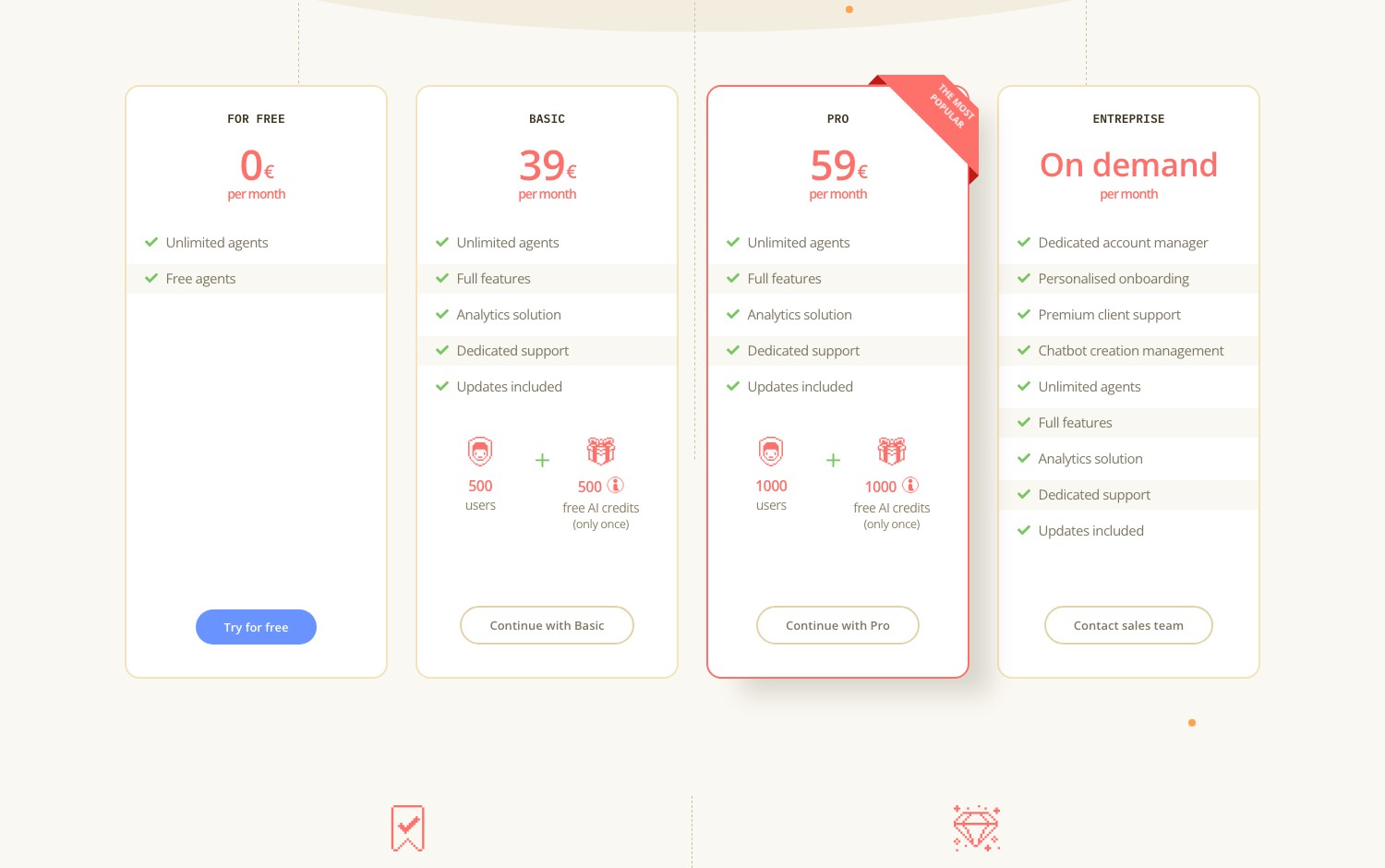
Good news: choosing B2B, B2C or both does not change the price of the platform. It is the same subscription, the same channels, the same editor; only the size of the scenario build changes. Here is the Botnation grid checked today on the pricing page, excluding VAT.
| Plan | Price excl. VAT per month | What it includes | For whom |
|---|---|---|---|
| Free | €0 | Unlimited agents, to test the platform | Validating the idea, learning the editor |
| Basic | €39 | Unlimited agents, full features, analytics; 500 users and 500 AI credits offered once | A first bot in production, small volume |
| Pro | €59 | The same, with 1,000 users and 1,000 AI credits offered once | The running bot, any audience |
| Enterprise | On demand | Dedicated account manager, personalised onboarding, premium client support, chatbot creation management | Two separate journeys, accompanied team, delegated creation |
AI credits can be topped up in packs: 1,000 credits at €25, 5,000 at €100, 15,000 at €250, 60,000 at €900. Beyond the included users, each additional user costs €0.05 per month. All prices are quoted excluding VAT.
For fully delegated creation (the team builds the scenario or scenarios for you), the price is set on quote; the pricing page answers the question itself, stating for turnkey creation outside a subscription that “it will generally cost between €5,000 and €30,000, or even more, depending on the features you need”, and adds: “Our team of bot developers will create a custom AI chatbot for you, based on a quote.”
Build it yourself, or entrust the build to the publisher
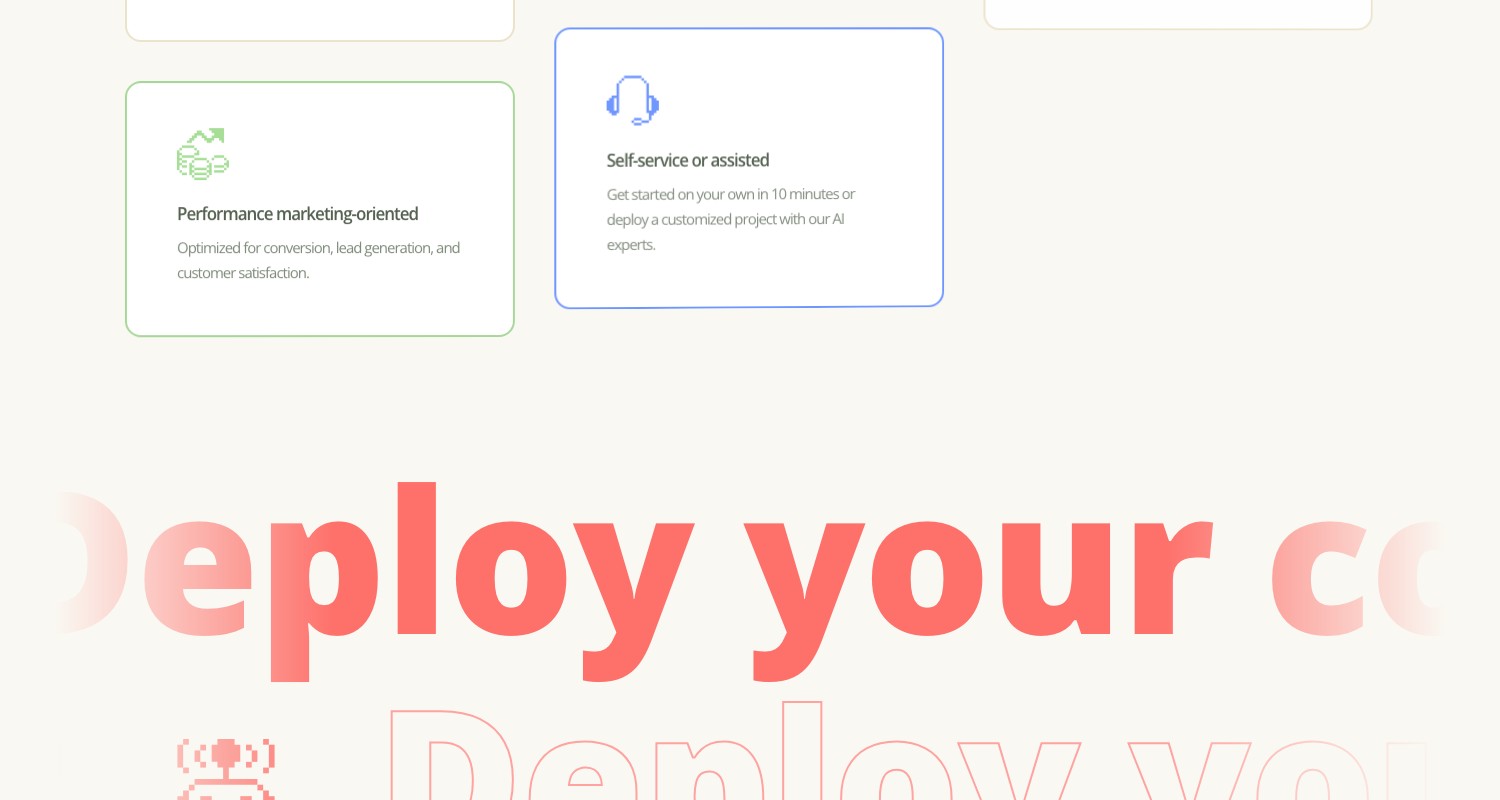
What remains is the method choice, which is simpler than it is made out to be. Botnation is not only the publisher of a no-code platform: it is also a provider that builds custom chatbots for its clients, through the Enterprise offer and its chatbot creation management services. The site’s homepage sums it up in two cards: a “Self-Service offer” (you create and manage your agent yourself on the platform) and an “Accompanied offer” (experts design, optimize and run your agent for you).
How to decide? If your conversations fit in a spreadsheet and someone on the team enjoys turning them into scenarios, the self-service path is the fastest and the most instructive: start for free, publish, fix things weekly. If both audiences are already there with volume, or nobody has a free pair of hands, custom creation short-circuits the problem: the team that builds your bot is the team that publishes the platform, so there is no intermediary between the tool and the people who know it line by line, and you keep your hands on the editor after delivery to evolve the scenarios yourself. An external agency remains a legitimate choice in very specific cases: a niche trade that requires an integrator already in place, an on-site presence, a legacy system to hook back. It is not the shortest path, but sometimes it is the only one.
Whatever the audience, the best first week is the same: collect the twenty questions actually asked last month (emails, calls, tickets), write the twenty answers, publish them in the bot, and add one exit door to a human. In B2B as in B2C, the bot that solves twenty real questions beats the one that skims a hundred.
Frequently asked questions
Can one single chatbot really serve a B2B and a B2C audience?
Yes, on two conditions: an entry menu that separates the audiences from the first message, and distinct scenarios behind that menu. What does not work is the single mixed scenario: it asks qualification questions to hurried consumers and gives short answers to demanding professionals. This article’s router decides based on your volume and your ownership.
Which metric should I track first for a B2B chatbot? And in B2C?
In B2B: the number of qualified leads handed over (with their conversion rate on the sales side) and the time to first response. In B2C: the first-contact resolution rate and conversation satisfaction. The two dashboards must be read separately; mixing them is the surest way to fix nothing.
Is a B2C chatbot covered by the European AI regulation? And a B2B one?
Both, equally. Article 50 of regulation 2024/1689, applicable since 2 August 2026, requires informing any natural person that they are interacting with an AI, from the first interaction, unless it is obvious from the context. The consumer or professional status of the interlocutor changes nothing in the obligation; on the other hand, a significant decision made by the bot alone (refusal, pricing) is prohibited by the GDPR and requires human intervention.
How much does a chatbot handling both audiences cost?
The platform does not bill per audience: €0 to test, then €39 or €59 per month excluding VAT depending on the included user volume, with AI credit packs from €25. What costs is the build: free if you write it yourself in the editor, or covered by a quote in the Enterprise offer, the pricing page mentioning “generally between €5,000 and €30,000, or even more” for turnkey creation outside a subscription.
Should the tone differ between B2B and B2C?
On the French market the formal “vous” applies on both sides, except for brands that own a casual consumer tone; in English, focus on register rather than grammar. Business vocabulary, figures and processes are accepted in B2B; short sentences, immediate answers and zero jargon win in B2C. Simplest test: read your welcome message out loud, once as a hurried professional buyer, once as an even more hurried individual customer.
Two audiences, one question to settle
The B2B chatbot and the B2C chatbot are not two products: they are two settings of the same tool, chosen question by question, from tone to channel, from metric to human handover. The only real structural decision is the router’s: one scenario with two front doors, or two separate journeys on the same platform. Everything else adjusts, gets measured and gets fixed, conversation after conversation. And the law watches the same spot for both audiences: say it is an AI, and never leave the machine alone in front of a decision that commits.
Your two audiences already have their questions: start with the first twenty
Build the scenario yourself on the platform, or entrust the creation to the team that publishes it, within the Enterprise offer, on quote.
Request a quote for the creation of your chatbot or talk to our chatbot creation experts.