



In short: Rasa is an open source framework written in Python for building chatbots and voice assistants by hand: a language understanding engine, dialogue management, custom actions, deployment on your own servers. The Developer Edition is free but capped (one bot per company, 1,000 external conversations per month or 100 internal conversations), and going to production requires a Rasa Pro license whose price is not published: third-party comparisons mention a starting point around $35,000 per year. The software therefore costs almost nothing: it is the construction, the hosting and the maintenance that you pay for, in development days.
You want to build a chatbot and the name Rasa comes up in every “open source” comparison. Solid reputation, large community, available code: the framework looks like the natural favorite of technical teams. But between the GitHub repository and an assistant in production for your customers lies a path whose real cost few articles spell out.
This article covers the full picture: how a Rasa chatbot works, what the framework really costs in 2026 (editions, caps, production license), how much construction effort to expect for your project, which limits to know before you start, and when a hosted no-code platform like Botnation does the same job without writing a single line of code.
What exactly is Rasa?
Rasa is an open source framework for building chatbots and voice assistants, written in Python. It is not an off-the-shelf piece of software that you install and configure by clicking: it is a development toolkit, just like a web framework. You write configuration files, you train a language model, you program the bot’s actions in Python, and then you deploy the whole thing on infrastructure, yours or a hosting provider’s.
The state of the project can be checked in seconds on the public repository: as of September 21, 2026, the Rasa GitHub repository shows 21,324 stars and an Apache 2.0 license, but also a stable version still stuck at 3.6.x (3.6.21) and last commits several months old. The message is clear: the historic open source core is in maintenance mode, and active development has moved to Rasa Pro, the commercial licensed edition maintained by the company Rasa Technologies.
A essential vocabulary point before going further: there are two Rasas. The historic open source core (the one on GitHub, under the Apache 2.0 license) covers the language understanding engine and scenario-based dialogue management. In parallel, the vendor offers Rasa Pro, an edition under a commercial license that ships the recent building blocks, including the CALM approach (Conversational AI with Language Models), which relies on large language models to drive the dialogue. The free Developer Edition gives access to Rasa Pro for evaluation purposes and small deployments, within the caps detailed below.
Do not confuse it with an “all included” chatbot platform either: Rasa provides neither default managed hosting, nor a visual creation interface in its free core, nor ready-made connectors you can configure in a few clicks. Those are precisely the pieces you assemble yourself. If the framework versus platform distinction interests you, we cover it in our guide to chatbot platforms.
How a Rasa chatbot works
A Rasa bot rests on three blocks that talk to each other: language understanding, dialogue management and custom actions. Let us walk through them in the order of an actual conversation.
The NLU engine: understanding what the user says
The NLU block (Natural Language Understanding) receives every message and extracts an intent (what the user wants: “track an order”, “request a refund”) and entities (the details: an order number, a date, an amount). For that, you supply sample sentences for each intent: the model trains on them. The quality of the bot depends directly on this feeding work, sentence by sentence, language by language. We explain this mechanism in detail in our article on how chatbots work.
Dialogue management: deciding on the answer
Once the message is understood, the bot must decide on the response: ask a clarifying question, call a system, confirm an action. In the open source core, this steering is written as stories and rules in YAML files: the path of the conversation is described by hand, step by step. In Rasa Pro, the CALM approach complements this: large language models interpret the user’s general intent and connect it to declared business flows, which makes the dialogue less rigid, at the price of a more complex architecture to master.
Actions, channels and deployment
Third block: custom actions, written in Python with the provided SDK. This is where your bot becomes useful: query your CRM, create a ticket, check an order, write to a database. Then come the channel connectors (website, messaging apps, contact center) and deployment: Rasa is containerized and deploys on Kubernetes with Helm, self-hosted or in a private cloud.

- Training data: sample sentences, entities, answers, to be written and maintained by hand.
- Configuration: processing pipelines and dialogue policies in YAML.
- Python code: custom actions, validations, system integrations.
- Infrastructure: containers, Kubernetes, monitoring, backups, version upgrades.
The summary fits in one sentence: nothing is impossible with Rasa, but nothing is already done. Every block above is a work site, and that is exactly where the real cost of the framework lives, as confirmed project by project by our chatbot development method.
A concrete example: an order tracking bot
Let us take a simple case to pin the ideas down: a bot that answers “where is my order?”. In Rasa, this means creating a “track_order” intent with a few dozen sample sentences (“where is my parcel”, “my order has not arrived”…), extracting the “order number” entity, then writing a Python action that queries your logistics API and formats the answer. Each additional language duplicates the sample sentence work. Each new use case (returns, invoices, exchanges) restarts the cycle: data, action, tests. That cycle, repeated, is what makes up the construction budget, whereas on a no-code platform the same scenario is assembled visually from ready-made blocks and a connector configured with the mouse.
How much does a Rasa chatbot cost?
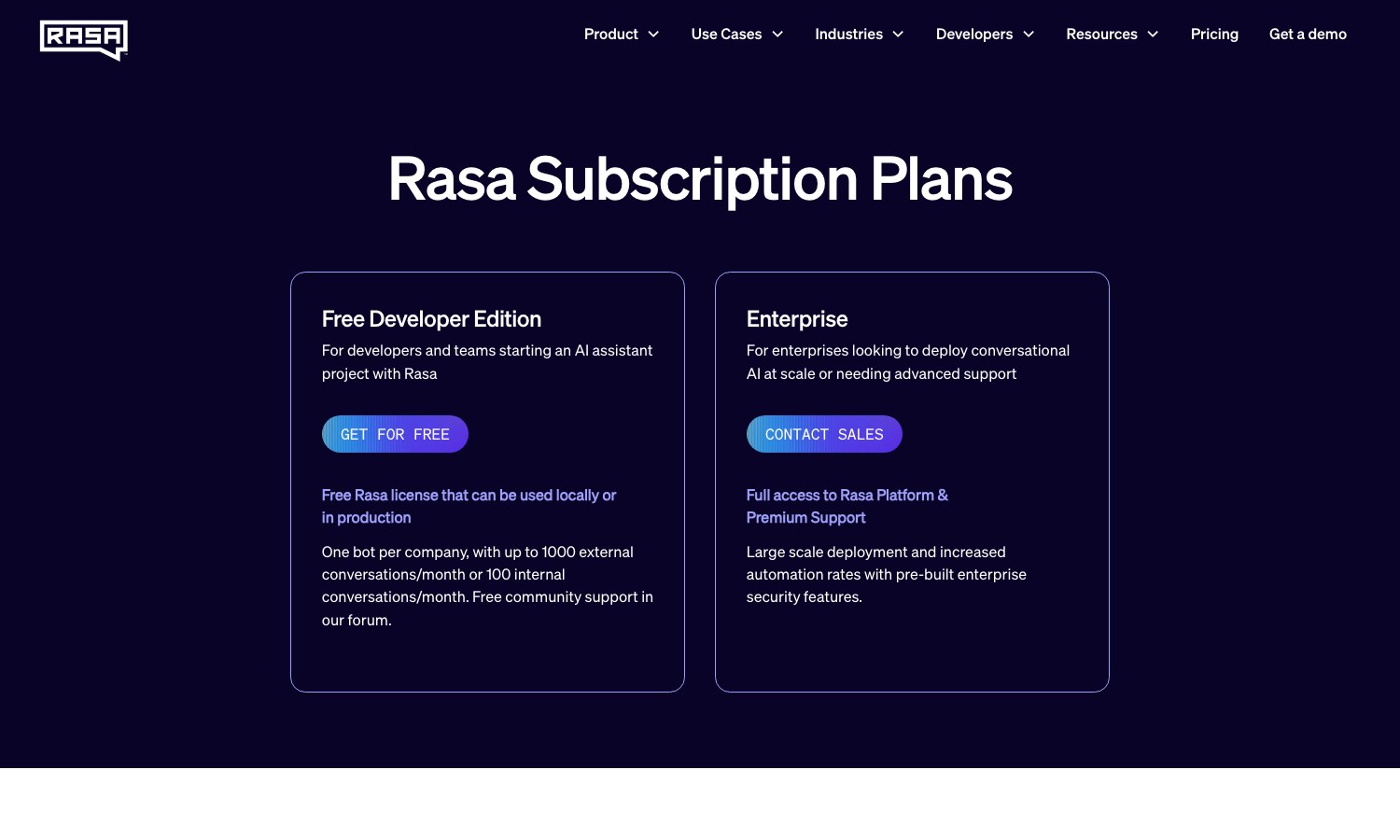
A tricky question: “Rasa is free” is both true and very misleading. Here is the grid as it stands on September 21, 2026 on the vendor’s pricing page.
| Edition | Listed price | What it covers |
|---|---|---|
| Developer Edition | Free | One bot per company, up to 1,000 external conversations per month (or 100 internal conversations), community support. Usable locally or in production within those limits. |
| Rasa Pro (production) | Not published (quote only) | The full framework under a commercial license: CALM, multilingual NLU, custom actions, REST and WebSocket connectors, Kubernetes deployment, end-to-end testing, personal data management, multi-LLM, observability. Paid support as an option. |
| Platform (enterprise offers) | Not published (quote only) | Rasa Pro plus team tools: flow building interface, testing panel, conversation analytics, access management (SSO, roles), premium 24/7 support as an option. |
Three honest remarks about this table. First, the vendor publishes no production price: the official grid leads to a sales contact, and only the Developer Edition cap is spelled out in black and white (1,000 external conversations per month). Next, third-party comparisons give an order of magnitude: the comparison published by Voiceflow in July 2026 puts the starting point of Rasa in production “around $35,000 per year”, a figure to take as an indicative range to be confirmed by quote, not as an official price. Finally, the Developer Edition’s community support remains “best effort”: as soon as the bot becomes business critical, paid support enters the budget.
Then comes the largest share, the one no grid shows: the cost of construction and operation. Developing the flows and actions, feeding the training data, integrating with your systems, hosting (self-hosted means servers to pay for and watch), corrective and evolving maintenance, framework upgrades. This is the item that separates projects, and it is exactly what the simulator in the next section measures.
For the most useful public fact: the free Developer Edition lets you prototype seriously without spending anything, as long as you stay under the 1,000 monthly external conversations. It is a real advantage to validate a use case before committing a budget.
Estimate the construction effort of your Rasa project
The simulator below estimates, from four characteristics of your project, the construction effort of a Rasa chatbot in man-days, the corresponding calendar duration and an indicative cost. It compares it with the same scope built on a hosted no-code platform. The assumptions are deliberately displayed below the tool: this is a decision-support order of magnitude, not a quote.
Simulator: your Rasa project in 4 questions
1. Functional scope of the bot
2. Languages of the bot
3. Integrations with your systems
4. Hosting mode
Reminder: the framework is free; construction, hosting and maintenance are not. And beyond 1,000 external conversations per month, the Rasa Pro production license becomes necessary.
Pick an answer in each of the 4 questions, then click “Estimate my project”.
| Project block | Simulator assumption (order of magnitude) |
|---|---|
| NLU and dialogue core | 15 man-days (simple FAQ) to 45 man-days (LLM-powered agent) |
| Additional languages | +6 man-days (2 to 3 languages), +15 man-days (4 languages and more) |
| IT integrations | +2 man-days (none), +8 (1 to 2), +20 (several systems) |
| Hosting | +1 man-day (managed), +6 man-days (self-hosted or private cloud) |
| Recipe and testing | +20% of the sub-total |
| Hosted no-code reference | 2 to 8 man-days depending on scope, hosting included |
| Daily cost | €550 excl. tax per man-day (confirmed Python developer, editorial market assumption) |
| Team productivity | about 18 productive man-days per month and per developer |
Method: the orders of magnitude in the table are editorial assumptions built from typical chatbot project scopes; they are deliberately pessimistic for Rasa on testing (20% of the sub-total) and cautious on multiple integrations. The production license cost is not included, for lack of a public grid. Use the result as a starting point for an internal discussion, not as a contractual figure.
The limits of Rasa to know before choosing
The framework is excellent at what it was designed for. But four limits come up systematically in projects.
- Python is mandatory: as soon as your bot leaves the question-and-answer pattern (actions, integrations, tests), a Python developer profile is indispensable, for construction as well as maintenance.
- No visual interface in the open source core: flows and configuration are written in files; the visual flow builder and the analytics are reserved for the paid platform offers.
- Time to market: between getting to grips with the framework and a bot in production, count weeks of development at the very least, against a few days on a no-code platform for a simple scope.
- Operating burden: self-hosted, availability, security, backups and framework upgrades are your permanent responsibility.
Before you decide, three questions settle most debates. Who will maintain the bot in twelve months: the team that built it, or a business team that must be able to change an answer without a development ticket? What is the real delay before a first useful version: are weeks of construction acceptable, or is the need already pressing? And what is the total cost over three years, license included: a “free” framework with two part-time developers is very expensive, a €59 per month subscription reads at a glance. These questions have no universal answer, but they have a right answer for your organization.
None of these limits is a blocker for a technical team that has time and needs full control. They are decisive, however, for a business team that wants an operational bot fast, without hiring or outsourcing development.
Rasa or a hosted no-code platform: how to decide
The two approaches do not serve exactly the same need, and the right choice depends on three questions: who will maintain the bot, within what timeline, and with what budget.
| Criterion | Rasa (open source framework) | Hosted no-code platform (like Botnation) |
|---|---|---|
| Skills required | Python developers | Autonomous business team after light training |
| Time to launch | Weeks to months depending on scope | Days, ready-made templates |
| Entry cost | Free on the Developer Edition, then quote-based license and development days | Free (€0) then plans from €39 per month |
| Hosting | Your responsibility (self-hosted or private cloud) | Included and managed by the vendor |
| Total customization | Total: code, models, flows, everything can be changed | Broad but framed by the tool |
| Data on your side | Yes, when self-hosted | Vendor hosting (enterprise offer for dedicated needs) |
| Maintenance | Your continuous responsibility | Included in the subscription |
A word about the comparisons you will read elsewhere: many tables pit “free open source” against “paid SaaS” without counting the same items. The free framework compares with the subscription price only if you take developers’ salaries, hosting and maintenance out of the picture; the opposite would be just as misleading. The two models do not say the same thing when brought back to the question that matters: how much does the next change to your bot cost, and who can make it.
In short: Rasa wins when you have an available technical team, a need for total control (data, model, deep integrations, deployment on your own infrastructure) and a horizon of several months. The no-code platform wins when the goal is an operational bot quickly, maintained by the vendor, run by the business team, with a subscription-level cost. If you compare market players one by one, our page on Genesys chatbot follows the same price and limits verification approach.
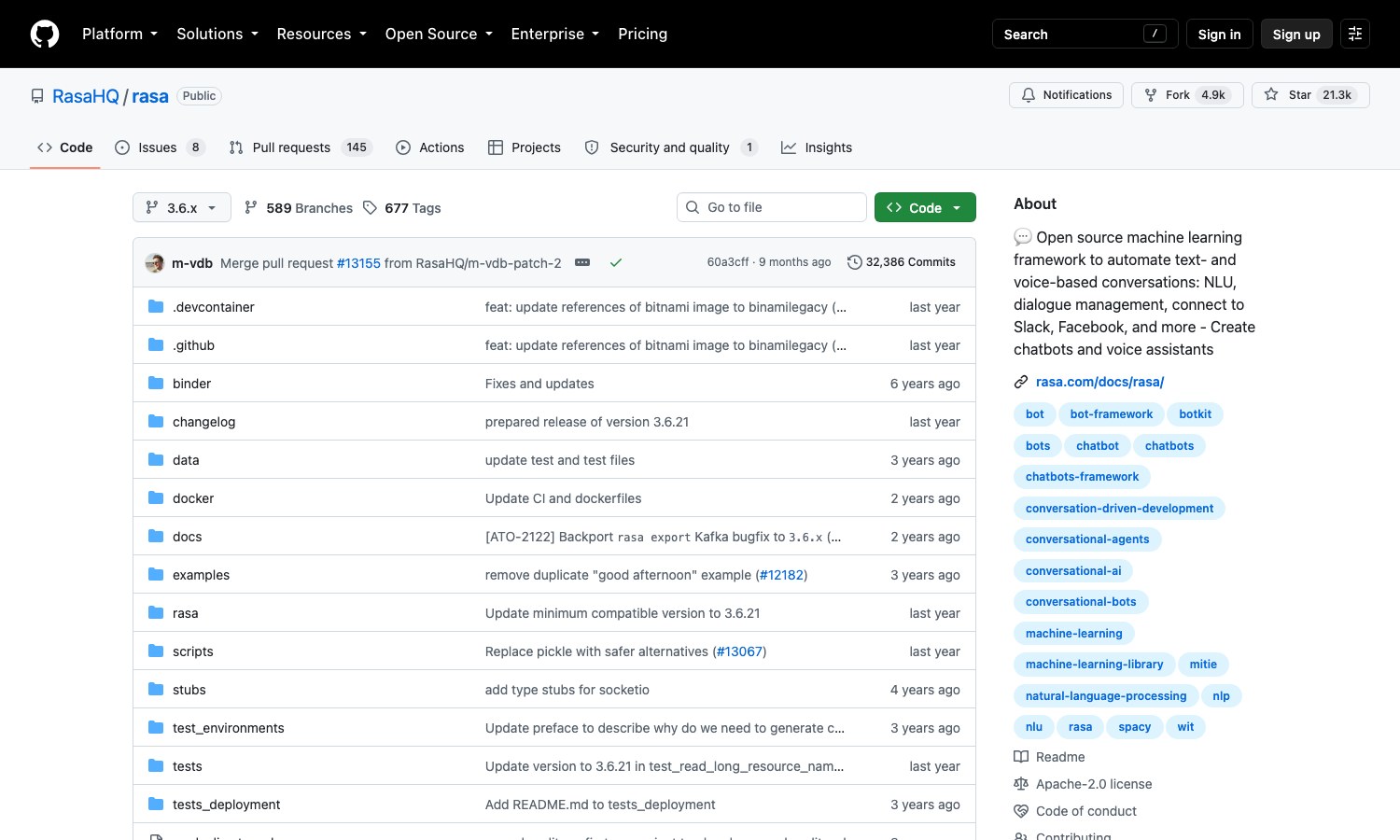
The screenshot above shows the public Rasa repository as consulted on September 21, 2026: Apache 2.0 license displayed, stable core at 3.6.x and ageing last commits, three signals to read before adopting an open source framework (and the sign that innovation now happens on the Rasa Pro side).
How Botnation answers the same need
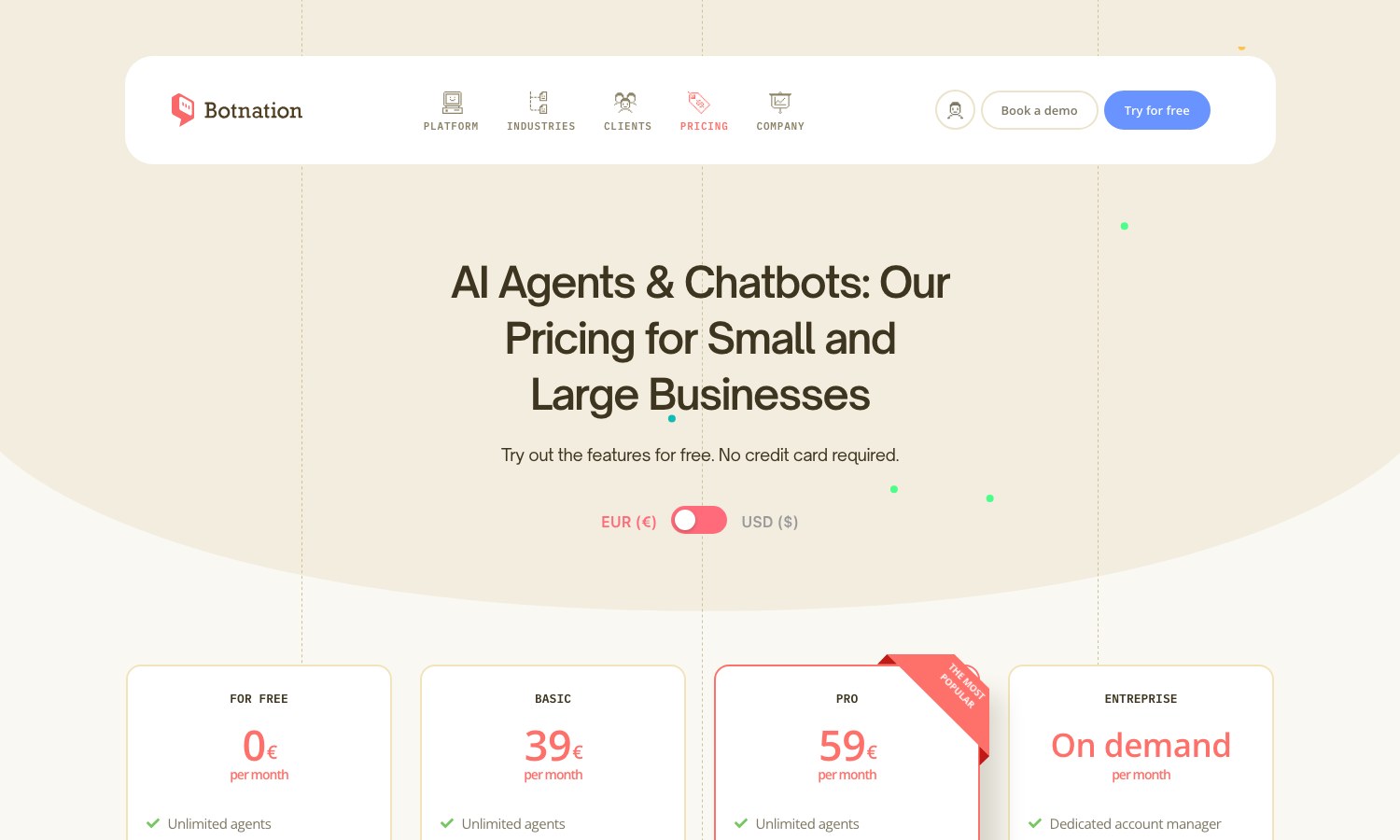
Botnation attacks the problem from the other end: instead of handing you a framework to assemble, the platform provides the visual builder, the channels (website, WhatsApp, Messenger, Instagram), hosting and updates, with a public range: Free at €0, Basic at €39 per month, Pro at €59 per month, Enterprise on demand (grid checked on September 21, 2026 on the pricing page, prices displayed in euros). A simple project starts without a developer, and the Enterprise offer covers advanced needs: Botnation publishes a no-code platform and builds custom chatbots for its customers, with chatbot creation experts who build the assistant for you, on quote.
The point of the comparison with Rasa: the team that builds the custom work is the team that publishes the platform, so the customer gets an assistant they can later evolve themselves in the builder, without taking code back over. That is the difference in nature with a framework: custom does not imply going back to a permanent technical work site.
On the team side, Botnation’s enterprise page publicly presents its “chatbot creation experts”: for a project beyond the templates, these botmakers build the assistant on quote, with a dedicated account manager and personalized onboarding in the Enterprise offer. The customer can then evolve the flows in the builder, or hand the changes over to the same team; in both cases there is no code to take over and no infrastructure to administer.
For customer support or an automated FAQ, the fastest path is to start from a ready-made use case: our customer support chatbot shows the typical scope deliverable in days.
Frequently asked questions about Rasa
Is Rasa really free?
The Developer Edition is, with precise caps: one bot per company, 1,000 external conversations per month or 100 internal conversations, and community support. Production beyond those limits requires a Rasa Pro license whose price is not published; the third-party order of magnitude cited is around $35,000 per year to start (Voiceflow, July 2026), to be confirmed by quote. The historic core on GitHub remains under the Apache 2.0 license.
Do you need to know how to code to build a Rasa chatbot?
Yes, for everything beyond strict question-and-answer. The open source core is driven by configuration files and Python (custom actions, integrations, deployment). The visual flow builder is reserved for the paid platform offers. Without a developer in the team, a no-code platform is the shortest path.
Does Rasa work in English?
Yes. Rasa Pro highlights a language-agnostic NLU, and the open source core trains on your own sample sentences, in English as in any other language. Note that each added language is a real training data and testing effort, which the simulator above quantifies.
Can you host a Rasa chatbot on your own servers?
Yes, it is one of the framework’s strongest arguments: self-hosted deployment (on premises or private cloud) is possible, with Kubernetes and Helm. It also means availability, security, backups and updates are your permanent responsibility.
What budget for a Rasa chatbot in production?
Three items: the production license (by quote, the cited third-party order of magnitude is about $35,000 per year to start), construction (typical projects count in tens of man-days, try the simulator), and operations (hosting, maintenance, evolutions). A simple bot with heavy traffic can cost more in license than a complex project kept under the Developer Edition caps.
When to prefer a no-code platform over Rasa?
When the need is an operational bot fast (FAQ, customer support, appointment booking, lead qualification), when the team that will run the bot is a business team, and when the budget is managed as a subscription rather than in development days. Rasa remains the right tool when total technical control is a goal in itself.
The final word
Rasa is an excellent framework, and its free cap of 1,000 conversations per month lets you prototype without spending money. But the real question of a project is never “is the software free”: it is “who builds, who maintains, and at what total cost”. If your team has no Python developers to dedicate for weeks, a hosted no-code platform will deliver the same result much faster, and our team can build the custom parts for you when the need justifies it.
Build your chatbot without writing a line of code
Try the platform for free, or hand the construction of your assistant over to our chatbot creation experts.