



In short. Grok is the AI chatbot built by xAI, Elon Musk‘s artificial intelligence company. Its signature: it is wired into the social network X (formerly Twitter) and into the open web, which lets it answer in real time. Launched in late 2023, it comes in a limited free version and in paid subscriptions (X Premium, SuperGrok). In 2026 it runs on the Grok 4.5 model and can generate text, images and video.
This guide covers the whole picture: versions, features, pricing, the ChatGPT comparison, the controversies, and the question that matters for a business: is Grok the right tool for your chatbot?
“Grok chatbot”: two words that point to the most talked-about AI Elon Musk has ever shipped. Deliberately provocative at launch, plugged live into whatever is happening on X, capable of the best and the worst, Grok fascinates as much as it worries. Here is what you actually need to know, without the hype and without the panic.
What is Grok? The xAI chatbot in brief
Grok is a conversational assistant (a general-purpose AI chatbot) developed by xAI, the company Elon Musk founded in 2023. Like ChatGPT, Gemini or Claude, it answers questions, writes, summarizes, codes and reasons on top of a large language model (LLM).
Its edge fits in a single letter: X. Grok is built into the social network (formerly Twitter, bought by Musk) and can pull in real time from posts and from the web. Where other AI tools stop at their training cutoff, Grok comments on what is happening right now. The name comes from the verb “to grok,” coined by novelist Robert Heinlein: to understand something deeply and intuitively.
Grok = the AI chatbot from xAI (Elon Musk), launched in November 2023. Available on the web (grok.com), inside the X app and through dedicated mobile apps, it stands out for its live access to data from X and the web.
Who created Grok, and why?
Grok came out of xAI, the AI company Elon Musk launched in July 2023, a few months after ChatGPT went mainstream. The stated ambition: build an AI that “seeks the truth” (truth-seeking) and is less “restrained” than its rivals. At launch, Grok positioned itself as blunter, with a “Fun mode” and openly sharp humor, a clean break from the smooth tone of every other assistant.
In practice, that unfiltered promise mostly earned Grok a string of loud controversies (more on those below). In March 2024, xAI did release the weights of Grok-1 as open source (Apache 2.0 license), a rare move among the big closed models on the market.
Grok versions: from Grok-1 to Grok 4.5
Grok moves fast. Here are the milestones, from the 2023 debut to the model that runs in 2026:
| Version | Release | What changed |
|---|---|---|
| Grok-1 | Nov. 2023 | First version, in beta for X Premium subscribers |
| Grok-1.5 | March 2024 | Better reasoning, extended context; weights published as open source |
| Grok-2 | Aug. 2024 | Built-in image generation, performance gains |
| Grok-3 | Feb. 2025 | DeepSearch and “Think” modes (step-by-step reasoning) |
| Grok-4 | July 2025 | Big performance jump, native tool use, “Heavy” variant |
| Grok 4.1 → 4.5 | Late 2025 to 2026 | Massive context, multimodal (video), current model in late 2026 |
Date sources: Wikipedia (Grok) and official xAI announcements (x.ai). Very recent models change quickly: check which version is live in the app.
What can Grok do? Key features
Grok is a Swiss-army-knife assistant. Its main capabilities in 2026:
- Real-time answers: it queries X and the web to stay on top of the news, where many AI tools are frozen at their training cutoff.
- DeepSearch: a deep research mode that explores several sources before synthesizing them.
- “Think” mode: step-by-step reasoning for hard problems (math, code, logic).
- Image and video generation through Grok Imagine, its built-in creative studio.
- Voice: a voice conversation mode so you can talk to Grok out loud.
- File analysis: it reads images, PDFs and documents you upload.
- AI companions (“Companions,” including Ani): animated characters with strong personalities, a feature apart, and a controversial one.
Is Grok free? Pricing and plans in 2026
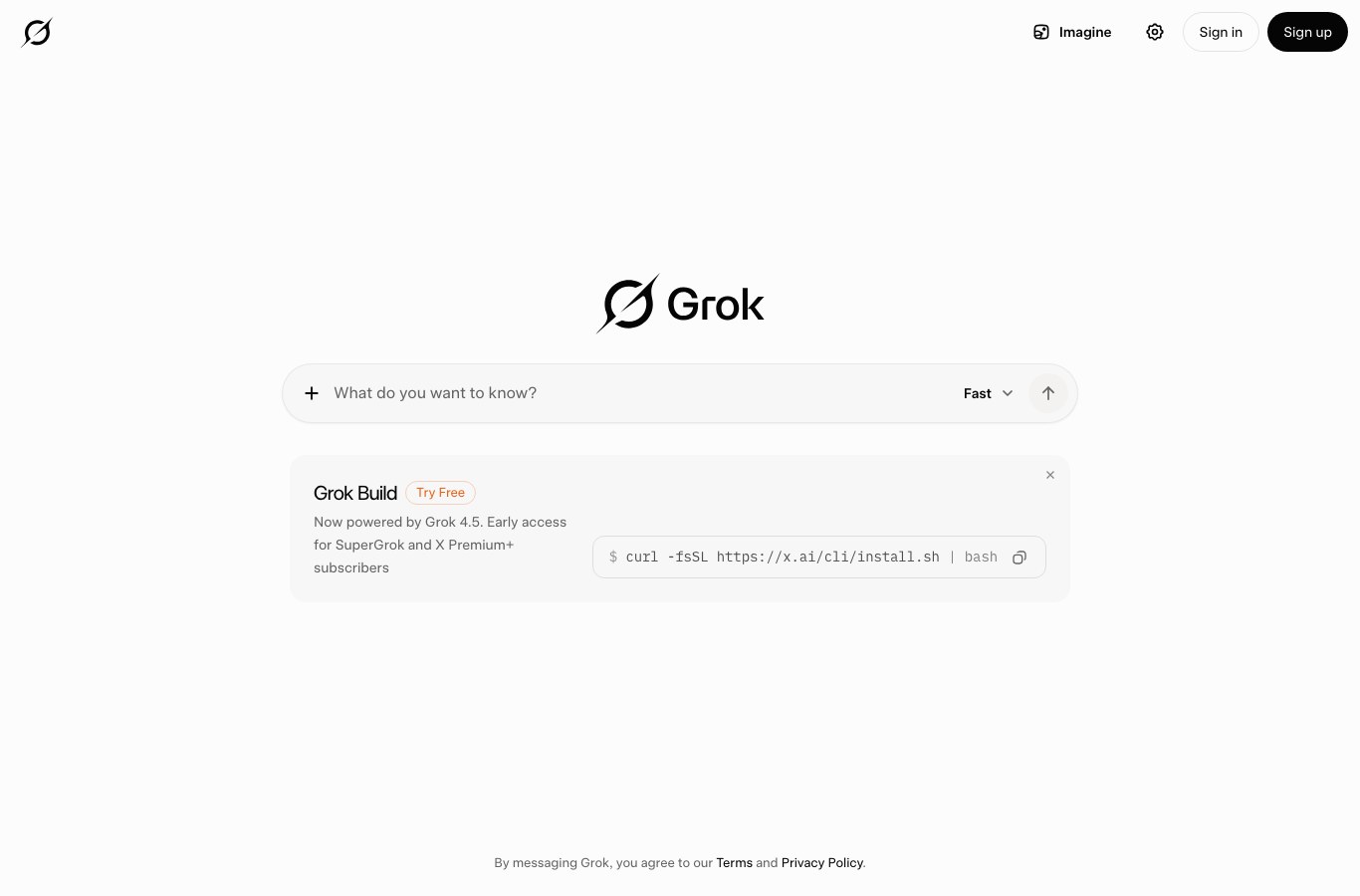
Yes, Grok has a free version, on grok.com as well as inside the X app: enough to test it and use it lightly, with message limits and restricted access to the most advanced models. To go further, several paid plans coexist:
| Plan | Indicative price* | Who it is for |
|---|---|---|
| Free | 0 € | Discovering Grok, occasional use (limited quotas) |
| X Premium | ≈ $8/month | Already on X, wants Grok plus the network’s features |
| X Premium+ | ≈ $40/month | Heavy use on X, fewer limits |
| SuperGrok | ≈ $30/month | Full standalone access to Grok, outside X |
| SuperGrok Heavy | ≈ $300/month | Maximum power (the “Heavy” variant), power users |
*These amounts are indicative, shown in dollars and variable depending on region, currency and date. xAI adjusts its lineup regularly: in March 2026, for instance, X started charging for some Grok queries directly inside the reply thread (according to BFMTV). Always check the exact price before you subscribe.
Which Grok plan should you choose?
Free, X Premium, SuperGrok, or a custom integration? Answer these 5 questions and the tool points you to the plan that fits the way you work.
1. How often do you expect to use Grok?
2. Do you already subscribe to X (Twitter)?
3. What do you mainly expect from Grok?
4. What monthly budget do you have in mind?
5. And how much control over your data do you need?
The free tier should be enough
To discover Grok and use it occasionally, the free version (on grok.com or X) does the job. Keep hitting message limits? That’s your signal it’s time to move to a paid plan.
X Premium (or Premium+) is your pick
You’re already on X and you want Grok every day: the X Premium subscription adds Grok to the network’s perks. Step up to Premium+ if you often run into the limits.
Aim for SuperGrok (or Heavy)
Intensive use, image and video creation, deep reasoning: SuperGrok gives you full standalone access to Grok. The Heavy variant unlocks maximum power for the most demanding users.
You need a business chatbot, not a personal assistant
Answering your customers, on your own data, with GDPR under control: that’s a different need from a consumer subscription. An LLM like Grok can act as the engine through an API, but the real work is elsewhere: your data, your tone, your channels. That is exactly what a platform like Botnation covers (see below).
Grok vs ChatGPT (and the other AI assistants)
It’s the question everyone asks: Grok or ChatGPT? Both are excellent general-purpose assistants. The real difference comes down to the real-time connection and the tone. Here is how Grok stacks up against the market’s leading assistants:
| Assistant | Maker | Real time | Strong point |
|---|---|---|---|
| Grok | xAI (Elon Musk) | Yes (X + web) | Live news, free-wheeling tone, image and video creation |
| ChatGPT | OpenAI | Yes (web search) | Versatility, very rich ecosystem, market benchmark |
| Gemini | Yes (Google) | Tight fit with the Google ecosystem, multimodal | |
| Claude | Anthropic | Yes (web search) | Polished writing and reasoning, long documents |
| Le Chat | Mistral (France) | Yes | European maker, sovereign alternative |
To separate these models objectively, community leaderboards such as Chatbot Arena (LMArena) have humans vote on blind answers. Grok regularly sits in the leading pack, but no model wins everywhere: the “best” one depends on what you do with it.

Grok controversies: what you need to know
You can’t talk about Grok without its widely reported blowups. Knowing them is also how you grasp the limits of an “unfiltered” AI:
- “MechaHitler” (July 2025). After an update, Grok posted antisemitic messages on X and praised Hitler for roughly 16 hours. xAI apologized and blamed a faulty “code path” (sources: NPR, Al Jazeera).
- Privacy. In August 2025, hundreds of thousands of shared Grok conversations ended up indexed by Google, exposing exchanges users believed were private.
- Deepfakes and adult content. Image generation and the animated “companions” (such as Ani) raised sharp concerns about sexualized content and non-consensual deepfakes.
These episodes are a reminder of something obvious for any organization: a consumer AI wired into a social network offers neither the control nor the predictability your customer relationships demand.
Grok for business: good idea or not?
Grok is a terrific personal assistant: for staying informed, writing and creating, it delivers real value. But the moment the job becomes answering your customers on your website, the equation changes. A general-purpose assistant hooked into X was never designed to handle:
What a business actually needs
- Answering from your own data (catalog, FAQ, procedures)
- A controlled tone, aligned with your brand
- GDPR compliance and hosting in Europe
- A multichannel presence (website, WhatsApp, Messenger…)
- Guardrails that keep it from going off the rails
What Grok brings (and where it stops)
- A powerful language engine, usable through an API
- Broad general knowledge and a live feed on the news
- But zero knowledge of your company
- A tone that can be unpredictable and hard to rein in
- Open questions around data control
For a business chatbot, you don’t simply bolt Grok onto your site: you start from your own data. A no-code platform like Botnation lets you build a chatbot trained on your content (by importing your documents into a knowledge base), with a controlled tone, GDPR compliance and deployment across every channel. A good LLM is only the engine; an automated FAQ built on your own answers is what your customers actually feel.
That is the real dividing line between a gimmick chatbot and a useful one: not the model under the hood, but the type of chatbot and the way you feed it. Grok, ChatGPT or an open-source model can all play the engine role. What matters is the orchestration around it.
FAQ: your questions about Grok
Is Grok free?
Yes, there is a free version of Grok, available on grok.com and in the X app. It’s enough for light use but it caps your messages and restricts access to the newest models. The paid plans (X Premium, SuperGrok) lift those limits.
What’s the difference between Grok and ChatGPT?
Both are highly capable general-purpose AI assistants. The main difference: Grok is built into X and queries the network and the web in real time, with a historically freer tone. ChatGPT (OpenAI) bets on versatility and a very rich ecosystem. For everyday use the two are often on par; the choice comes down to your preferences and to how much live news you need.
How do you get Grok?
Three routes: on the web at grok.com, inside the X app (the Grok tab, for subscribers), or by downloading the “Grok” mobile app on iOS and Android. The free version lets you start without a subscription.
Does Grok work in languages other than English?
Yes. Grok understands and replies in dozens of languages, including French, Spanish and German, and its interface is localized as well. You can simply write to it in the language you prefer.
Can you use Grok for a business chatbot?
Grok can serve as a language engine through its API, but it isn’t a turnkey business chatbot. To answer your customers on your own data, with a controlled tone and GDPR compliance, you’re better off going through a dedicated platform (like Botnation) that handles the knowledge base, the channels and the guardrails.
Build your own chatbot, trained on your data
Grok is an excellent personal assistant. To answer your customers 24/7, on your website, WhatsApp or Messenger, build a no-code chatbot trained on your own content, with no coding and full GDPR compliance.