




An “advanced” chatbot training course is not defined by its length but by six precise skills: conversation design, knowledge base, system prompt, integrations, measurement and compliance. As long as two of those six building blocks are missing, you have a level 2 need, not an advanced one.
On the French market, the range runs from one day at 890 € excl. VAT to steer a project, up to four or five days for a full technical track, with developer prerequisites that rule out half the candidates. The prices below were recorded on the providers’ own pages on 4 August 2026.
And since 2 February 2025, Article 4 of the European AI Regulation has required employers who deploy an AI system to ensure a sufficient level of “AI literacy” among their teams. Training is no longer only a career choice.
You have already built a chatbot. It answers, it holds up, and it has plateaued. Slightly awkward questions fall into the void, the knowledge base is ageing, and nobody can say whether the bot saves time or wastes it. That is the exact moment when people type “advanced chatbot training” into Google and land on twenty product pages that all promise the same step up without ever saying what they actually cover.
This guide does the work those pages skip. It defines what “advanced” means in verifiable skills, provides a tool to place your real level, compares the programmes and the prices actually published in France, explains who can pay, and covers the regulatory obligation that no catalogue has integrated yet.

“Advanced chatbot training”: two very different searches behind the same words
First thing to clear away, because it pollutes the whole search: “chatbot training” covers two opposite subjects. There is learning to build chatbots, and there is using a chatbot as a teaching tool inside a learning programme. Both compete for the same search results, which is why you land on e-learning blogs while looking for a technical course.
Advanced chatbot training: a course aimed at someone who can already ship a working chatbot, and who wants autonomy on the building blocks that keep a bot alive in production, namely the knowledge base, model guardrails, integration into the information system, performance measurement and compliance. What sets it apart from an introductory course is its prerequisites, not its number of days.
This article only deals with the first meaning: learning to design, connect and run a chatbot. If your subject is the opposite, a conversational assistant serving learners, the right entry point is the internal chatbot in the workplace, which covers support and procedure delivery use cases.
The six skills that really separate a beginner from an advanced level
No provider publishes a reference framework. The words “level 2”, “advanced” and “expert” are attached to nothing, and every catalogue uses them its own way. So here is the grid we use, built from what the first page of Google actually covers, and from what breaks in production.
- Conversation designDialogue tree, contexts, variables, follow-ups, escape routes to a human. This is the one block beginners often handle well. It stops being enough the moment a generative model is plugged in.
- The knowledge baseChoosing sources, splitting them, keeping them current, understanding why the bot answers off target after a document changes. This is the heart of the subject and the first measurable gap between a demo bot and a useful one. Our guide on how to train a chatbot on your own data details this step.
- System prompt and guardrailsRole, tone, scope, explicit refusals, behaviour on out-of-scope questions. This is where the difference plays out between a bot that invents and a bot that says “I do not know”. A subject almost absent from introductory courses.
- IntegrationsAPIs, webhooks, CRM connection, multichannel publishing. This block moves the project into the information system, with the authentication and availability questions that come with it.
- Measurement and improvementResolution rate, escalation rate, review of lost conversations, comparative testing. Without it, nobody can defend next year’s budget.
- Compliance and dataInforming the user, marking generated content, retention periods, legal basis for the processing. This block has become mandatory, and we come back to it below.
Buying “advanced” when the blocker is block 2. A team that cannot get its bot to answer from its own content does not need a four-day course on natural language processing. It needs one day on the knowledge base. The diagnostic below exists precisely to avoid that spending.
Place your level before paying for anything
Answer on the six blocks. The score updates on every click, and the tool names the skill you are weakest on: that is what should drive the content of the course, not the level printed on the brochure.
Level finder: which training do you actually need?
Six skills, three possible answers. No data is sent anywhere.
1. Conversation design: dialogue tree, contexts, variables, handover to a human.
2. Knowledge base: choosing sources, splitting them, keeping them current, understanding why the bot answers off target.
3. System prompt and guardrails: role, tone, scope, explicit refusals, out-of-scope behaviour.
4. Integrations: APIs, webhooks, CRM connection, publishing on several channels.
5. Measurement: resolution rate, escalation rate, review of lost conversations, comparative testing.
6. Compliance: informing the user, marking generated content, retention of conversations.
0points out of 12
An “advanced” course would waste your money: the prerequisites published by technical providers assume blocks 1 and 2 are already in place. Start with an introductory track or with free video training, then run this diagnostic again. You will have an advanced need in a few weeks, not today.
You ship chatbots that work, and you are stuck on one or two blocks. The right format is short and targeted: one day of level 2 on the missing block, or coaching on your own project. A four-day track would spend half its time on what you already know.
You are exactly the audience for three to five day tracks focused on knowledge base, integrations and deployment. Check that the programme really covers measurement and compliance: those are the two modules most catalogues skip, and they are the ones that keep a project alive over time.
A standard catalogue will not teach you much more. Two things will move you forward: coaching on your real case with someone who has already shipped bots in your sector, and a proper watch routine. Look at bespoke work and project reviews rather than open enrolment sessions.
Your weakest blockconversation design
What an “advanced” programme actually contains
The top organic result on this query in France is a four-day track, 28 hours, referenced VE850-012 at ENI Service. Its programme is public and it is instructive: it devotes 7 hours to agent personalisation and 7 hours to deployment and advanced improvements.
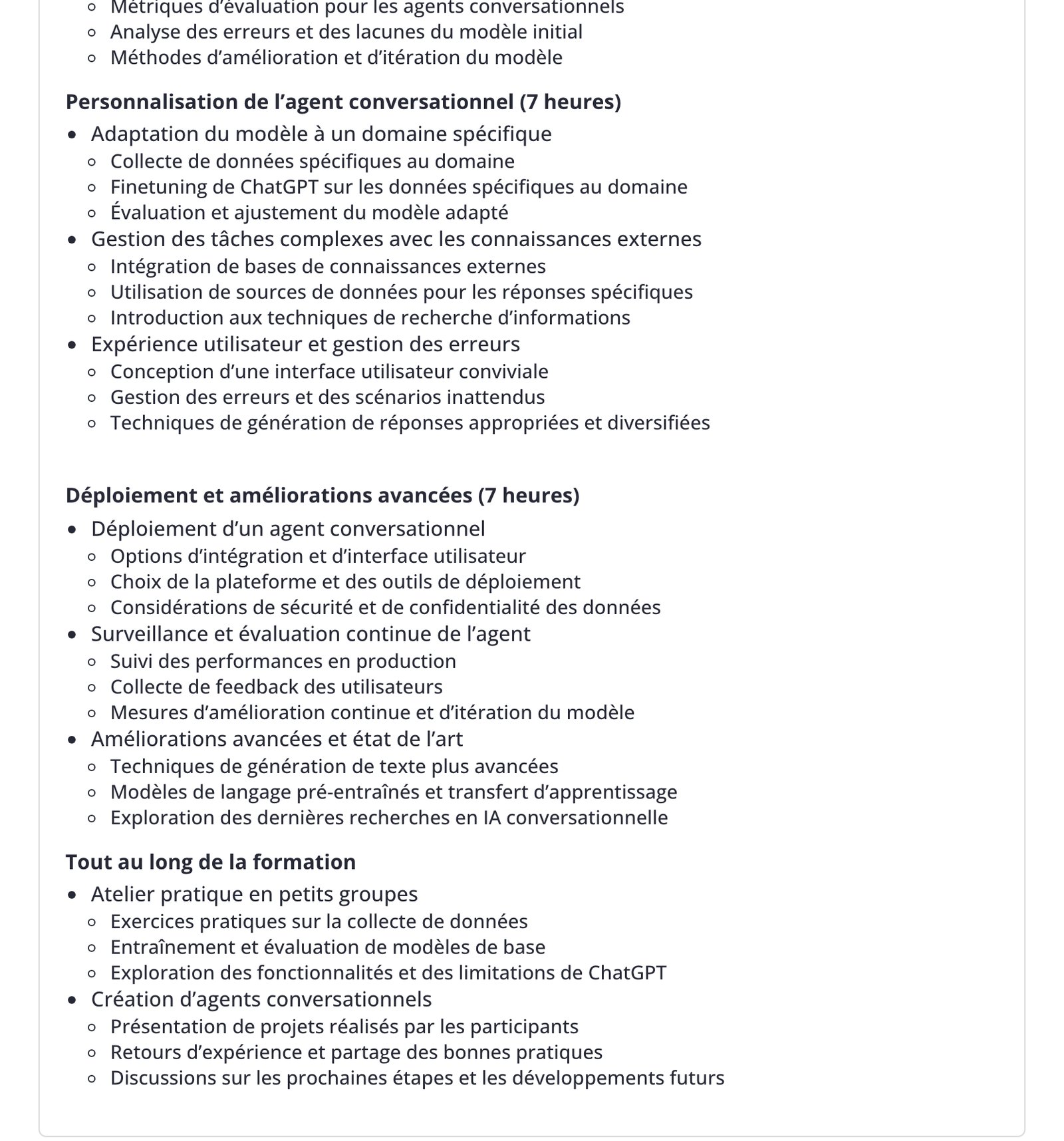
What this programme says, and it holds for the whole market: a serious “advanced” module necessarily goes through integrating external knowledge bases, handling errors and unexpected scenarios, monitoring performance in production and collecting user feedback. If those four points are missing from what is being sold to you, it is not an advanced course, it is a stretched introductory one.
What this programme does not say, and that is true of nearly all of them: nothing on compliance, nothing on running costs. Yet those are the two questions your management raises at the second meeting. We put numbers on the second in our guide to the generative AI chatbot and what it really costs.
“Advanced” at a technical training provider and “advanced” at a platform vendor do not mean the same thing. The first will have you writing code and handling models; the second will have you squeezing everything out of a visual editor. Both are legitimate, but a developer will be bored in the second and a marketing lead will be lost in the first. That is the first filter to apply.
What it costs: prices recorded on 4 August 2026
Very few providers publish their price on the course page, which makes comparison painful. Here is what was actually displayed on 4 August 2026 on the pages of the courses ranking on the first page of Google in France. Amounts are excluding VAT, open enrolment rate unless stated otherwise.
| Provider | Course | Length | Price excl. VAT | Stated prerequisites |
|---|---|---|---|---|
| ENI Service | Building an advanced conversational agent with ChatGPT (ref. VE850-012) | 4 days, 28 h | not published on the page | front and back end development, Python and machine learning basics recommended |
| Orsys | Building and deploying a conversational agent in JavaScript (ref. BQW) | 3 days, 21 h | 2,360 € | JavaScript and Node.js |
| 2IIA | Building a professional AI chatbot | 5 days, 35 h | not published on the page | not stated, intermediate level announced |
| Demos | Building an AI chatbot without coding, level 2 (ref. ITM122) | 1 day, 7 h | 990 € (in-house 2,390 €) | a level 1 course in generative AI |
| Cegos | Steering a chatbot project (ref. 9614) | 1 day, 7 h | 890 € (in-house 2,490 €) | none |
| Unow | ChatGPT, advanced features level 2 | 3 h virtual class, then one month of coaching | not published on the page | ChatGPT basics and a paid account |
| Botnation | Botnation chatbot training | 1 to 2 days | on request, Qualiopi certified | none |
Three lessons come out of this survey.
- A day costs between 780 and 890 € excl. VAT when the price is public. Orsys charges 2,360 € for three days, Cegos 890 € for one day, Demos 990 € for one day: the market order of magnitude is around 800 to 900 € per day and per person.
- Half of the providers publish no price at all. That is not an oversight, it is a commercial policy. Ask for the rate in writing before any sales call, and ask for the in-house rate too: from four or five participants, in-house is almost always cheaper.
- Prerequisites are the real filter. A course that requires JavaScript and Node.js automatically rules out a business team. A “no code” course rules out deep integration work. Read the prerequisites before the programme.

Who pays: the French funding routes, and what to check anywhere else
General information about the French vocational training funding schemes, current as of 4 August 2026. It does not replace the advice of your OPCO, your HR department or a careers adviser, who alone can rule on your situation. Outside France, the schemes differ entirely: the principles below still apply, the names and amounts do not.

The CPF, provided the course leads to a registered certification
This is the point commercial pages keep quiet about. The French personal training account does not fund any course at all. Article L6323-6 of the labour code, in the version in force since 27 June 2026, states that eligible courses are those “sanctioned by the professional certifications registered in the national register provided for in Article L. 6113-1, those sanctioned by attestations validating skill blocks within the meaning of that same Article L. 6113-1, and those sanctioned by the certifications and accreditations registered in the specific register mentioned in Article L. 6113-6“.
In practice: a chatbot course can only be paid for from the CPF if it leads to a certification listed in the RNCP or in the specific register. Many chatbot courses on the market deliver none. They can be excellent, they are simply not fundable through that route. The check takes a minute: look for an RNCP or RS reference number on the course page, not the word “certifying”, which commits nobody to anything.
Since 1 April 2026, the compulsory financial contribution paid by the CPF holder has risen from 100 € to 150 €, under decree no. 2026-234, which revalued the amount set by decree no. 2024-394 of 29 April 2024. It is paid at the time of enrolment on the platform. Jobseekers and holders whose course is co-funded by their employer or by an OPCO are among those exempt. Source: moncompteformation.gouv.fr, page accessed on 4 August 2026.
The OPCO, when the company decides
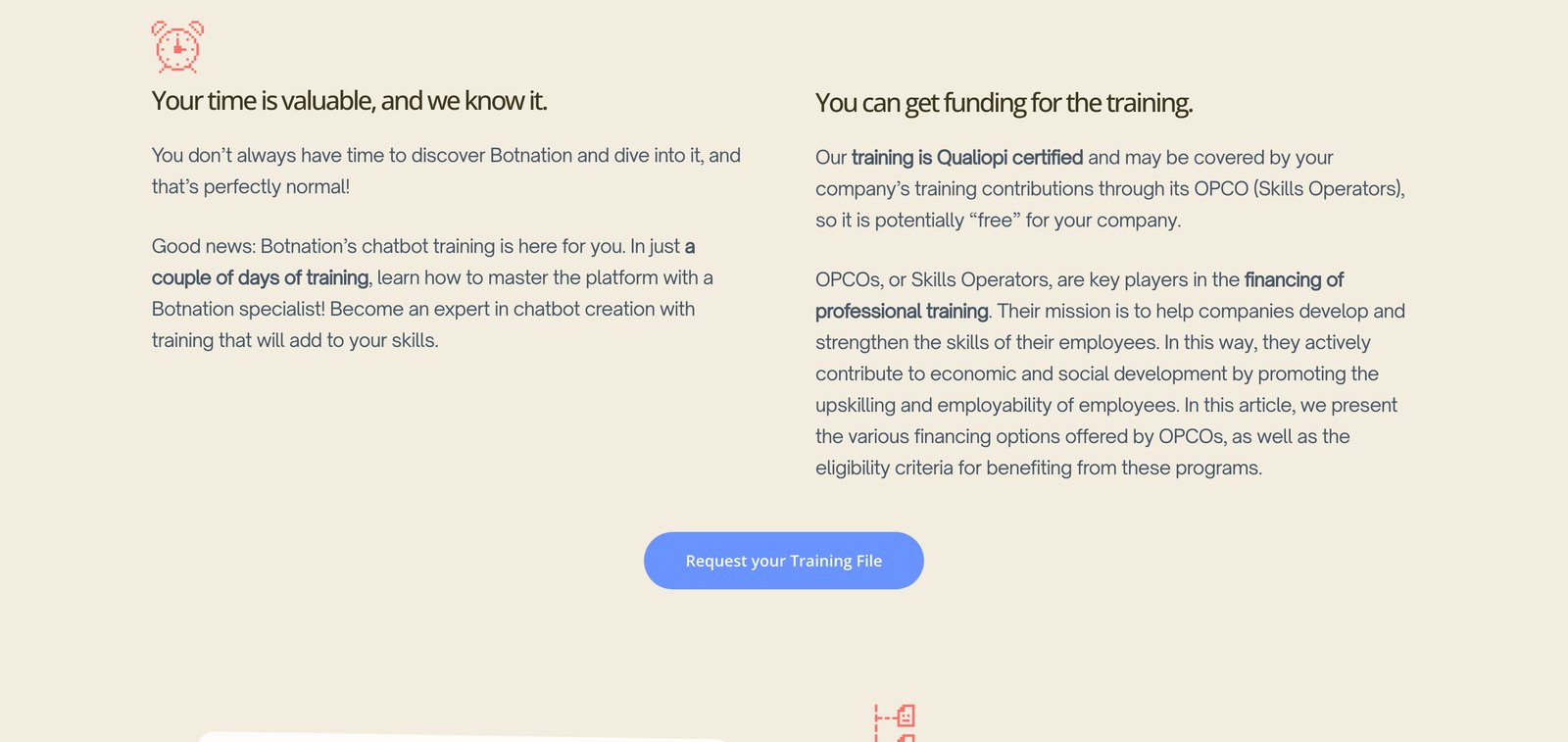
For an employee whose company is driving the project, this is the most common and the simplest route. Your industry skills operator can cover all or part of the cost, on one condition that admits no exception: the training provider must hold the Qualiopi certification. That quality certification has been required since 1 January 2022 of any provider of skills development activities seeking access to public or pooled funds. Without Qualiopi, the OPCO refuses to pay, however good the course is.
The company skills development plan
Third route, often the fastest: the employer puts the course in its skills development plan and pays for it out of its own budget, with or without the OPCO stepping in. It is the natural channel when the course is short, when it involves several people from the same team, or when it is tied to a dated project. It is also the only one that lets you bring a trainer onto your own use case rather than sending one person off to follow a generic programme.
The case for in-house
- The trainer works on your real content and your real bot.
- Cost per person collapses from four participants onwards.
- Compliance questions are handled on your case, not in the abstract.
- Business and technical teams hear the same thing at the same time.
The case for open enrolment
- Only one person to train, with no collective project behind it.
- A wish to compare practice with other companies.
- An individual budget available, in France through the CPF.
- A need for an early date without organising an internal session.
Since 2 August 2026, training on conversational AI is also an obligation
This is every catalogue’s blind spot. The European artificial intelligence regulation, Regulation (EU) 2024/1689, contains two articles that directly concern anyone putting a chatbot online.
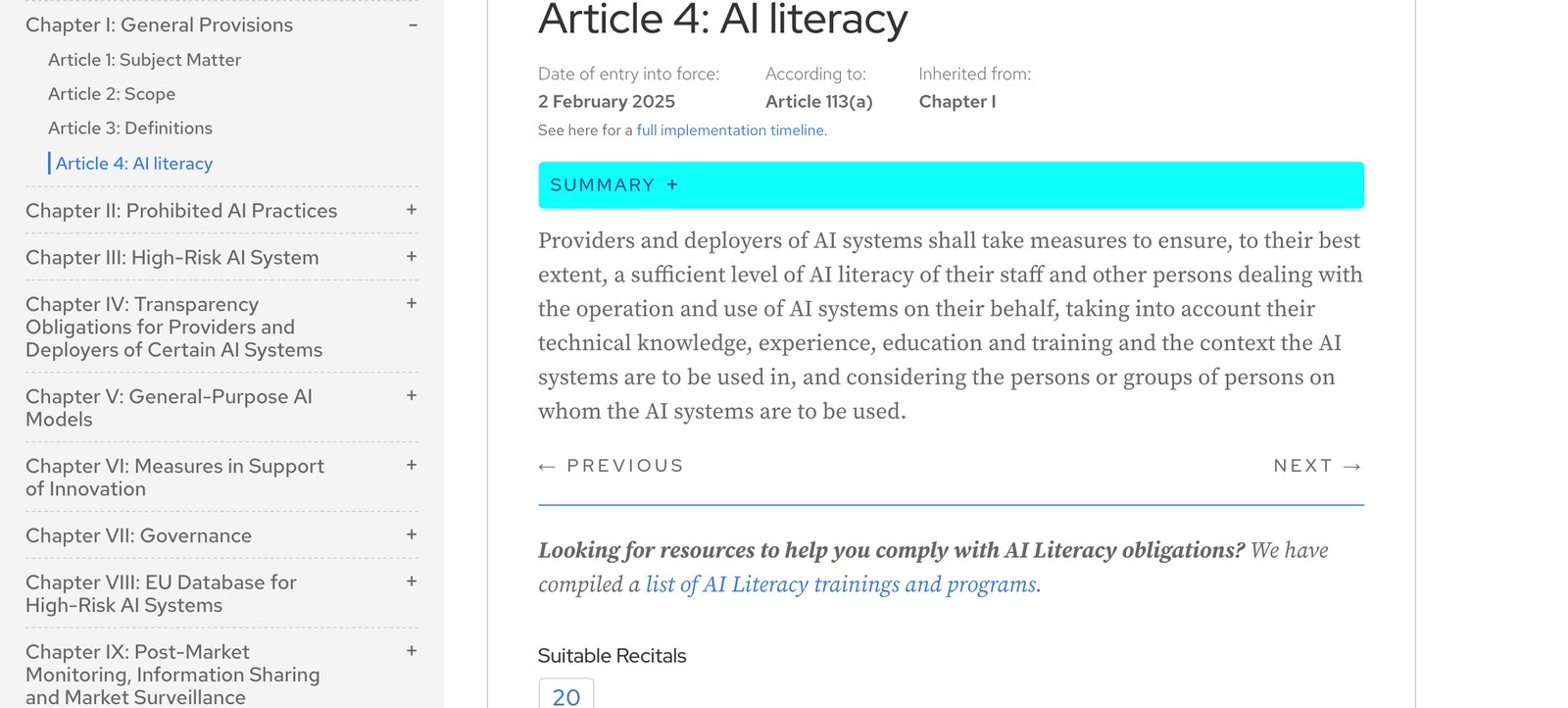
The first is Article 4, applicable since 2 February 2025, on AI literacy. Its wording is short and unambiguous: “Providers and deployers of AI systems shall take measures to ensure, to their best extent, a sufficient level of AI literacy of their staff and other persons dealing with the operation and use of AI systems on their behalf“, taking into account their technical knowledge, experience, education and training.
The regulation defines AI literacy itself, in Article 3, point 56: “skills, knowledge and understanding that allow providers, deployers and affected persons […] to make an informed deployment of AI systems, as well as to gain awareness about the opportunities and risks of AI and possible harm it can cause“. In other words, knowing how to deploy with full awareness and knowing what the technology can do, for better and for worse. It is not a diploma, it is a level of understanding you must be able to show.
The second is Article 50, applicable since 2 August 2026, that is to say two days before this article was written. Its paragraph 1 requires that AI systems intended to interact directly with natural persons be designed so that those persons are informed they are interacting with an AI system, unless that is obvious. Its paragraph 2 requires machine-readable marking of generated content. Breaches of Article 50 fall under Article 99(4), which provides for fines of up to 15 million euros or 3 % of worldwide annual turnover, whichever is higher.
Those two articles give you an unanswerable argument for getting a chatbot course funded: upskilling the team that runs the bot is no longer a comfort, it is a compliance measure. Put the request in those terms to your management or your funder, and attach the text of Article 4. The acceptance rate is not the same.
The free route: how far it actually takes you
Before committing 900 € a day, it is worth knowing what free covers. On a no-code platform, it covers far more than people assume. Botnation publishes, for example, over six hours of free video training on chatbot design, as webinar replays and tutorials.
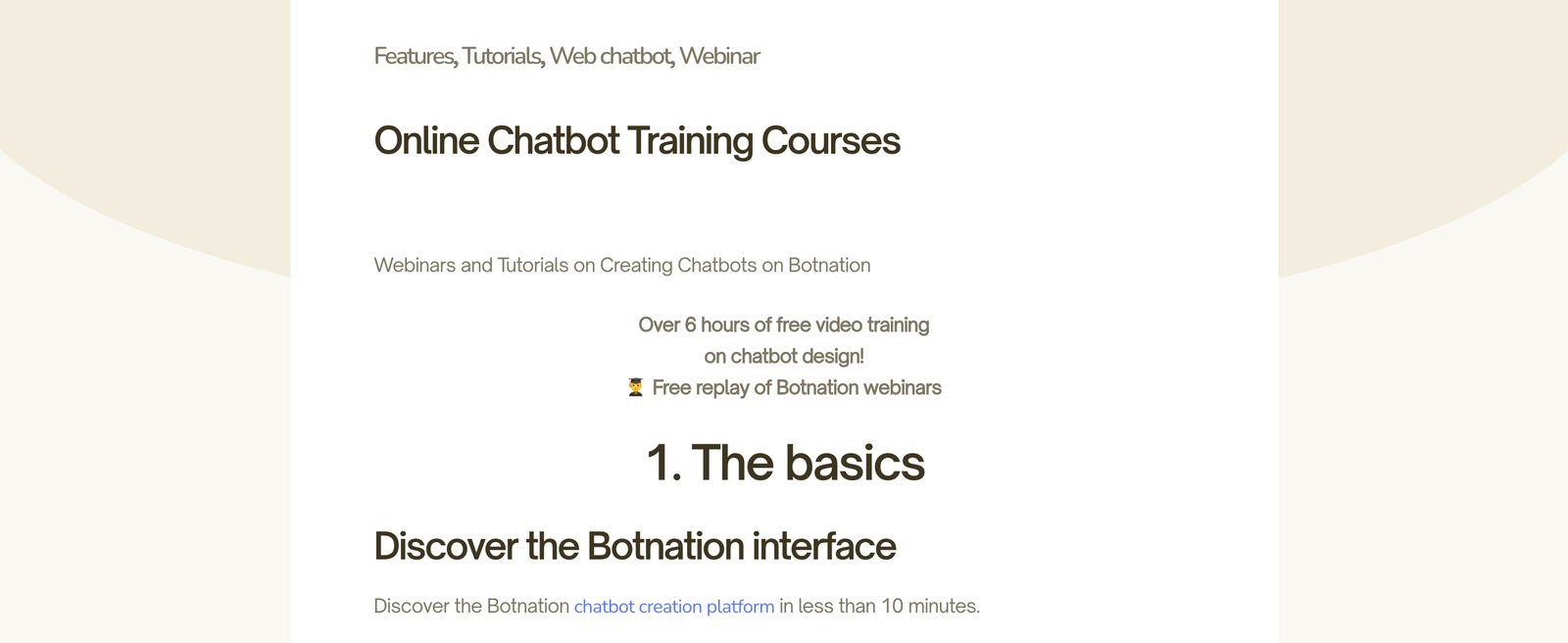
The catalogue goes well beyond first steps: conversation contexts, variables, carousels generated from an RSS feed, A/B testing, lead capture, data import and export, multichannel publishing. In terms of our grid, that covers blocks 1 and 5 properly, and blocks 2 and 4 partially.
What video does not replace comes down to three things: a trainer’s feedback on your conversation flow, a decision on your data, and compliance work on your case. That is precisely what you pay for in a course. If none of those three is blocking you, keep your budget.
A sequence that works well: the six hours of video for the mechanics, then a real chatbot built on a real case and published, then one or two days of guided training once your questions have become precise. Training first and practising afterwards is the least efficient order, because you do not yet know what to ask.
Seven questions to ask before signing a training quote
- What exactly are the prerequisites?If they mention a programming language, the session is not for a business team. If they mention nothing, ask for the profile of the previous cohort.
- Does the programme cover the knowledge base and integrations?Those are blocks 2 and 4 of the grid. Without them, the word “advanced” is decoration.
- Is there a module on measurement and one on compliance?Almost no catalogue has the second. Since 2 August 2026, that is a gap.
- Is the provider Qualiopi certified?A closed question with a verifiable answer. Without Qualiopi, no pooled funding is possible in France.
- Does the course lead to an RNCP or RS certification?That is the only condition that opens the CPF. Ask for the reference number, not a promise.
- Will we work on my project or on a textbook case?The difference in value is enormous and it never shows on the brochure.
- What is the in-house rate for my headcount?Always compare it against the open enrolment rate multiplied by the number of participants. The switch often happens at four people.
If your need turns out to be having the bot built rather than learning to build it, the question changes nature and so do the criteria: we detailed them in our guide to choosing an AI chatbot agency, and in the one comparing the three routes to developing a chatbot, namely coding it, using a platform, or having it built.
Frequently asked questions
Is chatbot training eligible for the French CPF?
Only if it is sanctioned by a certification registered in the RNCP or in the specific register, as required by Article L6323-6 of the labour code. Many chatbot courses deliver none and are therefore not fundable through the CPF, however good they are. Look for an RNCP or RS reference number, and budget for the compulsory 150 € contribution applicable since 1 April 2026, unless you are exempt.
Do you need to code to take an advanced chatbot course?
It depends entirely on the track. Technical courses explicitly require a development background: JavaScript and Node.js at Orsys, front and back end development plus some Python and machine learning at ENI Service. Conversely, level 2 “no code” tracks only ask for a level 1 in generative AI. Both lead to an advanced level, in different jobs.
How many days does it take to become autonomous on a chatbot?
On a no-code platform, one to two guided days are usually enough to become autonomous on design and publishing, provided you have already practised on your own. For full autonomy including integrations and running the bot, market tracks plan on three to five days, that is 21 to 35 hours. The deciding factor is not the number of days but whether you work on a real case.
What is the difference between chatbot training and prompt engineering training?
Prompt engineering covers only one of the six blocks, the system prompt and guardrails. It is a useful but partial skill: it says nothing about the knowledge base, integrations, measurement or compliance. A prompt engineering course is a good complement, rarely a substitute.
How do you become a chatbot master?
The term describes a hybrid profile between conversation design, data and integration. There is no single qualification leading to it. Career pages published by schools mention a computing or data background at bachelor or master level, but in practice most people doing the job come from marketing, support or project management and learned on the ground. A portfolio of bots actually running in production counts for more than a diploma.
Can you train seriously without spending anything?
Yes for the mechanics, no for the judgement calls. The six hours of free Botnation video cover design, variables, contexts, A/B testing and lead capture. What stays paid is a trainer’s eye on your conversation flow, the decision on your own data and the compliance work on your case. The right strategy is to exhaust the free resource before buying, not the other way round.
Chatbot training or chatbots for training, how do you avoid the mix-up?
The two subjects share the same keywords but have nothing in common. If you want to build chatbots, aim at technical catalogues and platform vendors. If you want to use a conversational assistant to support learners, the subject belongs to the internal chatbot and procedure delivery, with completely different selection criteria.
Train on your own chatbot, not on a textbook case
In one or two days, a Botnation specialist takes you from “it runs” to “it holds in production”, on your content and your channels. Qualiopi certified training, fundable through your OPCO in France. And if you would rather start on your own, the six hours of video are there, free.
Main sources: Article 4 and Article 50 of Regulation (EU) 2024/1689 on artificial intelligence; Article L6323-6 of the French labour code, version in force since 27 June 2026; decree no. 2026-234 on the amount of the compulsory contribution to the funding of courses eligible for the personal training account; public pages of the providers cited, accessed on 4 August 2026. Training prices change: check them with the provider before making a decision.