



- An employee support chatbot answers a company’s internal requests: HR, payroll, IT, facilities. It is not a customer service chatbot, and the difference is not cosmetic: the user is under an employment contract.
- Three criteria are enough to sort a request: the data involved, whether the answer is the same for everyone, and whether an individual decision is taken at the end. The tool below sorts on those three axes.
- Before switching the tool on, the works council is informed: in France, a bot handling employee requests is an automated personnel management process under Article L2312-38 of the Labour Code.
- Across the 19 organic results recorded on 11 August 2026 for the French query, none cites the Labour Code, none mentions the works council, and only one mentions the EU AI Act.
An employee looking for their remaining leave, a badge that no longer works, an expense claim stuck for three weeks: these requests generate no revenue, they appear on no commercial dashboard, and yet they eat a considerable share of HR and IT time. Hence the employee support chatbot, an internal assistant that absorbs repetitive questions and leaves teams with what genuinely needs a human.
The idea is sound. What is written around it is less so. The pages competing on this topic line up benefits, tool lists and availability promises, but none answers the one question that actually stalls a project: which requests can I hand to a bot, and what does that force me to do before switching it on? This article answers both, with a sorting tool and the legal texts opened one by one.
Employee support chatbot: what the term actually covers
An employee support chatbot is a conversational agent installed inside the company, whose users are its own staff. It answers day-to-day requests: where to find a document, which rule applies, how to start a procedure, where a file stands. Depending on the organisation, it is also called an internal assistant, a staff bot or a conversational helpdesk.
Its scope goes well beyond human resources. In most deployments it covers at least four areas: HR and payroll (leave, payslips, certificates, onboarding), IT (access, passwords, hardware, incidents), facilities (premises, badges, room booking, expense claims) and internal policy (remote work, travel reimbursement, safety rules).
Why it is not a customer service chatbot in disguise
The temptation is strong to take the customer service bot and turn it inwards. That is a design mistake, for a simple reason: a customer can leave, an employee cannot. This asymmetry changes everything, from tone to legal framework.
| What changes | Customer service chatbot | Employee support chatbot |
|---|---|---|
| Who is on the other side | A free, often anonymous visitor | An identified person, bound by an employment contract |
| Nature of the data | Order and account data | Personnel management data, sometimes sensitive |
| Way out | The visitor closes the tab | The employee still has to get an answer somewhere |
| Framework to clear first | Information about the processing | Works council information, staff information, HR legal basis |
| Cost of a wrong answer | A lost sale | A right poorly exercised, a deadline missed, a dispute |
That is also why a customer-facing helpdesk chatbot and an internal assistant are not run the same way, even when they sit on the same platform. The two overlap on purely technical questions and diverge as soon as the answer touches the contract.
And how does it compare with an HR chatbot?
The HR chatbot is a subset of employee support, not a synonym. It handles the relationship between the employee and the HR function. Employee support also takes IT and logistics requests, which often represent the largest volume and the easiest scenarios to automate. Many projects fail because they start with the most sensitive subject, payroll, instead of the most mechanical one, the locked password.
The third organic result on the French query, on 11 August 2026, is an interview published in RF Social issue 211, dated October 2020. It reports that 25 % of the HR departments surveyed were using HR chatbots, against 6 % in 2018. The figure is real and attributed, but it is six years old. On a subject where the technical offer has changed several times since, that is the sign of a results page that has not refreshed.
What a bot can absorb, and what has to come back
The question is never « can the bot do it ». Technically, a language model wired to your documents can draft an answer to almost anything. The question is whether that answer is allowed to be the answer. Three criteria are enough, and they come in this order.
- Is an individual decision taken at the end? Granting a day off, opening an access, approving an expense claim: that is a decision affecting one person. It is not delegated to an automated system.
- Is sensitive data involved? Health, trade union membership, a harassment situation. A chatbot thread is not where that information should land.
- Is the answer the same for everyone? If it is, the bot gives it alone. If it depends on the file, you have to authenticate then read. If it calls for judgement, the bot prepares and hands over.
The tool below applies exactly those three rules, in that order of priority, and adds a reading of volume. The reference table under the chips lists twelve real requests positioned on the three axes: each row reloads the tool.
Can the bot handle this employee request?
Answer the four questions, or load a real case from the reference table just below.
1. What data does the answer involve?
2. Is the answer the same for everyone?
3. Is an individual decision taken at the end?
4. How many requests of this type per month?
The bot can collect the request, check that it is complete, restate the applicable rule and route it to the right team. It does not deliver the answer. The CNIL, France’s data protection authority, writes that a conversation without human intervention « ne peut conduire à elle seule à des décisions importantes pour la personne concernée » (cannot on its own lead to decisions that matter for the person concerned), and point 4 of Annex III of the EU AI Act covers systems used to make decisions affecting terms of work-related relationships.
What to set up: an automatic acknowledgement, a stated turnaround time, and a button that opens the file with the right person.
Health, trade union membership, a harassment report: Article 9 GDPR prohibits processing this data as a matter of principle, and the CNIL asks for particular care as soon as a chatbot may collect it. The correct scenario hands over the contact and the channel, then stops.
What to set up: no follow-up question, no storage of the message, and a genuinely reachable person behind it.
The bot saves time on collection, not on arbitration. It gathers the documents, restates the request and passes it on complete: the team receives a ready file instead of a three-line message.
What to set up: the list of expected documents, a summary shown before sending, and the name of the receiving team.
The bot can answer on its own, provided it identifies the person before fetching the value from the HR system. Without authentication, it states the general rule and points to the portal.
What to set up: authentication, a read-only connection to the HR system, and a sentence that dates the value shown.
This is where the value sits: one answer that is identical for everyone, with no arbitration and no sensitive data. These requests are handled end to end, at any hour, and they are the ones to write first.
What to set up: a single dated source, a link to the reference document, and a way out to a human at every step.
Three rules can apply at once. The tool always keeps the most demanding one, in this order: individual decision, then sensitive data, then case-by-case judgement.
| Employee request | Data | Answer | Decision | Outcome | Load |
|---|---|---|---|---|---|
| Where do I find my payslip | None | Same for everyone | None | The bot answers on its own | |
| What are the remote working rules | None | Same for everyone | None | The bot answers on its own | |
| My account is locked, how do I unlock it | Routine HR data | Same for everyone | None | The bot answers on its own | |
| How many days of leave do I have left | Routine HR data | Depends on the file | None | Guided answer, wired to the record | |
| Get a proof of employment letter | Routine HR data | Depends on the file | None | Guided answer, wired to the record | |
| Why was my expense claim rejected | Routine HR data | Depends on the file | None | Guided answer, wired to the record | |
| Dispute the calculation of a bonus | Routine HR data | Calls for judgement | None | Pre-qualification, then a human | |
| Flag a disagreement on an appraisal write-up | Routine HR data | Calls for judgement | None | Pre-qualification, then a human | |
| Book a day off | Routine HR data | Depends on the file | A decision | The bot prepares, a human decides | |
| Request access to a business application | Routine HR data | Depends on the file | A decision | The bot prepares, a human decides | |
| Report a sick leave | Sensitive | Depends on the file | None | Immediate escalation, nothing logged | |
| Report a harassment situation | Sensitive | Calls for judgement | None | Immediate escalation, nothing logged |

The step the whole top 20 skips: the works council
Here is the measurement. On 11 August 2026, the 19 organic results for the French query « chatbot support salarié » on Google France were recorded then downloaded one by one. Result of the count, excluding menus and footers: zero page mentions the works council, zero page cites the Labour Code, zero page mentions a data protection impact assessment, and one mentions the EU AI Act. Ten pages out of nineteen say the word GDPR, most often in a general paragraph about data hosting.
In other words, a reader preparing a project from the first page of Google will learn everything about the benefits and nothing about the three obligations that condition the rollout. Here is the first one, and it is the most often forgotten.
A bot handling employee requests is an automated personnel management process
Article L2312-38 of the French Labour Code, in force since 1 January 2018, runs to three sentences. The second one bears directly on an internal chatbot. The official text is French only; the translation below is ours, with the original in the caption of the screenshot.
The social and economic committee is informed, prior to their use, about the methods or techniques used to assist in the recruitment of job applicants, and about any change to them.
It is also informed, prior to their introduction in the company, about automated personnel management processing, and about any change to it.
The committee is informed and consulted, prior to the decision to implement them in the company, about the means or techniques that make it possible to monitor employee activity.
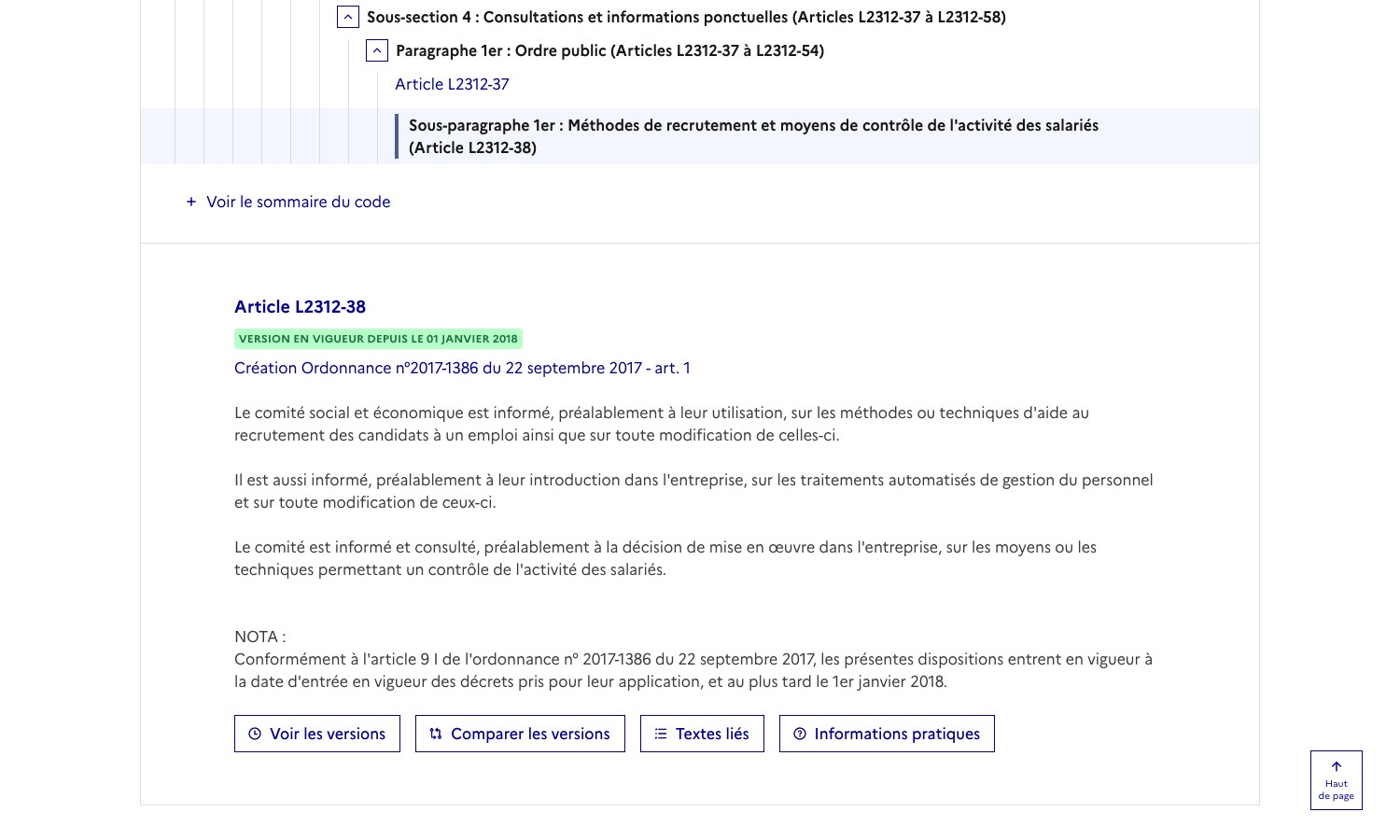
Three levels, three regimes. A bot that reads the HR system to answer « you have 12.5 days left » handles personnel management data: second paragraph, prior information. A bot that logs who asks which question, when and how often, can become a means of monitoring employee activity: third paragraph, information and consultation, before the implementation decision. The difference is not cosmetic, since a consultation implies an opinion, therefore a deadline and an agenda.
And the introduction of new technologies
The second text is Article L2312-8, in its version in force since 25 August 2021. Its paragraph II lists the matters on which the committee is informed and consulted, and its fourth point covers:
L’introduction de nouvelles technologies, tout aménagement important modifiant les conditions de santé et de sécurité ou les conditions de travail
The introduction of new technologies, and any significant change affecting health and safety conditions or working conditions.
A conversational assistant that becomes the official entry point for internal requests ticks both halves of that sentence: it is a new technology, and it changes the way employees reach their rights. Note that these powers apply to companies with at least fifty employees, as paragraph IV of the same article specifies.
The text nobody ever quotes
The third one is the shortest article of the French Labour Code on this ground, and it fits on one line. Article L1222-4, in force since 1 May 2008:
Aucune information concernant personnellement un salarié ne peut être collectée par un dispositif qui n’a pas été porté préalablement à sa connaissance.
No information personally concerning an employee may be collected by a system that has not been brought to their attention beforehand.
The operational translation: the employee must know that the bot exists, what it records and for how long, before talking to it. One sentence in the welcome message and one information page on the intranet are usually enough, but their absence is a compliance gap, not a communication detail.
These three articles do not say « a chatbot is forbidden ». They say when the committee must be informed and when it must be consulted. The project schedule therefore has to include a works council milestone before go-live. It is the kind of milestone that costs two weeks when planned, and several months when discovered at the end of testing. This article provides general information and does not replace advice from a lawyer or from your data protection officer.
High risk or not? What the EU regulation actually says
The second obligation comes from Regulation (EU) 2024/1689, the EU Artificial Intelligence Act. On this precise point, the most common answer is wrong in both directions: no, an internal chatbot is not automatically high risk, and no, it is not automatically out of scope either. It all depends on what it does.

The starting point: Annex III, point 4
Annex III of the regulation lists the systems considered high risk. Its point 4, titled « Employment, workers’ management and access to self-employment », covers in particular, at (b):
AI systems intended to be used to make decisions affecting terms of work-related relationships, the promotion or termination of work-related contractual relationships, to allocate tasks based on individual behaviour or personal traits or characteristics or to monitor and evaluate the performance and behaviour of persons in such relationships.
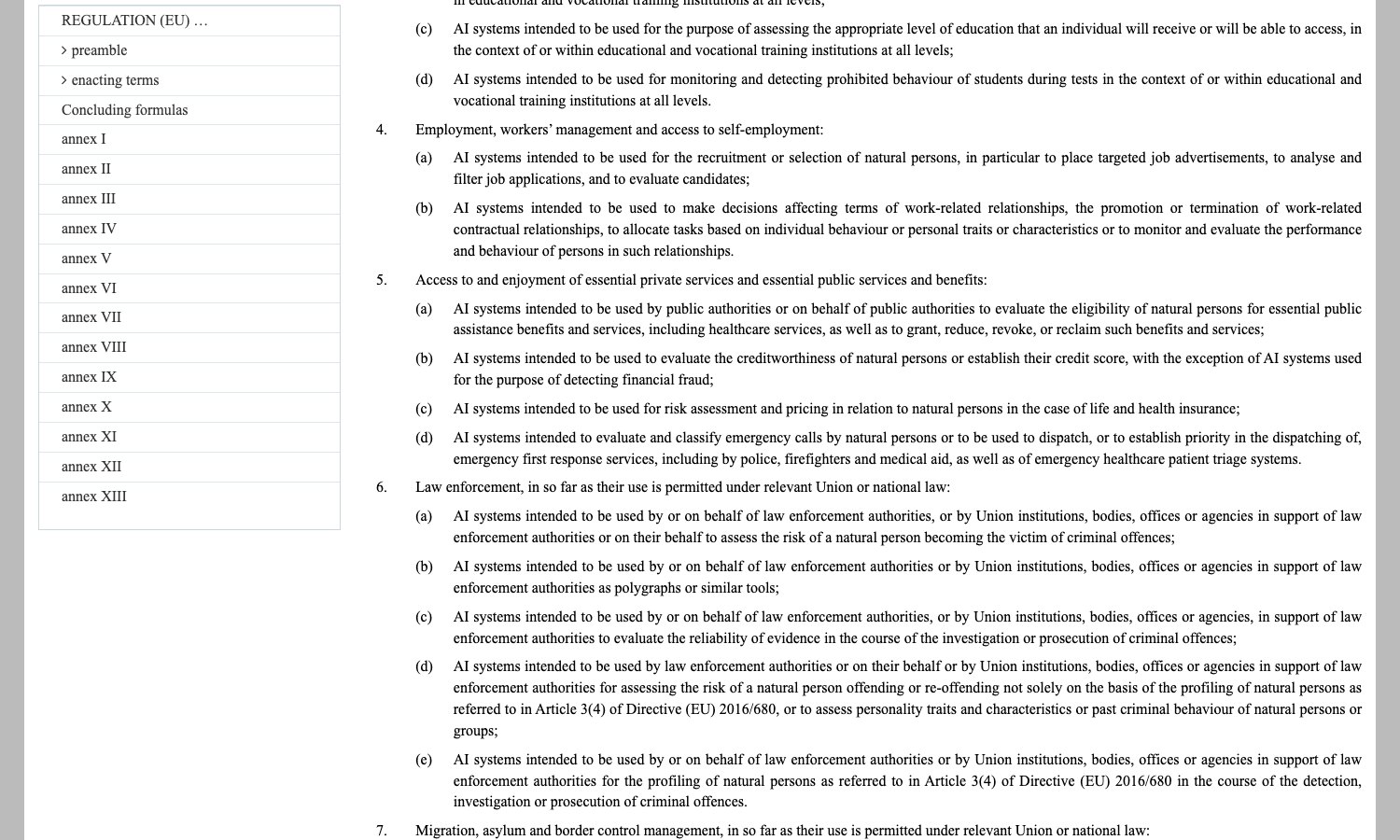
Read the end of the sentence: to monitor and evaluate the performance and behaviour. A bot that only answers questions does not fall in there. A bot that scores manager responsiveness, prioritises requests by requester profile or feeds an individual activity dashboard, does.
The derogation in Article 6(3)
The regulation provides its own way out, in Article 6(3): a system referred to in Annex III is not considered high risk where it does not pose a significant risk of harm, and in particular where, among other conditions:
the AI system is intended to perform a narrow procedural task
An assistant that answers « here is the procedure and here is the form » is exactly that. But the same paragraph ends on a sentence with no nuance:
Notwithstanding the first subparagraph, an AI system referred to in Annex III shall always be considered to be high-risk where the AI system performs profiling of natural persons.
Profiling is therefore the red line. It is also, in practice, the feature vendors promote under the name personalisation. Be careful about what is switched on by default.
What the employer must do in every case
Two obligations apply regardless of the classification. The first targets employers specifically, in Article 26(7):
Before putting into service or using a high-risk AI system at the workplace, deployers who are employers shall inform workers’ representatives and the affected workers that they will be subject to the use of the high-risk AI system.
The second is Article 50(1), applicable since 2 August 2026: systems intended to interact directly with natural persons must be designed so that those persons are informed that they are interacting with an AI system, « unless this is obvious from the point of view of a natural person who is reasonably well-informed, observant and circumspect ». On an internal bot named after a house mascot, that is not always obvious: an explicit line costs nothing.
| What the bot does | Likely regime | What applies |
|---|---|---|
| It answers questions and points to a form | Not high risk, narrow procedural task | Article 50, informing the persons |
| It prepares a file that a human decides on | Preparatory task, to be documented | Article 50, plus documenting the assessment |
| It allocates tasks, evaluates or profiles | High risk, Annex III point 4 | All high-risk obligations, plus Article 26(7) |
Data: what the French regulator forbids the bot to decide
The third obligation is the one most pages touch on without ever reaching the practical consequence. The CNIL, France’s data protection authority, published a dedicated chatbot page on 19 February 2021 that answers exactly the question an internal project runs into. The page exists in French only; the original wording is quoted first, with our translation after it.
Une conversation avec un chatbot sans intervention humaine ne peut conduire à elle seule à des décisions importantes pour la personne concernée, telles que le refus d’une demande de crédit en ligne, l’application de tarifs plus élevés ou l’impossibilité de présenter une candidature à un poste.
A conversation with a chatbot without human intervention cannot on its own lead to decisions that matter for the person concerned, such as refusing an online credit application, applying higher prices or making it impossible to apply for a job.
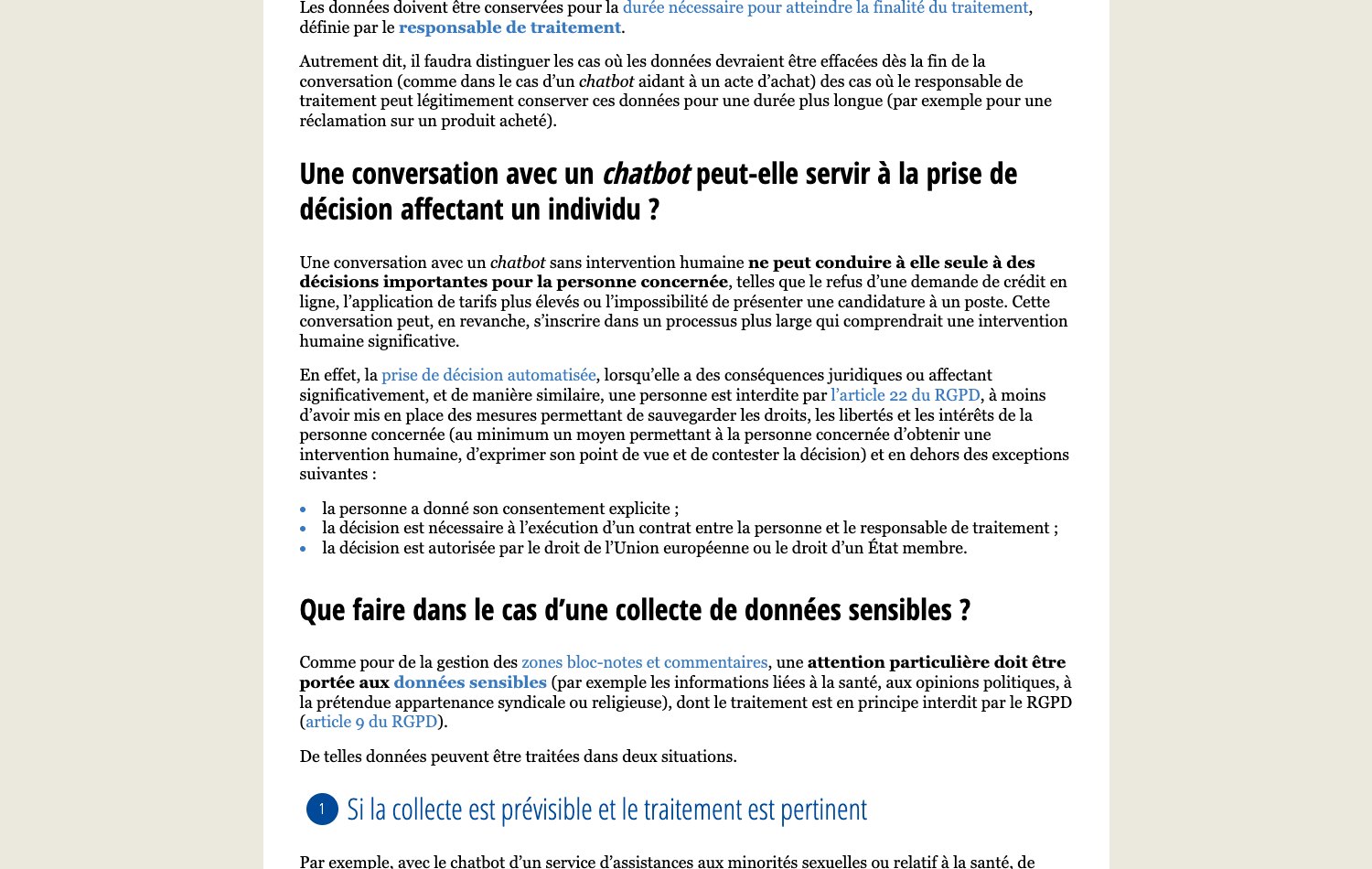
The CNIL ties that limit to Article 22 GDPR, which prohibits fully automated decisions producing legal effects or similarly significantly affecting a person, save for framed exceptions and save where at least a way for the person to obtain human intervention, express their point of view and contest the decision is provided. Transposed to employee support: a bot that refuses a leave request with no human in the loop is a problem, even if the rule it applies is correct.
Sensitive data has no business in the thread
The same page asks for « particular care » with sensitive data, explicitly naming information relating to health, political opinions, alleged trade union membership or religion, whose processing is prohibited in principle by Article 9 GDPR.
Yet an employee reporting a sick leave is talking about their health, an employee looking for a staff representative reveals a union orientation, and an employee reporting harassment does both. Good design does not filter those messages after the fact: it plans, for those subjects, a scenario that hands over the channel and the contact, then withdraws, without recording the content.
The French HR reference framework does not cover everything
One last technical point, useful for your data protection officer. The CNIL reference framework on human resources management, adopted by deliberation no. 2019-160 of 21 November 2019, serves as the benchmark for routine HR processing. But it expressly excludes certain systems from its scope, among them « les analyses algorithmiques visant à prédire le comportement ou la productivité des salariés », algorithmic analyses aimed at predicting employee behaviour or productivity. An assistant that stays within documentary answers falls inside the framework; an assistant that drifts towards prediction falls outside it, and the employer then has to run its own assessment.
On the technical side, the question of documentary scope arises exactly as it does for any chatbot wired to a knowledge base: the cleaner and better dated the base, the less the bot invents. That is also the whole point of how you train a chatbot on your own data.
Where to plug it in: intranet, Teams, Slack, and deskless staff
The channel drives usage far more than the quality of the answers. An excellent assistant nobody finds is worth nothing. In the RF Social interview already cited, access was already mostly « via l’intranet de l’entreprise », through the company intranet, and broadening the delivery channels was a demand expressed by 33 % of respondents in 2020, against 17 % two years earlier.
The four entry points that come up in practice:
- The intranet or HR portal: the most natural one, but it assumes the employee goes there. Good for prepared questions, poor for urgency.
- Team messaging (Teams, Slack): the bot sits where people already work. This is the channel that produces the best volumes among office populations.
- SMS or WhatsApp: the only credible option for deskless staff, in stores, workshops or on the road. It is also the shortest channel, so the least forgiving of wordy answers.
- A physical station: reception kiosk, workshop screen. Rare, but decisive in industry.
At Botnation, these entry points stack on a single agent from the channels page. One budget note: sending SMS consumes credits on top of the subscription, as the pricing page states.
What it really costs
Two routes exist, and they do not compare line by line. The first is building it yourself on a no-code platform, the second is having the agent built for you. The platform’s public pricing, recorded on 11 August 2026, gives the first order of magnitude.
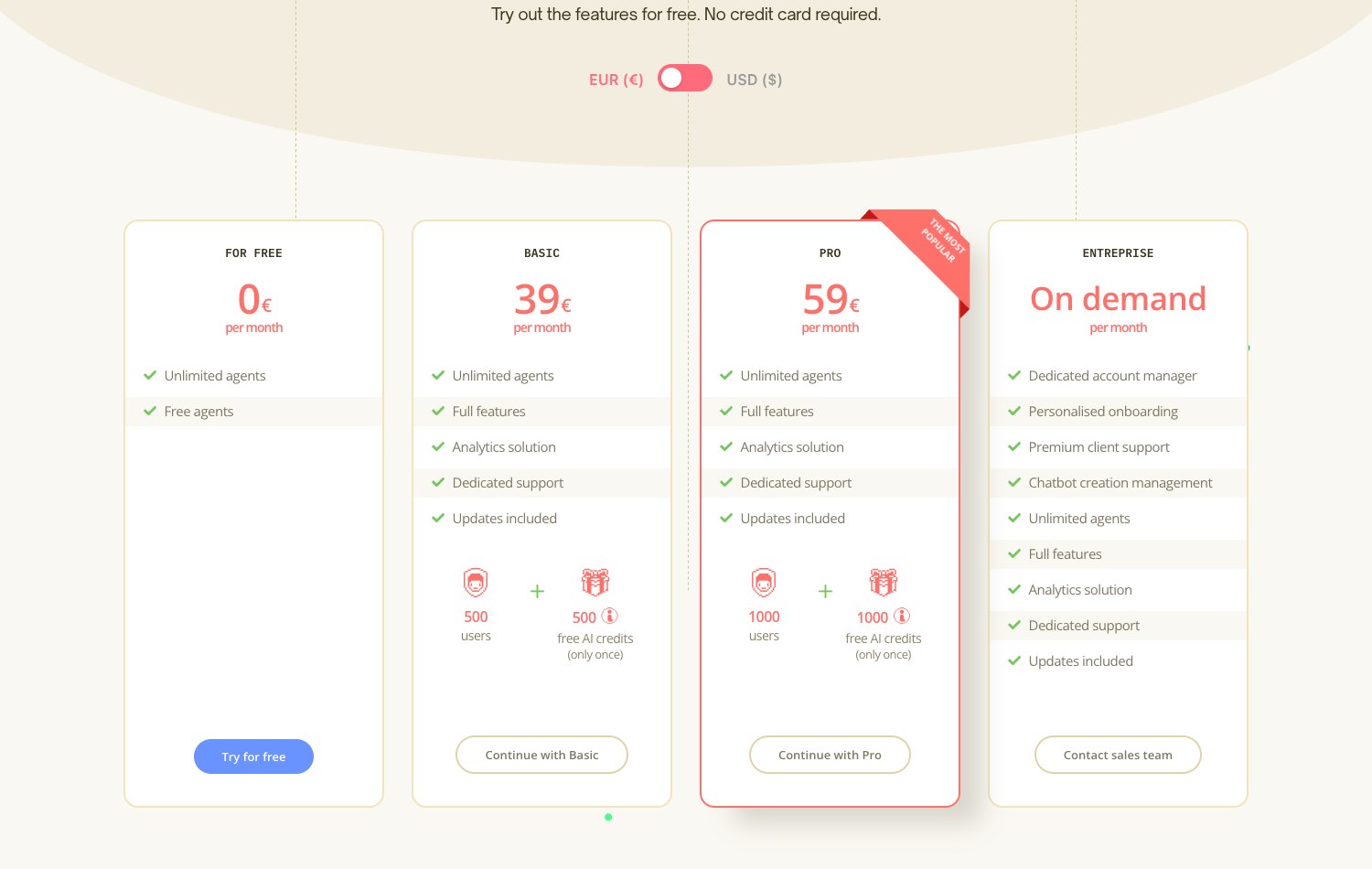
| Plan | Monthly price | What it includes |
|---|---|---|
| For free | 0 € | Unlimited agents, free agents |
| Basic | 39 € | 500 users, full features, analytics, dedicated support, 500 free AI credits (only once) |
| Pro | 59 € | 1,000 users, same features, 1,000 free AI credits (only once) |
| Entreprise | On demand | Dedicated account manager, personalised onboarding, premium support, chatbot creation management |
Prices are shown excluding tax, and in euros when the page is opened from the European Union. AI usage is paid in credits bought on top: 1,000 credits for 25 €, 5,000 for 100 €, 15,000 for 250 €, 60,000 for 900 €, with an out-of-plan user costing 0.05 € per month. The Entreprise plan, which includes having the agent built by the vendor’s own teams, is quoted on demand: no public price exists, and any range quoted elsewhere for this kind of work is a market order of magnitude, never a Botnation rate.
It is neither the licence nor the build: it is content upkeep. A company agreement changes, an expense claim procedure is revised, a piece of software is replaced, and the bot answers wrong the next day. Plan a named owner per domain and a quarterly review. Without that, the first year is good and the second destroys trust.
Seven steps to roll it out without failing
- Count before you choose. Three months of tickets, emails to HR and IT requests, sorted by reason. Without that count, scope is decided on intuition, and intuition always overestimates the noble subjects and underestimates passwords.
- Run every reason through the three criteria. Data involved, standardisation, decision. The tool on this page does exactly that sorting, reason by reason.
- Write the first twenty scenarios, not two hundred. The first twenty reasons generally cover most of the volume. The next ones cost as much to write and return far less.
- Write down what the bot does not do. An explicit list of immediate escalation subjects, harassment and health first, with the real contact behind it. It is the single most important scenario in the whole project.
- Clear the employee representation milestone. Works council information under Article L2312-38, consultation if the tool allows monitoring of activity, staff information under Article L1222-4. To be scheduled before go-live.
- Set the data framework. Legal basis, retention period for conversations, handling of sensitive data, and an impact assessment if the processing warrants one. Your data protection officer decides.
- Open it to a pilot team, measure, extend. Three indicators are enough: share of requests handled without a human, share of escalations, and the rate at which an employee comes back on the same subject within seven days. The third is the only one that catches a false good answer.
This sequence overlaps that of a classic internal company chatbot project, with one difference: steps 5 and 6 are often pushed to the end there. They belong in the middle. On the purely technical side, the chatbot development method and the list of most frequent mistakes usefully complete the picture.
Frequently asked questions
Can an employee support chatbot replace an HR team?
No, and no serious deployment aims for that. It absorbs requests with a single repetitive answer, which frees time for subjects that need judgement. The three sorting criteria on this page show that any request involving an individual decision stays, by construction, on the human side.
Do you have to consult the works council before deploying an internal chatbot?
French law distinguishes two regimes. Article L2312-38 provides for prior information of the committee on automated personnel management processing, and for information and consultation on the means that make it possible to monitor employee activity. Article L2312-8, II, 4 also places the introduction of new technologies within the scope of information and consultation, for companies with at least fifty employees. The answer therefore depends on exactly what the tool does, which is worth settling with a lawyer.
Must the chatbot tell the employee they are talking to an AI?
Article 50(1) of Regulation (EU) 2024/1689, applicable since 2 August 2026, requires that people be informed they are interacting with an AI system, unless this is obvious from the context. A line at the top of the conversation settles it without debate.
What happens if an employee talks about their health to the bot?
That is sensitive data within the meaning of Article 9 GDPR, whose processing is prohibited in principle. The right design reflex is an escalation scenario that immediately hands over the right contact, without asking a follow-up question and without keeping the content of the message.
Is an employee support chatbot a high-risk AI system?
Not by nature. Point 4 of Annex III of the EU regulation covers systems that make decisions on work-related relationships, allocate tasks based on individual behaviour, or monitor and evaluate performance. A documentary assistant may fall under the Article 6(3) derogation as a narrow procedural task. However, as soon as it performs profiling of natural persons, it is always considered high risk.
How long does it take to set up an employee support chatbot?
The technical delay is no longer the issue: on a no-code platform, the first twenty scenarios are written in a few days. What sets the real schedule is counting the requests beforehand, writing answers validated by each department, and the works council information or consultation milestone, which requires an agenda and a notice period.
What to take away
An employee support chatbot is not judged on how many questions it can answer, but on how sharp the boundary is between what it handles and what it passes on. That boundary is drawn with three criteria, it is documented, and it is presented to the works council before go-live. The companies that succeed are the ones that wrote down, in black and white, the list of what their bot refuses to do.
Start with the twenty requests you receive most
Create an agent for free, wire it to your internal procedures and watch what your teams actually ask it. That log, and only that log, tells you where to draw the line.
Sources. French Labour Code, Articles L2312-8 (version in force since 25 August 2021), L2312-38 (version in force since 1 January 2018, created by ordinance no. 2017-1386 of 22 September 2017) and L1222-4 (version in force since 1 May 2008), texts read on Légifrance on 11 August 2026; Regulation (EU) 2024/1689 of 13 June 2024, Article 6(3), Article 26(7), Article 50(1) and Annex III point 4, English text of the Official Journal of the European Union on EUR-Lex; CNIL, Chatbots : les conseils de la CNIL pour respecter les droits des personnes, 19 February 2021; CNIL reference framework on human resources management, deliberation no. 2019-160 of 21 November 2019; RF Social issue 211, October 2020, interview « Le chatbot un allié des RH et des salariés ? »; the pricing, channels and HR industry pages of botnation.ai, consulted on 11 August 2026. The survey of the nineteen organic results for the query « chatbot support salarié » was carried out on 11 August 2026 on Google France, each page then being downloaded and analysed excluding menus and footers. French legal texts and the CNIL page are published in French only; translations into English are ours.