



- An enterprise AI chatbot platform is a complete environment where several teams design, publish and manage conversational agents: multiple channels, an AI engine, integrations with your information system, roles and analytics.
- What sets enterprise usage apart is not the technology but the requirements: multi-team governance, GDPR and AI Act compliance, system integration, volume. None of these four requirements is solved inside the scenario editor.
- Three operating models exist: full autonomy on the platform, a trained in-house team, or delegating custom creation. Botnation covers all three: editor of the platform and creation provider through its Entreprise offer.
- Cost has three lines: the license (from 39 € per month excluding VAT on the public grid checked on September 16, 2026), AI credits (25 € per 1,000, down to 0.015 € per credit), and the build, free in autonomy or on quote when delegated.
- An estimator mid-article computes the annual budget of your configuration from the public grid, and a six-milestone selection method avoids the most common mistake: choosing the tool before framing the requirement.
The query “enterprise AI chatbot platform” is misleading: it looks like a buying query, and it is actually an organization question. Most pages answering it stack feature comparisons, as if choosing an enterprise platform came down to ticking boxes. Yet a support team, a marketing team and an IT department that all want the same chatbot are not asking the same questions, and no feature list can decide for them.
This article takes the problem from the other end: first what concretely changes when a company, not a single person, operates the platform (who is allowed to change what, where the data goes, how the bot joins the rest of the system), then the full cost based on the public price grid checked on September 16, 2026, and finally the question nobody treats seriously: who, between your teams and a provider, will actually build and keep the agent alive.
If you are looking first for how a chatbot platform works inside (scenario editor, AI engine, channels) or for a classification of solution families, read our guide on what a chatbot platform is: we will not repeat it here. This article assumes you know what the brick is, and that what you need is the enterprise layer on top.
An enterprise AI chatbot platform, concretely
Enterprise AI chatbot platform: a software environment, usually SaaS, that lets several teams of the same organization design, publish, measure and evolve AI-assisted conversational agents, across several channels (website, WhatsApp, Messenger, Instagram), with distinct roles per collaborator, integrations with the information system, and a compliance framework the company can be held to.
The difference with individual use fits in one sentence: in enterprise use, the chatbot is not a project, it is shared equipment. It has successive owners, it crosses processes that existed before it (support, lead qualification, HR, internal helpdesk), and it engages the organization’s liability toward its customers and employees. Concretely, four things change in nature:
- The scope of use expands: an agent that starts on the contact page ends up on WhatsApp, then in internal support. The platform must publish on the four main channels without rebuilding the scenario each time, which our overview of distribution channels details.
- Several people modify the same object: the editor of the answers is not the account administrator, who is not the developer wiring the webhook. Without roles and without history, every change becomes a potential incident.
- The data stops being anecdotal: customer conversations, histories, internal knowledge bases. Their hosting, retention and transfer to a processor become legal subjects.
- The bot must integrate: with the CRM to qualify a lead, with the ticketing tool to transfer, with the article base to answer. An enterprise chatbot that talks to no other system remains a demo.
It is this layer, invisible in comparisons, that decides the success of the project. And it is also what makes the price: not the license, but everything needed around it for the tool to live inside an organization.
What really changes when the company is the one using it
Governance: several teams, one agent
The first subject of an enterprise platform is not technical, it is political: who is allowed to touch the chatbot. In practice, three roles almost always coexist. A business owner (support, marketing, HR) who decides on the answers and the tone. One or more editors who change the scenarios daily. An administrator who manages the account, the channel connections and the integrations. When these roles are merged, every bot change becomes a negotiation; when they are clearly distributed inside the platform, the agent evolves as fast as your procedures.
So check two things before any commitment: the number of collaborators the platform accepts on a single account, and the granularity of roles. On this precise point, Botnation’s public grid is explicit: the price includes “an unlimited number of chatbots, an unlimited number of team members” (checked on September 16, 2026), which avoids the classic pitfall of per-seat tools where adding a read-only intern costs a seat.

The second side of governance is traceability: who changed which answer, when, and how to roll back. It is commonplace in a content management tool, still rare on chatbot platforms, and yet decisive the day a wrong answer has been served to thousands of customers. Require a change history and a test environment before publishing to production.
Compliance: GDPR and the AI Act are no longer optional
Two texts directly frame an enterprise chatbot in Europe, and both apply today.
The GDPR first, because a conversational agent processes personal data by nature: typed identifiers, conversation histories, sometimes sensitive data when the bot answers health or human resources questions. Article 28 of Regulation (EU) 2016/679 requires that resorting to a processor, typically your platform’s editor, rest on sufficient guarantees and a contract framing the purposes, security, return and deletion of the data. Concretely: ask for the data processing agreement before signing, and check where the conversations are hosted. The CNIL, France’s data protection authority, devotes to chatbots a practical factsheet, “Chatbots: CNIL advice to respect people’s rights” (19 February 2021, published in French only), which recalls the right reflexes: determine the purpose before collecting, minimize what the bot asks for, set retention periods, inform the users.
The European regulation on artificial intelligence next, Regulation (EU) 2024/1689. Its Article 50, in application since 2 August 2026, requires that the persons interacting with an AI system be informed that they are interacting with an AI system, unless this is obvious from the point of view of a reasonably well-informed, observant and circumspect person. For an enterprise chatbot, this translates into an information sentence at the start of the conversation, and clear signaling at handover to a human: the customer must know whether they are still talking to a machine. Its Article 4, applicable since 2 February 2025, further requires providers and deployers of AI systems to ensure a sufficient level of AI literacy of their staff: in other words, training the teams that build and operate the agent is no longer a comfort option, it is a written obligation.
These two texts do not make the project complicated; they make it documentable. A serious enterprise platform must let you say in five minutes: where the data is, who accesses it, how long it is kept, and how the user is informed. If your contact cannot answer, that is your answer.
System integration: where the project is really won
The third requirement is the most underrated of the three, and the one that eats the budget: wiring the chatbot to the rest of the company. A useful enterprise agent does at least one of these three things: it writes to a system (create a lead in the CRM, open a ticket), it reads from a system (order status, leave balance), or it delegates to a human with its context (transfer to an advisor with the history).
For that, the platform must expose webhooks and connectors to the usual tools: spreadsheets, emailing solutions, automation gateways, payments. The Botnation grid lists among the included features “live chat, webhooks, Google Sheets, OpenAI, Mailchimp, Sendinblue, Gmail, Zapier, Stripe, surveys, conversion funnels” (checked on September 16, 2026). When your need steps outside the ready-made connectors, integration becomes a project of its own: our article on the chatbot integrator’s craft details what it actually connects, how such a project runs and what it costs.
One point of vigilance that recurs in every field report: human handover. An enterprise chatbot is not a tool that replaces human contact, it is a filter that makes it possible where it has value. The transfer mechanism (which queue the conversation lands in, with what context, within what delay) deserves as much attention as the quality of the automatic answers.
Who runs the platform: the three operating models
One question structures the whole budget and the whole calendar: who builds the agent and who keeps it alive. Only three models exist, and the right choice depends on your resources, not on fashion.
| Model | Who builds | Who maintains | When it is the right choice | Main limit |
|---|---|---|---|---|
| Full autonomy | Your team, on the no-code editor | Your team | A circumscribed use case (FAQ, qualification), one available referent | Quality caps at the time available in-house |
| Trained in-house team | Your team, after training and framing | Your team, with occasional support | Several planned use cases, several departments involved | The upskilling must be funded and scheduled, which Article 4 of the European AI regulation has required since February 2025 |
| Custom creation | The platform’s editor or a provider | The provider at first, then you | Complex need, many integrations, nobody in-house to carry the project | Cost on quote, initial dependency on the provider |
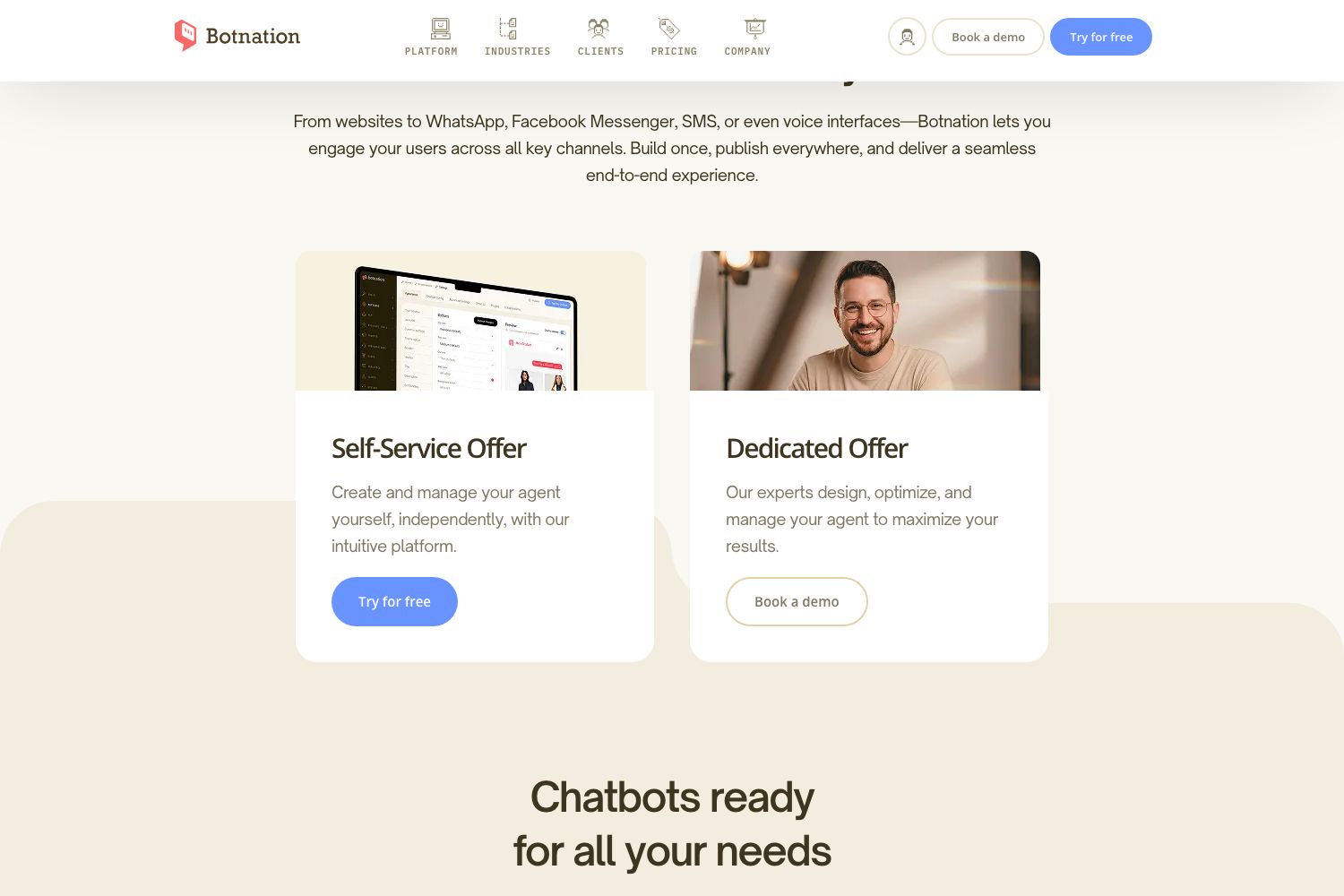
This table has a direct consequence on the choice of platform itself: if you anticipate moving from one model to another (start alone, then delegate), pick an actor able to occupy both sides of the table. Botnation displays precisely this dual positioning on its homepage, with two named offers: “Self-Service Offer”, promising to “create and manage your agent yourself, independently, with our intuitive platform”, and “Dedicated Offer”, where “our experts design, optimize, and manage your agent to maximize your results” (checked on September 16, 2026).
A word on the middle model, often forgotten: training an in-house team is not a budget version of custom work, it is a separate investment. It gets planned (who is trained, on what, with which materials), measured (how many scenarios the team edits alone each month) and bounded (from which level of complexity to call a specialist). The companies that succeed with their chatbot are almost always the ones that wrote this boundary in black and white.
The real cost: license, AI credits and build
The budget of an enterprise AI chatbot platform reads on three lines, and it is the sum of the three that speaks. All the information below comes from Botnation’s public pricing page, checked on September 16, 2026, prices excluding VAT.
Line 1: the license
| Plan | Price per month | What it changes for the company |
|---|---|---|
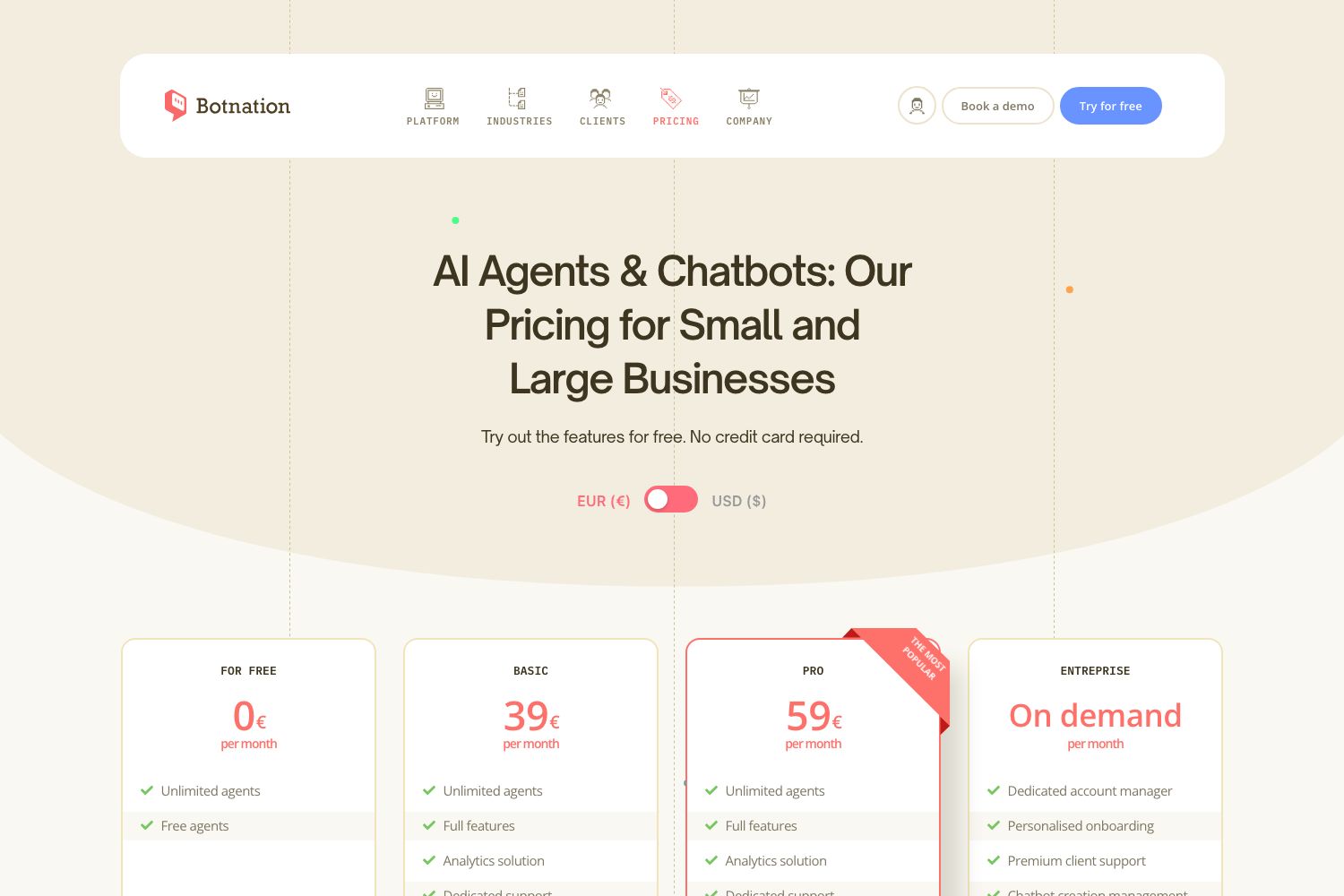
| For Free | 0 € | Unlimited agents, feature testing: the training ground before any commitment. |
| Basic | 39 € | 500 users, 500 AI credits offered once, full features and analytics: the first production tier. |
| Pro | 59 € | 1,000 users, 1,000 AI credits offered once: the standard tier of an enterprise bot in production. |
| Entreprise | on demand | Dedicated account manager, personalised onboarding, premium client support and chatbot creation management: the platform plus the hands. |
Two honest notes on this grid. First, the paid tiers scale linearly in users and in credits offered up front, but everything else (agents, team members, features) is unlimited from the first paid tier. Second, a user outside a plan is billed 0.05 € per month: negligible per unit, but worth watching if your bot reaches tens of thousands of unique visitors.
Line 2: AI credits, the real cost variable
This is the line comparisons forget and the one that rings the till. Every call to the AI engine consumes credits, and the pace depends on what you ask of the engine. The equivalences published on the pricing page, for 1,000 credits: 1,000 GPT-3.5 requests, as many on a customized AI, 500 advanced requests on a customized AI, or 100 GPT-4.0 requests (checked on September 16, 2026). In other words, a GPT-4.0 answer costs ten times more credits than a GPT-3.5 answer: the choice of engine is a budget decision, not only a qualitative one.
| Credit pack | Price excl. VAT | Cost per credit |
|---|---|---|
| 1,000 credits | 25 € | 0.025 € |
| 5,000 credits | 100 € | 0.020 € |
| 15,000 credits | 250 € | 0.0167 € |
| 60,000 credits | 900 € | 0.015 € |
The price per credit drops by a third between the smallest and the largest pack: beyond a certain volume, the question is no longer “how many credits” but “which pack”, and the answer is computed.

Line 3: the build, from zero to a quote
Building the scenario, writing the answers, wiring the integrations: in autonomy on a no-code platform, this line costs time, not euros. Delegated, it costs euros. And if you developed a chatbot yourself outside any platform, the same pricing page gives the market’s order of magnitude: “generally between €5,000 and €30,000, or even more, depending on the features you need”, a range the page itself presents as indicative, so much does a development estimate depend on scope (checked on September 16, 2026).
The important point for a company: these three lines do not compete, they compose. The most frequent formula is neither “all in autonomy” nor “all custom”: it is the platform on a Pro license with credits adjusted to the real volume, then a delegated creation project for the initial scenario and the integrations, then a return to autonomy for day-to-day maintenance. At Botnation, this relay is called the Entreprise offer: it literally includes “chatbot creation management”, a dedicated account manager, personalised onboarding and premium support, on demand. The pricing page FAQ puts it bluntly: “Our team of bot developers will create a custom AI chatbot for you, based on a quote” (checked on September 16, 2026). None of these formulas prices the custom work in euros: that is consistent, the price of a creation depends on scope, and a published figure would be wrong for half the projects.
Estimator: the annual budget of your configuration
The estimator below automatically composes the credit packs (it looks for the cheapest combination covering your monthly volume), adds twelve months of license and displays the total. The data comes from the public grid checked on September 16, 2026: change your answers, the calculation is immediate.
Your annual budget, computed from the public grid
Four answers, one budget. The simulator composes the packs and adds the license.
How many AI requests per month?
Which engine for each request?
Which license?
Who builds the chatbot?
Autonomy is the right caliber
At this level of spend, a Basic or Pro plan covers the need without negotiating: the item to fund is not the license but the hours of the person who will maintain the scenario. Name a referent, give them time, and the budget will stay in this range.
Use the free tier to test the real scenario before the first invoice: on the grid checked on September 16, 2026, it opens unlimited agents without a credit card.
To frame before signing anything
The amount becomes significant: time to check the two levers that swing the bill fivefold. The first is the engine: a GPT-4.0 request consumes ten times more credits than a GPT-3.5 one, and not every conversation deserves it. The second is volume: measure what visitors actually type before buying the pack above.
A four-to-six-week pilot on a single channel, with the cheapest engine, gives a more reliable measurement than any estimate.
Enterprise volume: negotiate rather than click
At this level you are no longer buying a pack, you are building a recurring cost item. That is exactly the scope of the Entreprise offer: dedicated account manager, personalised onboarding, premium support, pricing on demand. A committed volume is better discussed than a pack recomposed every month.
Take the opportunity to handle the two other enterprise subjects at the same time: the compliance framework (data processing agreement, hosting) and the integrations, which cost more than credits when treated as an afterthought.
The right question is no longer the listed price, it is the quote
Your configuration steps outside the standard grid: the license or build part is priced on quote, according to the real scope (number of scenarios, integrations, channels, service level). That is the work of the Entreprise offer and its chatbot creation management.
The quote is free and worth more than any estimate: describe the use case, the target channels and the systems to wire, and ask for the dedicated account manager. The rest of the article helps you prepare that conversation.
Calculation assumptions: the number of requests and the engine are yours; the equivalences and pack prices come from Botnation’s pricing page checked on September 16, 2026 (for 1,000 credits: 1,000 GPT-3.5 requests, 500 advanced requests on a customized AI, 100 GPT-4.0 requests). The credits offered at sign-up, once, are not deducted. The verdict thresholds, 1,000 € and 5,000 € per year, are reading markers specific to this article, not market thresholds.
| Pack | Price excl. VAT | GPT-3.5 or GPT-4.0 equivalence | Checked on |
|---|---|---|---|
| 1,000 credits | 25 € | 1,000 GPT-3.5 requests or 100 GPT-4.0 requests | September 16, 2026 |
| 5,000 credits | 100 € | 5,000 GPT-3.5 requests or 500 GPT-4.0 requests | September 16, 2026 |
| 15,000 credits | 250 € | 15,000 GPT-3.5 requests or 1,500 GPT-4.0 requests | September 16, 2026 |
| 60,000 credits | 900 € | 60,000 GPT-3.5 requests or 6,000 GPT-4.0 requests | September 16, 2026 |
The selection method: six milestones
What remains is orchestrating all this. The method below is the one followed by projects that reach production, in the order decisions are actually made.
- Write the use case before the tool. One case, one success measure, one channel. “Improving customer relations” is not a use case; “answering the 20 questions that precede 60% of our tickets, on the contact page” is one. This framing conditions everything else, including the operating model.
- List the enterprise requirements in three columns. Compliance (data hosting, data processing agreement, user information within the meaning of Article 50 of the AI regulation), governance (how many collaborators, which roles), integration (which systems, in which direction). This fifteen-line document is worth more than any product demo.
- Test the platform on your real case, not on the demo. A four-to-six-week pilot with your content, your channels and the cheapest engine. Measure the resolution rate and the credits consumed: that measurement, and it alone, makes the budget reliable.
- Run the compliance and security review. Data processing agreement signed, data location clear, retention periods set, the AI information sentence written, a sketch of the team training plan. Two hours of work when done early, a project freeze when done late.
- Deploy in waves. One channel, then the next; one scope of questions, then the next. Each wave ends with an explicit decision: continue, correct, stop. It is the only protection against the zombie chatbot lingering in production without an owner.
- Institutionalize the run. A named referent, a monthly review of poorly resolved conversations, a credit budget tracked as its own line. The day nobody knows who owns the chatbot anymore, it still answers, but badly.
This method is independent of the operating model: it applies in autonomy as in delegated creation. In the latter case, milestones 1, 2 and 4 become the brief for your provider; our guide on how to develop a chatbot goes into the detail of that document.
Botnation: the platform’s editor, and if you want it, the hands that build
On this market one confusion keeps coming back: opposing platforms (the tool) and providers (the hands). Botnation occupies both sides, and that is precisely what interests a company: the team that can build your custom chatbot is the one that edits the platform. Concretely, when creation is delegated, there is no middleman between the tool and the one who masters it best, and at delivery the account, the scenarios and the knowledge base stay in your editor: your team can take over what was built for it.
That said, with the nuance it deserves: a third-party agency remains a legitimate choice, sometimes the best one, for a highly specialized craft, an on-site engagement or an integrator already in place at your company. The selection criterion is not the label, it is continuity: who will be able to change your chatbot in eighteen months, with which tool, and what will remain in place if the relationship ends.
The public grid sums up this dual positioning in four lines: three self-service plans (including a free tier without a credit card), and an Entreprise offer on demand bundling a dedicated account manager, personalised onboarding, premium support and chatbot creation management. For a first step on the support side, the client support chatbot page details the most frequent enterprise use case.
Pick your side of the platform
Test the platform in autonomy from the free tier, or entrust the construction of your agent to the team that edits it: two paths, the same tool, credits and roles that remain yours.
For a custom creation: talk to our chatbot creation experts or book a demo.
Frequently asked questions
How much does an enterprise AI chatbot platform cost?
Three lines to add up. The license: from 0 € (free tier) to 59 € per month excluding VAT for the standard plans of the Botnation grid checked on September 16, 2026, the Entreprise offer being on demand. AI credits: 25 € per 1,000, up to 900 € per 60,000, each request consuming from 1 credit (GPT-3.5) to 10 credits (GPT-4.0). The build: time in autonomy, a quote if delegated. A development outside any platform, for its part, typically runs “between €5,000 and €30,000, or even more” according to the same page, as an indicative range.
What is the difference between a chatbot platform and an enterprise chatbot?
The platform is the tool; “enterprise” describes the operating requirements: several teams with roles, a compliance framework (GDPR, AI regulation), integrations with the information system and a tracked volume. Our chatbot platform guide covers the tool; this article covers the enterprise layer that goes with it.
Do we need a lawyer or a DPO to deploy an enterprise chatbot?
Not necessarily, but at minimum four points must be handled: the legal basis and purpose of the data collected, the data processing agreement with the editor (Article 28 of the GDPR), the retention period of conversations, and user information. Since 2 August 2026, Article 50 of the European AI regulation further requires informing people that they are interacting with an AI. The CNIL’s “Chatbots” factsheet of 19 February 2021 works as a checklist; with sensitive data (health, HR), the answer becomes yes.
Can conversation data be hosted in Europe?
It is a question to ask the editor before signing, together with its exact location and that of the infrastructure subcontractors. The GDPR does not strictly impose European hosting, but transfers outside the Union require specific guarantees, and many companies set European hosting as a purchasing requirement. It belongs in your requirements document, not among the options discovered after signing.
Can we start in autonomy and move to the Entreprise offer later?
Yes, and it is the most frequent path. You start on the free or Pro tier with a circumscribed use case, you measure, then when the scope widens (more channels, integrations, volume), you switch to the Entreprise offer for delegated creation and follow-up by a dedicated account manager. The account, the scenarios and the data stay the same: what changes is the accompaniment, not the tool.
Who should own the project in-house: marketing, support or IT?
The owner is the business line that benefits from the use case (support for an FAQ bot, marketing for qualification), with IT validating integrations and compliance. What matters is not the department but the name: an identified owner, a tracked credit budget and a monthly review. An enterprise chatbot without a named owner quickly becomes nobody’s chatbot.
The final word
Choosing an enterprise AI chatbot platform is not choosing a piece of software: it is deciding three things that appear in no comparison. Who touches the agent (governance), in which legal framework it speaks (compliance), and who builds it (the operating model). The license, for its part, reads in one line: 0, 39 or 59 euros per month on the public grid, plus credits that compute, plus a quote when creation is delegated.
The good news is that none of these decisions is irreversible: the free tier exists for that, and the path from autonomy to accompaniment is a marked one. The less good news is that none can be improvised downstream: governance is decided before the first disputed change, compliance before the first complaint, the operating model before the first budget. Six milestones, three cost lines, one named referent: that is little, and it is exactly what it takes for an enterprise chatbot to outlive its demo.
Take action, from the right side
Open the free tier and build your first agent, or ask for a quote from the team that edits the platform: both paths lead to the same tool.
A custom creation? Talk to our chatbot creation experts or book a demo.