




- The price of a chatbot breaks down into three cost lines: the subscription (from 0 to €59 per month on Botnation’s public grid as read on 18 September 2026), usage (AI credits) and construction (free if you build it yourself, quoted if you delegate it).
- On a self-service SaaS plan, a production-ready chatbot starts at €39 per month excluding taxes (Basic plan), with a free tier to test without a credit card.
- For a fully delegated custom build, Botnation’s own pricing page quotes an indicative range of “between €5,000 and €30,000, or even more”; third-party providers publishing in French give figures of the same magnitude, from €2,000 to more than €50,000 depending on scope.
- Hidden costs exist on both sides: AI credits beyond the included amount, extra users (€0.05 per user per month), maintenance and evolutions on one side; in-house time on the other.
- The comparator in the middle of this article adds up both routes over 36 months using public prices, and shows the month when the custom build catches up (or not) with the subscription.
How much does a chatbot cost? The question looks simple, and most of the published answers are too simple. You find ranges dropped in a single sentence, tables of software compared on a gut feeling, or the opposite: a dossier so dense that you never come out of it with a figure you can put in a budget. What is missing, in between, is what actually moves the bill: what you buy, and who builds it.
This article breaks the price of a chatbot down line by line, with dated figures: Botnation’s public grid as read on 18 September 2026, the AI credit equivalences published by the same page, and order-of-magnitude figures from third-party providers to situate custom builds. It ends with a comparator that adds up both routes over three years, because the real question is not the displayed price, but the cumulative cost of both routes, and the moment when the route that starts the most expensive becomes the cheapest.
The topic deliberately differs from our more specialised dossiers: if your challenge is multi-team governance and compliance for an enterprise AI chatbot platform, or choosing a provider (see our dossier on the AI chatbot agency), read them as complements. Here, we talk budget.
The price of a chatbot reads across three cost lines
Whatever the vendor, a chatbot bill always breaks down into three lines. Mixing them up is the first cause of bad surprises, because each line follows a different logic: one is a predictable subscription, the second varies with your traffic, the third depends on an organisational decision.
- The licence is the subscription to the platform: the scenario editor, the channels (website, WhatsApp, Messenger, Instagram), hosting, updates. It is the most readable line, displayed on pricing pages, and the easiest to cap: you pick a tier, it shows up on the invoice every month.
- Usage covers the variable consumption: AI requests, conversation volume, extra users. It is the line that surprises, because it depends on data few companies measure before launching: what their visitors actually type to the chatbot.
- Construction, finally: who designs the scenario, wires the integrations, connects the knowledge base, tests and fixes. Done by your team in a no-code editor, this line costs time. Delegated to experts, it is quoted.
These three orders of magnitude read together, not separately. The SaaS grid says nothing about construction cost if you delegate; the custom range says nothing about the licence you will have to pay anyway to run the tool. A complete budget adds them up, which is exactly what the comparator below does.
Four factors move the bill
For an identical subscription scope, two chatbots from the same vendor can end up costing vastly different amounts. The gap almost always comes from one of these four factors:
- The number of channels. A website-only chatbot is the cheapest case. Each added channel (WhatsApp, Messenger, Instagram) widens coverage, and sometimes volume: a popular channel can multiply conversations, and therefore the “usage” line.
- The AI engine you pick. On credit-based platforms, not all answers are equal: a cheap generic engine, an AI personalised to your brand or a premium model do not consume the same number of credits per request. On Botnation, the pricing page details these equivalences: for the same credit budget, you do not get the same number of answers depending on the engine.
- Integrations with your information system. Connecting the chatbot to a CRM, a helpdesk or an internal base is rarely included in a standard build. It is the craft of the chatbot integrator, and it is often that line, more than the scenario itself, that swings a quote.
- Who builds and who maintains. Building in-house costs internal time (training, writing scenarios, testing); delegation costs a quote. In both cases, someone has to maintain: scenarios to enrich, knowledge base to update, statistics to read. This recurring cost is the most often forgotten in the initial budget.
Before comparing a single price, measure your real volume: how many visitors, how many questions, what share deserves an AI answer rather than a menu. Fifteen days of statistics on the main channel are enough to avoid the double mistake: buying too many credits, or choosing an overpriced engine for questions that three standard answers close.
Route 1: self-service SaaS and its public grid
This is the most readable route: you subscribe, you build in the no-code editor, you publish. The displayed price covers the licence, and construction is an investment in internal time rather than money. At Botnation, the public grid as read on 18 September 2026 reads as follows:
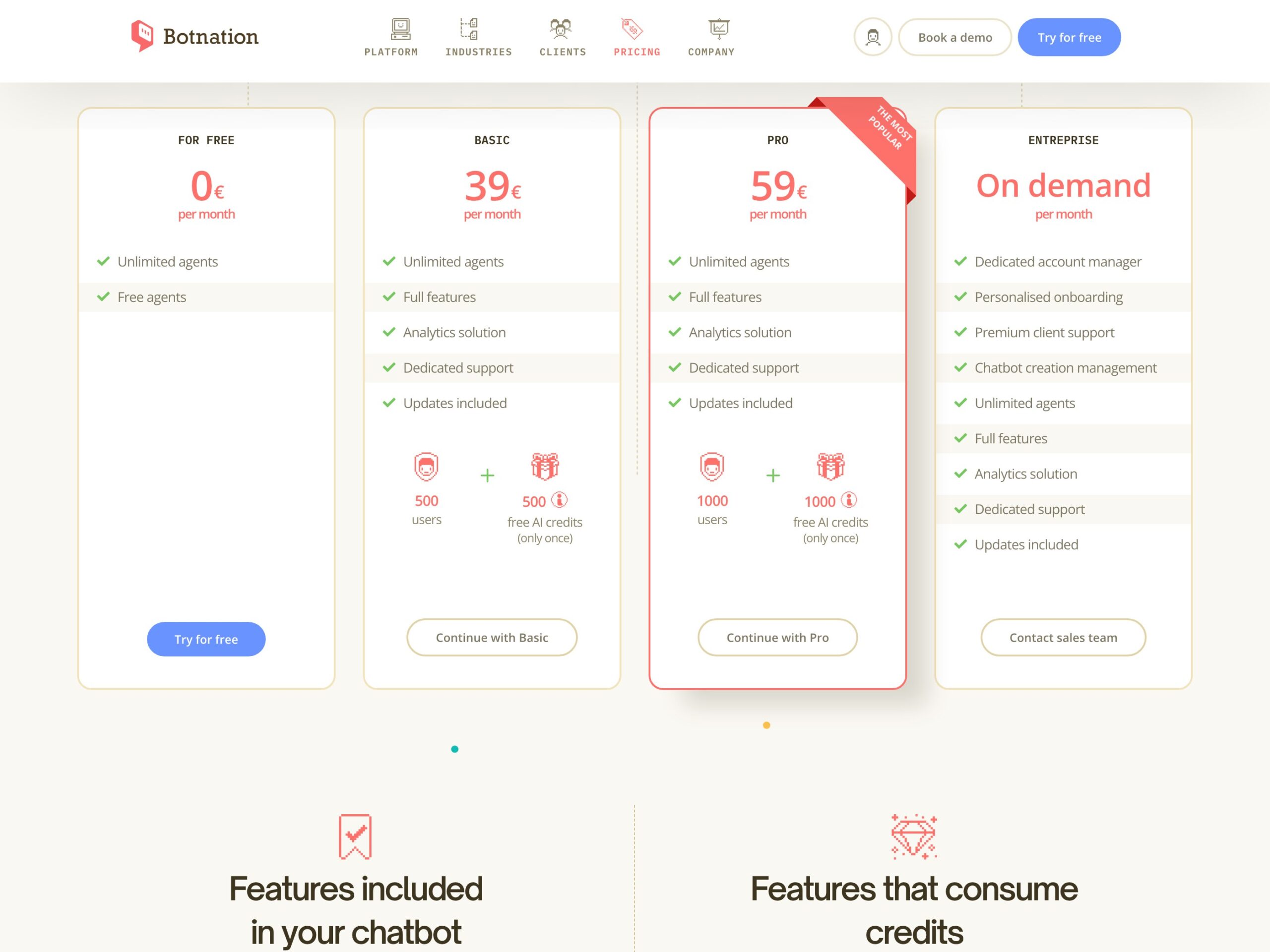
| Plan | Public price excl. taxes | What it covers | For which stage |
|---|---|---|---|
| FOR FREE | €0 / month | Unlimited agents, free agents, no credit card required | Testing the real scenario before any invoice |
| BASIC | €39 / month | Unlimited agents, full features, analytics solution, dedicated support, updates included, 500 users + 500 free AI credits (only once) | A first chatbot in production |
| PRO | €59 / month | The same coverage with 1,000 users + 1,000 free AI credits (only once) | The most popular tier: several use cases, more volume |
| ENTREPRISE | On demand | Dedicated account manager, personalised onboarding, premium client support, chatbot creation management, unlimited agents | Enterprise requirements: guidance and delegated construction |
Two points of this grid deserve a close read. First, the free AI credits are granted only once at sign-up: they help you start, not run the whole year. Second, the ENTREPRISE plan is not a price tier but another mode of relationship: it literally includes “chatbot creation management”, that is, the delegated construction discussed in route 2. The public grid also ends with the mention that all prices are quoted excluding taxes, VAT applying to legal entities located in the European Economic Area.
AI credits: the usage line, in public figures
Beyond the included credits, AI usage is bought in packs, displayed on the same page with volume discounts:
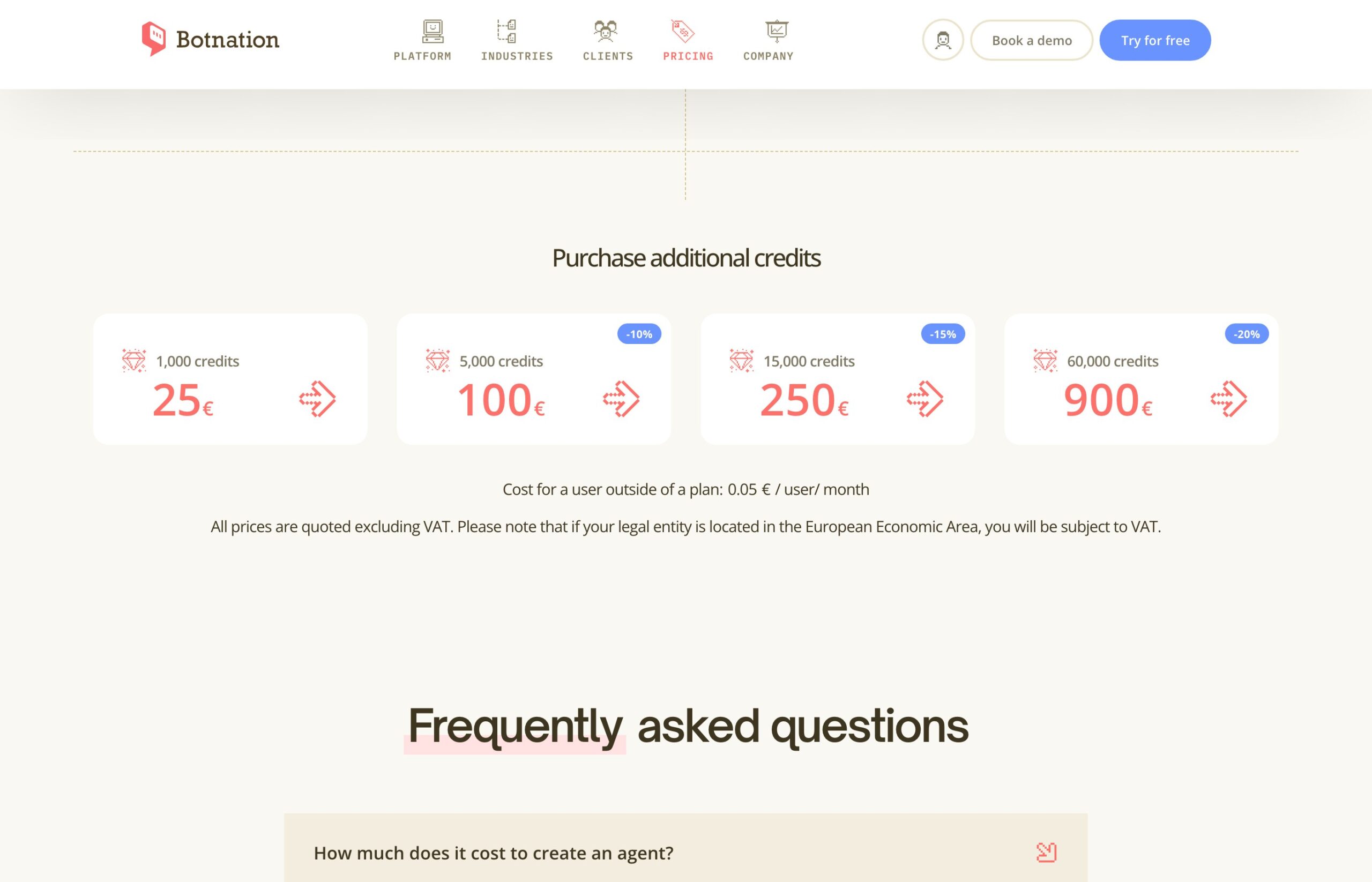
| Credit pack | Public price excl. taxes | Displayed discount | Equivalences published by the page |
|---|---|---|---|
| 1,000 credits | €25 | -10% | 1,000 GPT-3.5 requests or custom AI requests, 500 advanced queries, 100 GPT-4.0 requests, 50 DallE 3 images |
| 5,000 credits | €100 | -15% | The same credit ratio, times five |
| 15,000 credits | €250 | -20% | The best displayed ratio of the intermediate packs |
| 60,000 credits | €900 | Lowest volume price | Enterprise volume, to be negotiated beyond |
The usage line has another component, displayed right below the packs: a user outside of a plan costs €0.05 per user per month. On a deployment that exceeds the 500 or 1,000 users included depending on the tier, this line counts: 2,000 users beyond the PRO plan means €100 more per month, to be written into the budget as seriously as the licence itself.
This reading of the grid applies to the self-service SaaS tiers. It says nothing about a delegated construction quote, which belongs to route 2 and is negotiated separately.
Route 2: delegated construction and its quote
Delegating construction means paying once to get a chatbot built by specialists, then running it on the route 1 subscription. The price depends on scope: number of scenarios, channels, integrations, knowledge base, service level. Two families of sources help situate it.
First source: Botnation’s own pricing page, which answers the question “How much does it cost to create an agent?” in its FAQ, distinguishing the two routes. After presenting the SaaS plan, it writes: “Our team of bot developers will create a custom AI chatbot for you, based on a quote.” And to situate that quote, the same FAQ gives a range: “between €5,000 and €30,000, or even more, depending on the features you need”, immediately adding: “These price ranges are indicative, as it is difficult to estimate the cost of developing your chatbot.” Read on 18 September 2026, this range has the merit of being published by the vendor itself: it is an indicative order of magnitude, not a price list, and even less a commitment.
Second source: third-party providers who publish their own orders of magnitude in French. They cross-check remarkably well:
- Radiank, consulted on 18 September 2026, opens its guide with (published in French only): « La réponse franche : entre 0 € et plus de 50 000 €. » (in plain English, from €0 to more than €50,000). It prices, from €0 to more than €50,000; it prices an enterprise chatbot configured on a platform at « 50 à 300 €/mois d’abonnement + 500 à 2 000 € de configuration initiale » (€50 to €300 per month of subscription plus €500 to €2,000 of initial setup) when you go through a provider; for a chatbot connected to internal documents (RAG), it announces a setup of €3,000 to €15,000 and running costs of €200 to €1,500 per month.
- Digital Unicorn, consulted the same day (published in French only), situates provider-led setups « au l’alentour de 2000 à 5000 euros » (around €2,000 to €5,000) for a first level, a simple chatbot between €1,000 and €5,000, and a hosting and maintenance infrastructure of €50 to €200 per month at basic level, €300 to €1,000 per month at scalable level.
- Agenda Formation, specialised in the public market (published in French only), prices a phone-answering robot at « à 700 € HT par mois sur le marché public » (€700 excluding taxes per month on the public market) and a customisation at « à 1000 € par jour » (€1,000 per day), with market amounts of « 0,50 € HT à 0,70 € HT par minute d’usage » (€0.50 to €0.70 excluding taxes per minute of usage) for voice agents.

These third-party figures obviously do not bind Botnation, and they should be read as market milestones published in French, not as a price list. They still draw a stable hierarchy: a first chatbot built with a provider’s help usually sits between €2,000 and €5,000, an integrated enterprise chatbot between €5,000 and €15,000, and deeply integrated projects exceed €30,000, up to well beyond €50,000 in the complex cases quoted by Radiank.
At Botnation, this delegated route goes through the ENTREPRISE plan and its “bot developers”: the team that builds the custom chatbot is the one that edits the platform. Formulated as a comparison, this model has a concrete budget consequence: the scenario is built in the no-code editor your team keeps in hand after delivery, on your own account, which reduces the maintenance-dependency risk encountered when the build was made in the provider’s proprietary tools. This does not rule out the other paths: an agency or chatbot consultant remains legitimate for a very specific trade, an on-site arrangement or an ecosystem of tools already in place at your company; what matters is comparing quotes on the same scope, not on the same figure.
The right reflex to frame this route: request a quote describing the use case, the channels and the systems to connect, and weigh it against the three-year cumulative cost of the SaaS route, which the comparator below computes for you. The team is also available online, as shown by the “Contact sales team” button of the ENTREPRISE plan.
The hidden costs to write into the budget
Beyond the three cost lines, a realistic budget plans for the expenses that appear on no price line but almost always end up happening:
- AI credits beyond the pack. Packs renew: a successful chatbot consumes, and a request on a premium engine consumes ten times more than a GPT-3.5 request according to the equivalences published by the pricing page. This is the first line that moves during the year.
- Users outside of a plan. €0.05 per user per month beyond the tier: invisible on a mock-up, significant on an internal deployment of several thousand people.
- Maintenance and evolutions. In self-service, it is internal time: enriching scenarios, updating the knowledge base, reading statistics, fixing unanswered questions. Delegated, it is a contract: the third-party providers quoted above price hosting and maintenance at €200 to €1,500 per month depending on complexity.
- Partial rebuilds. A chatbot ages: new products, new organisation, new channels. Planning an annual enrichment budget avoids discovering in month thirteen that the tool has not followed the company.
- Team time. The most underestimated cost: training, writing scenarios, qualifying answers. Even on a no-code platform, someone writes, tests and fixes. That time exists whatever route you choose; only its owner changes.

None of the ranges quoted in this article is a commitment: Botnation’s are presented by the vendor as indicative, and the third-party providers’ are their own grids published in French, read on 18 September 2026. Only a quote established on your actual scope is a firm figure.
SaaS or custom: compare the 36 months, not month 1
The question that really settles it: over three years, which route costs less? The comparator below adds up, using the public prices read on 18 September 2026: the monthly licence, the credit pack you renew, then the delegated construction and its yearly running cost if you choose it. It displays the cumulative cost of both routes at 12, 24 and 36 months, and the month when, if any, the custom build stops being more expensive.
Your SaaS vs custom comparator over 36 months
Four answers, two cumulative costs, one dated verdict. All prices exclude taxes.
Which SaaS licence?
Which AI credit pack do you renew every month?
Do you delegate the custom build (one-off)?
Yearly running cost of the custom build (maintenance and evolutions)?
Your budget reads on the SaaS grid
Without delegated construction, your cumulative cost is the one of the SaaS tiles: licence and credits, nothing else. The construction route stays open later: the scenario your team builds in the editor will remain, and a quote can always be requested on a precise scope.
The quote pays for itself fast, at this usage level
With this level of licence and credits renewed every month, the delegated construction is absorbed in less than a year: beyond that, the custom build costs less than the SaaS route over the rest of the horizon. Before signing, check that the quote covers the same scope your team would have built, integrations included.
The custom build catches up with the subscription within the horizon
This is the balance case: the SaaS route is cheaper early on, and the custom build becomes the most economical choice before the end of the 36 months. If your horizon exceeds three years, the comparison swings towards the quote; if it is shorter, self-service remains the cheapest route.
On this horizon, self-service wins
Even adding the delegated construction and its yearly running cost, the SaaS route stays cheaper for the full three years, and catch-up would happen beyond month 36, or never if the custom build’s running cost catches up with the subscription. The quote still makes sense for other reasons (business scope, internal capacity), but not for cost reasons on this horizon.
Comparator assumptions: the licences (€39 and €59 per month) and the packs (€100 and €250) come from Botnation’s pricing page as read on 18 September 2026; the delegated construction amounts (€2,000, €5,000, €15,000 and €30,000) combine the low end published by a third-party provider and the indicative range of the same page’s FAQ; the FOR FREE tier is not compared (real usage assumed). The yearly running amounts (€1,500 and €4,000) are reading assumptions specific to this article, sitting below the maintenance ranges published by the third-party providers quoted above; the running cost is smoothed over 12 months. The credits offered at sign-up (only once) are not deducted, and users outside of a plan (€0.05 per user per month) are not counted.
| Comparator input | Value used | Source and date of the reading |
|---|---|---|
| BASIC / PRO licence | €39 / €59 per month | Botnation pricing page, 18 September 2026 |
| Credit packs 5,000 / 15,000 | €100 / €250 per month | Botnation pricing page, 18 September 2026 |
| Delegated construction | €2,000 / €5,000 / €15,000 / €30,000 | Low end: level published by a third-party provider (Digital Unicorn, provider-led setup); upper ends: indicative range “between €5,000 and €30,000, or even more” from the pricing page FAQ, read on 18 September 2026 |
| Yearly running cost of the custom build | €1,500 / €4,000 per year | Article assumptions, consistent with the €200 to €1,500 per month maintenance priced by Radiank on the most complex projects |
Getting a quote that holds the comparison, in five steps
Whether you compare two providers or a provider and the SaaS route, a quote only has value if it is built on the same scope. Five steps make it comparable:
- Measure the real volume. Number of expected conversations per month, share of questions that deserve an AI answer, targeted channels. This is the data that sizes the credits, therefore the usage line, therefore the comparison.
- Describe the construction scope, not only the outcome. Number of scenarios, languages, integrations (CRM, helpdesk, internal base), migration of existing content. A quote without an integration scope is not comparable; it is the line that moves the amounts most between €5,000 and €30,000.
- Require the running cost as a separate line. Maintenance, evolutions, hosting: ask for them priced apart, for year 1 and the following ones. The third-party ranges quoted above show the gap between light and heavy maintenance.
- Compare the cumulative cost, not the entry price. Use the comparator above with your own volumes: a €15,000 quote can be the cheapest choice from the second year, a €5,000 quote may never catch up with a well-calibrated Pro subscription.
- Check who keeps control. In which tool will the scenario be built, on which account, with what editing rights on your side? A construction delivered in an editor your team can take over is worth more than a black box at the same price.
This last step joins the broader organisational choice covered by our dossiers on the price of established vendors and on advanced chatbot training: upskilling your team is also a budget route, sometimes the most profitable of all.
Frequently asked questions about the price of a chatbot
The questions that systematically come up when budgeting, with the dated answers of this article.
What budget should you plan for a first enterprise chatbot?
With the public grid read on 18 September 2026: €0 to test on the FOR FREE tier, then €39 or €59 per month excluding taxes on BASIC or PRO depending on user volume, plus a credit pack if AI usage exceeds the included credits. For a delegated construction, the FAQ of the same page situates the quote “between €5,000 and €30,000, or even more”, to be taken as an indicative order of magnitude. A first complete self-service enterprise budget therefore most often sits between €470 and €3,700 per year, licence and credits included.
Is the FOR FREE tier really usable?
The pricing page states it without ambiguity: €0 per month, unlimited agents, no credit card required. It serves to build and test the real scenario before the first invoice. Its limit is that of any entry tier: as soon as the chatbot serves your visitors in production with AI and user volumes, moving to BASIC or PRO becomes necessary, notably for the AI credits and the number of included users.
How much does the AI itself cost, for example GPT-4?
On Botnation, AI is consumed in credits, and the pricing page publishes the equivalences: with 1,000 credits, you get 1,000 GPT-3.5 requests or requests on a custom AI, 500 advanced queries, 100 GPT-4.0 requests or 50 DallE 3 images. The same budget therefore allows ten times more conversations on a generic engine than on a premium one: lever number one to hold the usage line is to reserve expensive engines for the questions that deserve them.
Is the custom build always more expensive than SaaS?
No, and that is the point of reasoning in cumulative cost. Over the first 36 months, the SaaS route most often stays cheaper: that is what the comparator shows for most configurations. But with high AI usage (PRO licence and a large credit pack renewed every month), the catch-up of a construction quote arrives before the end of the three years. Beyond the comparison horizon, the balance depends on your volume and the level of maintenance you retain.
What does Botnation’s ENTREPRISE plan exactly include?
On the grid read on 18 September 2026: dedicated account manager, personalised onboarding, premium client support, chatbot creation management, unlimited agents, full features, analytics solution, dedicated support and updates included. It is the entry door to delegated construction and the guided relationship mode, with pricing on demand. The bot developers are also reachable online, as the “Contact sales team” button of the plan shows.
Should you plan costs beyond the subscription?
Yes, and it is better to write them down from the start: renewal of credit packs if usage exceeds the included credits (granted only once), users outside of a plan at €0.05 per user per month, maintenance and evolutions (internal time in self-service, a contract when delegated), and yearly enrichment of scenarios and of the knowledge base. This is the submerged mass of the budget, the one that decides the real cost over three years.
The right price is the one of your volume, not the one of the shop window
The price of a chatbot is not a figure, it is an equation with three unknowns: a public and predictable licence, a usage that is measured before being bought, a construction worth either a zero-euro quote or five figures depending on who does it. Market ranges, including the one Botnation itself publishes for custom builds, serve to situate a quote, never to replace it.
The next step comes down to two moves: measure fifteen days of real conversations, then run the comparator with your own figures. If the SaaS route covers the horizon, open the free tier and build; if the custom build catches up, request the quote with the scope written down in black and white. In both cases, you will have a defensible budget, not a hunch.
Compute, test, then decide
Open the free tier to build your first scenario, or ask for a priced quote from the team that edits the platform and also builds custom chatbots: both paths go through the public grid.
A delegated construction project? Contact the sales team.