




In brief
A chatbot integrator is the provider who connects your conversational assistant to your real ecosystem: the website widget, messaging apps, the CRM, ticketing, your content and your security rules. The project runs in six stages, from auditing the existing setup to operations, and its price tracks the number of connections. This guide maps the six families of connections, walks through a full rollout, offers a selector to tell whether your project needs one, gives the price ranges observed in 2026 and eight verifiable criteria for choosing yours.
You have picked your chatbot platform, or had your scenarios designed. What remains is the stage where most projects are won or lost: making the assistant live where your users and your data already live, meaning on the website widget, inside WhatsApp or Messenger, wired to the CRM, the ticketing system and your content. This work of connecting, putting into service and handing over has a name: it is the job of the chatbot integrator.
The topic has changed scale: according to INSEE, France’s national statistics institute (TIC 2025 survey, Insee Première no. 2120, July 2026), 18 % of French companies with 10 or more employees used at least one artificial intelligence technology in 2025, up from 10 % in 2024, and 43 % of the companies using AI report generative text or speech AI. More conversational assistants deployed also means more CRMs to wire, more documentation bases to connect, more data rules to frame: in other words, more integration projects.
A positioning note before we dive in: Botnation is the publisher of a no-code platform for building chatbots and AI agents, and also builds custom chatbots for its clients through its Entreprise offer. Publisher and integrator: the two realities coexist, and this article treats the integrator’s trade for what it is, including when it is entrusted to an outside provider. If you are looking for the upstream phase instead, our guide on designing a chatbot covers framing, and “developing a chatbot” covers the technical routes.
Chatbot integrator: the definition, and the line with the consultant and the agency
Definition
A chatbot integrator is the provider who puts a conversational assistant into service inside a company’s information system: they install the conversation channel, connect the bot to the agreed tools and data, test the whole on real cases, then hand over documentation and accounts the client can use. They generally do not define your conversational strategy (that is the consultant’s role) and they do not necessarily write your content: they connect, they ship, they hand over.
The distinction matters because the word “chatbot” covers four different support trades, often conflated in quotes. The table below separates them by what they actually deliver:
| Provider | Their trade | What they deliver | When to call them |
|---|---|---|---|
| Chatbot consultant | Advice and framing: strategy, platform choice, indicators | Assessment, recommendations, requirements brief | You do not yet know what to build or for whom |
| Chatbot agency | Turnkey creation: design, copywriting, build | A chatbot designed and delivered, content included | You want to outsource the bot’s entire creation |
| Chatbot integrator | Technical connection and go-live | A bot wired into your ecosystem, tested, documented | The bot exists (or its platform is chosen), it must live in your stack |
| Publisher with services | Platform plus custom build by its own experts | The software foundation and the integration project, from one supplier | You want a single point of contact for the tool and its rollout |
In real life, the lines move: a chatbot agency integrates what it creates, a publisher like Botnation offers both the platform and chatbot creation services in its Entreprise offer, and an independent integrator can step in on a platform they did not choose. So the useful question is not the label but the scope written into the quote: who designs, who connects, who maintains, and in whose name the accounts are opened.
What the integrator actually connects: the map of six families
“Integrating a chatbot” stays vague until you name what gets connected. In practice, every chatbot integration project breaks down into six families of connections, each with its interface contracts, its pitfalls and its testing load:

| Family | Concrete examples | What the connection unlocks | Watch-out |
|---|---|---|---|
| 1. The conversation channel | Website widget, WhatsApp, Messenger, Instagram | The bot meets users where they already are | Each channel’s rules (response windows, formats) constrain the scenarios |
| 2. The CRM | Creating and updating records, lead status, qualification tags | Every conversation feeds the sales pipeline | Define which fields are written, by whom, and what happens on duplicates |
| 3. Knowledge sources | FAQ, documentation, internal procedures connected to the bot | The bot answers from your content, not from invention | The freshness and segmentation of the sources drive answer accuracy |
| 4. Business tools | Ticketing, appointment calendar, e-commerce database, ERP | The bot acts: opens a ticket, books, checks an order | Application back-and-forth is the costliest part of the project |
| 5. Measurement | Conversation events, resolution rate, analytics exports | You steer the bot on numbers, not impressions | Pick the useful events before instrumenting everything |
| 6. Identity and security | User authentication, permissions, consent, logging | The right people see the right answers | Frame it from the start, with the legal basis and retention periods |
Three field notes complete this map. First, every connection lives through an interface contract: an API call, a webhook or a native connector of the platform. The quality of that contract (formats, errors, retries) decides how solid the wiring is, far more than the tool itself. Second, family 3, plugging in your content, deserves dedicated treatment: our guide on the chatbot grounded in your data details how to segment and secure the sources. Third, family 6 is not optional: transparency owed to the user of a conversational system has been an obligation since article 50 of the European AI Regulation entered into application on 2 August 2026, and the CNIL, France’s data protection authority, has framed chatbot data processing since February 2021 (“Chatbots” factsheet, 19 February 2021).
Rule of thumb
Count your connections before asking for a quote: it is the most honest unit of measure for the project. A bot “just on the website with the FAQ” is one connection; the same bot wired to WhatsApp, a CRM and a ticketing tool is four to six, and the price follows.
The rollout of a chatbot integration project, from framing to operations
A serious integrator always runs through roughly the same six stages. Knowing them gives you a reading grid for quotes: a skipped stage always gets paid for later.
The integrator inventories what the bot will plug into: site pages, channels already in use, CRM and business tools, available content, security rules in force. This audit produces the initial list of possible connections, with their constraints.
Connections get sorted by value delivered and effort required: which ones gate the launch, which wait for version 2. The output of this stage is a written scope, connection by connection, which becomes the technical appendix of the quote.
Each wiring is built and tested individually: the widget displays and loads the scenarios, the CRM receives the test record, the documentation source answers. A connection is never “probably fine”: it is verified in isolation before being combined.
Actual requests get replayed, not textbook cases: the question phrased three different ways, the duplicate record in the CRM, the WhatsApp message outside business hours, the documentation source contradicting the FAQ. Every gap is fixed and replayed.
The bot starts with reduced visibility or on a single channel, long enough to confirm volumes and behaviours, then opens up. A rollback plan is written before day one in production, not after.
Connections live on: APIs evolve, content ages, usage drifts. The run covers connection monitoring, source updates and the handling of unresolved conversations.
The handover itself is a deliverable of its own. At the end of the project, you should receive at minimum:
- the connection documentation: what is wired, where, with which accounts and which interface contracts;
- full access in your own name: platform account, scenarios, knowledge base, API keys if the bot uses any;
- the acceptance test book: the tested cases, their outcome, to replay the verification after every change;
- the run plan: who watches what, how often, and what to do when a connection goes down.

Watch out
Acceptance testing on real data is not negotiable. A bot tested only on fictional requests almost always misses its real weaknesses: unforeseen phrasings, dirty data in the CRM, stale content. Demand at least one week of real conversations observed before full opening.
Do you need an integrator for your project? The scope selector
Five questions are enough to place your project on the scope ladder. Tick the situation closest to yours in each group: the panel shows the go-to-market mode to favour. On a tie, the selector keeps the lightest mode: it is always the right starting point, a scope gets reassessed at every version.
Integration scope selector
Answer with today’s situation, not with the three-year ambition.
1. Where will the chatbot live first?
2. How many tools must be connected to the bot?
3. Which knowledge will you plug into the bot?
4. Who will keep the connections alive after go-live?
5. What is your dominant constraint?
Set it up yourself
Your project fits inside the platform: one channel, a mastered FAQ, no tools to connect, and you at the controls. Go-live happens autonomously on a no-code platform, starting on the free plan to validate, then stepping up one tier as volume arrives. The one appointment not to miss: write the questions and answers, from day one, the way they are actually asked.
Autonomy, with onboarding support
Your project stays standard (one channel, one content base) but calls for some method: the platform and its personalised onboarding are enough, with no outside integrator. Take the time to frame the sources before opening, and set a one-month review: that is where the improvements that matter get decided.
An integrator wires the bot into your ecosystem
Messaging apps, CRM, ticketing: your connections go beyond no-code settings and deserve a dedicated project, whether entrusted to an independent integrator or to the creation services of your platform’s publisher. Demand a quote per named connection, acceptance testing on real cases and complete flow documentation at handover.
Governed integration: several systems, sensitive data
Your project combines several tools, scattered sources and data requirements: it is run like a company-wide project. Full requirements brief, written acceptance milestones, data processing framed up front, a named run plan. This is the scope where the choice of integrator weighs the most: take the time to run the eight criteria below.
The selector gives the dominant mode at the moment you answer: scopes evolve, and today’s light mode can become next year’s structured project.
The price of a chatbot integration: the 2026 orders of magnitude
The price of a chatbot integration is understood through its structure: it combines a build cost (the connection project, billed on time spent or as a fixed fee) and a foundation cost (the platform licence, billed by subscription). The ranges below are orders of magnitude observed on public sources at the dates indicated: they are neither price lists nor commitments, and every real project drifts from the average.
| Scope | Observed order of magnitude | Source and date of the reading |
|---|---|---|
| Simple wiring: website widget, existing FAQ | under €500 | “Intégration de chatbot” project listed on the French marketplace Codeur, reading of 11 September 2026 |
| Standard integration: one or two channels, a CRM or a ticketing tool, content to connect | €1,000 to €10,000 | Conversational AI project listings on Codeur, same reading |
| Full chatbot development outside a subscription platform | generally between €5,000 and €30,000, “or well beyond” | Botnation’s French pricing FAQ, reading of 11 September 2026 (ranges the page itself calls indicative) |
| Foundation: platform subscription | from €0 to €59 per month depending on the tier, custom beyond | Public grid on Botnation’s pricing page, reading of 11 September 2026 |
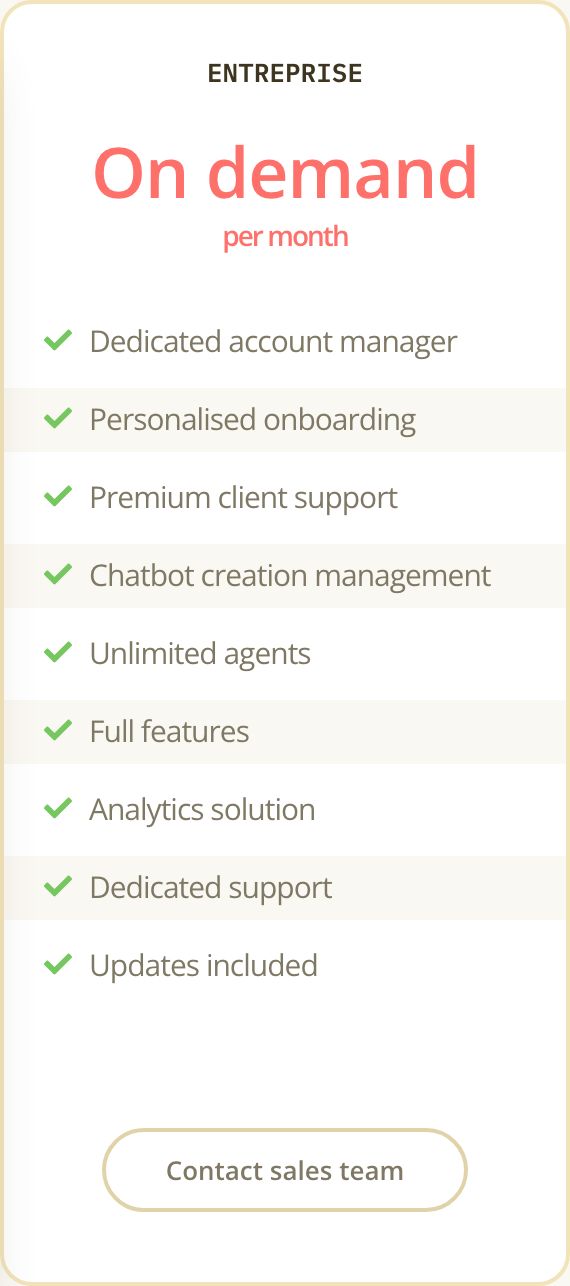
Botnation’s French pricing page puts its own estimate this way for anyone developing outside the subscription: “Si vous souhaitez développer vous-même votre chatbot, par vos propres moyens, sans passer par notre solution d’abonnement SaaS, alors il vous en coûtera en général entre 5000€ et 30000€, voir bien plus, selon les fonctionnalités dont vous avez besoin.” That is: in general between €5,000 and €30,000, and sometimes well beyond, depending on the features you need; the page adds that these ranges are indicative and that a development cost is hard to estimate (French text quoted from the reading of 11 September 2026; the English pricing page carries the same FAQ without the range sentence). For the foundation: the grid read the same day shows a free tier at €0, Basic at €39 per month, Pro at €59 per month and an Entreprise offer “On demand” that literally includes “Chatbot creation management”, a “Dedicated account manager”, “Personalised onboarding” and “Premium client support”. The pricing of the custom services in that offer is not public: it is quoted on request.
Three practical lessons follow from these numbers. First, the gap between “under €500” and “€5,000 to €30,000” measures neither the quality of providers nor their honesty, but the number of connections and how unique the need is: your scope sets the bill. Second, comparing an integration quote with a platform subscription compares two different things: the project (once) and the foundation (recurring). Third, the item everyone forgets is the run: monitoring and repairing connections as APIs evolve, keeping content fresh. A quote that says nothing about the run leaves you to discover that cost in production.
Tip
Ask for two scenarios to be priced: the minimal scope that puts the bot in service (often one channel and the FAQ) and the full scope. The difference between the two is your version 2 budget, and it negotiates far better before the project than in the middle of it.
How to choose a chatbot integrator: 8 verifiable criteria
Sales proposals all look alike; projects do not. The eight criteria below are verifiable before signing, on paper: each answer is observed in the quote, in the method or in the references presented.
- They audit before pricing. A price given without inventorying your existing setup (channels, CRM, content) is a bet, not a quote. The audit can be short, but it must exist and be visible in the proposal.
- They speak in named connections. “Complete integration” is not a scope. The quote must list each connection: which channel, which tool, which direction the data flows, which behaviour on error.
- They know the platform and your stack, by name. Ask what they have already wired on your precise combination (your CRM, your ticketing, your chatbot platform). Interface contracts are mastered through repeated experience.
- They separate design, integration and run. Three trades, three lines in the quote. Blending the three is the first source of disappointment: it hides who does what when something breaks.
- They hand over accounts and documentation in your name. Platform account, scenarios, knowledge base, API keys: everything must belong to you at delivery, with flow documentation precise enough for another provider to pick the project up.
- They plan a written acceptance test. A list of test cases, replayable, with their expected outcome. Without an acceptance book, every future change starts from scratch.
- They frame the data before wiring. Legal basis of the processing, retention periods, any subcontractors: these points are decided at framing, not after go-live. An integrator who asks you zero data questions is a warning sign.
- They offer a run, or make you self-sufficient. Both are honest; neither is. Demand to know who monitors the connections after go-live, how often, and at what cost.
Red flags
A firm price without an audit, a one-line scope, no acceptance testing, accounts opened in the provider’s name, zero questions about your data: five signals that, taken alone, deserve a written question and, combined, justify looking elsewhere.
The publisher-integrator option: the platform and the hands
One route the market often forgets: entrusting the project to the publisher of the platform itself. Botnation publishes a no-code platform for building chatbots and AI agents, and offers chatbot creation services in its Entreprise offer: the team that builds your bot is then the team that publishes the tool, which limits the lossy translation between the requirements brief and the build, and you keep your hands on the editor after delivery: the account, the scenarios and the knowledge base stay open in your name inside the platform.
This route does not exclude the others, and it is not always the right one. A third-party agency remains legitimate when your project calls for a very specific expertise, an integration on your premises already carried by an incumbent provider, or a continuous presence only a local player provides. The sound way to decide is to apply the same criteria as above: audit, named connections, acceptance, accounts in your name, run. The Entreprise offer is quoted on request, via the contact page or the pricing page which describes its contents.
Frequently asked questions about chatbot integrators
What is the difference between a chatbot integrator and a chatbot agency?
The agency designs and creates the chatbot end to end: strategy, content, scenarios, go-live. The integrator takes over when the bot (or its platform) already exists: they wire it to your site, your channels, your CRM and your data. Many agencies integrate what they create; not every integrator designs. The line reads in the quote: design, integration and run appear there as distinct scopes.
Do I need an integrator for a simple FAQ chatbot?
No, generally not. A bot serving a mastered FAQ in a website widget goes live autonomously on a no-code platform, starting from the free tier of Botnation’s grid (€0, reading of 11 September 2026). The integrator becomes useful when connections pile up: messaging apps, CRM, ticketing, knowledge sources to consolidate.
How long does a chatbot integration take?
A simple wiring (widget plus ready FAQ) is counted in days. A standard integration with a CRM or a ticketing tool is counted in weeks, acceptance included. A multi-tool scope with sensitive data is run as a project, over one to several months. No duration can be seriously promised without the prior audit: be wary of a calendar given before discovering your existing setup.
Who owns the chatbot and its accounts after the integration?
You do, in any properly run project: the platform account, the scenarios, the knowledge base and the API keys must be opened in your name, and the documentation handed over complete enough for a third party to take the project over. A provider who keeps the accounts in their own hands ties you to them for no benefit: it is a major warning signal.
Can an integrator work on any chatbot platform?
It depends on the platform. An independent integrator works all the faster when they already know the interface contracts of your platform (connectors, webhooks, API) and of your business tools. Some publishers in practice reserve certain service levels to their own experts: that is the case of Botnation for the creation services of the Entreprise offer, who work on the platform they publish.
What happens to the integration when you change platforms?
Connections do not transfer automatically: every new platform rebuilds its own interface contracts. What carries over is your capital independent of the tool: the content and the FAQ, the acceptance book, the map of connections and the accounts in your name. That is one more reason to demand these deliverables on every project: they underpin your reversibility.
Conclusion: integration is a project, not a checkbox
A chatbot is only worth its connections: the channel where it meets your users, the CRM it feeds, the content that grounds it, the data rules that frame it. These connections are designed as a six-stage project, priced by named scope and delivered with documentation and accounts in your name. Whether you run it autonomously on a no-code platform, entrust it to an independent integrator or to the publisher’s experts, the same criteria apply: audit, named connections, acceptance, run.
From wiring to results
Start in autonomy on the Botnation platform, from the free plan to the Basic and Pro offers, or entrust your chatbot’s creation and integration to our chatbot creation experts under the Entreprise offer: in both cases, the account, the scenarios and the base remain yours.
Sources and readings: Botnation pricing pages, French and English editions (grid and FAQ, readings of 11 September 2026); project listings on the French marketplace Codeur (reading of 11 September 2026, orders of magnitude from public listings); INSEE, TIC 2025 survey, Insee Première no. 2120, July 2026; CNIL, France’s data protection authority, “Chatbots” factsheet, 19 February 2021; Regulation (EU) 2024/1689 on artificial intelligence, article 50, applicable since 2 August 2026.