




In short. Claude is Anthropic’s chatbot. There is a genuinely usable free plan, a Pro plan at €15 per month on the annual subscription (€18 monthly) and a Max plan starting at €90 per month. The interface is localised.
To plug Claude into the chatbot on your own website, those prices stop mattering: what counts is the API, billed per million tokens. The simulator below works out the real bill, and shows why one little-known technical option, prompt caching, cuts the cost by more than half.
“Claude chatbot” is an ambiguous search. Behind it sit two very different people: the one who simply wants to chat with Anthropic’s AI from a browser, and the one who wants Claude to answer their customers, on their site, using their own content. Both need numbers, and they are not the same numbers.
This article covers both. Every price quoted here was read off the official pages on 31 July 2026, and the screenshots are in the text. Euro to dollar conversion uses the European Central Bank reference rate of 30 July 2026, that is €1 = $1.1476.
What Claude actually is
Claude is a conversational assistant published by Anthropic, an American artificial intelligence company based in San Francisco. The name covers both the family of language models and the consumer application built on them: the website, the iOS and Android apps, the desktop app.
That is where the most common confusion starts. When someone says “Claude”, they sometimes mean the product (a chat interface, like ChatGPT) and sometimes the engine (a model you call programmatically). The price is completely different in each case, and that is the first thing to sort out before comparing anything.
A token is the billing unit of every language model. It is a fragment of a word: roughly 3 to 4 characters. A page of text weighs about 500 tokens. You pay for the tokens you send in (input) and the tokens the model produces (output), at different rates.
The model line-up in July 2026
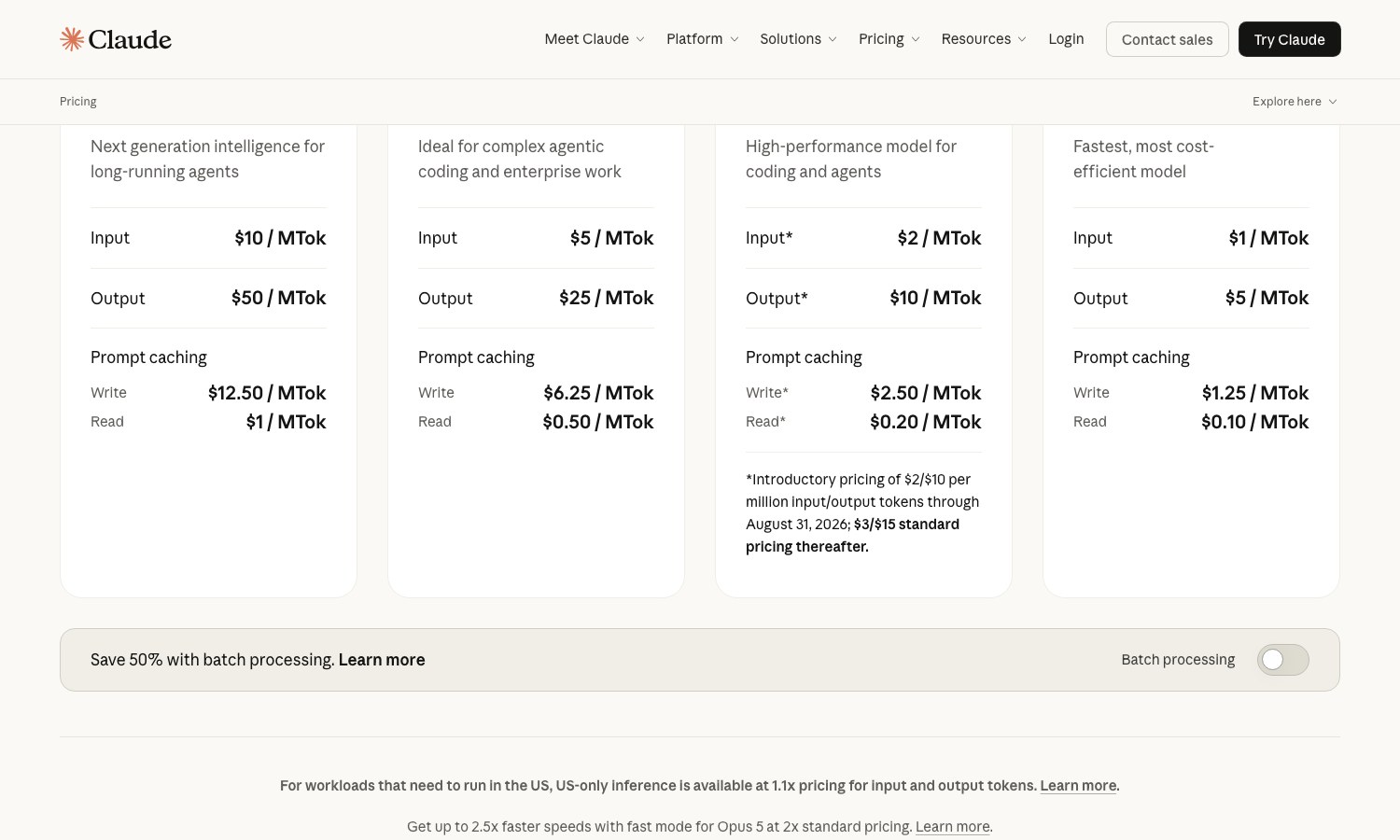
Anthropic does not sell one model but a range, from the fastest to the most capable. The choice is not cosmetic: between the two ends, the price per million tokens varies by a factor of ten.
| Model | Official positioning | Input / million tokens | Output / million tokens |
|---|---|---|---|
| Haiku 4.5 | Fastest, most cost-efficient | $1 | $5 |
| Sonnet 5 | High-performance model for coding and agents | $2 (introductory rate) | $10 (introductory rate) |
| Opus 5 | Complex agentic coding and enterprise work | $5 | $25 |
| Fable 5 | Long-running agents, the next generation | $10 | $50 |
The introductory rate for Sonnet 5 runs until 31 August 2026; after that the official grid says $3 in and $15 out. Remember that detail: it is exactly the kind of small print that doubles a forecast bill one month after go-live.

Is Claude free?
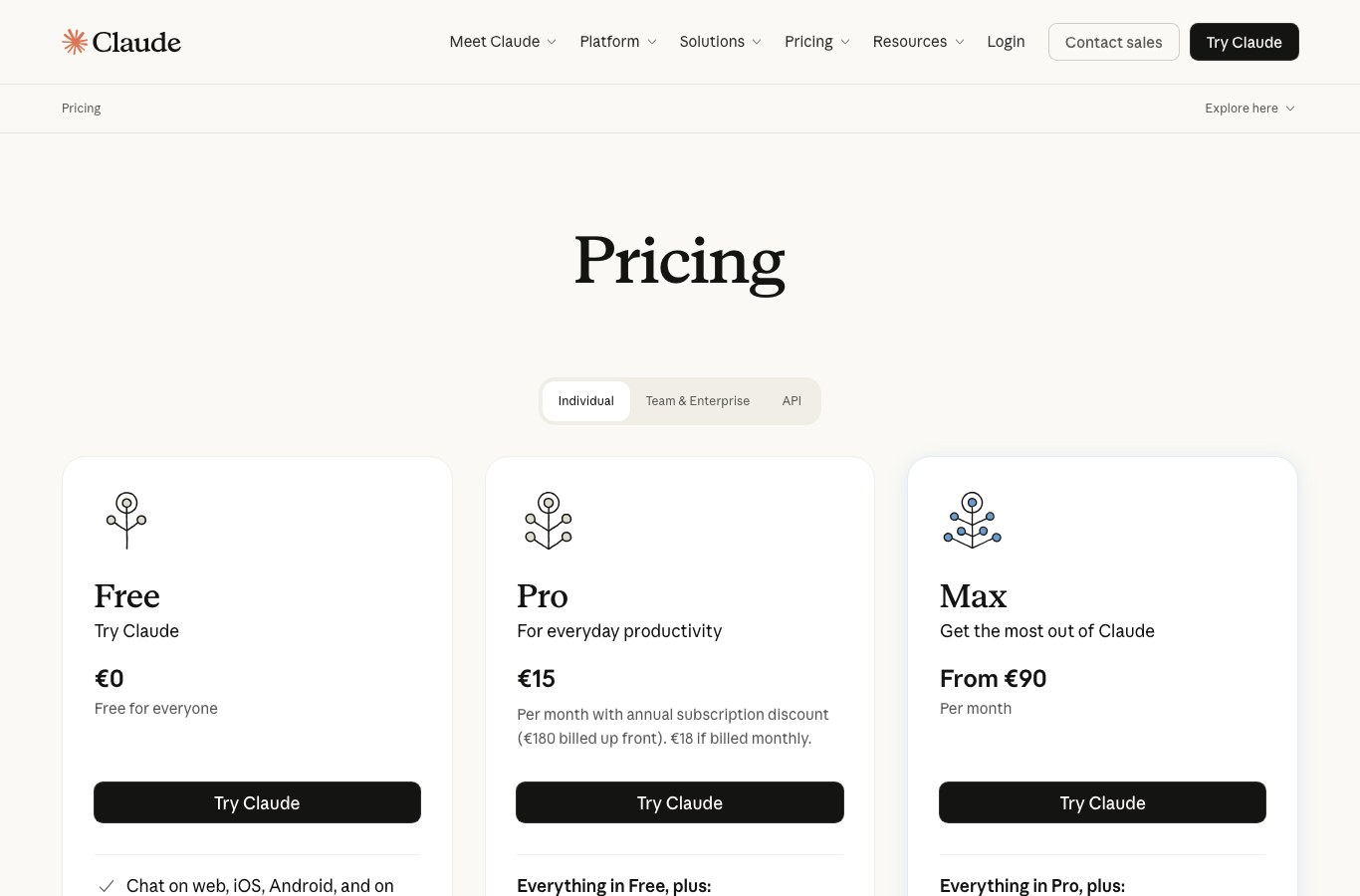
Yes, and it is a real free plan, not a three-message demo. Here are the three individual plans, as displayed from the European Union.
| Plan | Price | What it gives you |
|---|---|---|
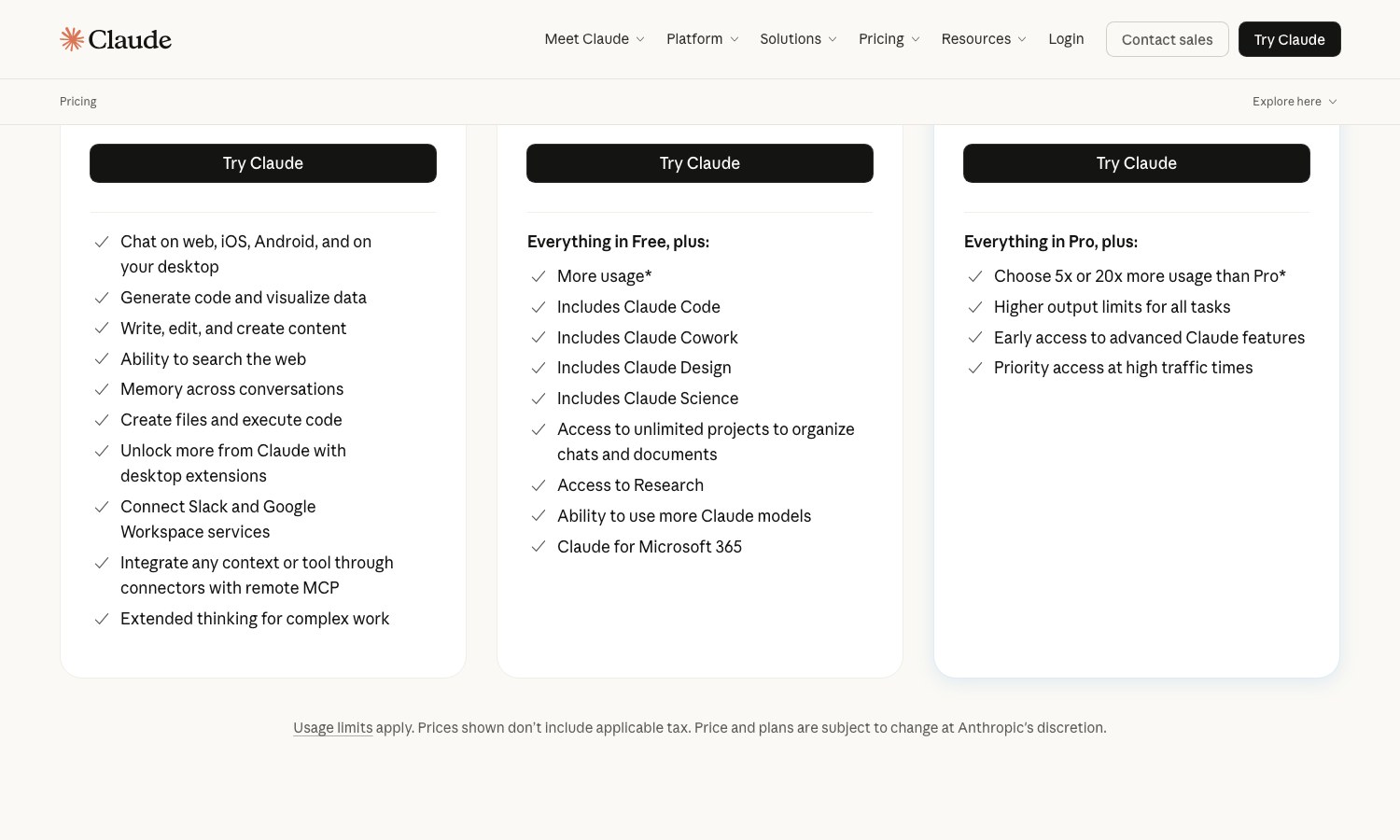
| Free | €0 | Chat on web, iOS, Android and desktop; code generation and data visualisation; web search; memory across conversations; file creation and code execution; Slack and Google Workspace connectors; extended thinking. |
| Pro | €15 per month on the annual subscription (€180 billed up front), €18 per month billed monthly | Everything in Free, plus more usage, Claude Code, Claude Cowork, Claude Design, Claude Science, unlimited projects, access to Research, access to more models. |
| Max | from €90 per month | Everything in Pro, plus 5x or 20x more usage than Pro, higher output limits, early access to new features and priority access at high traffic times. |
The official page states that usage limits apply, including on the paid plans. Anthropic does not publish a number of messages per plan and reserves the right to change prices and plans. For regular professional use, test the free plan for a week before committing to twelve months paid up front.
Claude in your own language: what actually works
The question shows up in every Google suggestion: “Claude AI free”, “Claude AI in French”. The answer fits in one screenshot.
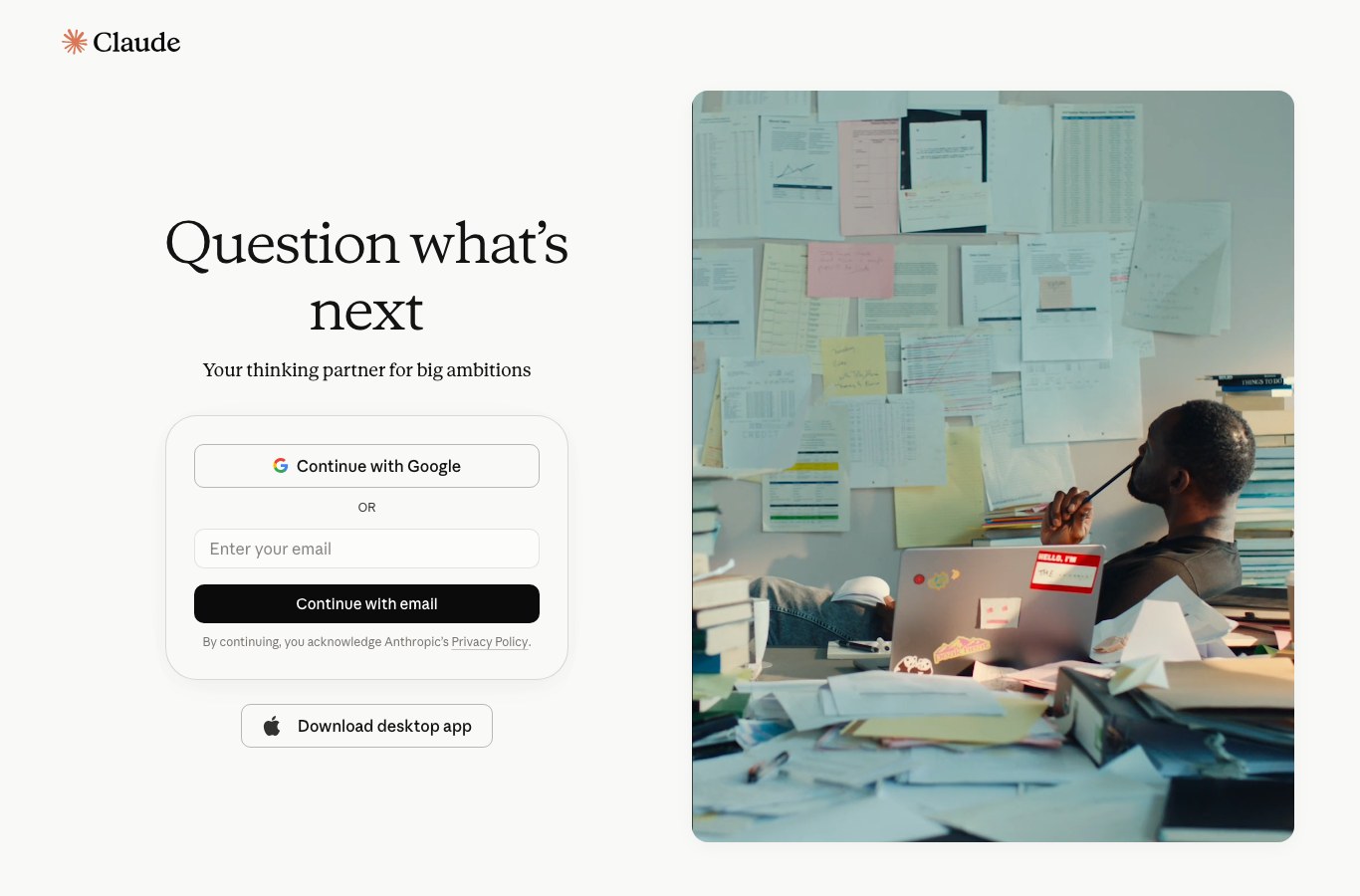
The interface localises automatically and Claude answers in the language you write in. Three caveats, though, are worth knowing before you build a professional workflow on top of it.
- The product site stays in English. The pricing page, the technical documentation and the help centre are in English wherever you open them. Only the currency changes.
- A non-English text costs more than an English one. For the same content, French, Spanish or German split into more tokens than English, because of accents and longer words. On an API bill, that gap is not negligible.
- Models are not reference books. On narrow local topics (law, public bodies, administrative procedures), a general-purpose model gets things wrong with total confidence. A business chatbot therefore has to draw on your own content rather than on the model’s general knowledge.
Claude or ChatGPT: the differences that matter
This is the question Google itself puts at the top of its “people also ask” box. Rather than crowning a winner, here are the criteria the choice actually turns on for professional use.
| Criterion | What to look at |
|---|---|
| Subscription price | The individual plans of the major assistants all sit within a few euros of each other, around €20 per month. That is not where the difference is made. |
| API price | This is what counts once you industrialise. Always compare the input/output pair of the model you will actually use, not the flagship one. |
| Context window | It sets how much document you can send in one go. Anthropic’s recent models advertise a one million token context window, which is a very large file. |
| Ecosystem | Connectors, desktop apps, office integrations. Check plan by plan: several of these building blocks are not in the free tier. |
| Data handling | The decisive criterion in a business, and the one comparison articles document worst. See the next section. |
Model rankings shift every month and none of them wins on everything. If you want an independent measurement rather than a sales pitch, look at how the Chatbot Arena ranking works, where humans vote blind between two answers.
What the shared conversations story really showed
In late July 2026 a story went around the tech press, then the mainstream press. It deserves to be told precisely, because the shorthand version going around (“Claude conversations are public”) is false, and because the real lesson is useful to any company using an AI assistant.

The facts
- Saturday 25 July 2026 Users on Reddit notice that a simple Google query using the
site:operator restricted to the claude.ai share path returns a long list of conversations. - Monday 27 July 404 Media publishes the first article. Fortune, the BBC, then French outlets 20 Minutes and Les Numériques follow over the next few days.
- The content Among the indexed pages, the press reported a named medical report, clinical trial results listing patient names, documents holding the names and phone numbers of primary school children, and cryptocurrency wallet keys. Artifacts, the mini applications built inside Claude, were caught in the same net.
- The mechanism Only conversations their author had explicitly shared through the share button were affected. Sharing creates a snapshot of the conversation at its own public web address. There was apparently no
noindextag on those pages, so search engines treated them like any other public page. - Anthropic’s answer The company did not describe an incident but a design. Its spokesperson told the press that Anthropic does not share chat directories or sitemaps with search engines, that those share links are neither guessable nor discoverable unless the user distributes them, and that “when someone shares a conversation, they are making that content publicly accessible”.
- Since then The results stopped appearing in Google from 28 July. The press did note, however, that links already exposed remained reachable to anyone holding them.
Check your own shares. In Claude, the share menu at the top right of a conversation holds a visibility selector: switching a conversation from shared back to private disables the direct link. Run the same check on the other AI tools your team uses: public link sharing is an industry standard, not one vendor’s quirk.
The lesson, for a company
A consumer assistant is not a sensitive data processing tool, whoever publishes it. Its sharing features are built for convenience, not for compliance. As soon as customer, medical or contractual data enters the loop, the right reflex is not to pick a different consumer assistant but to change category of tool altogether: a deployment whose scope, access and retention you control.
Plugging Claude into your website chatbot: three routes
On to the other half of the search. You do not want to chat with Claude, you want your visitors to get correct answers, on your site, from your content. Three routes exist, and they differ in both cost and lead time.

1. The API directly
Your developers call Anthropic’s API from your code. Full control, pay as you go. In exchange, everything has to be built: the interface, the history, the knowledge base, human handover, analytics, moderation. Count the token bill plus the development time and the maintenance.
2. A no-code platform
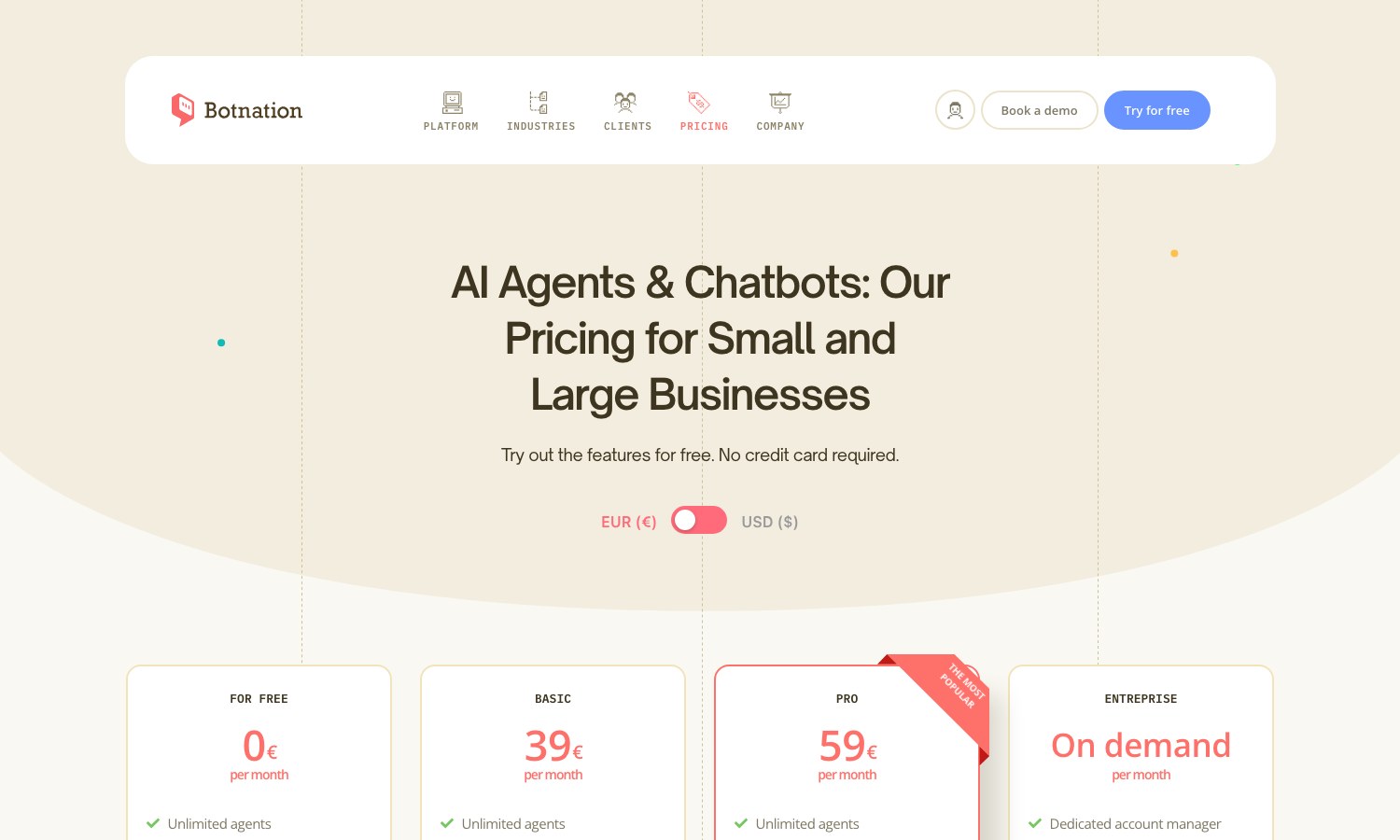
You build the flow in a visual editor, connect your content, and the AI layer comes with it. No API keys and no infrastructure to manage, and you keep control of the scenarios. That is the Botnation model, billed in credits rather than per token.
3. A custom build
You hand the design and the build to a team. Botnation publishes the platform and builds custom chatbots for its clients through its Enterprise offer and its chatbot creation experts. A third-party agency remains a legitimate choice for a very specific industry or an integration already in place.
What actually decides
It is almost never the token price. It is how long your team takes to get the bot live, to fix a wrong answer the day a customer complains, and to connect the bot to your existing channels. A cent saved per conversation does not pay for a week of development.
A Pro or Max subscription does not entitle you to use Claude inside your product. Those are individual plans. Application use goes through the API, with its own billing and its own terms. Confusing the two is the most common budgeting mistake on this topic.
Simulator: what your Claude chatbot would cost
Nobody publishes the figure. Here it is. The calculation reflects how a website chatbot really works: on every visitor message you resend your system prompt, your knowledge base and the whole conversation history to the model. That repetition is what costs, far more than the answer itself.
Estimate the monthly API bill
Move the sliders and pick a model. The calculation assumptions are spelled out under the tool.
Model called
Prompt caching
Without prompt caching, the same configuration would cost € per month. The static block of your prompt (instructions and knowledge base) is billed 1.25 times its price the first time, then a tenth of the price on every re-read. It is the only lever that genuinely changes the order of magnitude of a chatbot bill.
Assumptions: 500 tokens per knowledge base page, 400 tokens of system prompt, 60 tokens per visitor message, 220 tokens per answer. The full history is resent on every call. Standard rates, excluding the batch discount, excluding tax, and excluding the cost of options such as web search and code execution. The Sonnet 5 rate used is the standard $3 and $15, not the introductory rate running until 31 August 2026.
How to read this result
- The knowledge base is the dominant line item. Push the page slider: the bill climbs far faster than it does with the number of messages. That is the best argument for sending only the relevant excerpts rather than your whole catalogue on every question.
- The most expensive model does not improve factual answers. A support chatbot gets things wrong because it lacks the right information, not because the model lacks power. Improve where the answers come from first.
- This figure is not the total cost. It excludes hosting, the interface, supervision and human time. At low volume, those line items weigh more than the tokens.
What changes on 2 August 2026
Article 50 of the European Union’s Artificial Intelligence Act becomes applicable on 2 August 2026. It requires that people interacting with an AI system be informed of it, unless that is obvious from the context. In other words: your chatbot has to say that it is a chatbot.
This is not a cosmetic formality. Article 99 of the regulation provides for fines of up to €15 million or 3% of worldwide annual turnover for breaches of the transparency obligations. Good practice is simple and free: an explicit welcome sentence, a name that does not pretend to be human, and a way out to a human adviser.
This paragraph summarises a regulation and does not replace legal advice. The reference text is Regulation (EU) 2024/1689. Have your setup reviewed by your own counsel if you handle sensitive data or operate in a regulated sector.
Five common mistakes
What fails
- Budgeting a customer project on the price of an individual subscription.
- Picking the most expensive model “to be safe”, then discovering the bill a month later.
- Pasting customer data into a consumer assistant, then sharing the conversation.
- Sending the entire documentation on every question, with no selection.
- Letting the bot answer everything, including what it does not know.
What works
- Separating internal use (subscription) from product use (API or platform) from day one.
- Starting on the cheapest model and moving up only when quality demands it.
- Keeping sensitive data to a deployment whose scope you control.
- Turning on prompt caching and sending only the useful excerpts.
- Planning a fallback sentence and a handover to a human, and saying so in the welcome message.
Frequently asked questions
Is Claude really free?
Yes. The Free plan costs €0 and gives access to chat on the web and mobile apps, web search, memory across conversations and code execution. Usage limits apply and Anthropic does not publish the figures. For occasional use it is more than enough.
How much does Claude cost per month?
For an individual: €0 on Free, €15 per month on the annual subscription (€180 billed up front) or €18 monthly for Pro, and from €90 per month for Max. Prices read off claude.com on 31 July 2026, excluding applicable tax. For use inside a product, billing goes through the API and is per million tokens: use the simulator above.
Does Claude work in languages other than English?
Yes. The interface localises automatically and Claude answers in the language you write in. The technical documentation and the pricing page, however, stay in English, and a non-English text consumes more tokens than an equivalent English one.
Are my Claude conversations public?
No, they are private by default. The late July 2026 episode concerned only conversations their authors had explicitly shared by link: those public pages ended up indexed by search engines. A share link makes the content reachable to anyone holding it, including after it has disappeared from search results. Switch the conversation back to private from the share menu to disable the link.
Can I use my Pro subscription for my website chatbot?
No. The Free, Pro and Max plans are individual plans meant for personal use inside the Claude application. Embedding Claude in a product or a website goes through the API, which has its own usage-based billing, or through a platform that supplies the AI layer.
Which Claude model should I choose for a support chatbot?
The cheapest in the range is enough in the vast majority of cases. A support chatbot answers questions whose answer is in your documents: quality depends on selecting the right excerpts, not on the raw power of the model. Move up only if you see reasoning errors, not content errors.
What is prompt caching and why does it change everything?
It is a mechanism that avoids re-billing the fixed part of your prompt (instructions and knowledge base) at full price on every call. The official grid shows, for each model, a cache write rate of 1.25 times the input price and a cache read rate of one tenth of the input price. On a chatbot that resends the same block on every message, the saving often exceeds 50% of the bill.
Can Claude answer from my own documents?
Yes, but not on its own. You have to supply the right excerpts at the moment of the question: that is the principle behind chatbots connected to a knowledge base. The topic is covered in our guide to training a chatbot on your own data.
What to take away
Claude is an excellent work assistant, free for everyday use and €15 per month for heavy use. That much is settled, and the free plan already answers the question that brings most visitors here.
The second half of the subject is more interesting. Having a generative AI answer your customers is not decided on the price of a subscription but on three things: where the information comes from, who carries responsibility for what the bot says, and what a conversation costs at scale. The simulator gives you the third figure. The first two come down to how you build the bot, not to the model you call. That is also what separates the main families of chatbots from one another.
An AI chatbot on your site, with no API keys to manage
Try the platform for free, connect your content and publish to your website, WhatsApp or Messenger. Our chatbot creation experts take over if you would rather hand the build to someone else.
Sources: the Claude pricing page (individual plans and API) read on 31 July 2026; the European Central Bank reference exchange rate of 30 July 2026; Regulation (EU) 2024/1689 on artificial intelligence, articles 50 and 99, available on artificialintelligenceact.eu; press coverage of the indexing of shared conversations (404 Media, Fortune, BBC, 20 Minutes, Les Numériques), 27 to 30 July 2026.