



A public service chatbot is a conversational agent deployed by a government agency, a local authority or a public operator to inform, guide and support citizens. It is not just a FAQ: on entreprendre.service-public.gouv.fr, NOA has been guiding start-ups since 2021; on ants.gouv.fr, the France Titres chatbot went 24/7 (launched October 2024, progressive rollout, source dated 5 March 2025, in French); and the national police offer the same channel on masecurite.interieur.gouv.fr.
Since 2 August 2026, Regulation (EU) 2024/1689 (the EU AI Act) has applied in France. It requires, among other things, that users be clearly informed that they are talking to an AI (Article 50(1)), that AI-generated text published to inform the public be marked (Article 50(4)), and that AI literacy be ensured within the team (Article 4, applicable since 2 February 2025).
Then there is the pre-existing baseline: GDPR and the French data protection authority (CNIL) guidance (no significant automated decision without safeguards, sensitive data constrained, purge), plus mandatory accessibility for public services (Article 47 of the French law of 11 February 2005 and the RGAA reference framework), which most market offers do not even mention.
You run a citizen desk, a procedures website, a phone switchboard or a local government front office. Volumes are up, teams cannot keep up, and someone suggests “installing a chatbot”. The word is everywhere since the French government announced, on 16 June 2026, a 655 million euro investment in AI through France 2030, a “public health chatbot” on Ameli.fr and a conversational assistant for all civil servants before the end of 2026 (info.gouv.fr, 18 June 2026, in French).
The problem is that most pages ranking for “public service chatbot” are product sheets. They describe an ideal assistant without ever saying what the law actually requires since 2 August 2026, nor what a chatbot must never do on its own. This guide does the other half of the job: verifiable real-world cases, the legal obligations, and a tool to assess your level of readiness before putting anything online.
What exactly is a public service chatbot?
A public service chatbot is a conversational agent deployed by a public entity: central government, prefecture, ministry, municipality, inter-municipal body, department, public operator (health insurance, secure documents, social security…), hospital, or an association delivering a public service. What makes it special is not technical: it is its framework. It talks to citizens who did not choose to be customers, it sometimes handles sensitive data, and its mistakes can have administrative or legal consequences.
Public service chatbot: a conversational agent operated by a public administration or public operator to inform, guide or support citizens in their procedures. It can also be extended to civil servants (internal assistant), like “L’Assistant”, the assistant announced by the French government on 16 June 2026 for all civil servants.
Three technical families share the field, and the level of legal scrutiny is not the same:
| Type of assistant | What it does well | Where it fails | What the framework adds |
|---|---|---|---|
| Rule-based scripts (dialogue tree) | Opening hours, addresses, documents required, procedure route, simple appointment booking | Out-of-scenario questions, rephrasing, edge cases | Nothing specific if no personal data is processed |
| Generative AI on a document base (RAG) | Drafted answers from your official texts, FAQs, departmental sheets | Outdated source, incomplete answer, hallucinated eligibility | Disclosure of the artificial nature (Article 50(1) AI Act), human review (Article 50(4) for texts published to inform the public) |
| Generative AI plus actions (file, payment, signature) | Pre-filling, appointment booking, file tracking | Decision, validation, refusal: the boundary is legal, not technical | A significant automated decision requires meaningful human intervention (Article 22 GDPR, CNIL guidance of 19 February 2021) |
So the boundary that matters is not “generative or not”. It is: does the bot inform, or does it decide? Everything else in this article follows from that question.
What the EU AI Act actually changes for a public service
Regulation (EU) 2024/1689 of the European Parliament and of the Council of 13 June 2024, known as the “Artificial Intelligence Act”, entered into force on 1 August 2024 and has been applicable since 2 August 2026 (Article 113). Chapters I and II had already applied since 2 February 2025, and Chapters III (Section 4), V, VII, XII and Article 78 since 2 August 2025. Four points deserve a careful reading for a public service.
1. Telling the citizen they are talking to an AI (Article 50(1))
The official text (Official Journal of the EU, 12 July 2024): “Providers shall ensure that AI systems intended to interact directly with natural persons are designed and developed in such a way that natural persons concerned are informed that they are interacting with an AI system, unless this is obvious from the point of view of a natural person who is reasonably well-informed, observant and circumspect, taking into account the circumstances and the context of use.”
In practice for a public service: the “You are talking to an AI assistant” notice (or its audio equivalent) must be visible as soon as the conversation opens. A visible robot with an obvious name may suffice in some contexts, but caution wins: announce it systematically. It is also a trust question: the citizen must know whether their exchanges are read by an agent, or not read at all.
2. AI-generated text published to inform the public (Article 50(4))
The point almost nobody cites. The regulation requires deployers of an AI system that generates text published “with the purpose of informing the public on matters of public interest” to indicate that the text has been generated or manipulated by AI. With two exceptions worth knowing: the law authorises it for crime prevention or detection purposes, or the content has been subject to a human review process or editorial control and a natural or legal person holds editorial responsibility for the publication. Paragraph 5 of the same article adds that this information must be provided in a clear and distinguishable manner at the latest at the time of the first interaction, and must conform to the applicable accessibility requirements.
Practical translation: if your chatbot publishes a municipal newsletter, a publicly displayed official answer or a news digest, plan an identified human review or mention the AI origin. Both are compliant; neither is optional.
3. AI literacy for the team (Article 4, since 2 February 2025)
Article 4 requires providers and deployers to take measures to ensure, “to the extent possible”, a sufficient level of AI literacy for staff and other persons dealing with the operation and use of the system. For a public service, this means in practice: train front-office and switchboard staff on what the bot knows and does not know, how to spot a failing answer, and how to take over. This is a management prerequisite, not a communication bonus.
4. What if your chatbot assesses eligibility for public support?
A chatbot that determines eligibility for a public assistance benefit falls under Annex III, point 5(a) of the regulation, which covers AI systems intended to be used by public authorities, or on their behalf, to evaluate the eligibility of natural persons for essential public assistance benefits and services, and to grant, reduce, revoke or recover such benefits. The classification itself comes from Article 6(2): “In addition to the high-risk AI systems referred to in paragraph 1, AI systems referred to in Annex III shall be considered high-risk.” Recital 58 has no classifying effect: it provides the interpretive background for point 5(a), citing healthcare, social security benefits, social services, social assistance and housing.
The corresponding obligations apply since 2 August 2026, the general application date of the regulation (Article 113). The deferral to 2 August 2027 (Article 113(c)) only concerns Article 6(1), i.e. AI systems integrated into products covered by the Union harmonisation legislation listed in Annex I: that is not the case of a chatbot answering citizens. Useful nuance from Article 6(3): an Annex III system is not high-risk if it does not pose a significant risk of harm to health, safety or fundamental rights and does not have a significant impact on the outcome of the decision-making, for instance a narrow procedural or preparatory task, unless it profiles natural persons, always considered high-risk.
Do not conclude “my information chatbot is not affected”. Determining eligibility, even upstream of the file, brings your assistant close to the “high-risk” scope: that is exactly the scenario covered by Annex III, point 5(a), illuminated by Recital 58. Reading the full text, and a lawyer’s opinion, are essential as soon as your bot answers eligibility, benefit or rights questions.
GDPR and CNIL guidance: the baseline, still applicable
The AI Act does not replace the GDPR: both apply side by side. The CNIL reminded us in its joint note with the French Council for AI and Digital Affairs (CIANum), published on 20 July 2026: “If the main instruments of European data protection law and artificial intelligence regulation already apply to them”, their specific features call for an adaptation of how these rules are implemented. Its guide Chatbots: CNIL advice to respect people’s rights (19 February 2021, in French) remains the operational reference. Five points to keep.
A conversation with a chatbot without human intervention cannot, on its own, lead to important decisions for the person. Automated decision-making with legal effects or similarly significant effects is in principle prohibited by Article 22 GDPR, unless safeguards (obtaining human intervention, expressing one’s point of view, contesting the decision) or exceptions apply (explicit consent, contract, Union or Member State law).
- Cookies and trackers: if the chatbot runs through a cookie dropped before its activation, prior consent is required (free, specific, informed, unambiguous). Otherwise, a tracker strictly necessary to provide the service requested by the user requires no consent (Article 82 of the French Data Protection Act).
- Retention period: conversation data is kept for the time necessary for the purpose. The CNIL contrasts a purchase conversation (erase at the end) with a claim to handle (legitimate longer retention).
- Sensitive data: processing is in principle prohibited (Article 9 GDPR). Two cases to know: if collection is foreseeable and relevant, it must fit an exception (explicit consent, important public interest reason, etc.); if it is not foreseeable, you must warn users before use not to share such data and plan an immediate or regular purge.
- DPIA: sensitive data is one of the nine criteria triggering a data protection impact assessment. Another criterion, such as large-scale collection, is sufficient on its own.
- Agentic AI: the July 2026 CNIL and CIANum note highlights the growth of retained data (persistent memory), hyper-personalised profiles, unclear responsibility allocation and extended cybersecurity risks. If your bot “acts” (accesses other services, sends, confirms), document data flows and the sharing of responsibility.
Accessibility: the obligation most offers ignore
Public administrations’ online public communication services must be accessible, under Article 47 of the French law n° 2005-102 of 11 February 2005, implemented through the RGAA (general accessibility improvement framework, version 4). For a chatbot, this means: keyboard and voice navigation, sufficient contrast on your bubbles and buttons, field labels understandable by screen readers, no exclusive reliance on natural language, and a published accessibility statement.
This is not a doctrinal point: the accessibility statement of the “Change of address” online service on service-public.gouv.fr, established on 27 February 2026, reports a DINUM (French digital agency) audit showing that 81% of RGAA 4.1.2 criteria are met, and lists the remaining non-conformities (radio buttons poorly read, inconsistent headings, insufficient contrast…). The lesson applies to your chatbot: accessibility bugs are the first to disqualify an online public service.
Four real cases that show the way
Verifiable public cases are more numerous than you might think. Here are four systems whose sources are public, with the lesson each one brings.
| Public service | What the chatbot does | What it teaches |
|---|---|---|
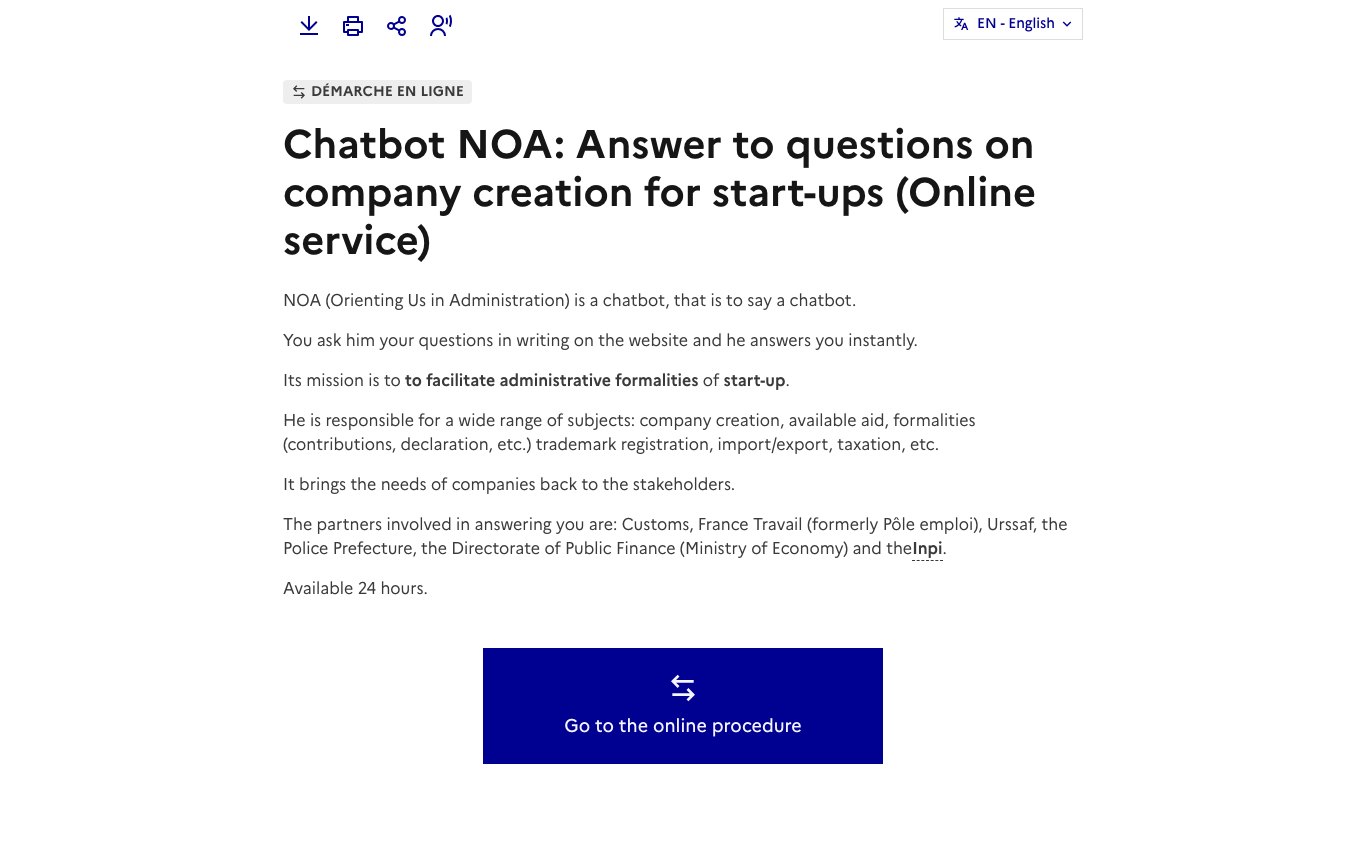
| NOA, the official digital assistant for company founders, entreprendre.service-public.gouv.fr | Answers in writing on company creation (creation, support, formalities, trademarks, tax), and feeds needs back to the relevant actors: customs, France Travail, Urssaf, police prefecture, public finance directorate, INPI | A public bot is not alone: it routes to the competent services. Feeding needs back to partner administrations is the real value |
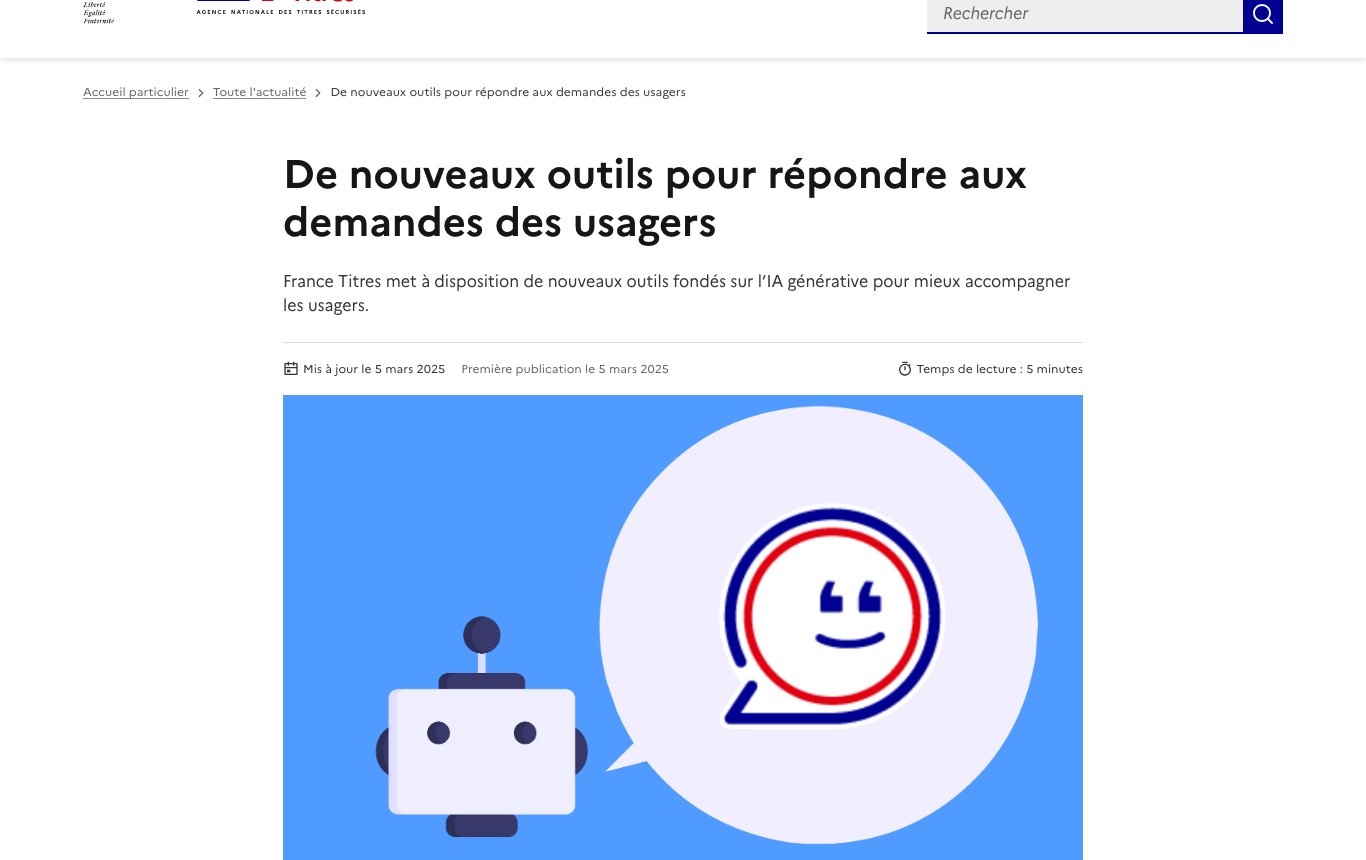
| France Titres chatbot, ants.gouv.fr | Available since October 2024 on the driving licence site; first active a few hours a day, it moved to 24/7, from driving licence to vehicle registration; since March 2025, 24/7 phone answers | A progressive rollout fed by telephone advisers works better than a big launch |
| Chat on masecurite.interieur.gouv.fr | Chat available 24/7 to inform and guide in administrative or judicial procedures, completed by a team of human operators | Citizens call a channel, not a technology: measure the resolution rate, not the number of messages |
| Public health chatbot (announced on Ameli.fr) | Should answer medical questions and guide to a first care arrangement, announced by the French government on 16 June 2026 (info.gouv.fr, updated 13 August 2026) | The framework comes from the state: information and guidance, no diagnosis. Keep that discipline even on less sensitive topics |
Seven use cases where a public service chatbot has a real value
Value is measured against a cost: a repetitive request, on which a human only repeats information already published. The seven cases below are the ones found in documented public rollouts.
- Guide the citizen to the right procedureNOA does it for start-ups. Orientation is the king case: zero decision, only guidance, and immediate gains on wrongly filed applications.
- Answer recurring questionsOpening hours, addresses, required documents, fees, useful numbers. That is the core of the France Titres chatbot: telephone advisers keep time for personalised support.
- Handle simple appointment bookingPassport or ID appointments, housing, advice: when the slot lives in a shared calendar, the bot qualifies the request (file type, municipality, situation) before proposing slots.
- Track a file without revealing personal informationThe bot indicates the stage or the expected document, without detailing sensitive content. Identity verification remains a human step or a dedicated scheme.
- Share local newsWorks, collections, closures, public sessions: an institutional news feed, with human review (Article 50(4) of the EU AI Act for texts informing the public).
- Support reporting and mediationStreet incidents, objections, disturbance: the bot collects the report and routes it to the service that handles it, never ruling on the merits.
- Assist civil servants themselvesInternal procedure search, letter templates, regulatory history. This is the scope of “L’Assistant”, the unique conversational agent announced for all civil servants before end of 2026.

What the chatbot must never do on its own
1. No eligibility, grant or refusal decision. Article 22 GDPR and the CNIL reading say it: without meaningful human intervention, an important decision cannot come from a one-to-one conversation.
2. No unsourced legal statement. A benefit, a cap, an invalid deadline: the bot must cite its source and point to the official page, not answer from memory.
3. No collection of sensitive data without warning and purge. The CNIL requires a warning before use and an immediate or regular purge if collection is not foreseeable.
4. No impossible escalation. Handover to a human must be displayed and working, including outside opening hours (a qualified contact form is enough). The same escalation logic, applied to private customer service, is detailed in our article after-sales chatbot: who handles each request, and the 4 legal rules.
Our tool: the readiness check for your public chatbot
Before commissioning anything, run this check. Five questions, three possible answers, no calculation on load, no data sent anywhere: the score only appears once all five questions are answered.
Readiness check: is your public service chatbot operational?
Five questions, three possible answers. No data is ever sent anywhere.
1. Volume of users: how many daily requests must this channel absorb?
2. Planned type of assistant: what will it concretely do?
3. User data: what is the chatbot likely to process?
4. Handover to a human agent: how is the user taken over?
5. Accessibility: where does RGAA compliance stand?
0risk points out of 22
Answer the five questions
Choose one answer for each question to get the project’s readiness level. No verdict is shown until the check is complete.
Ready for a public pilot
Reasonable volume, pure information, no sensitive data, human handover and accessibility addressed: the conditions for a pilot are met. Still frame three things before the green light: the official document source (who keeps the base up to date), the weekly review of conversations, and the Article 50(1) AI disclosure message if your bot is generative.
Solid base, three points to consolidate
The project is credible but has left one friction point: either a volume that requires reinforced documentation (DPIA or register), or an assistant acting on a file, or limited escalation. Address the highest point on the list before going live: it will set the level of the compliance file.
You are not ready for the public
At least two axes are at risk: sensitive data, decision or action on files, missing human escalation or accessibility not addressed. This is not a rejection of the project, it is a work order. Start with Article 22 GDPR (who decides?), then the document base (who answers?), then accessibility (who can use it?), before discussing conversation design.
Do not put this chatbot online before a full review
The scenario stacks the worst: large-scale processing, acting AI on files, sensitive data, no escalation or ignored accessibility. In this configuration, the risk is legal (Article 22 GDPR, Article 9 and CNIL guidance), and it is also institutional: a public error on social assistance sets a precedent, not an anecdote. Go through an impact assessment, a legal review, then reduce the scope to a pilot a human can supervise.
This check is an indicator, not an audit: any higher-risk project must keep DPIA and Articles 22 and 9 GDPR in mind as soon as sensitive data or decisions get closer.
On the writing itself, the rule is simple: the bot’s answer must never be stronger than its source. If the official page says “the file is being processed”, the bot says the same, not “your file has been accepted”.
How to deploy in five steps
- Measure the real flowCount questions received by the counter, the phone and email for two weeks, sort them by topic. The 80/20 pattern shows immediately: a handful of topics accounts for most requests.
- Break down the proceduresFor each topic: public information or processing? Who decides? What is the official source of the text? This sorting is the brief.
- Feed the bot with your textsA verified document base (fact sheets, orders, FAQs) beats a thousand scenarios. That is exactly what a RAG chatbot does, and it is also the main risk: if the source is outdated, the answer is too. The complete method, routes and costs are detailed in our guide how to develop a chatbot.
- Test with staff, then with usersRun the scenarios through front-office staff first: they know the questions that sting. Only then, a sample of citizens, with criteria (resolution rate, escalation rate, abandonment rate).
- Monitor and correctFailed conversations are your weekly gold mine: either the document base grows, or a question goes to escalation. Without this review, a public service chatbot degrades within months.
A public chatbot does not replace a counter, it clears it. Users who truly need it (personalised support, complex case, fragile situation) must reach a human faster, not be bounced around longer. That is the final criterion: does waiting time for a human agent go down or up?
What does it cost?
Two families of spend, not to be confused. The platform first: Botnation, the publisher of this site, publishes a free plan (0 €), a Basic plan at 39 € per month and a Pro plan at 59 € per month (prices in EUR, excluding VAT), with a custom offer for volumes and enterprise requirements (“on demand” plans and services). The design work next: creating scenarios, structuring the document base, configuring guard-rails, testing, training staff and monitoring. That is expert work, priced on quotation: no reliable public order of magnitude exists, and anyone quoting a fixed price without a scoping file tells you more about their marketing than about your project.
The real cost of a public service chatbot is not the invoice: it is document maintenance. A bot fed by a base that is not updated produces wrong answers with perfect confidence. Budget the review, not just the launch.

FAQ
Can a chatbot replace the front office of a town hall?
No, and that is not its role. A municipal front office combines information, listening, alerts and local service; the chatbot takes the repetition away. The local authorities that get the best out of it present it as a pre-screen: the citizen arrives with a prepared file, the agent keeps time for the individual case. The key question is not “does it replace” but “does it save human agent time”.
Does the EU AI Act apply to local authorities?
Yes. Regulation (EU) 2024/1689 applies to AI systems placed on the market or put into service in the Union, including by public authorities, as long as the system falls within its scope. The key date is 2 August 2026: the obligations for systems listed in Annex III (including point 5(a) on public assistance benefits) apply since that date, under Article 6(2). Only the class covered by Article 6(1), AI systems integrated into products covered by the Union harmonisation legislation listed in Annex I, benefits from a deferral to 2 August 2027 (Article 113(c)).
Who is liable if the chatbot gives a wrong answer?
Liability is shared depending on the setup, but the common-sense rule is: the entity that deploys the bot remains responsible for its public service. That is the reason for guard-rail 2 (no unsourced statement) and guard-rail 1 (no decision without a human). The CNIL reminds us that the data controller must pay particular attention to the rights and freedoms of individuals, with the help of its data protection officer if one has been appointed.
Does the chatbot have to be accessible?
Yes, mandatorily for public administrations’ online public communication services (Article 47 of the French law n° 2005-102, RGAA version 4). In practice: keyboard navigation, sufficient contrast, labels understandable by screen readers, published accessibility statement. The example of the address change online service on service-public.gouv.fr (81% of RGAA 4.1.2 criteria in the DINUM audit of February 2026) shows the actual expected standard.
Can health data be processed in a public chatbot?
Processing sensitive data is in principle prohibited by Article 9 GDPR, unless an exception applies (explicit consent, important public interest reason, etc.) and strict safeguards are in place. If collection is not foreseeable, the CNIL requires a warning before use and an immediate or regular purge. For a topic as sensitive as a “public health chatbot”, the framework announced by the state itself (orientation to a first care arrangement, no diagnosis) is a model to follow.
How long does a rollout take?
For a basic documentation scope (opening hours, documents, orientation), a few weeks are enough if the document base exists: then two to four weeks of testing and calibration with staff. For an assistant integrated into procedures (file, appointment, reporting), plan a structured project with scoping, legal review and a multi-week pilot. The France Titres chatbot itself went from a few hours a day to 24/7: time is an ally, not an enemy.
This guide is general information written for the French and European legal framework on 24 August 2026; it does not replace personalised legal advice. It focuses on French and EU law. In the United Kingdom, the EU AI Act does not apply and regulators follow a principles-based approach; in Canada, the proposed Artificial Intelligence and Data Act (AIDA) lapsed in January 2025 and no equivalent federal statute is in force. References cited (Regulation (EU) 2024/1689, GDPR, CNIL guidance) must be checked in their current version for your situation, in particular with your DPO or legal counsel. Public examples are dated and sourced; published prices are from the Botnation grid as of 11 August 2026 (“on demand” offer, priced on quotation).
In conclusion
The public service chatbot is mature, but it has a price: seriousness. An assistant that guides to the right procedure, cites its sources, announces it is an AI, steps aside before a human and is tested with staff will transform your front office. An assistant that answers everything will turn a volume problem into a trust problem, and the state’s own examples show the discipline to follow: inform, guide, feed needs back to the competent services, never decide alone.
The motto is the same for the EU AI Act, the CNIL and common sense: the decision stays human, the information becomes automatic. It is the only position that lasts, and by far the cheapest to fix.
Your public service chatbot, up to the 2026 rules?
Botnation is both the publisher of a no-code AI chatbot platform and a provider of custom chatbots (Enterprise offer, priced on quotation), with support from chatbot creation experts. The specific point: the team that builds is the team that publishes the platform, so you keep control of the editor after delivery.
Going further: the town hall chatbot has its own sector page, the complete town hall chatbot guide details absorbing citizen requests, and our article on RAG chatbots: where they get their information will help you structure the document base, the condition for everything else.