



A WordPress chatbot installs in minutes and answers your visitors 24/7. We compared the 15 best solutions of 2026 on pricing, AI, WordPress integration and GDPR compliance, with every figure checked on the vendors’ official sites on September 3, 2026. Botnation comes first for an English or French-speaking site: a French-built platform, an official plugin, no-code scenarios and generative AI trained on your site content.
A WordPress chatbot installs in minutes and answers your visitors 24/7, whether you want to automate support, qualify leads or sell on WooCommerce. Here are the 15 best solutions in 2026, compared on pricing, AI and WordPress integration.
We publish Botnation and we follow this market closely: this comparison was fully revised in September 2026, with pricing and features checked one by one on each vendor’s official site. You will find a summary table first, then a detailed card per tool, an installation guide in three methods, and a checklist to choose according to your profile.
What is a WordPress chatbot?
WordPress powers nearly six in ten websites that use a CMS, so it is the natural target for most chatbot vendors, who ship dedicated plugins or scripts to paste into the theme. The catch is picking the right one. Let us first define what you are actually installing.
A WordPress chatbot is a conversational assistant deployed on a site built with the WordPress CMS, via a plugin or a code snippet, that talks to visitors: answering their questions, guiding them to the right page and collecting their contact details without immediate human involvement.
What is a chatbot on WordPress for?
Five missions cover most of what a business site or a store needs:
- 24/7 support: instant answers to recurring questions (hours, pricing, delivery), at 2 a.m. and on public holidays alike;
- Lead qualification: a few well-timed questions to capture a name, an email and a precise need before handing over to sales;
- Automated FAQ: your frequently asked questions become instant answers, instead of a page visitors never read;
- WooCommerce abandoned carts: a conversational nudge at the exact moment of hesitation, contextual offers and assisted checkout;
- Appointment booking: the bot offers time slots and records the reservation in your calendar.
On the installation side, two schools coexist: the WordPress plugin, installed from the admin in a few clicks, and the snippet, a short script supplied by the vendor to paste into the theme, a code-injection plugin or an Elementor HTML block. The second method works with every theme; we come back to it in the tutorial.
Comparison table of the 15 best WordPress chatbots
The summary first, the details right after. Each row sums up what the tool actually does on a WordPress site. Prices checked on September 3, 2026 on official sites, excluding promotions, in the currency each vendor displays.
| Tool | Indicative price | Free edition | Dedicated WP plugin | Generative AI | Answers from site content | WooCommerce | Multilingual |
|---|---|---|---|---|---|---|---|
| Botnation | Free, then $39/mo approx. | Yes ($0) | Yes | Yes | Yes | Yes | Yes |
| Tidio | From ~$25/mo | 50 conversations/mo | Yes | Yes (Lyro) | Yes (Lyro) | Yes | Yes |
| AI Engine | Free + API costs | Yes (key required) | Yes | Yes (your key) | Yes (Pro) | No | Yes |
| WPBot | Pro from ~$39 | Yes | Yes | Yes (Pro) | Add-on | No | Yes |
| Crisp | From $45/mo | Yes (2 seats) | Yes | Yes | Yes | No | Yes |
| ChatBot (Text) | From $19/user/mo | 14-day trial | Snippet | Yes | Yes | Yes | Yes |
| ManyChat | From $14/mo | 25 active contacts/mo | No | Yes | No | No | No |
| Chatfuel | From $49/mo | Yes (Light plan) | No | Yes | Yes (AI base) | No | No |
| Collect.chat | From $14/mo | 100 responses/mo | Snippet | No | No | No | Yes |
| IBM watsonx | On quote, from $530/mo | 30-day trial | Snippet/API | Yes | Yes | No | Yes |
| Landbot | From 32 EUR/mo | 100 chats/mo | Snippet | Yes | Yes | No | Yes |
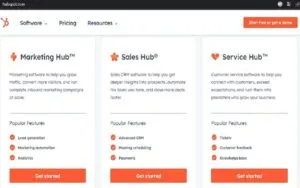
| HubSpot Chatbot Builder | Included in the free CRM | Yes | Yes | Yes | No | No | No |
| Zendesk | From 55 EUR/agent/mo | 14-day trial | Snippet | Yes | Yes | Yes | Yes |
| SmartsearchWP | Premium ~49.90 EUR/yr + API | Freemium | Yes | Yes (key required) | Yes (core product) | Add-on | Yes |
| Tytae | From 69 EUR ex. VAT/mo | No (demo on request) | Yes | Yes | Yes (core product) | No | Yes |
The 15 best WordPress chatbots in detail
Every card follows the same grid: pricing, free trial, free edition and features, then strengths, the weakness, and how the tool integrates with WordPress. Screenshots come from each vendor’s official site.
1. Botnation: the French platform, no-code with generative AI
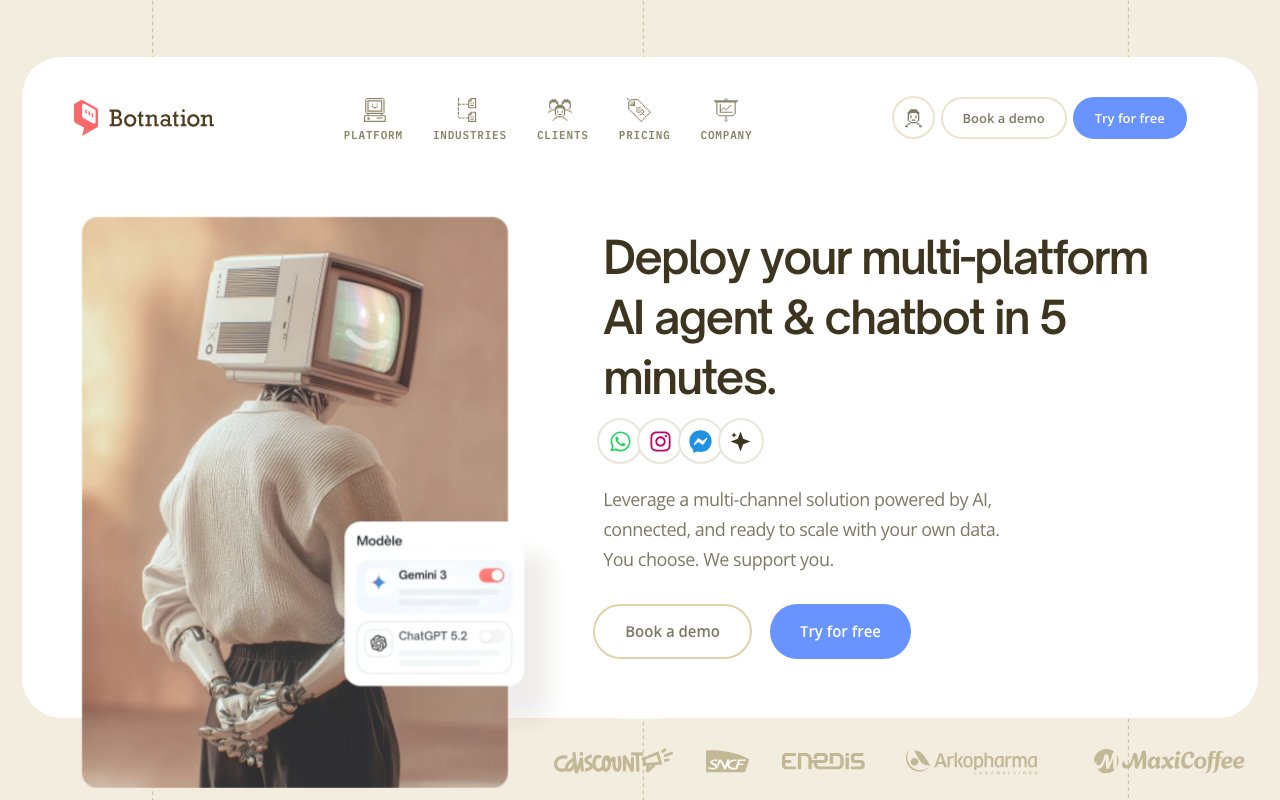
We publish Botnation, and we stand by ranking it first: it is the tool that ticks every box for an English or French-speaking site. The official WordPress plugin installs from the directory in two minutes, with zero code. You build scenarios by drag and drop, then switch on generative AI: the chatbot answers in natural language and can be trained on your site content (pages, posts, FAQ), a trend detailed below. The same bot deploys to WhatsApp, Messenger, Instagram and SMS, with CRM and emailing connectors. On the data side, the vendor is French: the AI runs independently of GAFAM services, and data stays hosted under French and European jurisdiction. The details are on our dedicated WordPress chatbot page.
Pricing
Free plan at 0 EUR, Basic at 39 EUR/month (500 users and 500 AI credits offered once), Pro at 59 EUR/month, and a custom Enterprise offer that includes chatbot creation services. Full detail on our pricing page.
Free trial
Not applicable: the free plan is permanent.
Free edition
Yes, for life: create and publish on your site, access scenarios, then move to a paid plan to unlock volumes and advanced features.
Features
No-code scenarios, generative AI, a knowledge base fed by site content, multichannel (web, WhatsApp, Messenger, Instagram, SMS), CRM connectors, statistics, GDPR and European hosting.
Strengths: GDPR-focused French vendor, no-code installation, AI and scenarios on one platform, multichannel deployment. Weakness: AI credits are consumed by volume, worth watching on a high-traffic site.
2. Tidio: live chat boosted by Lyro AI
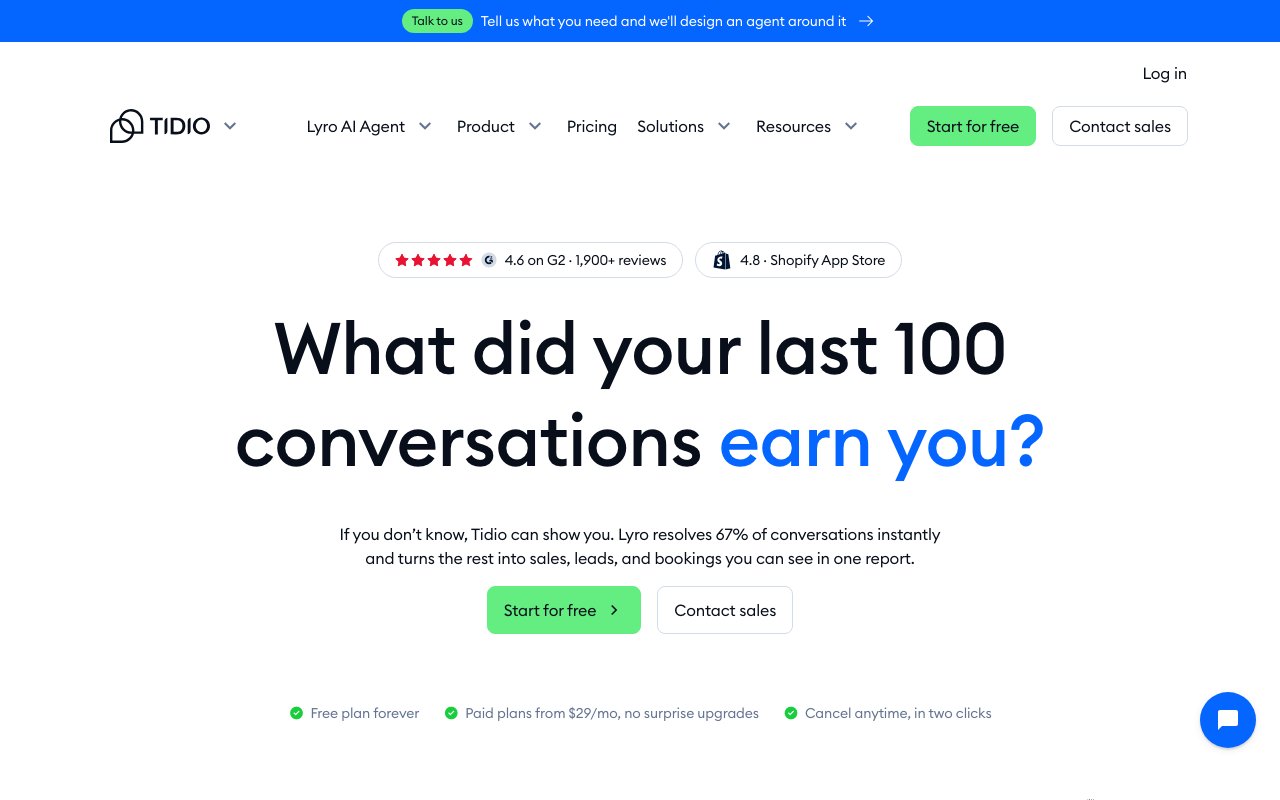
Tidio is one of the most installed chat plugins on WordPress (over 70,000 active installations). It combines a multichannel inbox with Lyro, an AI agent that learns from your pages and FAQ to write answers, handing over to a human when a question falls outside its scope.
Pricing
Free, then Starter from $24.17/month (annual billing) and Growth from $49.17/month; the Lyro AI is paid on top, from $32.50/month.
Free trial
7 days of paid features, no credit card.
Free edition
Yes: 50 billable conversations per month and 50 Lyro conversations offered for life, 10 seats.
Features
Live chat, scenario chatbot, Lyro AI agent trained on your content, Instagram, Messenger and WhatsApp inbox, statistics.
Strengths: very easy setup, support and sales in one console, a mature WordPress plugin. Weakness: the useful AI quickly becomes a paid add-on beyond the 50 conversations offered.
3. AI Engine: the WordPress chatbot with your own AI key
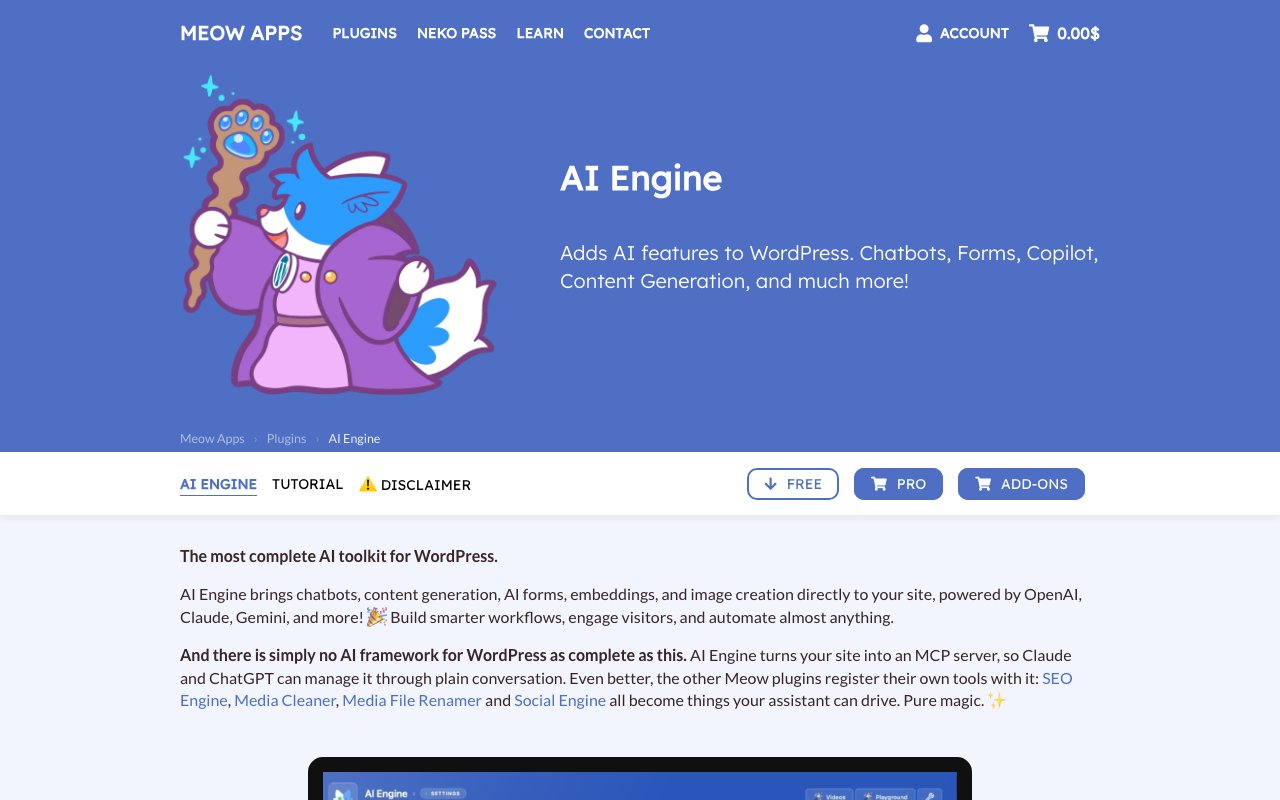
AI Engine, developed by Meow Apps, passes 100,000 active installations: it is the most widespread AI plugin on WordPress. Its philosophy is unique: you plug in your own key, at OpenAI, Claude, Gemini or Mistral, and only pay your actual consumption with the model provider. The free version creates chatbots by shortcode; the Pro version adds AI forms and a knowledge base built from your content and PDFs, so the bot answers from your site instead of making things up.
Pricing
Free plugin + API costs on your side; Pro version at $79.
Free trial
Not applicable: the free version is permanent, only the AI key is required.
Free edition
Yes, with a provider key required.
Features
Customizable chatbots, content generation, an editor copilot, AI forms and a knowledge base (Pro), an MCP server.
Strengths: total freedom over the model and the cost, a 100% WordPress ecosystem. Weakness: you manage an API key and technical settings; the knowledge-driven features are Pro.
4. WPBot: the lightweight chatbot from the WordPress directory
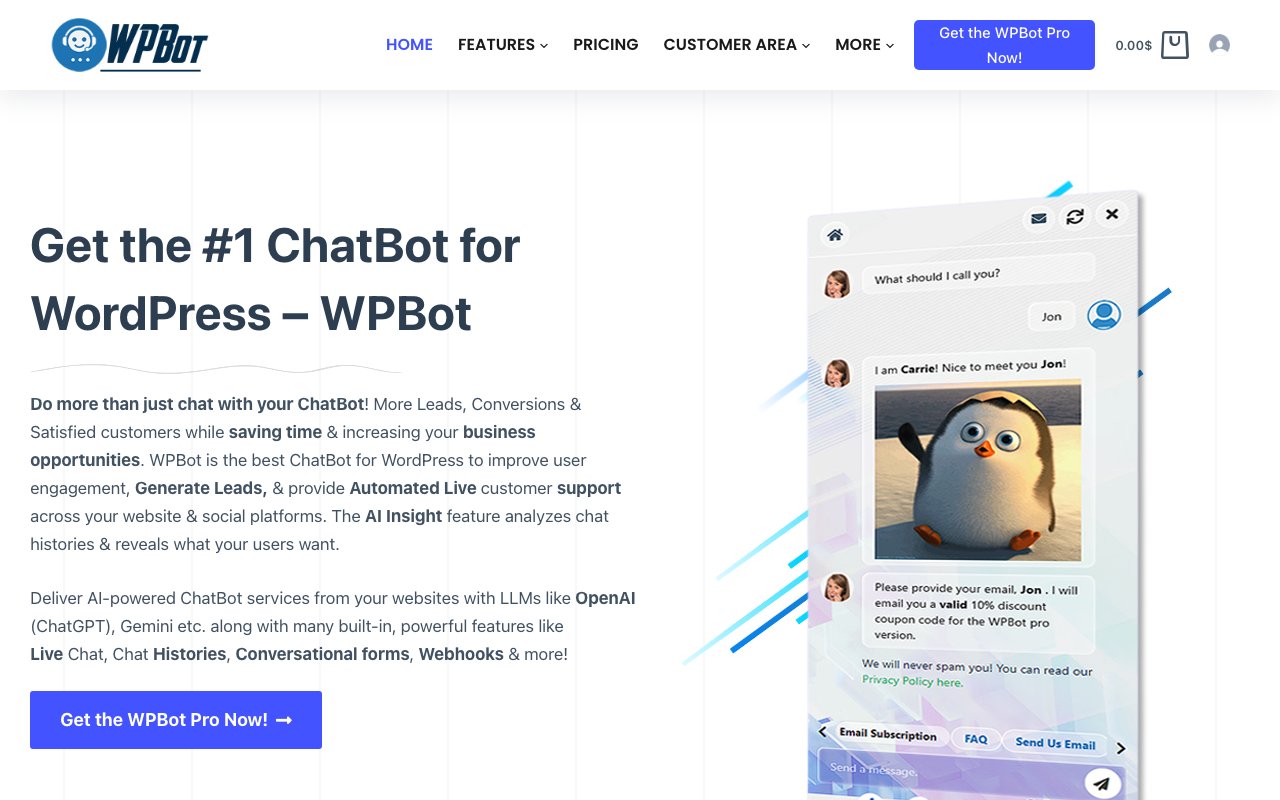
WPBot is a purely WordPress plugin (over 5,000 active installations) that does what it promises: automated 24/7 chat, visitor information capture and an FAQ module. The free version is enough for a business site; Pro licenses add the OpenAI integration, advanced search and conversation history. A sensible pick to automate simply, without subscribing to a SaaS platform.
Pricing
Free plugin; Pro licenses from ~$39 depending on scope.
Free trial
Not applicable: the free version serves as a permanent trial.
Free edition
Yes, with core features.
Features
Automated chat, lead capture, FAQ, OpenAI-powered AI extension in Pro, advanced search in Pro.
Strengths: lightweight, quick to set up, lifetime license possible. Weakness: conversational AI sits behind a paid add-on, and the whole stays less complete than a multichannel suite.
5. Crisp: shared inbox with an AI chatbot
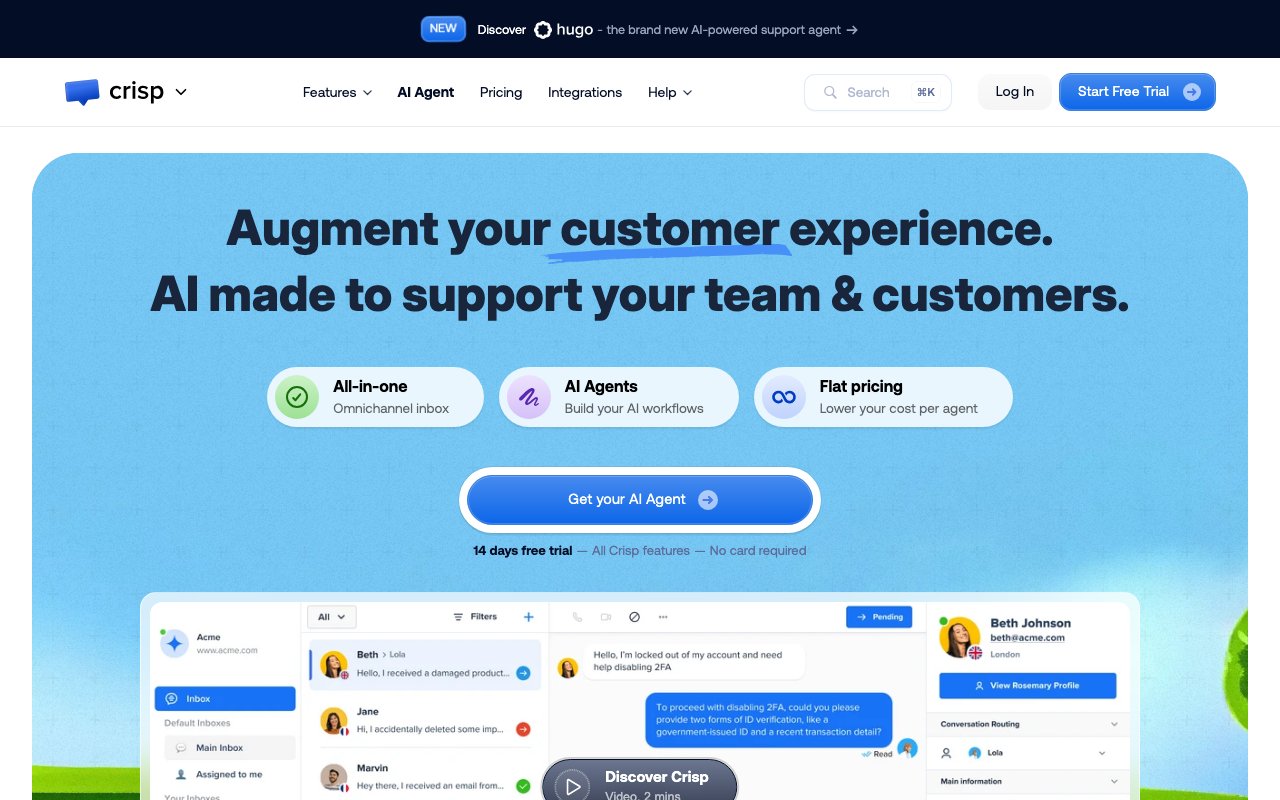
Crisp, published by a French company, is first and foremost a customer relationship suite: live chat, shared inbox, knowledge base and chatbot. The official WordPress plugin (over 20,000 active installations) installs the widget in two minutes. The free plan covers 2 seats; the AI chatbot and knowledge base only arrive with the Essentials plan. A good fit for teams that want humans and bot in the same place.
Pricing
Free (2 seats), Mini at $45/month per workspace, Essentials at $95/month (AI chatbot), Plus at $295/month.
Free trial
14 days on all paid plans, no credit card.
Free edition
Yes: 2 seats, widget, contact form and mobile apps.
Features
Live chat, shared inbox, AI chatbot, knowledge base, WhatsApp and social channels (Essentials and up), triggers.
Strengths: live chat and bot in one console, a French publisher. Weakness: the AI chatbot only becomes accessible from $95/month.
6. ChatBot (Text): the visual chatbot builder
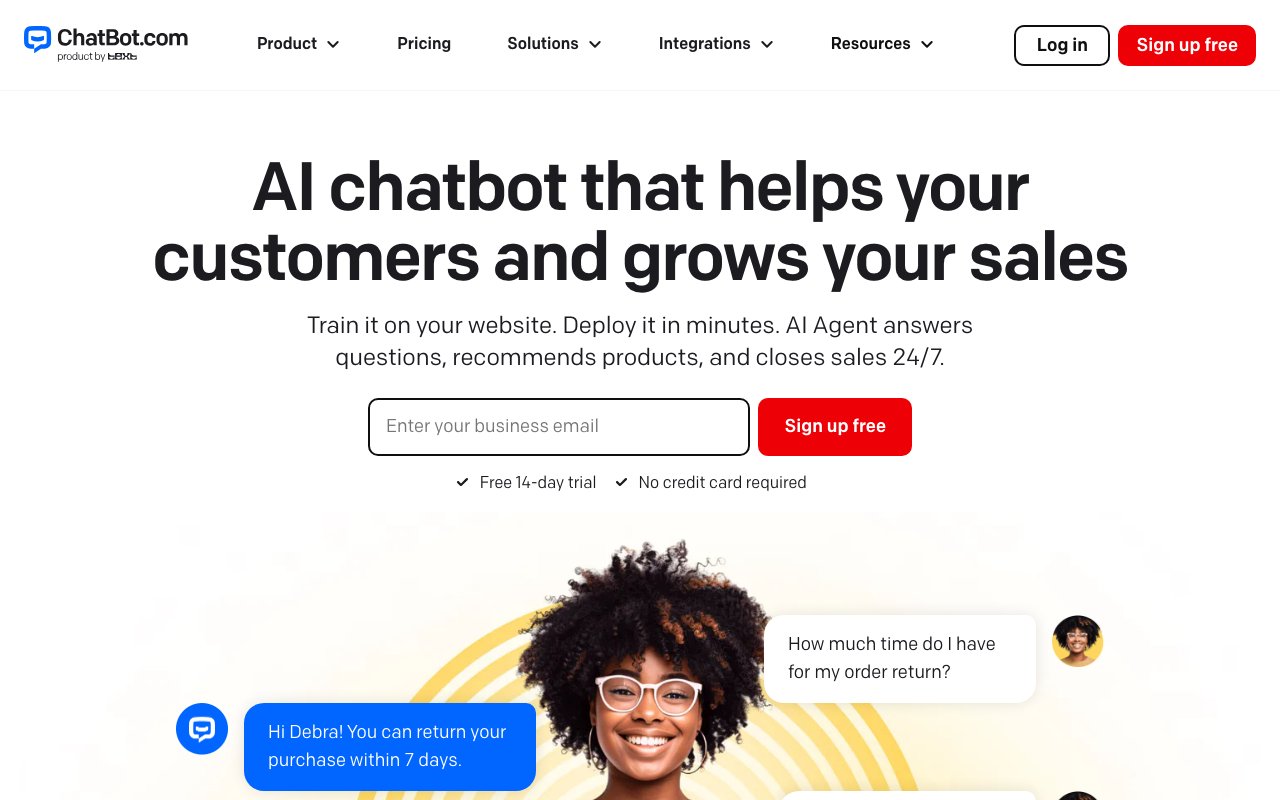
ChatBot, now marketed as Text, focuses on building chatbots with a visual scenario editor and an AI agent that resolves questions from a knowledge base fed by your articles, URLs and PDFs. WordPress integration goes through the site widget, with assumed WooCommerce compatibility and 48 supported languages.
Pricing
Essential from $19/user/month (annual), Growth from $79/user/month; extra AI resolutions billed by usage.
Free trial
14 days, no credit card.
Free edition
No, trial only.
Features
Visual scenario builder, AI agent, knowledge base (articles, URLs, PDFs), WooCommerce integration, 48 languages.
Strengths: a polished visual builder, a solid knowledge base, native multilingual support. Weakness: no free edition and per-user billing that climbs fast in a team.
7. ManyChat: social media automation

If your audience lives on Instagram, Messenger or WhatsApp, ManyChat is the go-to tool for automating private messages, comments and stories. Its core is not the site widget: there is no dedicated WordPress plugin, and social platforms remain its home ground.
Pricing
Free (25 active contacts/mo, 2 channels), then from $14/month depending on volume and channels.
Free trial
Not applicable: the free plan is the entry point.
Free edition
Yes, limited in contacts and channels.
Features
Private-message scenarios, keywords, sequences, AI steps, broadcasts on Instagram, Messenger, WhatsApp, TikTok and Telegram.
Strengths: the Instagram/Messenger/WhatsApp reference, a clear flow editor. Weakness: no plugin or real site widget: this is not a website chatbot.
8. Chatfuel: AI bots for Instagram and WhatsApp
Chatfuel targets the same uses as ManyChat: automating Instagram, Facebook and WhatsApp. The Light plan is free; the AI PRO plan adds an AI sales agent with a knowledge base, broadcasts and qualification funnels. Like ManyChat, it offers no WordPress plugin: it completes a site chatbot rather than replacing one.
Pricing
Light free; AI PRO at $49/month (about 29% off annually).
Free trial
An AI PRO trial is offered at sign-up.
Free edition
Yes (Light plan, no credit card).
Features
Visual flows, an AI agent with knowledge base, broadcasts, lead qualification, shared inbox.
Strengths: very simple on Meta messaging apps, AI included in the premium plan. Weakness: beside the point if you are looking for a chat widget on your WordPress site.
9. Collect.chat: conversational forms
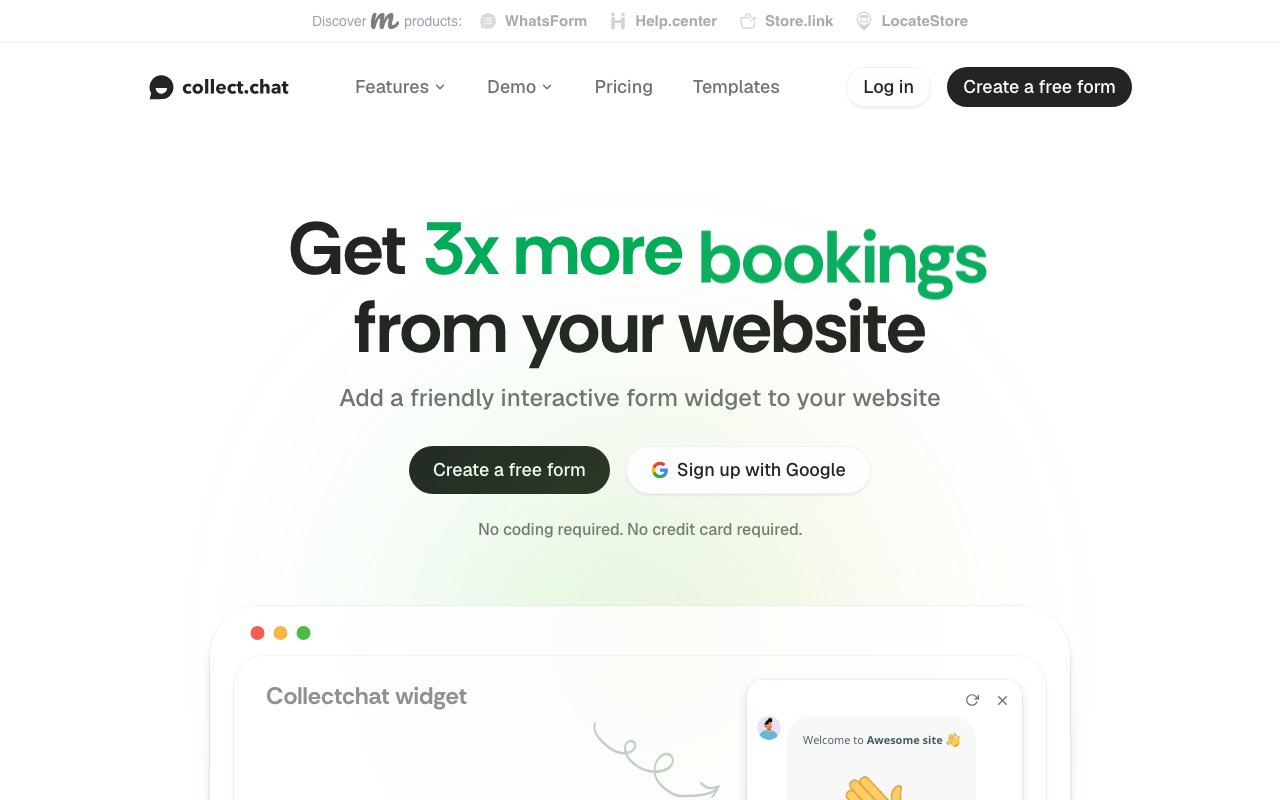
Collect.chat made a different choice: rather than a support agent, a builder of conversational forms that ask questions one by one. Installation goes through a snippet, and a helper AI generates the form from your goal described in one sentence.
Pricing
Free (100 responses/mo), Lite at $14/mo, Standard at $29/mo, Unlimited at $149/mo (annual billing).
Free trial
Not applicable: the free plan is permanent.
Free edition
Yes: 100 responses per month, 3 forms.
Features
Drag-and-drop builder, AI-assisted creation, online payments, appointment booking, Google Sheets and Zapier integrations.
Strengths: efficient conversational forms, gentle pricing, built-in payment. Weakness: no conversational support AI and no dedicated WordPress plugin.
10. IBM watsonx: enterprise-grade conversational AI
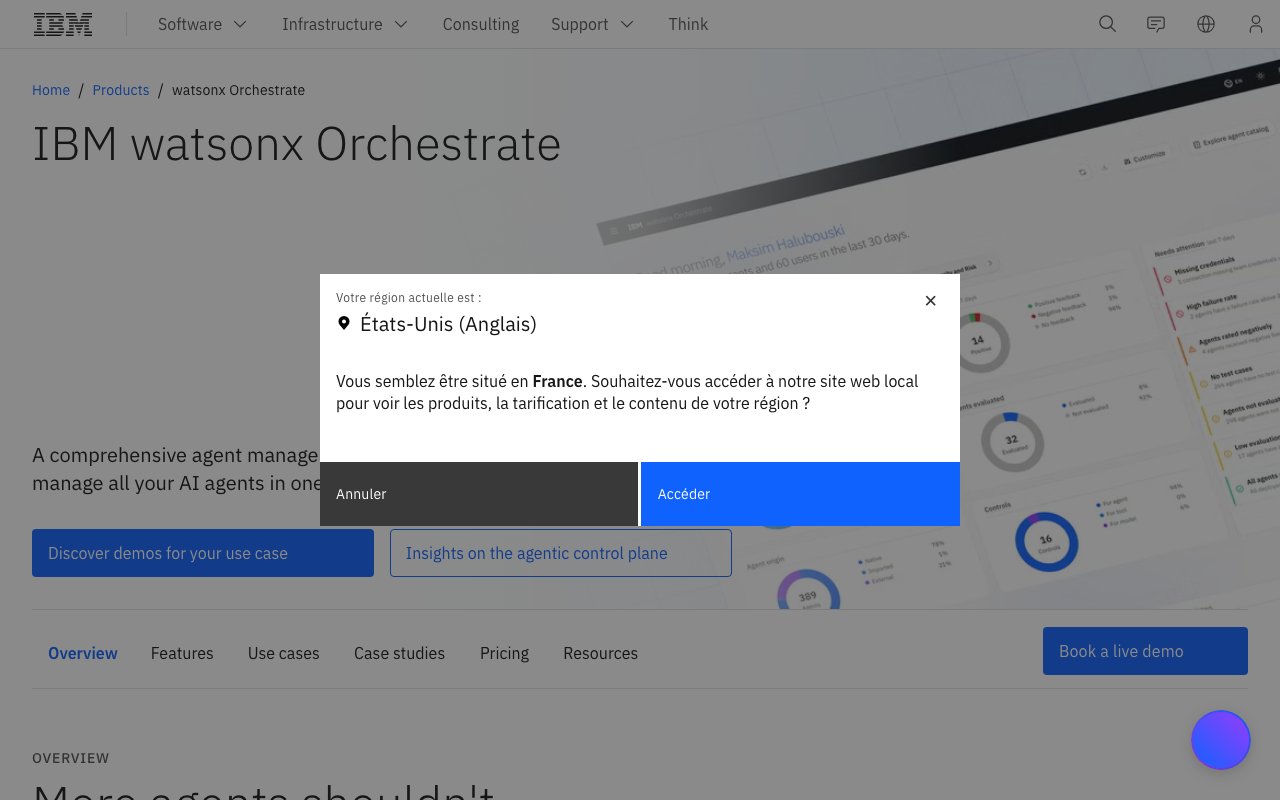
IBM has merged watsonx Assistant into watsonx Orchestrate, its enterprise AI agent platform. The historic Lite offer is gone: what remains is a 30-day trial, then pricing from $530/month for 200,000 messages and 4,000 active users. The tool remains a byword for robustness (web, Slack and Teams channels, large knowledge document stores), best reserved for IT departments industrializing AI assistants. WordPress integration happens via code snippet or API.
Pricing
Essentials from $530/month, Standard from $6,360/month, Premium on quote.
Free trial
30 days.
Free edition
No.
Features
AI assistants, tool orchestration, webchat and internal channels, knowledge document base, enterprise security.
Strengths: robustness, enterprise integrations, volumes. Weakness: pricing and complexity out of reach for an SMB; no free entry offer anymore.
11. Landbot: the no-code builder with visual scenarios
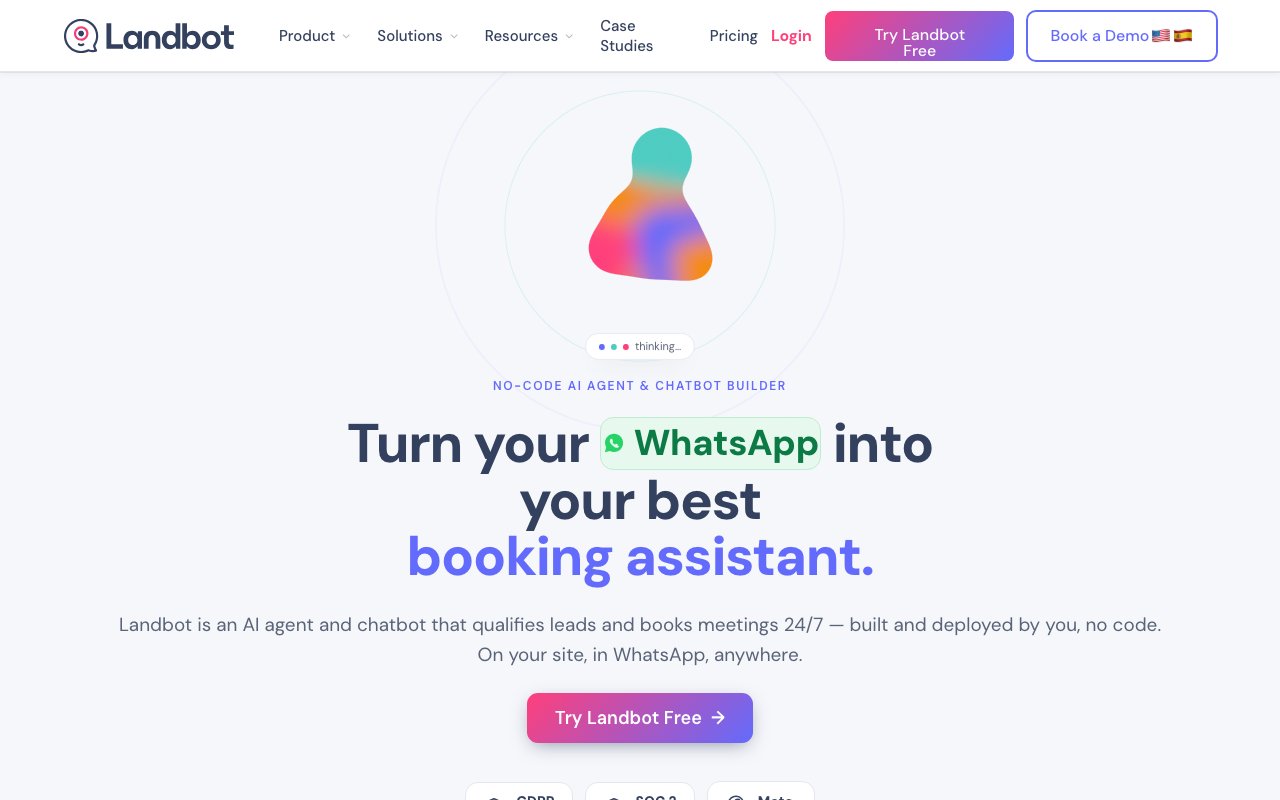
Landbot, based in Barcelona, wins people over with its visual builder: blocks assembled to create conversational journeys on the web, then on WhatsApp. AI conversations are anchored on your own knowledge base, and deploying to WordPress is done by pasting a code snippet that works with every theme.
Pricing
Free (100 chats/mo), Starter at 32 EUR/month (annual, 40 EUR monthly), Professional at 80 EUR/month, Business on quote.
Free trial
14 days on paid plans.
Free edition
Yes: 100 chats per month, without AI conversations.
Features
Visual builder, AI conversations grounded on your content, human takeover inbox, WhatsApp as an option, webhooks.
Strengths: quick onboarding, carefully designed scenarios. Weakness: AI is billed by conversation volume, and the WhatsApp channel is a costly option.
12. HubSpot Chatbot Builder: the chatbot included in a free CRM
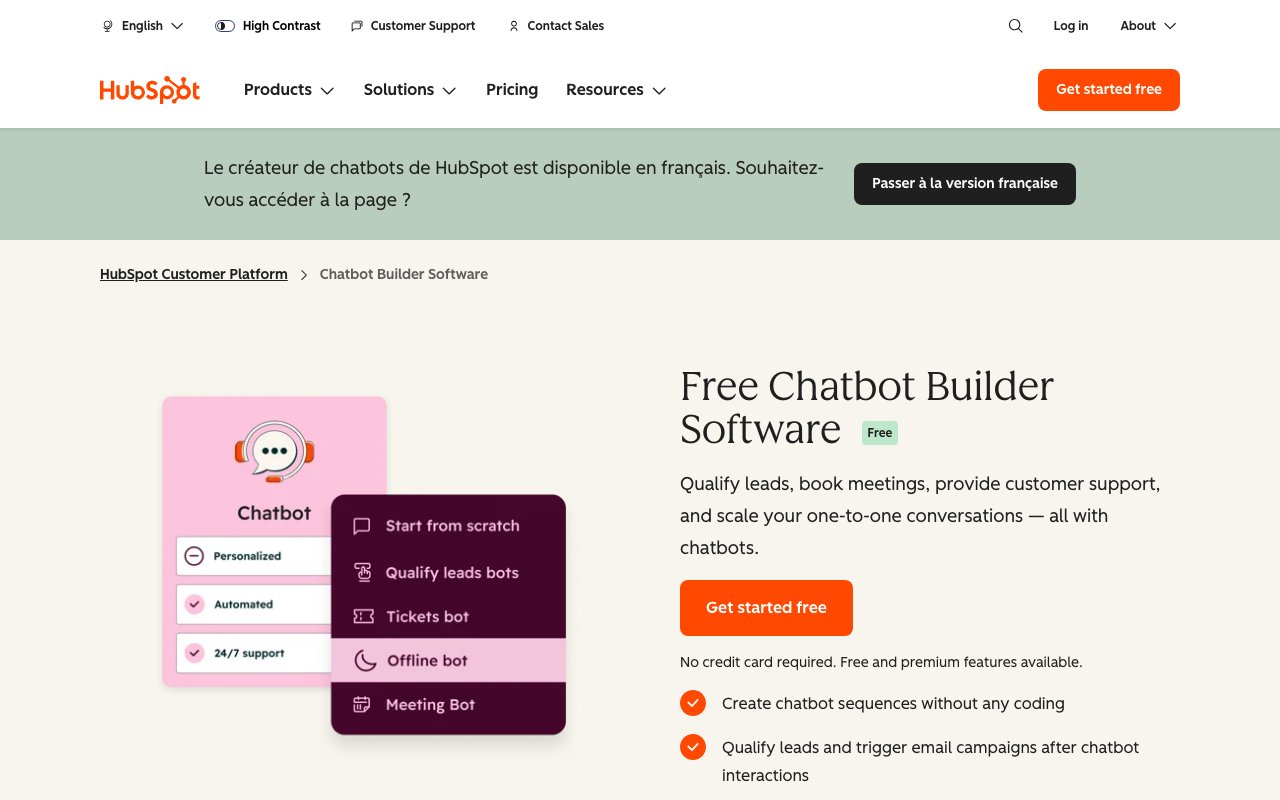
If you already use HubSpot’s free CRM, its chatbot builder costs nothing more: templates to customize without code, answers enriched by contact data, lead qualification and handover to an agent. The official HubSpot WordPress plugin installs the widget cleanly; advanced AI remains in the paid editions.
Pricing
Chatbot included in the free CRM; advanced features in the paid hubs (Marketing, Sales, Service).
Free trial
Not applicable: the base offer is free.
Free edition
Yes, with chatflow templates and human handover.
Features
Template-based chatflows, lead qualification, CRM data in the answers, ticket creation, emails triggered after the chat.
Strengths: free and perfectly integrated with a full CRM. Weakness: mostly rule-based bots in the free offer, and data hosted with a US vendor.
13. Zendesk: the chatbot inside a customer service suite
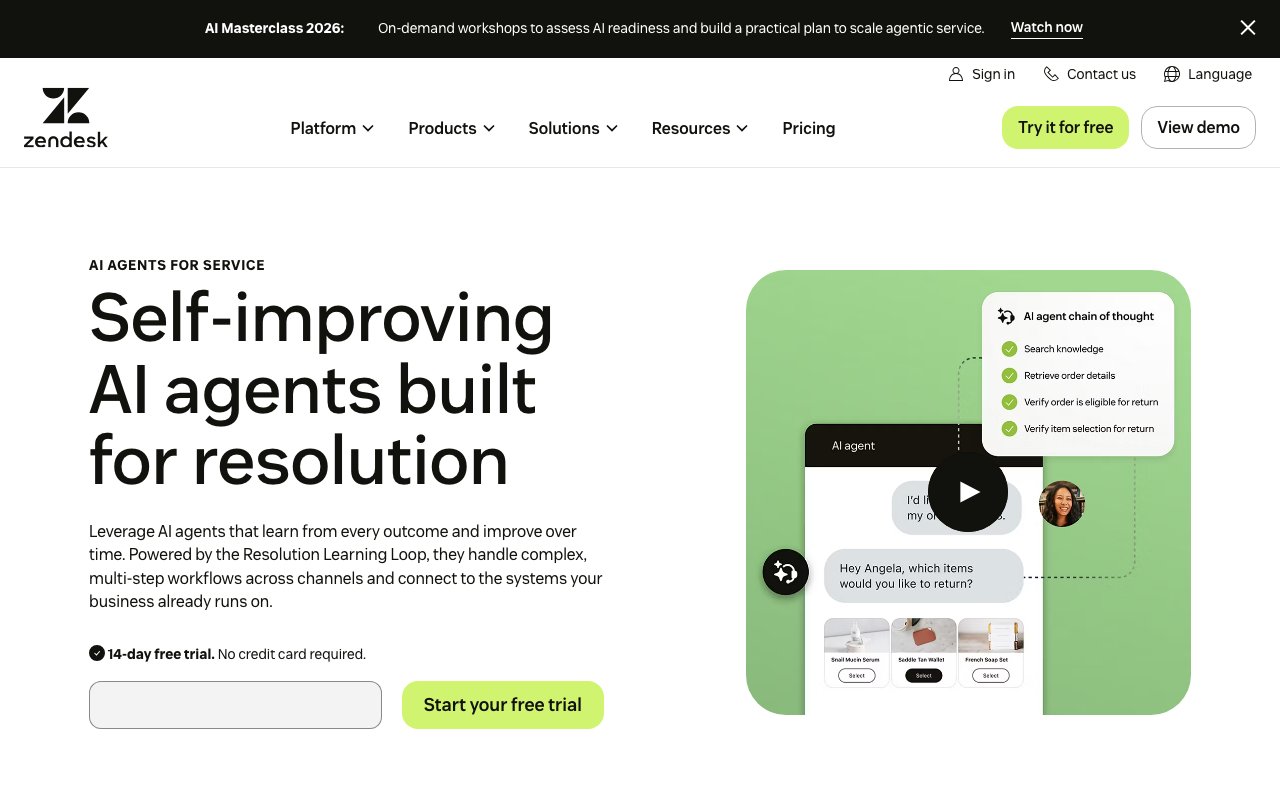
Zendesk is not a standalone chatbot: it is a complete customer service suite in which AI agents handle automated resolutions, billed only when they succeed. On WordPress, the widget installs through the official integration. A coherent choice if you want a full helpdesk; for a simple chatbot, it is a sledgehammer for a nut.
Pricing
Suite Team from 55 EUR/agent/month as displayed on the French site, with local pricing per region (annual billing); AI resolutions billed by usage; Copilot as an option at 50 EUR/agent/month.
Free trial
14 days.
Free edition
No.
Features
AI agents, AI knowledge base, omnichannel routing, messaging and phone, 80+ languages.
Strengths: a complete, proven suite, AI billed on outcomes. Weakness: per-agent cost, and the chatbot is one brick of a much larger whole.
14. SmartsearchWP: the AI chatbot as an internal search engine
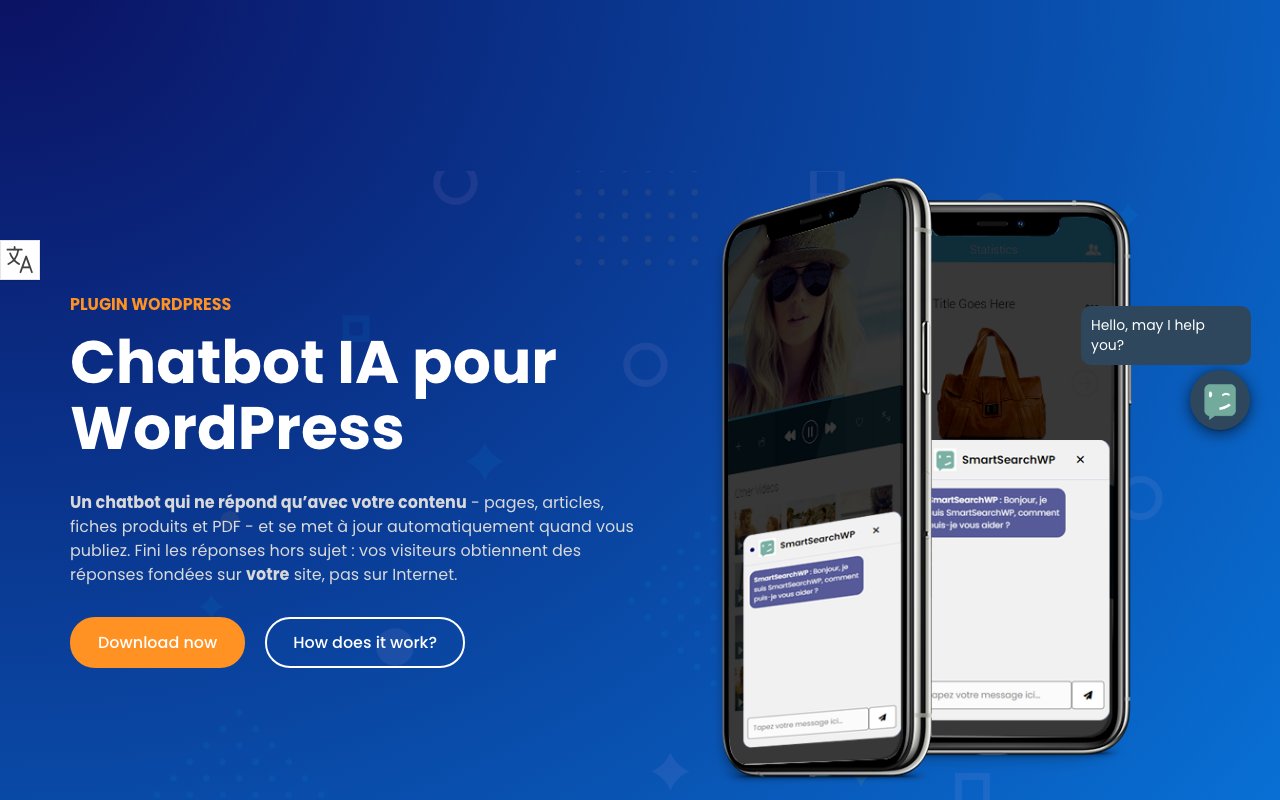
SmartsearchWP is a French plugin built around the very use case described below: a chatbot that answers from your site content. It indexes your pages and posts, understands questions in natural language and serves answers drawn from your content. The freemium version available on the WordPress directory is complemented by a Premium tier that unlocks WooCommerce, PDFs and custom post types; the OpenAI key stays on your side.
Pricing
Free freemium; Premium around 49.90 EUR/year; OpenAI API costs on top.
Free trial
Not applicable: the free version is the trial.
Free edition
Yes, with core features.
Features
Sourced answers from your content, semantic search, Premium add-ons (WooCommerce, PDF, custom post types, customization).
Strengths: conversational search as a standard feature, a French publisher, gentle pricing. Weakness: you must supply and monitor an OpenAI key.
15. Tytae: the sourced chatbot, built for WordPress
Tytae, a French company, pushes the same idea all the way to a single product: a WordPress plugin whose chatbot indexes your pages, posts, FAQ and documents to generate answers strictly drawn from your content, with the link to the source page. Human escalation is planned when a question leaves the scope, indexing is WPML and Polylang compatible, and the vendor advertises hosting and logs stored in France. The offer starts at 69 EUR ex. VAT per month, sized to traffic.
Pricing
From 69 EUR ex. VAT/month depending on conversation volume; custom quote.
Free trial
No, but a personalized demo on request.
Free edition
No.
Features
Sourced answers with a link to the page, human escalation, multilingual indexing (WPML, Polylang), GDPR and hosting in France.
Strengths: the sourced answer at the heart of the product, GDPR asserted on the French side. Weakness: no free entry offer, opaque pricing before the quote.
What are the benefits of a WordPress chatbot plugin?
Concrete benefits first, honest limits next.
- Total availability: the widget answers at 2 a.m. as at 2 p.m., public holidays included;
- Leads without extra traffic: the chat qualifies the visitors already there, at the right moment, before they leave;
- Fewer repetitive tickets: recurring questions (delivery time, hours, pricing) get an instant answer, your team keeps the complex cases;
- Per-page personalization: the scenario adapts to context (a pricing question on the pricing page, choice assistance on a product page);
- Selling on WooCommerce: cart recovery, product recommendations, assisted checkout;
- Clean data collection: every conversation feeds your CRM or emailing tool through connectors.
The limits are real, and honest to spell out: in a 2025 Ipsos BVA survey of French consumers, 90% said they would rather wait for a human advisor than a virtual one, and 72% would feel cheated if a company did not disclose that they were talking to an AI. A badly tuned chatbot frustrates more than it helps: off-topic answers, loops, no exit toward a human. Good practice comes down to three words: narrow scope, sourced answers, easy handover.
What features does a WordPress chatbot offer?
To compare offers beyond the price tag, here is the list of features that genuinely make a difference on a WordPress site in 2026:
- Generative AI trained on your content: the bot answers in natural language from your pages, posts and FAQ;
- Drag-and-drop scenarios: journeys built without code, testable before publication;
- Human handover: the conversation moves to an agent with history when the question exceeds the bot;
- Lead capture into the CRM: validated contact details pushed automatically to your tools;
- Statistics: conversation volume, unanswered questions, resolution rate, abandoned journeys;
- Multilingual: detecting the visitor’s language and answering in it;
- Behavior-based triggers: exit intent, time on page, scrolling, page visited;
- Integrations: emailing, calendars, payment, WooCommerce and social networks.
No single solution ticks the whole list at the same price: the summary table shows the split.
The 2026 trend: an AI chatbot that answers from your site content
A section missing from both comparisons sitting at the top of the query, even though it carries most of the market’s evolution: searches like “a chatbot that works as an internal search engine” are growing, a discussion thread on exactly that topic ranks among the top results, and whole products such as SmartsearchWP and Tytae, both ranked in this comparison, are built around the use case.
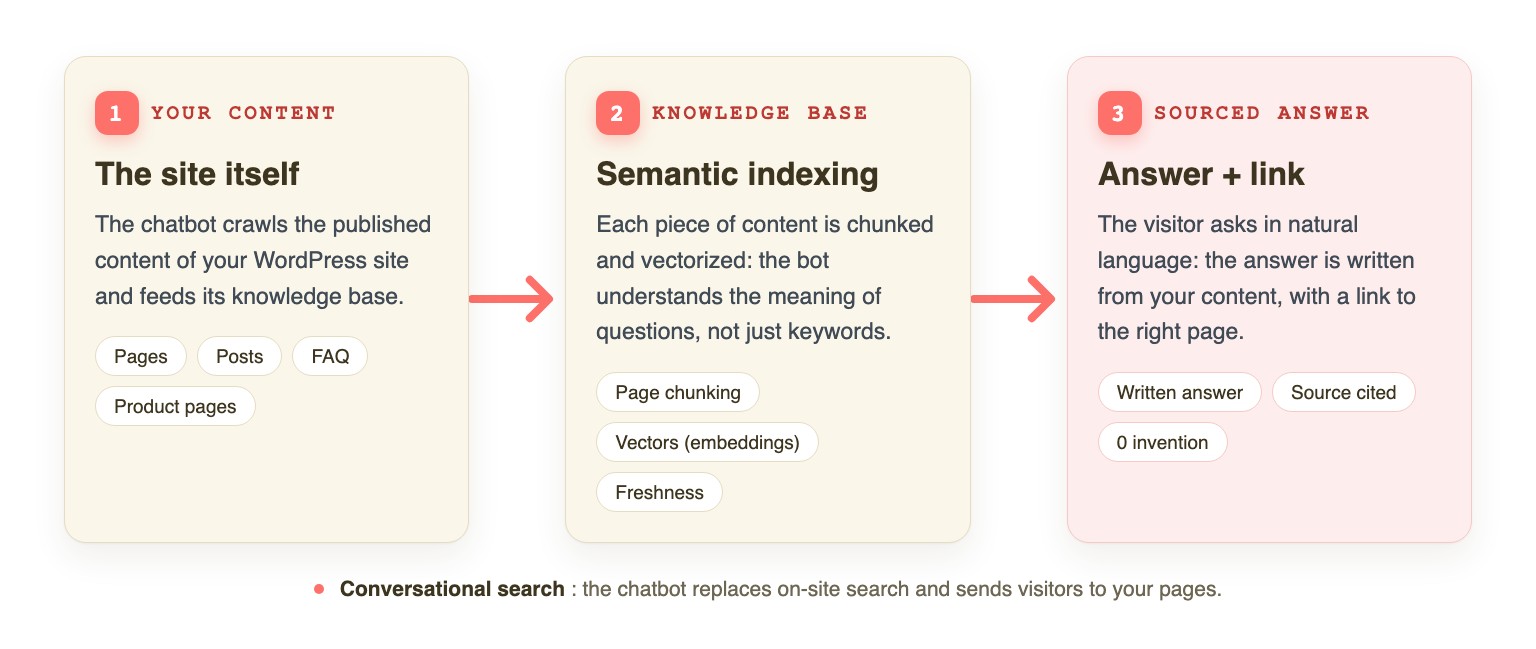
The principle is called conversational search, or RAG (retrieval-augmented generation): the chatbot does not improvise, it draws from your content. Concretely, your pages, posts and FAQ are indexed into a knowledge base; when a visitor asks a question, the system retrieves the relevant passages and writes the answer with its source. The visitor gets an answer, and the link to the right page.
Who is it for? Content-rich sites (blogs, documentation) where classic on-site search fails: visitors do not type the right keywords. E-commerce stores with large catalogs, where “do you have X in stock?” deserves better than a results page. Associations and public services, with always the same questions. On Botnation, this capability is native: the chatbot trains on your site content, a topic detailed in our article on the RAG chatbot.
GDPR and data hosting: the criterion everybody forgets
Where are conversations processed and stored? Which subcontractors are involved, under which agreements? How long are exchanges retained? These three questions rarely appear in comparisons, and they change everything: Article 50 of the European AI Regulation additionally requires transparency when a visitor talks to an AI. Vendors hosting data under French or European jurisdiction (Botnation, Crisp, SmartsearchWP, Tytae) spare you part of that verification work.
How to design a WordPress chatbot?
The tool does not do everything: the chatbot’s design decides half its effectiveness. Five steps are enough to start on solid ground.
Determine your chatbot’s function
Support, qualification, sales, appointment booking: pick one primary function and stick to it. A chatbot that tries to do everything on day one does everything badly. Start with the ten most frequent questions of your customer service, as measured in your emails or your current ticketing tool.
Give your chatbot a name
A name humanizes the exchange and reassures: a short first name, optionally paired with a role (“Lia, assistant to…”). Avoid technical names: “Bot v2” builds no one’s confidence.
Decide on a tone for your chatbot
Sober and professional on a B2B site, lighter on a consumer one: the tone should be your brand’s, and stay consistent from one scenario to the next. Transparency applies to tone too: do not pretend the bot is human.
Write a conversation script
Write the typical journey question by question, with answer variants and exits toward a human. No-code editors let you test the script before publishing; have it proofread by someone who does not know your product.
Test your chatbot
Test with real questions from real people, including badly phrased ones and typos. Check every answer from the visitor’s point of view: a correct answer in the wrong context hurts as much as a wrong one.
How much does it cost to set up a WordPress chatbot? From 0 to a few dozen euros or dollars per month for a self-service solution (Botnation’s free plan, Tidio or Landbot entry tiers), the cost of your own API consumption if you plug in your key (AI Engine, SmartsearchWP), and a quoted budget for accompanied creation: Botnation’s Enterprise offer, for instance, includes chatbot creation services delivered by the team that publishes the platform.
How to add a chatbot to WordPress?
Three methods depending on your tool and your relationship with code. The first suits 90% of situations, the other two cover special cases.
Method 1: with the Botnation plugin (recommended)
This is the shortest path: four steps, zero lines of code. Each step is described in our complete guide to the Botnation plugin.
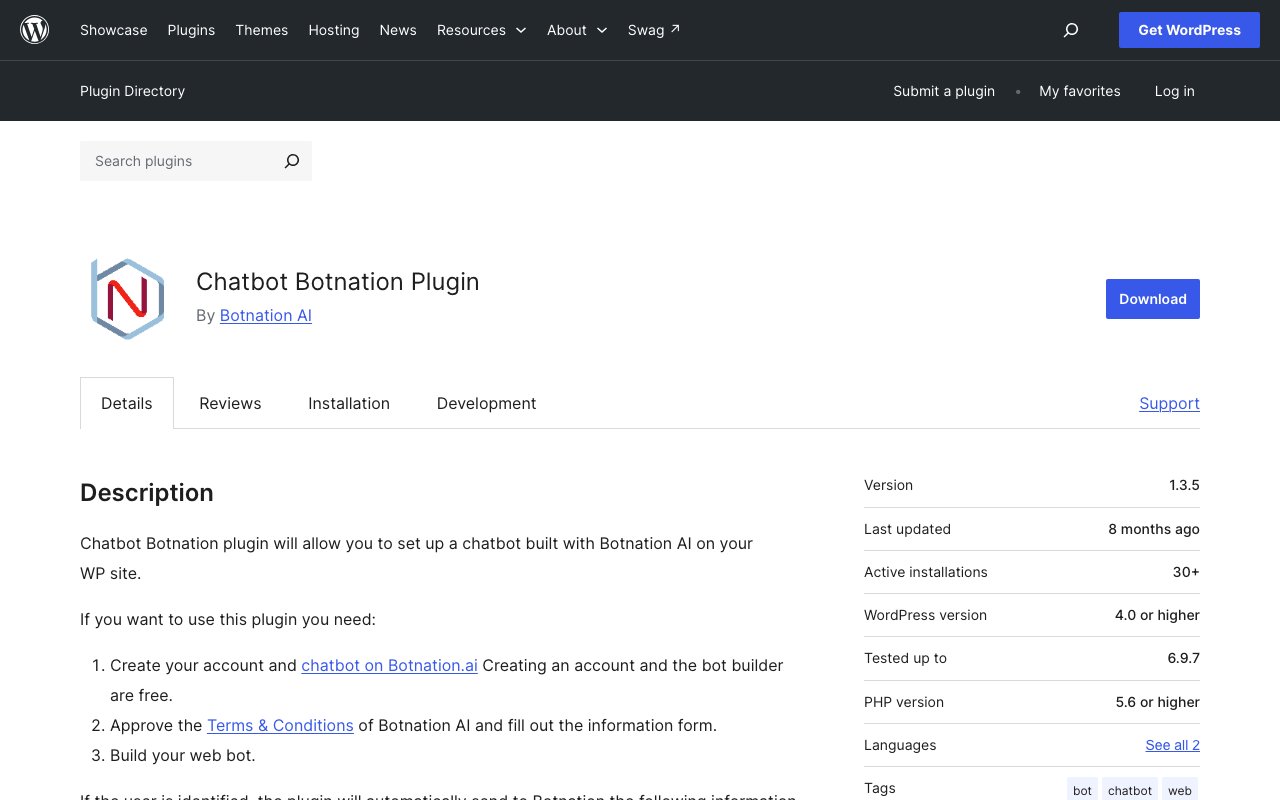
- Install the plugin In the WordPress admin, under Plugins then Add New, search for “chatbot botnation” and install the official plugin from the directory.
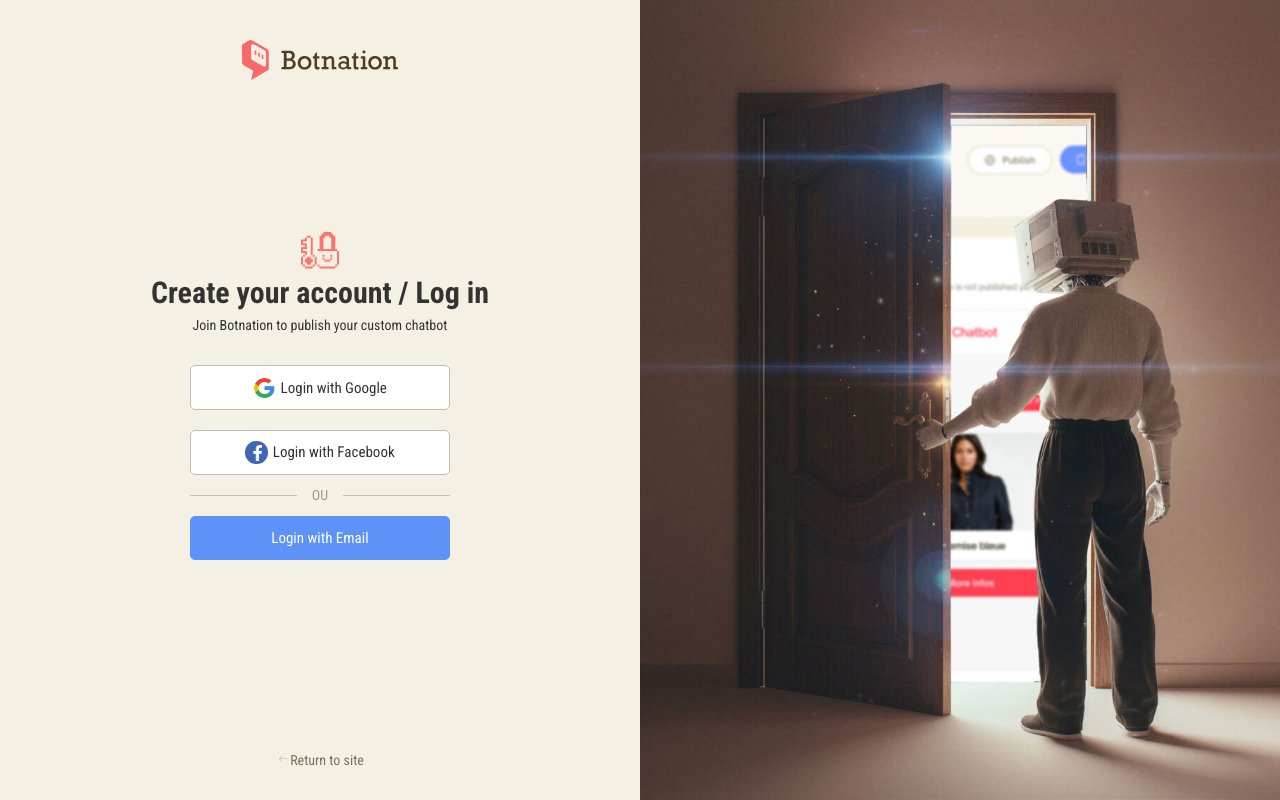
- Create your account The plugin offers to log in or create a free Botnation account: that is where you will build the chatbot.
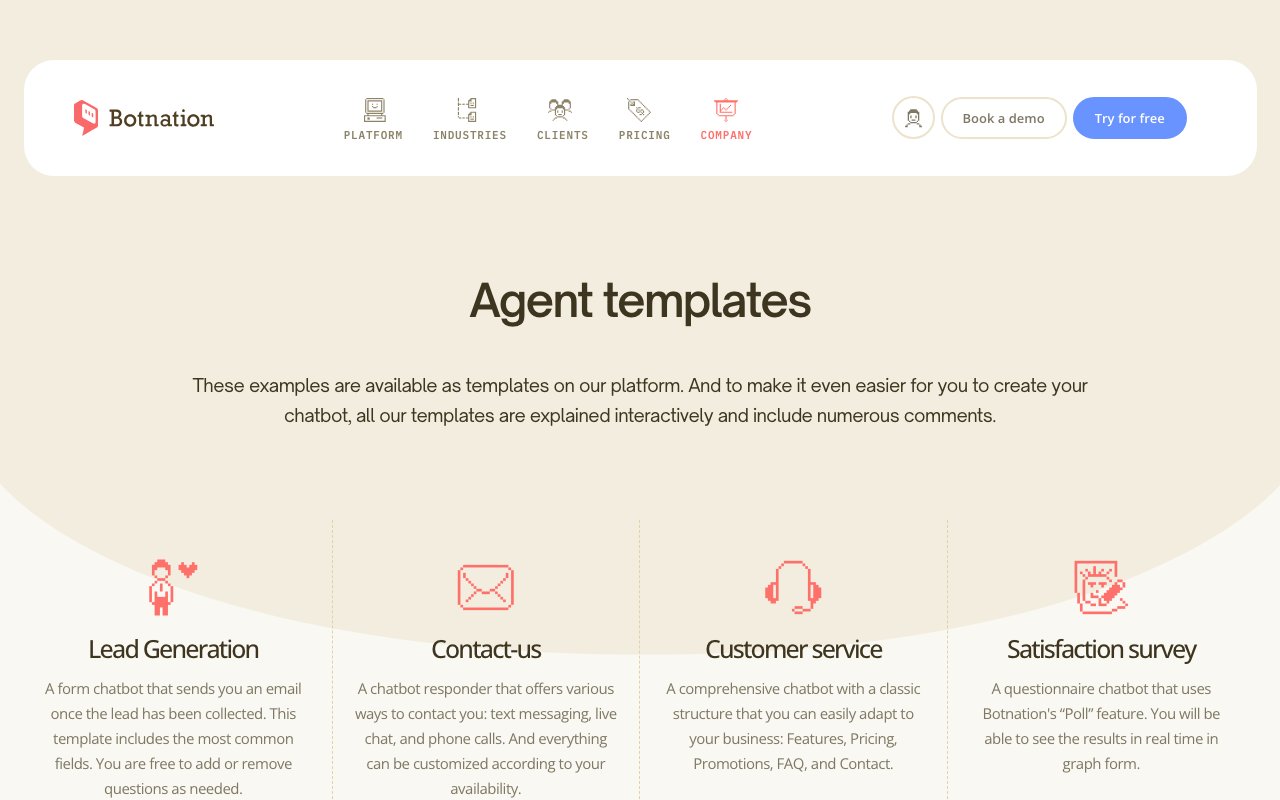
- Start from a template and customize Pick a chatbot template (support, FAQ, qualification) from the gallery, then adjust scenarios, colors and messages.
- Deploy Back in the plugin settings, connect your account: the widget is live on your site, on the pages you chose.
Method 2: without a plugin, with a code snippet
Every serious vendor supplies a code snippet to paste: Botnation’s is copied straight from the platform. On WordPress, three locations work: the theme file editor (a child theme preferably), a code-injection plugin such as WPCode or Insert Headers and Footers, or an HTML block in Elementor. Compatible with every theme and page builder, this is often the only option when the tool publishes no dedicated plugin.
Method 3: through a third-party plugin
The third path: a universal plugin connected to the AI of your choice. AI Engine, ranked number 3, works that way: plugin installed, OpenAI key entered, chatbot configured by shortcode. The most flexible method to control the model and the cost, at the price of a more technical onboarding.
How to choose the right WordPress chatbot?
Seven criteria are enough to separate the fifteen solutions in this comparison:
- The real budget: compare the price of the feature you need, not the entry offer, and what the free edition really covers;
- AI or rules: a scenario chatbot is enough for a fixed journey; generative AI becomes necessary as soon as questions vary;
- Answering from site content: the 2026 criterion, detailed in the trend section;
- WooCommerce: if you sell online, check the real support for catalog and cart, not just an “e-commerce” mention;
- CRM and emailing integrations: a captured but lost lead is worthless;
- Multilingual: essential as soon as your site offers several languages;
- GDPR and French-language support: data location, subcontractor agreements, assistance in your language.
Three typical profiles emerge. The business site that wants to automate its FAQ will pick a simple solution with a dedicated plugin and a free plan: Botnation or Tidio. The WooCommerce store will look for conversational selling and cart recovery: Botnation or ChatBot (Text). The content-rich site will gain from a chatbot trained on its pages: Botnation, or the specialists SmartsearchWP and Tytae.
FAQ
What is the best free WordPress chatbot?
For a French-speaking or European site, Botnation’s free plan is the most complete: a chatbot published with no time limit, no-code scenarios and AI, scaling up at 39 EUR/month. AI Engine is free if you plug in your own OpenAI key. Our dedicated free WordPress chatbot page expands on this.
Do I need coding skills to add a chatbot to my WordPress site?
No. The plugin method installs from the WordPress admin like any extension, without writing code. The snippet method only requires copying a vendor-supplied script into an injection plugin or an HTML block.
What is the difference between a rule-based chatbot and an AI chatbot?
A rule-based chatbot follows scenarios written in advance: predictable but rigid. An AI chatbot understands natural language, writes its own answers and can draw on your site content; it needs a well-defined scope to stay reliable.
Can a chatbot help increase sales on my WordPress site?
Yes, especially on WooCommerce: product recommendations, cart recovery at the moment of hesitation, answers to pricing or shipping objections. A well-tuned WooCommerce chatbot converts traffic that is already there, with no extra ad spend.
How do WordPress chatbots integrate with CRMs and other tools?
Through native connectors (HubSpot, Salesforce, Pipedrive, Zoho depending on the vendor) or through Zapier and Make, which connect most solutions to a CRM, an emailing tool or a spreadsheet. Data collected in conversation (name, email, need) feeds your contact records automatically.
What is the difference between a chatbot and a live chat plugin?
Live chat connects a visitor with a human, available or not depending on business hours. The chatbot answers alone, around the clock. The best solutions combine both: the bot handles the routine, then transfers the conversation to an agent with the full history.
Why add a chatbot to your WordPress site?
To answer recurring questions 24/7, qualify visitors before they leave, and free your team from repetitive requests. The curious can give Botnation a try on their WordPress site and form their own opinion.
How much does it cost to set up a WordPress chatbot?
From 0 (free plans by Botnation, Tidio, Crisp or AI Engine) to a few dozen euros or dollars per month for full plans; add the AI key cost when the plugin requires your own, and a quote for accompanied creation.
Is a WordPress chatbot free or paid?
Both: most vendors offer a free edition or a trial, then bill volumes and advanced features. The useful question is the tipping point, detailed in the first question of this FAQ.
Can you white-label a chatbot on WordPress?
It depends on the vendor: Crisp includes white labelling in its Plus plan, and some professional suites reserve it for partner programs. For an agency deploying chatbots for its clients, check resale terms before standardizing on one tool.
Ready to launch your WordPress chatbot this month?
Fifteen solutions compared, prices checked this month, three installation methods and a selection checklist: the map is complete. The fastest route to action remains Method 1: Botnation plugin, free account, customized template. The widget can be live before the end of the day.
Try Botnation for free on your WordPress site
Permanent free plan, official plugin, generative AI trained on your site content, data hosted under French and European jurisdiction.